

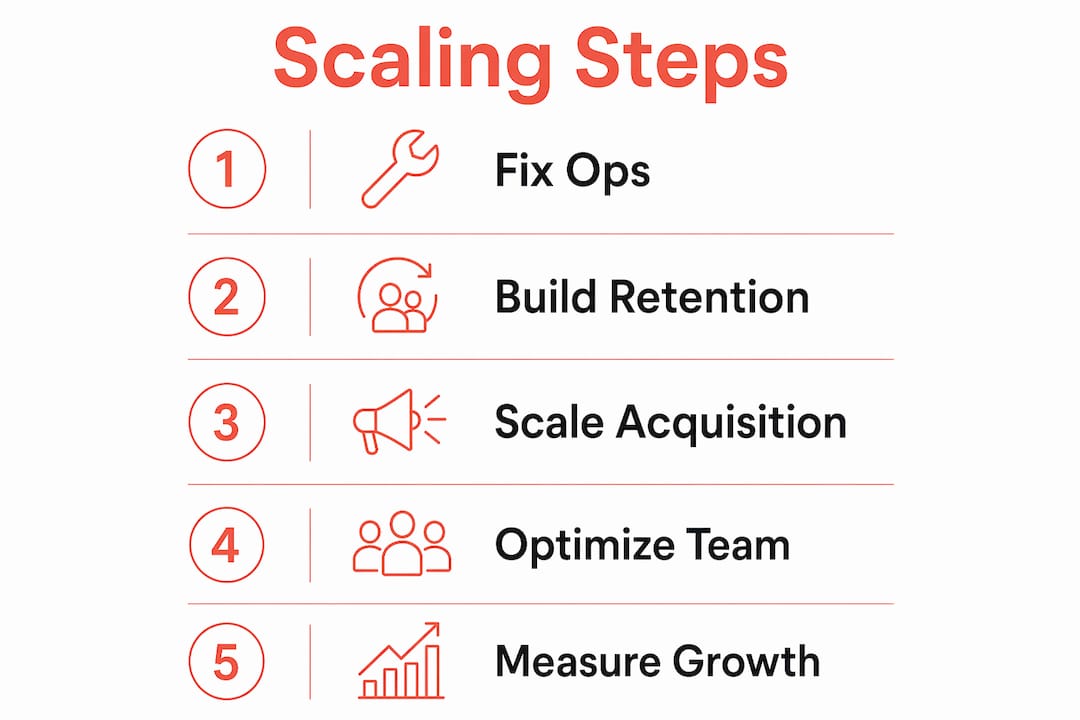
Scaling an ecommerce brand fast is defined as growing revenue while keeping operational complexity and unit economics in check through a deliberate sequence of business decisions. The challenge is real: customer acquisition costs have risen sharply, with average CAC now sitting between $68 and $84 due to ad auction inflation and privacy changes. That cost pressure means you cannot simply spend your way to growth. The brands that grow online store quickly in 2026 are the ones that fix their operations first, build a retention engine second, and then scale paid acquisition on proven unit economics. This article gives you that sequence, step by step.
What operational foundations must be in place before you scale ecommerce brand fast?
Operational readiness is the single most overlooked prerequisite for rapid ecommerce expansion. Most founders want to increase ad spend the moment revenue starts climbing. That instinct is expensive. Most ecommerce brands stall around $1.5M–$2M in annual revenue because of unit economics deficiencies, unclear CAC, and poor channel focus, not because of weak marketing.
Cash flow and inventory come first
Your cash conversion cycle determines how fast you can reinvest in growth. A long cycle, where you pay suppliers before customers pay you, creates a cash gap that widens every time you scale. Negotiate extended payment terms with suppliers and tighten your receivables. Brands that fix this constraint first can reinvest profits faster without relying on debt to fund growth.

Inventory management is equally critical. Stockouts kill momentum and damage customer trust. Overstock ties up cash. The fix is a demand forecasting process tied directly to your marketing calendar, so you know what to order and when before you run a campaign, not after.
Automate before you accelerate
Fulfillment automation, order tagging, and customer service triage are not optional at scale. They are the infrastructure that lets volume increase without proportional headcount increases. Brands using unified commerce strategies report up to 150% omnichannel GMV growth and 22% lower total cost of ownership compared to siloed operations. That gap exists because unified systems eliminate the manual work that breaks under pressure.
- Map every manual process in your fulfilment and support workflow
- Identify the three highest-volume tasks and automate them first
- Set up order tagging rules so your team handles exceptions, not routine queries
- Use a helpdesk platform with automated triage to route tickets by urgency and topic
- Review your supplier terms quarterly and renegotiate when volume justifies it
Pro Tip: Before you increase your ad budget by a single dollar, run a fulfilment stress test. Process twice your current daily order volume manually for one week and document every breaking point. Fix those points before you scale.
How to build a retention engine that accelerates ecommerce growth
Retention is the most undervalued growth lever in ecommerce. Repeat purchases account for 48% of ecommerce transactions. That figure means nearly half of all revenue in a healthy store comes from customers who have already bought. Acquiring a new customer costs five times more than retaining an existing one, so every dollar you put into retention compounds faster than acquisition spend.
The second purchase is the most important milestone in a customer’s lifecycle. Once a customer buys twice, their likelihood of making a third purchase jumps from 27% to 54%. That compounding effect is why retention investment pays back so quickly.
The four flows every ecommerce brand needs
Build these lifecycle flows before you scale acquisition spend:
- Welcome series: Send three to five emails over the first seven days. Introduce your brand story, set expectations, and deliver a reason to buy again. This is your highest open-rate window.
- Post-purchase flow: Trigger immediately after purchase. Confirm the order, manage expectations on delivery, and introduce complementary products. This flow reduces support tickets and plants the seed for the second purchase.
- Winback campaign: Target customers who have not purchased in 60 to 90 days. A well-timed offer with a clear expiry date recovers a meaningful portion of lapsed buyers.
- VIP tier programme: Identify your top 10% of customers by spend and treat them differently. Early access, exclusive products, and personal outreach build loyalty that no competitor can easily replicate.
Lifecycle marketing automation with email, SMS, and loyalty programmes drives sustainable, compounding growth and improved retention. The brands that build these flows before scaling acquisition are the ones that see profit grow alongside revenue, not lag behind it.
Pro Tip: Set up your winback campaign before you need it. Most brands build it reactively when revenue dips. Build it when things are going well, so it runs automatically and recovers revenue you would otherwise write off.
Which acquisition strategies actually scale a brand fast?
Paid acquisition is where most ecommerce entrepreneurs want to start. It is also where most of them waste money. Sustainable scaling requires a CLV:CAC ratio above 3:1 before you increase spend. Below that threshold, every dollar you add to your ad budget accelerates cash burn rather than profit.
The discipline here is counterintuitive. You scale by spending less on channels that have not proven themselves, not by spreading budget across every available platform.
Channel sequencing and budget discipline
Pick one channel, prove it, then expand. Brands that try to run Google Ads, Meta, TikTok, and email simultaneously without a proven unit economics foundation on any single channel spread their attention and budget too thin to generate meaningful data on any of them.
Google Ads CPC rates increased 12.88% year on year as of mid-2026. That cost increase makes creative quality and landing page performance more important than ever. A 100ms delay in site load time causes a 3.5% drop in conversions. At scale, that is a material revenue loss.
The most effective budget split for scaling ad spend efficiently is 80% on top-of-funnel creative testing and 20% on scaling proven bottom-of-funnel winners. This ratio keeps a fresh pipeline of creative entering the funnel while protecting the spend on what is already working.
| Budget allocation | Purpose | Key metric to watch |
|---|---|---|
| 80% top-of-funnel testing | Test new creatives under ad-based optimisation | Cost per click, thumb-stop rate |
| 20% bottom-of-funnel scaling | Scale proven creative under campaign-based optimisation | Return on ad spend, cost per acquisition |
- Audit your ecommerce conversion rate before increasing ad spend. A poor conversion rate means you are paying more to send traffic to a leaking funnel.
- Test landing pages, not just product pages. A dedicated funnel page built for a single offer consistently outperforms a standard product page for paid traffic.
- Add one new channel only after your primary channel delivers a CLV:CAC ratio above 3:1 for three consecutive months.
- Prioritise ad creative volume over ad creative perfection. More tests produce more data, and data drives better decisions.
What team structure supports rapid ecommerce scaling?
Founder-led operations are the most common growth ceiling in ecommerce. Founder-led businesses bottleneck growth beyond $1M–$5M in revenue. The transition to dedicated teams who own specific KPIs is what separates brands that reach eight figures from those that stall at seven.
The shift is not about hiring more people. It is about assigning metric ownership. When one person owns contribution margin, another owns creative performance, and a third owns customer retention metrics, accountability becomes specific and progress becomes measurable.
Key roles that drive outcomes at scale
- Growth operator: Owns paid acquisition performance, creative testing pipeline, and channel expansion sequencing. Reports on CLV:CAC weekly.
- Catalogue manager: Owns product feed quality, inventory availability, and merchandising decisions that affect conversion rate.
- Retention lead: Owns email and SMS revenue, repeat purchase rate, and lifecycle flow performance.
Offshore dedicated teams offer a practical path for brands that cannot yet afford senior local hires across all three functions. The cost efficiency allows brands to build accountable teams earlier in their growth curve. The key is that these team members own outcomes, not just tasks. Ecommerce accelerators have evolved into hands-on partnerships that reduce hiring overhead and complexity during scaling phases, giving brands access to experienced operators without the full cost of permanent senior hires.
Avoid vendor sprawl. Every additional agency, freelancer, or tool you add creates a coordination cost. That cost compounds as you scale and becomes a drag on speed. Consolidate where possible and assign clear ownership for every function.
Key takeaways
Scaling an ecommerce brand fast requires fixing operational foundations, building a retention engine, and scaling acquisition only after unit economics are proven above a CLV:CAC ratio of 3:1.
| Point | Details |
|---|---|
| Fix operations before spending | Address cash flow, inventory, and fulfilment automation before increasing ad budgets. |
| Retention compounds faster than acquisition | Repeat purchases drive 48% of transactions; build lifecycle flows before scaling paid spend. |
| CLV:CAC above 3:1 is non-negotiable | Scaling spend below this ratio accelerates cash burn rather than profit. |
| Budget split drives creative health | Allocate 80% to top-of-funnel testing and 20% to scaling proven winners. |
| Metric ownership breaks the ceiling | Assign dedicated team members to own growth, catalogue, and retention KPIs to move past $5M. |
What I have learned from watching brands scale and stall
The most common mistake I see ecommerce founders make is treating scale as a volume problem. They believe that more ad spend, more SKUs, and more channels will produce more revenue. Sometimes they do. But the revenue arrives without the profit, and the brand ends up bigger and more fragile than it was before.
The brands I have watched scale sustainably share one habit: they are obsessive about sequence. They fix the thing that is broken before they add the next layer. They do not run a winback campaign while their post-purchase flow is still broken. They do not scale Meta spend while their Google CLV:CAC is sitting at 1.8:1. They finish what they start before they start something new.
The finance-led growth mindset is not a constraint on ambition. It is the thing that makes ambition achievable. Brands that treat contribution margin as a vanity metric tend to run out of cash at exactly the moment their revenue looks most impressive. The ones that track it weekly make better decisions faster.
My honest recommendation: before you add any new channel, campaign, or hire, ask which existing constraint that addition will remove. If you cannot answer that question clearly, the addition is probably premature. Sequence and discipline will outperform aggressive spend every time I have seen it tested.
— Liza
How Moormarketing helps ecommerce brands grow with confidence
Moormarketing works directly with ecommerce brands that are ready to move past the tactics and build a system that actually scales. The team has helped a new toy retailer reach $2 million in monthly sales and taken a global furniture brand to $3 million per month, using the same sequenced approach this article describes.
If you are at the point where revenue is growing but profit is not keeping pace, or where ad spend is increasing but returns are flattening, the ecommerce growth strategy Moormarketing builds is designed for exactly that situation. The team also runs ecommerce marketing workshops that give founders and their teams the frameworks to make better decisions faster. Every engagement is handled by senior strategists, not outsourced, so the advice you receive is grounded in real outcomes.
FAQ
What does it mean to scale an ecommerce brand fast?
Scaling an ecommerce brand fast means growing revenue while keeping unit economics, operational capacity, and profit margins in check through a deliberate sequence of business decisions. It is not simply increasing ad spend.
What CLV:CAC ratio is needed before scaling paid acquisition?
A CLV:CAC ratio above 3:1 is the minimum threshold for scaling paid acquisition without accelerating cash burn. Below that ratio, increased spend compounds losses rather than profits.
How important is retention for fast ecommerce growth?
Repeat purchases account for 48% of ecommerce transactions, making retention one of the highest-return investments a brand can make. A customer who buys twice is twice as likely to buy a third time compared to a first-time buyer.
When should a founder stop running ecommerce operations themselves?
Founder-led operations typically bottleneck growth beyond $1M–$5M in revenue. Transitioning to dedicated team members who own specific KPIs is what allows brands to break through to eight-figure revenue.
What is the right budget split for scaling ecommerce ads?
Allocate 80% of your paid media budget to top-of-funnel creative testing and 20% to scaling proven bottom-of-funnel winners. This ratio maintains a fresh creative pipeline while protecting spend on what is already delivering results.