
Expect a blended cost-per-click around $0.90 to $2.50 and CPM between $8 and $25, depending on your industry and placement. A workable starting budget sits between $1,500 and $3,000 a month for local services, or $2,000 to $10,000 for small ecommerce brands chasing stable learning data. Below that, Meta’s algorithm struggles to optimise properly, so treat those figures as your floor, not a nice-to-have.
TL;DR:
- Campaigns need a minimum monthly budget of $1,500 to $3,000 for the learning phase to achieve effective optimization, especially in competitive markets.
- Costs vary significantly by industry, with real estate and finance paying roughly double what food and ecommerce brands pay for the same reach in Australia.
- A broader audience often results in lower costs per result due to better algorithm optimization, whereas narrow targeting can increase expense.
- Avoid wasting budget on creative fatigue; refresh ad creatives every two to four weeks to maintain engagement and keep costs stable.
- Proper tracking setup is crucial; incomplete conversion data can lead to inflated costs and reduced ad efficiency across all campaign objectives.
Table of Contents
- How much do Facebook ads cost in Australia right now?
- How does Meta’s ad auction actually set your price?
- What actually pushes your Facebook ad costs up or down?
- What budget do you actually need to see real results?
- Why do some campaign objectives cost more than others?
- What’s the fastest way to bring your ad costs down?
- Should you hire an agency, and what will it cost?
- What results has Moor Marketing actually delivered?
- Do Australian regulations affect what you pay for Facebook ads?
- What I’d prioritise if I were setting a Facebook ads budget in 2026
- Want help turning this into an actual budget plan?
- Where these figures come from
- Sources
How much do Facebook ads cost in Australia right now?
Numbers move depending on where you look, but the pattern across Australian benchmark reports is consistent enough to plan around. Blended CPC nationally runs between $0.90 and $2.50, and CPM typically lands between $8 and $25, with finance and real estate sitting near the top of that range and food or ecommerce closer to the bottom.
Placement matters more than most advertisers assume. Reels inventory often prices 20 to 30% cheaper on CPM than standard feed placements when you’re running cold prospecting campaigns, which makes it one of the easier levers to pull if your feed costs are creeping up. Stories tends to sit somewhere in between, closer to feed pricing but with lower engagement rates in most accounts.
Industry vertical changes the maths substantially. A trades business running local lead generation pays a very different price than a fashion ecommerce brand running catalogue sales, even in the same postcode.
Costs have climbed year on year, and the increase sharpened through 2025 into 2026 as more Australian businesses shifted budget onto Meta and competed harder for the same inventory, according to industry benchmark data. Anyone comparing this year’s numbers against a quote from two or three years ago should expect a noticeably higher starting point.
Seasonality bites hardest in the fourth quarter. If you’re running an ecommerce account, build that spike into your Q4 budget rather than being surprised by it in November.
Blended national averages for 2026: CPC $0.90 to $2.50, CPM $8 to $25, with real estate and finance advertisers routinely paying double what a food or ecommerce brand pays for the same reach.
A few extra numbers worth locking into your planning:
- Cost per lead for service businesses in competitive metro areas commonly sits between $15 and $60, depending on offer strength and landing page quality.
- Cost per acquisition for ecommerce varies wildly by average order value, but many Australian accounts target a blended CPA between $25 and $80.
- Video view campaigns are usually the cheapest unit cost on the platform, which makes them useful for warming an audience before you ask for a purchase.
How does Meta’s ad auction actually set your price?
You’re not paying a fixed rate card. Every time Meta has an ad slot to fill, it runs an auction between every advertiser targeting that person at that moment, and the winner is decided by a combination of your bid, your estimated action rate, and ad quality, not simply who bid the most money.
That third factor is the one most advertisers underrate. A high-quality, relevant ad can win the slot over a higher bidder because Meta weights the likely user experience into the score, so creative quality genuinely holds costs down even in a crowded vertical like finance or real estate.
Your bidding strategy also changes what you pay and how consistently:
- Lowest cost (highest volume) lets Meta spend your full budget to get as many results as possible, which tends to produce the cheapest average cost but can be volatile day to day.
- Bid cap sets a hard ceiling on what you’ll pay per result, giving you cost control at the expense of some volume, useful once you know your profitable CPA.
- Cost cap aims for an average cost near your target across the campaign, smoothing out the daily swings that bid cap can produce.
The campaign objective you pick also decides which action Meta optimises toward, and that changes your unit economics before you’ve written a single word of ad copy. An awareness objective optimises for cheap reach, a traffic objective optimises for cheap clicks, and a conversions objective optimises for the actual event you told Meta to value, usually a purchase or lead. Choosing the wrong objective for your funnel stage is one of the fastest ways to waste a Facebook ads budget in Australia without realising why the numbers look off.
Meta itself recommends giving campaigns time and a sensible budget structure rather than restarting them daily, noting that even small budgets can work provided the campaign runs long enough to exit the learning phase.
What actually pushes your Facebook ad costs up or down?
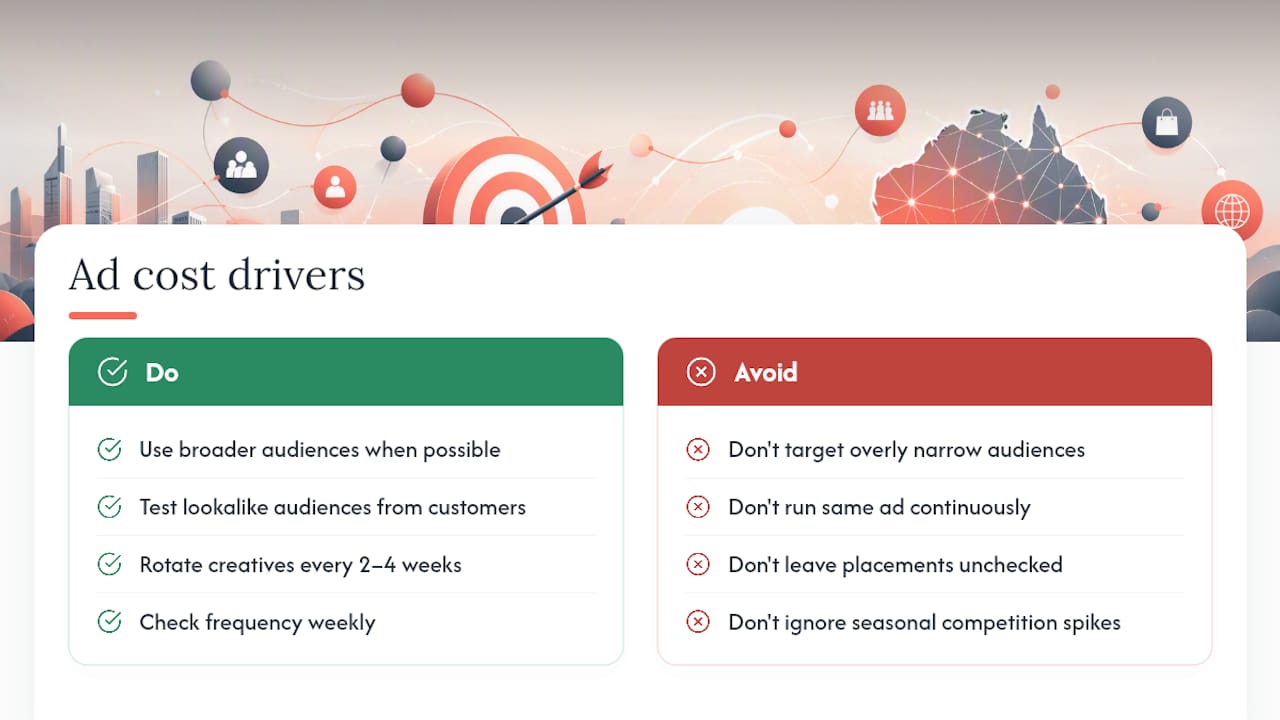
Audience size is the first lever, and it’s counterintuitive. A narrower, highly specific audience often costs more per result because you’re competing for a smaller pool of impressions, while a broader audience paired with Meta’s own optimisation frequently ends up cheaper per outcome. Lookalike audiences built from your existing customer list usually sit in a comfortable middle ground, retaining relevance without choking supply.
Creative fatigue is the second big driver, and it’s the one businesses ignore longest. Run the same ad to the same audience for too long and your frequency climbs, engagement drops, and Meta’s quality score follows it down, which pushes your CPM up even though nothing else changed. Most accounts should rotate fresh creative variants every two to four weeks for cold audiences, sooner if you’re spending aggressively.
Placement and device split matter more than people expect. Mobile feed, Reels, and Marketplace all price differently, and an account left on automatic placements without review can quietly drift toward the most expensive inventory available.
Seasonality and competitive events compound everything above. Retail sale periods, election campaigns, and major sporting finals all pull extra advertiser dollars into the auction at the same time you’re trying to spend yours.
Pro Tip: Check your frequency metric weekly, not monthly. Once frequency on a cold campaign creeps past 3 to 4 within a week, that’s usually the first sign your CPM is about to climb, well before your dashboard’s overall cost figures show it.
Finally, the quality of your event tracking feeds directly back into cost. If your Meta Pixel or Conversions API isn’t firing cleanly, the algorithm is optimising on incomplete data, which almost always shows up as higher cost per result than an equivalent account with tidy conversion tracking in place.
What budget do you actually need to see real results?
Meta’s own guidance is that even a few dollars a day can technically run a campaign, but “technically runs” and “generates a usable outcome” are different things entirely. Below roughly $1,000 a month, most accounts struggle to produce enough conversion signal for the algorithm to optimise properly, which means you’re paying for an experiment rather than a functioning channel.
Here’s how to think about staging your spend:
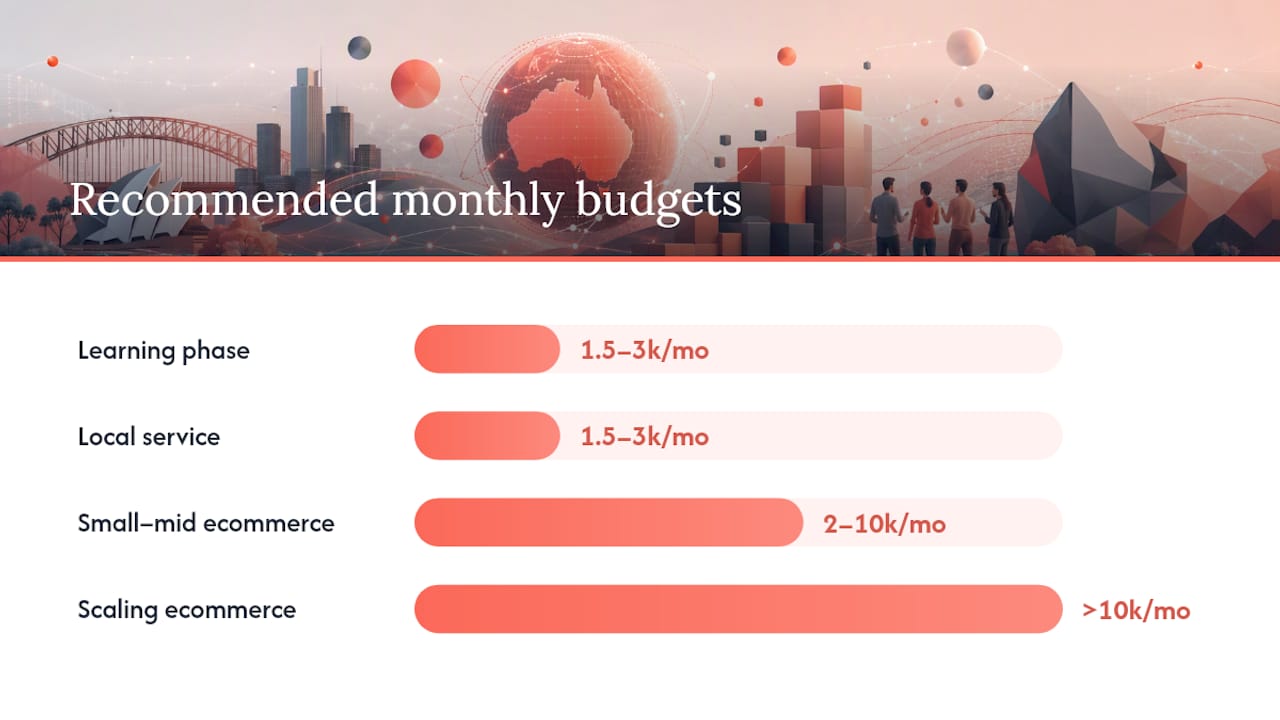
- Learning phase budget: run at least $1,500 to $3,000 a month for four to six weeks before judging performance, regardless of business type.
- Local service business: once past learning, $1,500 to $3,000 a month is usually enough to keep a steady lead flow in a single metro area.
- Small to mid ecommerce: budget $2,000 to $10,000 a month, scaling with average order value and how many SKUs you’re testing.
- Scaling ecommerce or multi-market: budgets above $10,000 a month generally need dedicated account management, whether in-house or agency, to avoid wasted spend across too many campaigns.
Here’s a worked example to make the maths concrete. Say you commit $3,000 a month to a conversions campaign, and your blended CPM sits at $15.
That $41.70 CPA only makes sense once you know your average order value and margin. A store selling a $150 product with healthy margin can absorb that cost comfortably; a store selling a $35 impulse item cannot, and needs to either lift average order value or push landing page conversion rate higher before scaling spend further.
Below $1,000 a month, most accounts can’t generate enough conversion volume for Meta’s algorithm to learn properly, according to Australian benchmark data — that threshold is your real starting line, not a suggestion.
Why do some campaign objectives cost more than others?
Objective selection is where a lot of Facebook ads budget in Australia quietly gets wasted, because businesses default to “conversions” for everything without understanding the cost gradient that runs across the funnel.
Awareness and reach objectives are cheapest per impression because Meta is optimising for the easiest outcome, showing your ad to as many eligible people as possible. Traffic campaigns cost more per result because you’re now asking for a click, a slightly harder action. Lead generation and conversions campaigns cost the most per unit because you’re asking for a genuine commitment, a form fill or a purchase, and fewer people in any given audience are ready to do that today.
This isn’t a reason to avoid conversion campaigns. It’s a reason to structure your funnel deliberately:
- Use awareness or engagement campaigns to build an initial audience pool cheaply before you ever ask for a sale.
- Retarget warm engagers with a conversions objective, where your cost per result will be far lower than targeting a cold audience with the same objective.
- For ecommerce with an established catalogue, Advantage+ Shopping campaigns frequently outperform manually structured campaigns at scale, because Meta’s automation handles placement and audience allocation across your full product range.
Shopify’s guidance is worth repeating here: don’t fixate on CPC in isolation. A cheap click that never converts is worse than an expensive click that does, so cost per acquisition or ROAS is the number that should drive your budget decisions, not the vanity metric sitting at the top of your ads dashboard.
What’s the fastest way to bring your ad costs down?
None of these tactics are secret, but the businesses that actually execute them consistently beat the ones that read about them once and move on.
- Test creative in batches, not one at a time. Run three to five genuinely different concepts against each other rather than tweaking one ad repeatedly, and let the data pick the winner within the first week of spend.
- Build exclusion audiences aggressively. Exclude existing customers from cold prospecting campaigns and exclude recent purchasers from retargeting, so you’re not paying to convince someone who already bought.
- Fix your landing page before you fix your ad. A campaign with a 1% landing page conversion rate needs a page overhaul, not a bigger budget; doubling spend into a leaky page just doubles the waste.
- Tighten your checkout flow. Every extra field or unclear shipping cost at checkout quietly raises your effective cost per acquisition, even though your Meta account looks unchanged.
- Track profit, not just return. POAS (profit on ad spend) gives you a truer read than ROAS alone, because ROAS ignores your cost of goods and can make a genuinely unprofitable campaign look healthy on the dashboard.
Pro Tip: Before increasing budget on a campaign, check your ad frequency and landing page load speed first. A slow-loading page under heavy traffic quietly inflates cost per acquisition in a way that looks, at first glance, like an ad problem.
A structured testing cadence matters more than any single tactic here. Businesses that run disciplined creative testing on a fixed schedule, rather than reactively swapping ads when performance dips, tend to hold lower blended costs over a full quarter than accounts making ad-hoc changes.
Should you hire an agency, and what will it cost?
Agency fees for Meta ads management in Australia generally fall into three bands. Mid-tier agencies with senior strategists typically charge $1,500 to $5,000 a month or 10 to 20% of ad spend, depending on scope. Larger agencies managing multi-channel budgets above $20,000 a month often negotiate custom retainers rather than a flat percentage, because the workload no longer scales linearly with spend.
Hiring an agency reduces your effective cost of acquisition when the fee is smaller than the inefficiency you’d otherwise absorb through trial and error, poor targeting, or slow creative iteration. It doesn’t help when your budget is too small to justify the fee in the first place, or when an agency is billing for generic templated management rather than genuine strategy work.
Before signing anything, ask a prospective agency:
- What’s your reporting cadence, and can I see a live dashboard rather than a monthly PDF?
- Who specifically works on my account, and is that the same senior person in every meeting?
- How do you define success beyond ROAS, and will you show me cost per acquisition against margin?
- What happens in month one if results are below your own forecast?
Red flags worth walking away from include vague reporting promises, reluctance to discuss actual account access, and any pitch that guarantees a specific ROAS before seeing your product margins or current traffic quality.
What results has Moor Marketing actually delivered?
Numbers on a benchmark table only mean something once you see them applied to a real account. Moor Marketing’s ecommerce case study and separate Facebook ads case study both walk through the budget structuring and creative decisions behind specific client outcomes, rather than staying theoretical.
The forecasting framework used with clients starts simple: take the client’s target CPA or ROAS, work backwards through the funnel using realistic click-through and conversion rate assumptions for their vertical, then set the minimum viable monthly budget needed to hit statistically useful volume within four to six weeks.
A practical example: a client committing $10,000 a month to Meta ads, selling a $90 average order value product with a 40% margin, gets modelled against a target CPA under $35 to stay comfortably profitable. At a blended CPM of $12 and an assumed 1.5% click-through rate with a 2.5% landing page conversion rate, that budget should produce roughly 208 conversions a month at a CPA near $48, signalling the landing page or creative needs work before scaling further, not the budget itself.
Do Australian regulations affect what you pay for Facebook ads?
Yes, though not through a direct tax or fee on ad spend. Australia’s regulatory environment shapes cost indirectly, mainly through what you’re allowed to say and target.
The Australian Consumer Law governs misleading advertising claims, and Meta’s own ad policies enforce restrictions around health, finance, and housing categories more tightly for Australian audiences than for some other markets. Ads in these “special ad categories” lose access to certain detailed targeting options, which typically pushes CPM higher because you’re competing in a broader, less segmented audience pool.
Privacy changes have had a bigger cost impact than most advertisers realise. Since Apple’s App Tracking Transparency changes reduced the tracking data available from iOS devices, Meta’s algorithm has less granular signal to optimise against for many Australian accounts, which has contributed to the gradual CPM and CPA increases seen since 2022. Setting up server-side tracking through the Conversions API partly offsets this, and accounts that skipped that setup are often paying a real, if invisible, premium for incomplete data.
Financial services and health advertisers face the steepest compliance overhead, with creative review delays and rejected ads adding real time cost on top of the media spend itself. Budgeting extra runway for approval cycles in these categories isn’t optional, it’s the reality of advertising in a regulated vertical on this platform.
What I’d prioritise if I were setting a Facebook ads budget in 2026
Creative and measurement matter more than the raw dollar figure you commit. A $2,000 budget with sharp creative and clean tracking will consistently outperform a $5,000 budget running tired ads into a poorly instrumented pixel, and I’d rather see a business fix those two things before touching the budget slider at all.
Patience is the second underrated factor. Give a new campaign a genuine four to six week learning window before declaring it a failure, because judging performance in week one is judging noise, not signal.
Escalate to agency support once your account complexity outpaces your available time to test properly, not simply once your budget crosses an arbitrary dollar figure.
— Liza
Want help turning this into an actual budget plan?
Reading benchmark ranges is useful; building a budget model specific to your margin, average order value, and growth targets is a different job entirely. An agency can work directly with eCommerce brands to translate numbers like the ones above into a real media plan, using senior strategists rather than outsourced account management, which is precisely the gap that leaves most self-managed accounts overpaying for underwhelming results.
If you’re building or scaling an ecommerce brand and want a second set of eyes on your Meta budget before you commit real spend, start with our guide to ecommerce growth strategies or book a session directly through Moor Marketing’s work with us page to walk through your specific numbers. For a lighter-touch option, the eCommerce Marketing Workshops cover budgeting and optimisation hands on, if you’d rather learn the framework than hand it off entirely.
Where these figures come from
The Australian cost ranges and budget recommendations throughout this guide draw on Meta’s own pricing and budgeting guidance, current Australian benchmark reporting on CPC, CPM, and CPA ranges, and Shopify’s advertiser guidance on framing cost per acquisition over raw click price. Audience scale figures reference Statista’s global Facebook user data. For a second read on campaign spend modelling, HarbourSide Digital offers Sydney-focused perspective worth comparing against.
Sources
- Facebook and Instagram Ads: Budgets, Costs & Schedules
- How Much Do Facebook Ads Cost in Australia? 2026 Guide
- Meta Ads Australia Playbook 2026: CPM & Strategy
- How Much Do Facebook Ads Cost? Pricing & Budgets
- Number of monthly active Facebook users worldwide