

Scaling ecommerce ads is defined as the process of increasing paid ad spend to grow revenue while maintaining or improving profitability. Common ecommerce ad scaling challenges span financial constraints, operational bottlenecks, and platform algorithm behaviour, and 74% of startup failures link directly to premature scaling. That statistic means most businesses hit a wall not because their product fails, but because they scale before their systems are ready. Recognising these challenges early is the difference between profitable growth and expensive chaos.
1. What are the top financial challenges in ecommerce ad scaling?
Financial instability is the most common reason scaling ecommerce ads destroys profit instead of building it. Before increasing ad spend, four metrics must be stable.
- Contribution margin above 40%. This is the revenue left after variable costs. Below 40%, every extra sale funded by paid ads shrinks your margin further.
- CAC payback under 6 months. If it takes longer than 6 months to recover your customer acquisition cost, scaling spend creates a cash flow gap that compounds quickly.
- LTV:CAC ratio above 3:1. A customer must be worth at least three times what it costs to acquire them. Anything lower and paid growth is structurally unprofitable.
- Cash conversion cycle under 45 days. Maintaining a cash conversion cycle below 45 days prevents the cash flow traps that cause insolvency even when revenue is growing.
Premature scaling amplifies every financial weakness. Profit margins often drop 30–50% when ecommerce stores double revenue, because shipping costs, return processing, and team expenses all rise faster than revenue. That compression catches most marketers off guard because the revenue line looks healthy while the margin line collapses.
Inflated inventory commitments are another trap. Scaling ad spend drives demand forecasts up, which pushes merchants to commit to larger supplier orders. If the ad performance dips, you are left holding stock you cannot move at the margin you planned.
Pro Tip: Track contribution margin, CAC payback, LTV:CAC, and cash conversion cycle weekly, not monthly. Monthly reporting hides the early warning signs that weekly data catches in time to act.
2. How do operational bottlenecks disrupt ad scaling?
Operational capacity breaks before most marketers expect it to. When ad spend increases and order volume doubles, fulfilment speed, customer service, and platform infrastructure all face simultaneous pressure.
The customer experience impact is direct and measurable. Repeat purchase rates drop by up to 40% when fulfilment slows from 3 days to 12 days during rapid growth. Paid traffic is expensive to acquire, so losing repeat purchases from those customers destroys the economics of scaling entirely.
Common operational breaking points include:
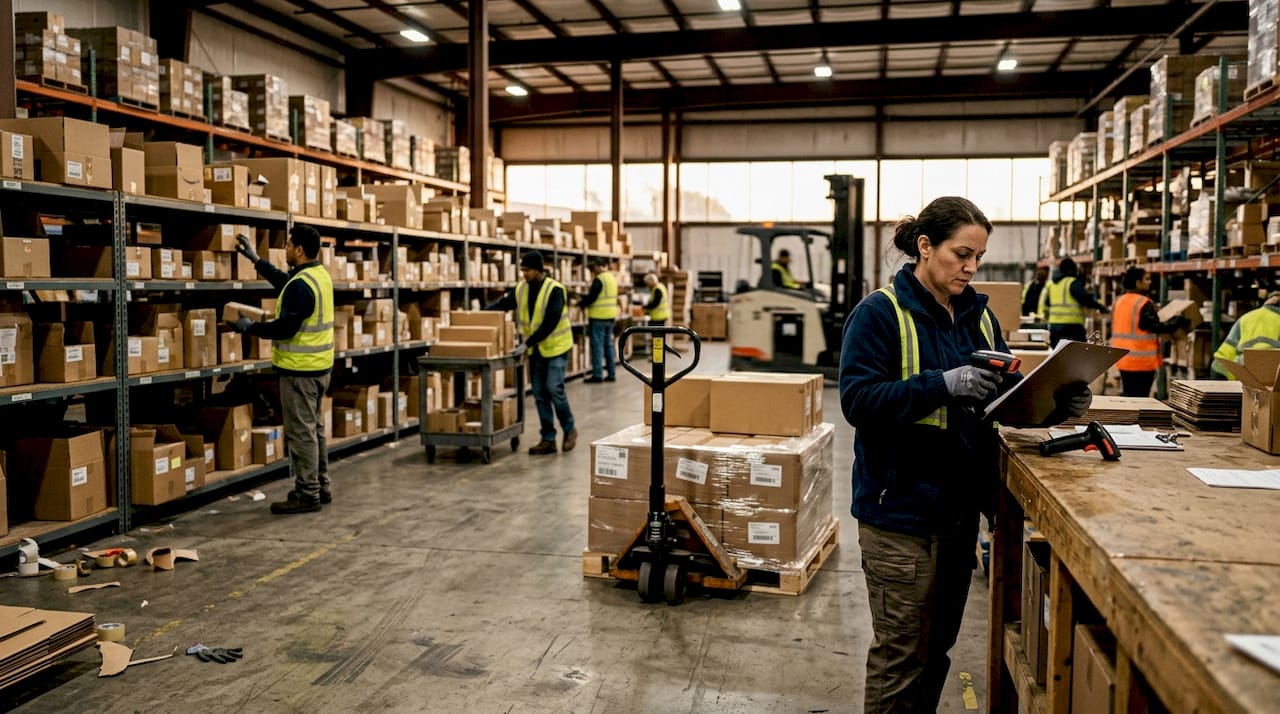
- Fulfilment speed degradation. Warehouse pick-and-pack processes that work at 200 orders per day often collapse at 400 without additional staff or automation.
- Customer service overload. Support ticket volume scales with order volume. Without automation, response times blow out and reviews suffer.
- Checkout and platform slowdowns. Database bottlenecks and inventory sync failures appear under traffic spikes, causing abandoned carts at the worst possible moment.
- Inventory sync failures. Selling out-of-stock products due to delayed sync between ad platforms and your store creates refund costs and customer complaints.
Asynchronous order processing and microservices architecture prevent these bottlenecks during traffic spikes. The principle is simple: design your systems to handle twice your current volume before you scale spend, not after. Automating customer service, order fulfilment, and inventory management through AI chatbots and third-party logistics integrations delays the need for additional hires and keeps operational costs from jumping in lockstep with revenue.
3. Which ad platform algorithm challenges hurt scaling most?
Platform algorithm behaviour is one of the least understood common ecommerce scaling bottlenecks. Most marketers increase budgets too fast and then blame the platform when performance drops, without realising they triggered the problem themselves.
Ad platform algorithms reset their learning phase when budgets increase by more than 20–25% in a single step. That reset causes 7–14 days of suboptimal delivery, including higher CPM and lower ROAS. Scaling a $1,000 per day budget to $2,000 overnight does not double your results. It typically halves them for two weeks while the algorithm relearns.
Creative fatigue compounds the problem. Scaling ad spend too fast triggers creative fatigue, which shows up as rising ad frequency with falling click-through rate. When the same audience sees your ad too many times, engagement drops and cost per click rises. The algorithm then pushes your ads to lower-quality audience segments to spend the budget, which accelerates the decline.
Audience saturation follows creative fatigue. Once your primary audience is exhausted, the platform moves into lookalike and interest-based segments that convert at lower rates. Attribution gaps caused by privacy changes and iOS updates make it harder to see this happening in real time, because multi-touch attribution data is incomplete.
Graduated scaling in increments of 15–20% every 3–5 days preserves algorithm stability and avoids learning phase resets. This approach feels slow, but it compounds. A campaign that scales 20% every 4 days reaches 3x spend in under a month without triggering a single reset.
Pro Tip: Build a pipeline of at least 5–8 fresh creative assets before scaling spend. Rotate new creatives in before frequency hits 3.0 to preempt fatigue rather than react to it. See ecommerce ad creative best practices for a practical 2026 framework.
4. What guardrails help marketers scale ads sustainably?
Sustainable ad scaling requires a framework, not just a budget increase. The most effective ecommerce scaling frameworks share one principle: identify the binding constraint at each growth phase and fix it before scaling further.
- Run a constraint test first. Increase spend by 20% and hold for 5 days. Watch conversion rate, fulfilment speed, and ROAS. If any metric degrades, you have found your constraint. Fix it before the next increase.
- Stabilise unit economics before scaling. Contribution margin, CAC payback, and LTV:CAC must all be within target thresholds. Scaling with weak unit economics accelerates losses, not profits.
- Establish a weekly operating cadence. Review marketing metrics, operations performance, and cash position every week. Incremental scaling with weekly KPI reviews improves long-term campaign sustainability. Monthly reviews are too slow to catch problems before they become expensive.
- Avoid multi-variable testing during scaling. Changing creative, audience, and budget simultaneously makes it impossible to know what caused a performance shift. Change one variable at a time.
- Automate before hiring. Team costs jump in steps, not gradually. Adding a staff member adds a fixed cost that persists even if ad performance dips. Automation scales up and down with volume.
Pro Tip: Treat your weekly review as a board meeting for your ad account. Set a fixed agenda: ROAS vs. target, conversion rate vs. baseline, fulfilment speed, and cash position. Decisions made without this cadence are guesses.
5. How to avoid the most costly ecommerce scaling mistakes
The most damaging ecommerce scaling mistakes to avoid are not dramatic failures. They are slow, quiet margin erosions that only become visible when it is too late to reverse them cheaply.
- Expanding channels before unit economics are proven. Expanding into new ad channels before unit economics prove out results in loss-making growth and cash burn. Test new channels with 10–15% of your ad budget for 90 days. Require at least a 3:1 LTV:CAC ratio and 30 or more conversions before committing further spend.
- Ignoring supplier terms during growth. Volume growth requires larger inventory commitments. Without negotiated payment terms and volume discounts locked in before scaling, your cash conversion cycle blows out and cash flow suffers.
- Neglecting return rate increases. Return rates from paid customers run 15–25%, compared to 8–12% for organic customers. As paid traffic grows as a share of total revenue, blended return rates rise and processing costs compound. Factor this into your margin model before scaling spend.
- Scaling spend before conversion rate is stable. Sending more traffic to a funnel converting at 1.2% does not fix the funnel. It amplifies the leak. Stabilise conversion rate first, then scale. Conversion rate optimisation is a prerequisite for profitable ad scaling, not an afterthought.
- Ignoring ROAS floor margins. Set a minimum acceptable ROAS based on your contribution margin. If ROAS drops below that floor, stop scaling and fix the funnel. Continuing to spend below floor margin is paying to lose money faster.
The digital marketing challenges that derail scaling are almost always predictable. The marketers who avoid them are not smarter. They are more disciplined about checking the right metrics before making the next move.
Key takeaways
Scaling ecommerce ads profitably requires stable unit economics, operational readiness, and graduated budget increases before any significant spend increase is made.
| Point | Details |
|---|---|
| Financial metrics come first | Contribution margin above 40%, LTV:CAC above 3:1, and CAC payback under 6 months must be stable before scaling. |
| Operational capacity must lead spend | Build systems to handle twice current volume before increasing ad budgets, not after. |
| Graduated budget increases protect ROAS | Increase spend by 15–20% every 3–5 days to avoid algorithm learning phase resets. |
| Weekly cadence prevents costly drift | Review ROAS, conversion rate, fulfilment speed, and cash position every week without exception. |
| Fix the funnel before scaling traffic | A leaking conversion funnel gets worse with more traffic. Stabilise conversion rate first. |
What I have learned about scaling ecommerce ads the hard way
The marketers I see struggle most with advertising challenges in ecommerce share one trait: they treat scaling as a reward for early success rather than a discipline that requires its own preparation.
The instinct after a strong month is to double the budget and ride the wave. What actually happens is that the wave breaks the systems underneath it. Fulfilment slows. Creative fatigues. The algorithm resets. Margins compress. And suddenly the “winning” campaign is losing money at twice the speed.
What actually works is systems thinking. Build the guardrails before you need them. Set your ROAS floor, your weekly review cadence, your creative rotation schedule, and your operational capacity thresholds before you touch the budget. When those systems are in place, scaling becomes a process rather than a gamble.
The other thing I have noticed is that most marketers focus on the wrong constraint. They obsess over creative when the real problem is a 2.8% conversion rate on a product page that has not been updated in 18 months. Or they chase new channels when their primary channel has not been properly optimised. Fix the binding constraint first. Everything else is noise.
Patience is not passive. It is the active decision to scale only when the numbers say you are ready. That discipline is what separates businesses that grow revenue sustainably from those that grow fast and then spend six months recovering.
— Liza
How Moormarketing helps ecommerce businesses scale with confidence
Scaling ad campaigns without breaking your margins or your operations is a skill that takes time to build. Moormarketing works directly with ecommerce marketers and business owners to develop the frameworks, financial guardrails, and creative systems that make scaling predictable rather than painful.
Moormarketing’s ecommerce marketing workshops are built specifically for the scaling challenges marketers face in 2026, covering unit economics, platform algorithm management, and operational readiness in practical, hands-on sessions. Every strategy is developed by senior strategists, not outsourced, so the guidance is specific to your business and your numbers. If you are ready to scale with a clear plan behind you, work with Moormarketing to build it.
FAQ
What is the main cause of ecommerce ad scaling failure?
Premature scaling due to unstable unit economics and cash flow issues causes 74% of startup failures. Scaling before contribution margin, LTV:CAC, and CAC payback are within target thresholds amplifies losses rather than profits.
How much should I increase my ad budget at a time?
Increase ad budgets by 15–20% every 3–5 days. Larger single increases of more than 20–25% trigger algorithm learning phase resets, causing 7–14 days of higher CPM and lower ROAS.
Why do return rates rise when scaling paid ads?
Paid traffic return rates run at 15–25%, compared to 8–12% for organic customers. As paid traffic grows as a share of total revenue, blended return rates and processing costs rise, compressing overall profitability.
What is creative fatigue and how do I prevent it?
Creative fatigue occurs when rising ad frequency causes falling click-through rate, signalling that your audience has seen your ads too many times. Rotate in fresh creative assets before frequency reaches 3.0 to prevent engagement from dropping and costs from rising.
When should I stop scaling ad spend?
Stop scaling immediately if ROAS drops below your contribution margin floor. Continuing to spend below that threshold means paying to lose money at an increasing rate. Fix the funnel or the creative before resuming any budget increases.