

SMS marketing earns its place in an eCommerce stack when it’s aimed at last-mile conversion, not cold traffic. The verdict: build an abandoned-cart flow first, since it consistently ranks as the highest-ROI SMS automation in eCommerce, then layer in welcome and win-back flows once opt-ins, quiet hours and consent are locked down and you’re measuring incremental lift rather than gross attribution.
TL;DR:
- Building an abandoned cart flow should be the top priority because it typically recovers 20 to 35 percent of abandoned carts and drives the highest ROI.
- Segment audiences based on behaviors like cart abandonment, recent purchases, and browsing activity, rather than solely demographics, to increase message effectiveness.
- Focus on high-intent moments such as cart recovery, shipping updates, and VIP offers, sending messages at optimal times and avoiding over-segmentation.
- Measure SMS success through delivery, click-through, conversion, and unsubscribe rates, but verify true ROI using holdout groups and proper attribution to avoid inflated results.
- Ensure SMS list growth is from genuine opt-ins at checkout or post-purchase, with clear messaging, opt-out instructions, and quiet hours to maintain list quality and compliance.
Table of Contents
- Why SMS marketing matters for eCommerce
- What strategies actually drive SMS revenue?
- Which five SMS flows should you build first?
- How do you build a compliant SMS list?
- What message templates and timing actually convert?
- How do you measure SMS performance correctly?
- How do you integrate SMS with Shopify and WooCommerce?
- How does an agency approach SMS strategy for clients?
- A 2026 playbook for treating SMS as a conversion channel
- How Moormarketing builds and scales SMS programs
- Sources
Why SMS marketing matters for eCommerce
SMS wins on speed. Text messages get read within minutes of landing, a gap that email and even paid social can’t close, and that immediacy is exactly why SMS open and read rates outperform email by a wide margin in most industry comparisons.
That speed changes what the channel is good for. SMS isn’t a discovery tool. Nobody finds your brand through a text message. It’s a nudge that catches someone at the exact moment they’re deciding whether to finish a purchase, restock a favourite, or come back after ignoring three emails. Treat it as a conversion accelerator sitting downstream of your acquisition channels, and it earns its keep. Treat it as a replacement for paid ads or organic reach, and you’ll burn through your list’s goodwill for very little return.
A few reasons SMS consistently punches above its subscriber count in eCommerce:
- Messages are read fast, often within minutes, so time-sensitive offers and cart recovery actually land while the intent is still warm.
- There’s no algorithm between you and the subscriber. What you send is what they see, in order, on a lock screen.
- Automated flows (cart, welcome, transactional) tend to generate more revenue per send than one-off broadcast campaigns, because they’re triggered by real buying signals instead of a calendar date.
- The channel forces brevity, which strips out the noise that dilutes email open rates.
Pro Tip: Don’t measure SMS against your email list size. Measure it against the number of high-intent moments it can catch, like a cart sitting untouched for twenty minutes. That’s a much smaller, much more valuable pool.
The honest ROI framing is this: SMS won’t replace your paid acquisition budget, and it shouldn’t try to. It’s the channel that turns “almost bought” into “bought,” and that’s a genuinely different job to the one email and ads are doing.
What strategies actually drive SMS revenue?
Most SMS programs fail for one of two reasons: they blast everyone the same generic message, or they over-segment to the point where every audience is too small to learn from. The programs that work sit in the middle, built around behaviour rather than demographics.
Segment by what people just did, not who they are. The eCommerce brands getting real revenue from SMS build around four core groups:
- Cart abandoners who added an item but didn’t check out within an hour.
- Recent buyers who need a shipping update, then a review request.
- VIP or repeat customers who spend well above the median order value.
- Browse abandoners who viewed a product page multiple times without adding to cart.
Each group needs different copy, different timing, and often a different offer. A cart abandoner needs urgency. A VIP needs to feel recognised, not upsold. Mixing these into one generic “check out our sale” blast is how you end up with unsubscribe rates that quietly strangle your sender reputation over a few months.
Personalise the message, not just the name field. Dropping a first name into a text isn’t personalisation, it’s a mail-merge trick from 2015. Real personalisation means referencing the actual product left in the cart, using a single clear call to action (never two competing links in one message), and sending to a mobile-optimised page that loads the exact item, not your homepage. If you’re already running paid social, the creative principles in ad creative best practices translate directly to SMS landing pages: one product, one offer, one button.
Cadence is where most brands lose control. SMS tolerates far less frequency than email. Reserve it for genuinely high-intent moments, cart abandonment, shipping updates, a flash sale your VIPs get first, rather than treating it as a second inbox for every marketing message you didn’t fit into an email. And resist the urge to slice your list into a dozen micro-segments. Every extra segment fragments the data your automation and ad platforms need to learn what’s working; a smaller number of well-defined groups, sent consistently, beats fifteen narrow ones sent occasionally.
Pro Tip: Your SMS list is an owned asset, not just a sales lever. Every opted-in number is a signal you can feed back into your ad platforms for lookalike audiences and retargeting. Treat list growth as seriously as you treat email capture, and it compounds the way email flows do when they’re built properly.
Which five SMS flows should you build first?
Five automated flows cover almost every high-ROI use case in eCommerce SMS. Build them in this order, because each one depends on infrastructure the previous flow already needs.
- Abandoned cart. Send the first message 30 to 60 minutes after abandonment, then a second nudge at 24 hours if the cart is still sitting there. Keep any discount modest and reserve it for the second message, not the first. This flow is typically the highest-ROI SMS automation in eCommerce, with industry playbooks reporting recovery rates in the 20 to 35% range for carts that receive a text.
- Welcome series. Trigger it the moment someone opts in, ideally with a small first-purchase incentive, and cap it at two or three messages spread across the first week. Welcome flows convert well because the subscriber’s interest is at its peak the day they hand over their number, not a month later.
- Order and shipping updates. Wire this to order confirmation, fulfilment, and out-for-delivery events. It’s the least glamorous flow and the most valuable for trust: transactional updates measurably cut “where’s my order” support tickets and give customers a reason to keep your texts turned on.
- Win-back. Trigger this for customers who haven’t purchased in 60 to 90 days, depending on your typical repurchase cycle. Escalate gently: a soft “we miss you” message first, followed by a stronger incentive only if the first gets ignored.
- Launch and broadcast campaigns. These are the one-to-many blasts for new drops or sitewide sales, and they need the tightest frequency controls of any flow. Segment out anyone who purchased in the last 48 hours, cap broadcasts at a handful per month, and never send a broadcast and a flow-triggered message to the same person on the same day.
Building in this order means your highest-return flow is live before you spend time on lower-frequency campaigns, and it means your compliance and segmentation infrastructure is already tested by the time you’re sending to your whole list.
How do you build a compliant SMS list?
List quality decides whether your SMS program is profitable or a compliance headache. The two best opt-in moments are the checkout page, where a simple checkbox next to the phone number field (“Text me order updates and exclusive offers”) converts well because it rides on existing purchase intent, and the post-purchase confirmation page, where a customer who just bought is primed to say yes to updates about that exact order.
Pop-ups and QR codes on packaging work too, but they need explicit opt-in language, not a pre-ticked box. Every message also needs a clear opt-out instruction (usually “reply STOP”) and sender identification, and you should build in quiet hours so promotional texts don’t land at 6am or midnight.
A few practical list-hygiene rules keep delivery healthy:
- Scrub invalid or landline numbers before your first send, not after a bounce report tells you.
- In the US market, understand how 10DLC registration affects sender reputation and deliverability if you’re sending at volume.
- Set a re-engagement window (often 90 to 180 days of inactivity) before you either win back or suppress a subscriber.
- Never buy or import a list you didn’t collect through a genuine opt-in.
What message templates and timing actually convert?
Short, specific copy beats clever copy every time in SMS.
A few templates worth adapting:
- Cart: “Hey [First Name], your [Product] is waiting. Complete your order in the next hour for free shipping.”
- Shipping: “Your order’s on its way! Track it here: [link]”
- VIP offer: “You’re one of our best customers, so here’s 48 hours early access to [Sale Name].”
Use plain SMS for most flows and save MMS (with an image) for launches and VIP offers where the extra cost is justified by a genuinely different-looking product shot. Cart and shipping messages perform on timing alone; send the first cart text within an hour, and time broadcasts for mid-morning or early evening when phones are actually being checked, not first thing when inboxes are already flooded. Every message needs exactly one link, pointing to a mobile-optimised page for that specific product or offer.
How do you measure SMS performance correctly?
Delivery rate, click-through rate, conversion rate, unsubscribe rate, and cart recovery rate are the five numbers worth tracking weekly. Most platform dashboards report these automatically, but the number that matters most, incremental lift, isn’t one of them.
The trap most eCommerce teams fall into is crediting SMS with every sale that happens after a text goes out, even sales that would have happened anyway through email or organic return visits. Measuring true incremental lift requires a holdout group or time-windowed attribution, comparing a segment that received the text against a comparable segment that didn’t. Skip that step and your reported ROI is almost always inflated.
Practical steps for cleaner measurement:
- Run monthly holdout tests on your biggest flow (usually cart abandonment) to see the real lift.
- A/B test send timing and incentive size before you A/B test copy, since timing moves the needle more.
- Build a simple dashboard alongside your existing ecommerce performance metrics reporting, rather than a separate SMS-only view stakeholders never open.
- Flag unsubscribe rate spikes within 48 hours of any broadcast, since that’s your earliest warning of fatigue.
How do you integrate SMS with Shopify and WooCommerce?
Most eCommerce platforms support SMS through a native app, a webhook, or a direct API connection, and the right choice depends on how much engineering time you actually have. A native Shopify or WooCommerce app is the fastest path for most stores, since it handles checkout events and order data without custom code. Webhooks and API integrations give more control over triggers and data enrichment but need a developer to maintain them.
Whichever path you choose, wire these events at minimum: checkout started (for cart abandonment), order created, order fulfilled, and subscription renewal if you sell anything recurring. Tag subscribers as they cross behavioural thresholds, first purchase, third purchase, lifetime value above a set figure, so your VIP and win-back segments update automatically instead of requiring a manual export every month.
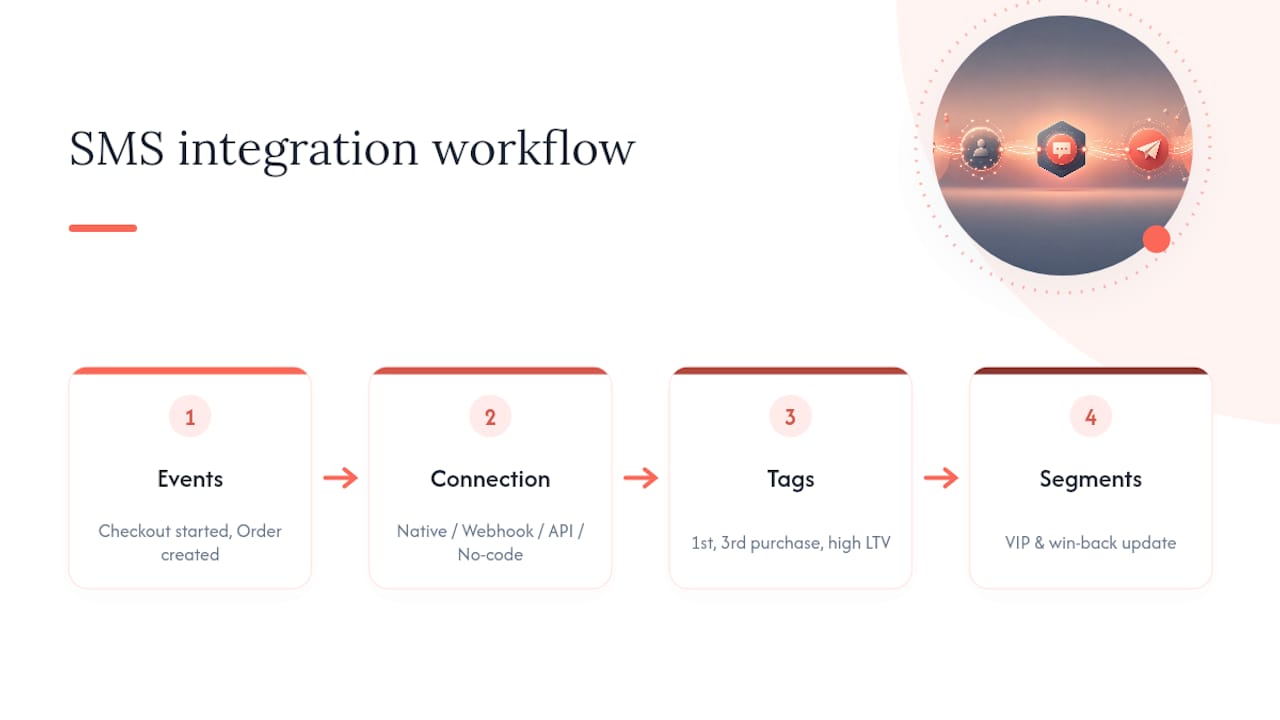
If you don’t have engineering resources on hand, Zapier or Make can bridge most of these events between your store and your SMS platform without a single line of code, which is often enough to get a working abandoned-cart flow live within a day.
How does an agency approach SMS strategy for clients?
When an agency audits a client’s SMS program, the first pass is never about copy or design. It’s about sequencing: which flow is missing, which flow is live but poorly timed, and which segment is being ignored entirely. The abandoned cart almost always gets fixed first, because it’s the fastest path to measurable revenue and it exposes whether the underlying integration (checkout events, order data) is even wired correctly.
The quickest wins in SMS rarely come from better copy. They come from fixing sequencing: getting the cart flow live with the right delay, getting quiet hours respected, and getting a clean opt-in source before a single broadcast goes out. Everything else is optimisation on top of a foundation that has to work first.
Reporting cadence matters just as much as setup. A monthly review against delivery, click-through, conversion and unsubscribe benchmarks keeps a program honest, and a clear handover process, documented flows, tagged segments, a shared dashboard, means an internal team can keep running the program without an agency permanently in the loop.
A 2026 playbook for treating SMS as a conversion channel
The conventional advice on SMS marketing still treats it like a smaller, cheaper email channel: build a list, send broadcasts, watch the revenue roll in. That advice is outdated and it’s expensive when you follow it, because SMS punishes frequency and rewards precision in a way email simply doesn’t.
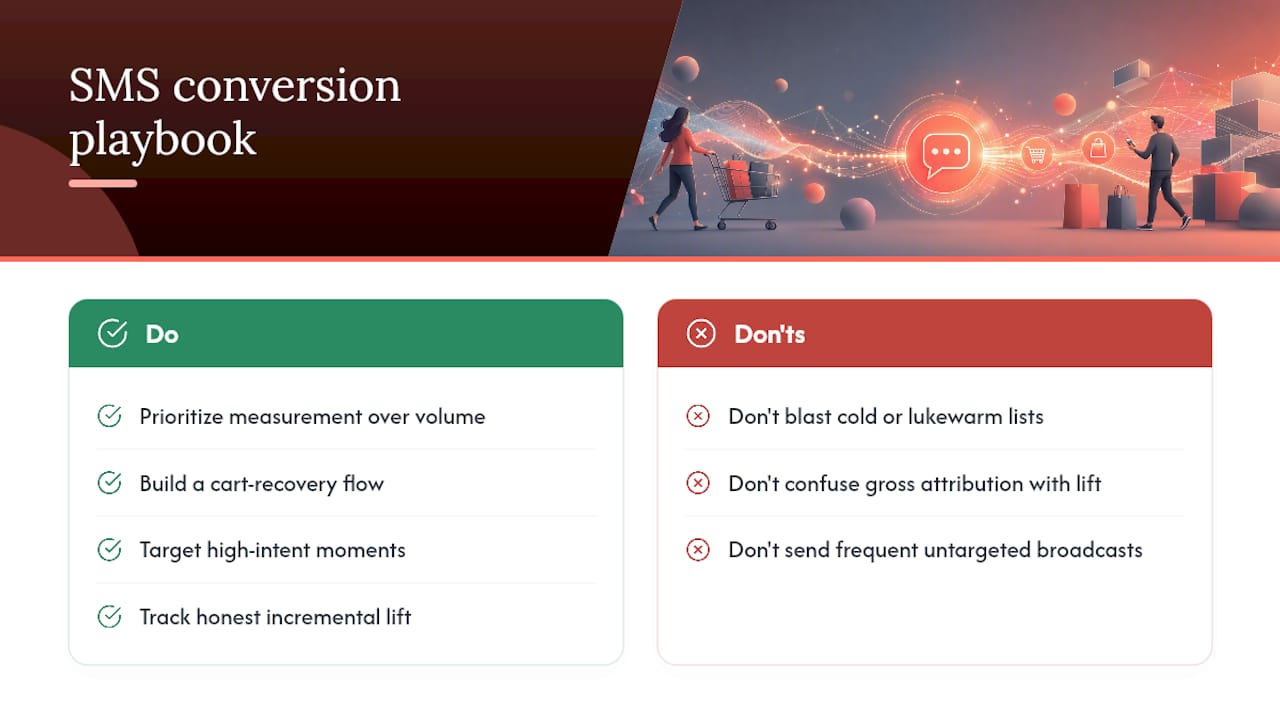
What the evidence actually supports is narrower and more useful. SMS earns its budget when it’s aimed at moments of decided intent: a cart sitting untouched, a shipment in transit, a VIP customer who’s earned early access. It underperforms, sometimes badly, when it’s used to manufacture demand from a cold or lukewarm audience.
If you take one thing from this playbook, prioritise measurement before you prioritise volume. A program sending fewer, better-timed messages with honest incremental-lift tracking will outperform a program sending twice as often with gross attribution masking how much of that “revenue” would have shown up anyway. Build the cart flow, measure it properly, then earn the right to scale.
— Liza
How Moormarketing builds and scales SMS programs
Some agencies work with growth-focused eCommerce brands as the senior team handling the strategy in-house, not farming it out to junior contractors, which matters when the difference between a profitable SMS program and a wasted send budget often comes down to sequencing and measurement discipline rather than clever copy.
If your SMS program is stuck at “we sent a few broadcasts and don’t really know if they worked,” that’s usually a sign the flow architecture and attribution setup need a proper audit before another dollar goes into sends. Some agencies provide hands-on strategy sessions and ongoing retainers that cover exactly this: auditing existing flows, wiring the missing abandoned-cart or win-back automation, and setting up measurement that shows real incremental revenue rather than inflated attribution. The eCommerce Growth Guide is a useful starting point if you want the wider channel context first, but if you’re ready to fix the SMS program itself, book a call with the team and get a straight answer on what’s missing before you spend another cent on sends.
Sources
- SMS Marketing for E-Commerce: The Complete 2026 Playbook — Ready
- SMS Marketing Best Practices for Ecommerce 2026