

Agile marketing frameworks are defined as iterative, data-driven methodologies that organise marketing teams into short cycles of planning, execution, and review. Understanding how agile marketing frameworks work is the first step to replacing slow annual planning with fast, responsive campaigns. Rooted in the Agile Marketing Manifesto, these frameworks draw on practices from Scrum and Kanban to keep teams aligned with real customer behaviour. The result is a marketing operation that adapts before campaigns become outdated, rather than after the budget is spent.
What are the core principles behind agile marketing frameworks?
Agile marketing is built on a clear set of values, not just a set of meetings. The Agile Marketing Manifesto defines five core values: validated learning over opinions, customer-focused collaboration over silos, adaptive campaigns over rigid plans, many small experiments over a few large bets, and responding to change over following a fixed plan. These values shift the team’s focus from producing outputs to delivering measurable customer value.
The ten principles that sit beneath those values reinforce this shift. Teams prioritise customer value over activity, meaning a campaign that generates real revenue beats one that simply looks busy. Cross-functional collaboration replaces the traditional handoff model, where a brief moves slowly from strategy to creative to media. Continuous data analysis replaces the quarterly review.
Agile marketing principles also demand a tolerance for experimentation. Teams treat campaigns as hypotheses to be tested against real performance data, then refined or abandoned based on results. This is the fundamental mindset difference between agile and traditional marketing. A traditional team launches a campaign and waits. An agile team launches, measures, and adjusts within the same sprint.
- Validated learning: Decisions come from data, not gut feel or seniority.
- Customer focus: Every sprint goal connects back to a specific customer outcome.
- Adaptive planning: Plans change when the data says they should.
- Experimentation: Small tests run constantly, reducing the cost of being wrong.
- Cross-functional teams: Strategists, creatives, and analysts work together, not in sequence.
Pro Tip: Before adopting any agile framework, write down your team’s current decision-making process. If decisions require three approval layers, agile will stall until that changes.
How do agile marketing teams operate day to day?
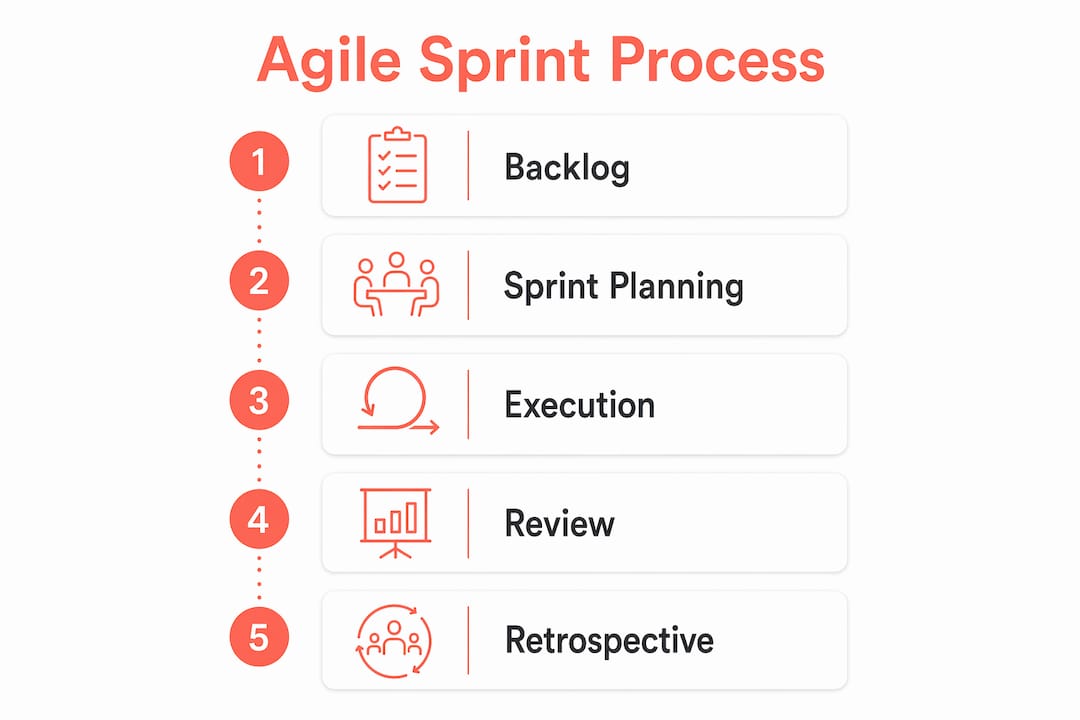
The daily rhythm of an agile marketing team is structured but not rigid. Sprint cycles typically run two to four weeks, with each sprint containing a defined goal, a set of tasks pulled from the marketing backlog, and a retrospective at the end. That cadence creates a predictable loop of planning, doing, reviewing, and improving.
The marketing backlog is the team’s master list of work. Items in the backlog are prioritised by business impact, not by who asked loudest. At the start of each sprint, the team selects the highest-priority items they can realistically complete. This prevents the common problem of teams committing to more than they can deliver.
Daily standups keep the team aligned without consuming the day. Each person answers three questions: what did I complete yesterday, what will I complete today, and what is blocking me? The standup runs for fifteen minutes or less. Blockers get resolved outside the standup, not during it.
Visual management tools like Kanban boards make work visible to everyone. A Kanban board typically shows columns for “To Do,” “In Progress,” and “Done,” with cards representing individual tasks. Kanban boards and workflow tools help teams spot bottlenecks before they become delays. Work-in-progress limits prevent any column from overflowing, which is the most common sign that a team has taken on too much.
- Sprint planning: Select backlog items that match the sprint goal and team capacity.
- Daily standup: Share progress, plans, and blockers in fifteen minutes or less.
- Sprint execution: Complete tasks, run experiments, and update the board in real time.
- Sprint review: Present completed work and gather feedback from stakeholders.
- Retrospective: Identify what worked, what did not, and what changes next sprint.
| Sprint activity | Frequency | Purpose |
|---|---|---|
| Sprint planning | Start of each sprint | Set goals and assign tasks |
| Daily standup | Every working day | Maintain alignment and surface blockers |
| Sprint review | End of each sprint | Share results with stakeholders |
| Retrospective | End of each sprint | Improve team process continuously |
Pro Tip: Keep your backlog to a manageable size. A backlog with 200 items is not a plan. It is a wish list. Limit it to work you can realistically complete in the next three sprints.
What are the common agile marketing frameworks and how do they differ?
Three frameworks dominate agile marketing practice: Scrum, Kanban, and Scrumban. Each suits a different team structure and work type.

Scrum is time-boxed and sprint-driven. Teams commit to a fixed scope of work for a set period, typically two weeks. Scrum includes defined ceremonies: sprint planning, daily standups, sprint reviews, and retrospectives. It works best for teams with predictable workloads and clear project boundaries, such as a product launch or a seasonal campaign series.
Kanban operates as a continuous flow system. There are no sprints. Work moves through the board as capacity allows, governed by work-in-progress limits on each column. Kanban suits teams that handle a high volume of varied requests, such as a content team managing ongoing social, email, and paid media simultaneously. The WIP limits force the team to finish tasks before starting new ones, which reduces context-switching and improves quality.
Scrumban is a hybrid that combines Scrum’s sprint planning with Kanban’s continuous flow. Teams use sprint goals for direction but allow work to flow continuously within those goals. This flexibility makes Scrumban a practical choice for teams transitioning from traditional methods, or for teams whose work mix changes week to week.
| Framework | Planning style | Best suited for | Key constraint |
|---|---|---|---|
| Scrum | Time-boxed sprints | Campaign launches, defined projects | Fixed sprint scope |
| Kanban | Continuous flow | High-volume, varied requests | WIP limits per column |
| Scrumban | Hybrid sprint and flow | Mixed workloads, transitioning teams | Requires clear WIP discipline |
Choosing the right framework depends on your team’s work pattern. If your marketing calendar is project-driven, start with Scrum. If your team manages a constant stream of requests, Kanban fits better. If you are not sure, Scrumban gives you room to adapt as you learn.
What are the benefits of adopting agile marketing frameworks?
The strategic impact of agile marketing is measurable. 53% of agile marketing teams actively help set organisational strategy, compared to 37% of non-agile teams. That gap reflects a real shift in how leadership perceives marketing when it operates with transparency and speed.
Collaboration improves significantly under agile conditions. 92% of marketers face collaboration challenges, and agile frameworks address this directly by making work visible and shared. When everyone can see the board, no one can claim ignorance of a bottleneck. Visibility creates accountability without requiring micromanagement.
Agile marketing also produces better campaigns, not just faster ones. Quality and effectiveness come from continuous customer feedback, not from more planning time. Teams that run short experiments and refine based on data consistently outperform teams that spend months perfecting a single campaign before launch. The mindset shift from finished campaigns to continuous testing is what separates high-performing agile teams from those that simply adopted the vocabulary.
Agile marketing is not about moving faster for its own sake. It is about learning faster. A team that runs ten small experiments in a quarter will outlearn a team that runs one large campaign, every time.
- Faster response to market changes and competitor moves.
- Higher strategic influence within the organisation.
- Reduced waste from campaigns that run too long without data review.
- Stronger team morale through clear goals and visible progress.
- Better alignment between marketing activity and business outcomes.
Pro Tip: Avoid the trap of measuring agile success by sprint velocity alone. Velocity metrics exist for capacity planning, not performance scoring. Using velocity as a reward metric creates perverse incentives and inflated estimates.
How to implement agile marketing frameworks successfully
Successful implementation starts with culture, not process. Teams that only rename meetings without changing how decisions are made fail to gain the benefits of agile. Real agile requires radical transparency, decentralised decision-making, and a willingness to let data override seniority. That is a cultural shift, and it needs leadership support from day one.
The practical steps follow once the cultural foundation is in place.
- Start small. Pick one team or one campaign type to pilot the framework. Do not attempt a full organisation rollout in the first sprint.
- Map your current workflow. Before adding a Kanban board, document how work currently moves from brief to delivery. Identify where it stalls.
- Set a realistic sprint goal. The first sprint goal should be achievable in two weeks with the current team. Overcommitting in sprint one destroys confidence in the process.
- Visualise all work. Put every task on the board, including the small ones. Hidden work is the enemy of agile. Breaking complex projects into smaller units improves both visibility and delivery quality.
- Run a genuine retrospective. The retrospective is not a debrief. It produces specific process changes that take effect in the next sprint. If nothing changes after a retrospective, the meeting was wasted.
- Manage stakeholder expectations. Agile does not mean requests get done immediately. It means requests get prioritised transparently. Stakeholders need to understand the backlog process before they experience it.
Limiting work-in-progress is the biggest operational barrier teams face during adoption. Most teams resist WIP limits because they feel like artificial constraints. They are not. WIP limits force the team to finish work before starting new work, which is the single most effective way to reduce delivery time. Address eCommerce ad scaling challenges early, because the same bottleneck patterns that slow ad scaling also slow agile adoption.
Pro Tip: Run your first retrospective with a simple format: three columns on a whiteboard labelled “Keep,” “Stop,” and “Start.” Ask each team member to add one item per column. Then commit to acting on at least one “Stop” and one “Start” before the next sprint.
Key takeaways
Agile marketing frameworks deliver measurable strategic advantage when teams commit to genuine cultural change, iterative experimentation, and continuous data-driven decision-making.
| Point | Details |
|---|---|
| Agile marketing is principle-driven | The Agile Marketing Manifesto’s five values define how teams make decisions, not just how they schedule work. |
| Sprint cycles create learning loops | Two to four week sprints generate regular data that teams use to improve campaigns before budgets are exhausted. |
| Framework choice depends on work type | Scrum suits project-driven teams; Kanban suits high-volume teams; Scrumban suits mixed or transitioning teams. |
| Strategic influence increases with agile | Agile marketing teams influence organisational strategy at a significantly higher rate than non-agile teams. |
| Culture precedes process | Renaming meetings without changing decision-making authority produces no agile benefit. |
What I have learned from watching agile marketing succeed and fail
The teams I have seen get the most from agile marketing share one quality: they treat the retrospective as the most important meeting in the sprint, not the least important. Every other ceremony is about doing the work. The retrospective is about improving how the work gets done. Teams that skip or rush retrospectives plateau quickly. Teams that take them seriously compound their improvements sprint after sprint.
The other pattern I keep seeing is the misuse of velocity as a performance metric. When leaders start rewarding teams for high sprint velocity, teams inflate their estimates to look productive. The number goes up, but the actual output does not. Velocity is a planning tool, full stop. The moment it becomes a KPI, it stops being useful.
My honest recommendation for most marketing teams is to start with Scrumban rather than pure Scrum. Pure Scrum works beautifully in software development, where sprints have clear boundaries. Marketing work rarely does. A campaign does not pause because the sprint ended. Scrumban gives you the planning discipline of Scrum with the flow flexibility of Kanban, and that combination fits the reality of most marketing environments far better than the textbook version.
The deeper truth is that agile requires a fundamental redesign of marketing operations, not just a new set of meetings. Teams that approach it as a process upgrade will get modest results. Teams that approach it as a new operating model will get the strategic influence and campaign performance that the data consistently shows is possible. That distinction is worth repeating to every leader who asks why their agile rollout is not working.
— Liza
Moormarketing’s approach to agile marketing in practice
Moormarketing works directly with eCommerce brands that need their marketing to move faster and perform better, not just look more organised.
The eCommerce marketing workshops at Moormarketing are built around the same iterative, data-driven principles that make agile frameworks effective. Senior strategists work hands-on with your team to map workflows, set sprint goals, and build the campaign testing habits that compound over time. Moormarketing has helped brands reach $2 million and $3 million in monthly sales by applying exactly these methods. If your marketing team is ready to move from annual planning to continuous improvement, work with Moormarketing to build the framework that fits your business.
FAQ
What is agile marketing in simple terms?
Agile marketing is a methodology where teams work in short cycles, test campaigns against real data, and adjust based on results rather than following a fixed annual plan.
How long is a typical agile marketing sprint?
Agile marketing sprints typically run two to four weeks, giving teams enough time to execute and measure a meaningful experiment before reviewing and replanning.
What is the difference between Scrum and Kanban for marketing?
Scrum uses fixed-length sprints with defined goals, while Kanban uses a continuous flow system governed by work-in-progress limits. Scrum suits project-based work; Kanban suits high-volume, varied request environments.
Do agile marketing teams have more strategic influence?
Yes. Agile marketing teams influence organisational strategy at a rate of 53%, compared to 37% for non-agile teams, according to 2026 State of Agile Marketing data.
What is the biggest barrier to agile marketing adoption?
The biggest operational barrier is limiting work-in-progress. Most teams resist WIP limits initially, but enforcing them is the most effective way to reduce delivery time and improve output quality.