

An ecommerce business exit strategy is the systematic process of preparing your online store for sale to achieve the highest possible valuation and a clean transfer of ownership. Most owners underestimate how much preparation this requires. Compressing your preparation time leads to a 20–40% reduction in sale price due to poor financial proof and operational instability. Starting your exit planning 18–24 months before you list gives you time to fix the issues that buyers use to drive your price down. This guide covers every stage of the process, from financial clean-up and valuation drivers to buyer types, deal structures, and the mistakes that kill deals at the finish line.
What are the essential steps in an ecommerce business exit strategy guide?
Preparation is the single biggest lever you control in any business sale. Owners who treat exit planning as a 90-day sprint consistently leave money on the table.
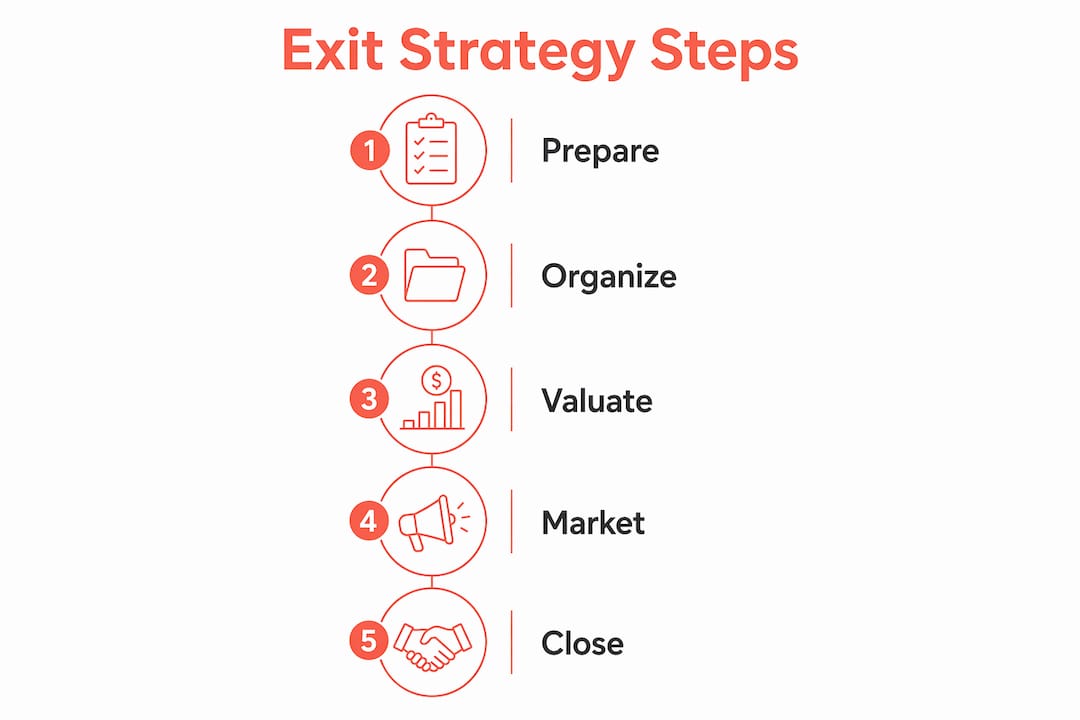
The ideal preparation window is 18–24 months before listing. Use that time to work through these steps in order:
- Separate personal and business finances. Commingled expenses are the number-one red flag for buyers. Open dedicated business accounts and run every business cost through them from day one of your preparation window.
- Switch to accrual accounting. Cash-basis books are harder for buyers to verify and often misrepresent revenue timing. Accrual accounting aligns your financials with how acquirers model businesses.
- Normalise your profit and loss statement. Remove one-off costs, document add-backs, and restate your earnings on a trailing 12-month basis. This produces a clean Seller’s Discretionary Earnings (SDE) or EBITDA figure that buyers can trust.
- Reconcile inventory. Buyers scrutinise inventory values closely. Unverified or inflated stock figures reduce your valuation and can kill a deal during due diligence.
- Document your standard operating procedures (SOPs). Every repeatable task in your business needs a written process. This proves the business runs without you, which is what buyers pay a premium for.
- Build a data room. Compile three years of financials, supplier contracts, customer data, IP documentation, and platform analytics into a secure, organised folder. Buyers expect this on day one of due diligence.
- Engage professional advisors early. Engaging a fractional CFO 12–18 months before exit gives you time to audit and prepare financials before a buyer sees them. A qualified CPA and a business broker or M&A adviser round out the team.
Pro Tip: Build your data room before you think you need it. Buyers who receive a complete, organised data room on request move faster and make stronger offers.
How do you maximise your ecommerce business valuation before sale?

Valuation in ecommerce is not guesswork. Typical exit multiples in 2026 range from 2.5x to 7x depending on your business model. Amazon FBA brands attract 2.5–3.5x SDE, Shopify direct-to-consumer brands fetch 3–4.5x SDE, and multi-channel brands with diversified revenue can command 5–7x EBITDA. Diversifying your revenue streams increases your multiple by 30–40%. That single change can add hundreds of thousands of dollars to your final sale price.
Buyers focus on these metrics above all others:
- Quality of earnings. Revenue must be consistent, recurring, and verifiable. Spiky or declining revenue signals risk and compresses multiples.
- Customer repeat rate. A high proportion of returning customers proves product-market fit and reduces buyer risk. Subscription models score highest here.
- Margin stability. Gross and net margins that hold steady across seasons show operational control. Erratic margins suggest cost problems buyers will price in.
- SDE vs EBITDA accuracy. SDE is the standard metric for smaller ecommerce sales. It adds back the owner’s salary and personal benefits to net profit. EBITDA is used for larger businesses and excludes interest, tax, depreciation, and amortisation. Using the wrong metric, or failing to document your add-backs, reduces your sale price significantly.
The valuation killers to eliminate before you list are founder dependency, customer concentration above 20% in a single account, and any financial operations issues that surface during due diligence.
Pro Tip: Run a mock quality-of-earnings review with your CFO six months before listing. Fix every issue it surfaces before a buyer’s adviser finds it instead.
Improving your ecommerce brand positioning also lifts valuation. A recognisable brand with strong organic traffic and loyal customers is worth more than an anonymous store with identical revenue.
What types of buyers are there and how does this affect your exit?
Understanding who will buy your business shapes every decision you make about how to present it. Buyer motivations directly affect valuation, deal structure, and negotiation tactics.
The three main buyer categories are:
- Strategic buyers. These are larger companies, often in your category, who want your brand, customer base, or technology. They pay premiums because your business creates synergies with their existing operations. A strategic buyer might pay 20–30% above market multiple if your brand fills a gap in their portfolio.
- Financial buyers and private equity. These buyers focus on standalone cash flow and target internal rates of return of 20–30%. They are disciplined and data-driven. They want clean financials, documented processes, and a management team that does not depend on the founder.
- Aggregators and individual buyers. Aggregators, particularly in the Amazon FBA space, move quickly and use standardised acquisition frameworks. Individual buyers often use SBA loans, which adds financing conditions to the deal. Both categories are sensitive to operational complexity and founder dependency.
Your preparation strategy shifts depending on which buyer type you are targeting. A business positioned for a strategic buyer needs strong brand equity and market share data. A business positioned for a financial buyer needs three years of clean, audited financials and documented ecommerce growth strategies that a new operator can execute without you.
Knowing how ecommerce businesses are acquired in your category gives you a real advantage when structuring your approach.
What deal structures and tax considerations matter before you exit?
The structure of your deal determines how much of the sale price you actually keep. Asset sales versus stock sales can produce a 15–20% difference in after-tax proceeds. That gap is not a rounding error on a $2 million transaction.
Key deal structure considerations include:
- Asset sale. The buyer purchases specific assets: inventory, IP, customer lists, and domain names. The seller retains the legal entity. Asset sales are more common in ecommerce and generally favour buyers from a tax perspective.
- Stock sale. The buyer purchases your company shares and assumes all liabilities. Stock sales often favour sellers because gains are taxed at capital gains rates rather than ordinary income rates. Buyers resist them because of liability exposure.
- Earn-outs. Part of the purchase price is paid over time, contingent on the business hitting agreed revenue or profit targets post-sale. Earn-outs reduce your upfront risk but introduce execution risk if the new owner changes the business model.
- Seller financing. You lend part of the purchase price to the buyer. This can increase your total proceeds and attract buyers who cannot fund the full amount upfront. The risk is buyer default.
Pro Tip: Engage your CPA before you begin negotiations, not after you receive a letter of intent. The structure you agree to in the first conversation sets the tax outcome for the entire deal.
Marketing automation that runs without daily founder input also strengthens your negotiating position. Buyers pay more for businesses where revenue generation is systematic rather than personal.
What common mistakes derail an ecommerce exit and how do you avoid them?
Most deals that fall apart do so during due diligence, not during negotiation. Common financial mistakes that kill deals include commingled personal expenses, inconsistent revenue recognition, and unverified inventory values. Each one signals to a buyer that your numbers cannot be trusted.
The most frequent deal-killers are:
- Founder dependency. If the business cannot operate without you for 30 days, buyers discount the price or walk away. Transitioning from operator to delegator 12–18 months before listing is the fix.
- Customer concentration. A single customer or platform representing more than 20% of revenue is a risk flag. Diversify before you list.
- Unclear IP ownership. Trademarks, domain names, and product designs must be registered in the business entity’s name, not the founder’s personal name.
- Rushing the first offer. Accepting the first letter of intent without running a competitive process leaves money on the table. A broker creates competitive tension between buyers.
- Inconsistent financial records. Buyers conduct rigorous due diligence on revenue quality, normalised earnings, and inventory accuracy. Gaps in your records give buyers grounds to renegotiate the price downward.
Transparency is not a weakness in a sale process. Buyers who find problems themselves lose confidence in everything else. Sellers who disclose issues proactively and show the fix retain buyer trust and deal momentum.
Maintaining strong ecommerce performance metrics through the sale process also matters. A business with growing organic traffic and improving conversion rates is harder to discount than one with flat or declining numbers.
Key takeaways
A successful ecommerce exit requires 18–24 months of preparation, clean financials, operational independence, and a clear understanding of your buyer’s motivations before you list.
| Point | Details |
|---|---|
| Start preparation early | Begin 18–24 months before listing to avoid a 20–40% reduction in sale price. |
| Clean your financials | Separate personal expenses, switch to accrual accounting, and document all SDE add-backs. |
| Know your multiple | Ecommerce multiples range from 2.5x to 7x; diversified revenue increases your multiple by 30–40%. |
| Match your buyer type | Strategic, financial, and aggregator buyers each require a different presentation and deal structure. |
| Plan tax structure early | Asset versus stock sale structure can shift your after-tax proceeds by 15–20%. |
What I’ve learned from watching founders exit too late
The most common mistake I see is founders who decide to sell and then start preparing. By that point, the financial records are a mess, the business runs entirely on the founder’s relationships, and the SOPs exist only in someone’s head. The sale either falls through or closes at a price that reflects the chaos.
The exits that go well share one pattern: the owner started thinking like a seller two years before they were ready to sell. They built systems, hired people, and cleaned up their books not because a buyer was coming, but because a well-run business is simply worth more. When the time came to list, the data room was ready, the financials were clean, and the business ran without them.
The other thing I’d push back on is the idea that exit planning is separate from growth planning. The actions that increase your valuation, diversifying revenue, improving repeat customer rates, building brand equity, are the same actions that grow a healthy business. If you treat your exit strategy as a parallel track to your growth strategy, you will do both better.
The valuation improvements that matter most to buyers are not cosmetic. They are structural. Fix the structure, and the multiple takes care of itself.
— Liza
How Moormarketing supports ecommerce owners building exit-ready businesses
Moormarketing works with ecommerce owners at every stage of growth, including the critical 18–24 month window before a planned exit. The same strategies that build a sellable business, consistent revenue, strong brand positioning, and documented growth systems, are the ones Moormarketing’s senior strategists implement with clients every day.

Moormarketing’s ecommerce marketing workshops give business owners the frameworks to grow revenue, reduce founder dependency, and build the kind of brand that buyers pay a premium for. Clients have converted $2 million in monthly sales for a new toy retailer and $3 million a month for a global furniture brand using these exact methods. If you are preparing your business for sale and want to increase what it is worth before you list, working with Moormarketing is a direct path to a stronger exit.
FAQ
How long does it take to sell an ecommerce business?
The sale process typically takes 6–12 months from listing to close, plus a 30–90 day transition period. Starting preparation 18–24 months before you plan to list gives you the best chance of a clean, high-value sale.
What is SDE and why does it matter for ecommerce exits?
Seller’s Discretionary Earnings (SDE) is the standard valuation metric for smaller ecommerce businesses. It adds the owner’s salary and personal benefits back to net profit, and unverified add-backs reduce your sale price significantly if they cannot be documented.
What multiple can I expect when selling my ecommerce store?
Ecommerce exit multiples in 2026 range from 2.5x SDE for Amazon FBA brands to 7x EBITDA for diversified multi-channel businesses. Diversifying your revenue streams can increase your multiple by 30–40%.
What is the biggest mistake founders make when exiting?
Founder dependency is the most common deal-killer. If your business cannot operate without your daily involvement, buyers discount the price heavily or withdraw their offer entirely.
Should I use an asset sale or a stock sale structure?
The choice between an asset sale and a stock sale can affect your after-tax proceeds by 15–20%. Engage a CPA before negotiations begin to determine which structure suits your situation and minimises your tax liability.