

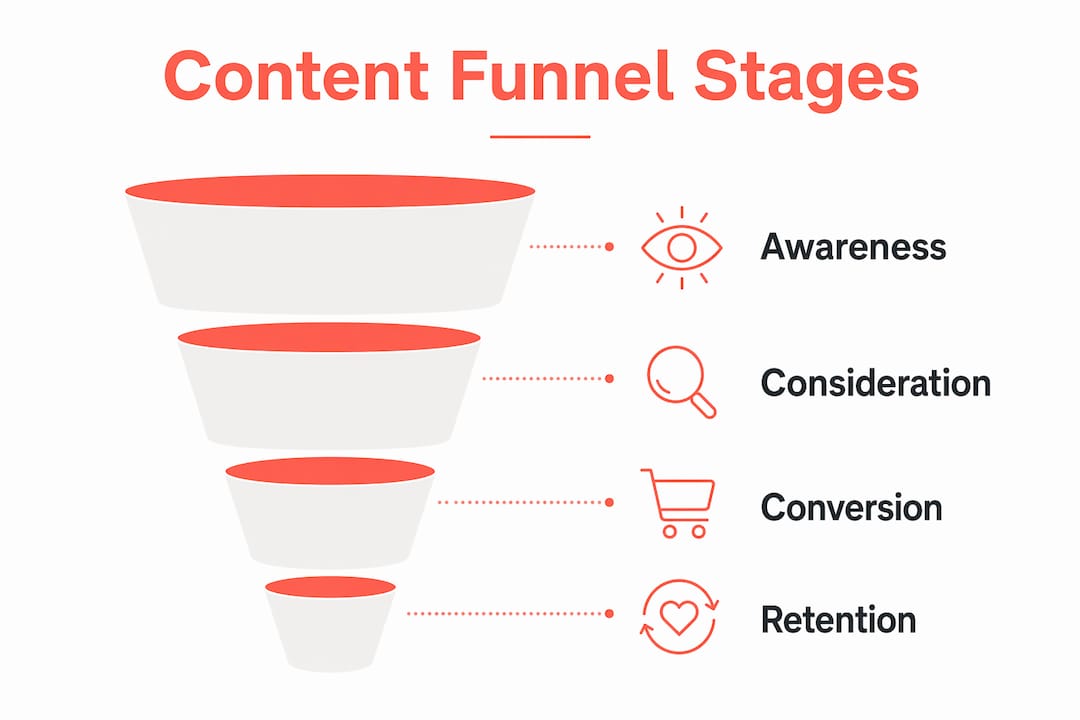
A content marketing funnel is the organising logic that matches published content to specific buyer journey stages, guiding prospects from first awareness through to purchase. Marketers also call this framework the “content lifecycle” or “buyer journey map,” but the funnel metaphor captures the narrowing from broad audience to committed buyer. The three core stages are Awareness (Top of Funnel, ToFu), Consideration (Middle of Funnel, MoFu), and Conversion (Bottom of Funnel, BoFu). Unlike a sales funnel, which tracks prospect progression through a pipeline, a content funnel organises what you publish and why. Getting this distinction right is the first step toward turning your content from an expense into a predictable revenue driver.
What is a content marketing funnel and how does it work?
A content marketing funnel is a strategic system mapping content to buyer psychological states across three to four stages. Each stage reflects a different mindset. At ToFu, buyers are problem-aware but solution-unaware. At MoFu, they are evaluating options. At BoFu, they are ready to commit. The funnel gives every piece of content a job to do, which prevents random asset creation and keeps publishing aligned to pipeline goals.
The most common misconception is that the funnel is just a labelling exercise. It is not. The funnel is the organising logic that connects editorial decisions to business outcomes. A blog post about “why your ecommerce conversion rate drops in winter” belongs at ToFu. A case study showing how a furniture brand reached $3 million a month in sales belongs at MoFu. A free strategy consultation belongs at BoFu. Each asset serves a distinct purpose.

The table below maps each stage to buyer mindset, content formats, and the metrics that actually matter.
| Stage | Buyer mindset | Content formats | Key metrics |
|---|---|---|---|
| Awareness (ToFu) | “I have a problem” | Blog posts, how-to videos, social content | Reach, impressions, new sessions |
| Consideration (MoFu) | “What are my options?” | Case studies, comparison guides, webinars | Time on page, email sign-ups, downloads |
| Conversion (BoFu) | “I am ready to buy” | Demos, consultations, testimonials, trials | Pipeline acceleration, conversion rate |
| Retention | “Am I getting value?” | Onboarding content, tutorials, newsletters | Repeat purchase rate, churn reduction |
Pro Tip: Map every content asset you currently publish to one of these stages. If you cannot place it, the asset has no clear job and is unlikely to move buyers forward.
Some models add a Retention stage for post-purchase value. Complex B2B marketing often requires even more nuance, including Implementation and Advocacy stages, because buyer journeys involve multiple stakeholders and rarely follow a straight line.
How does a content funnel differ from a sales funnel?
A sales funnel tracks prospects through pipeline stages toward a transaction. A content funnel organises the published assets that support that progression. The two are not the same thing, but they must work together. When they do, aligning these funnels turns publishing into a revenue-generating system rather than mere editorial activity.
The practical difference shows up in who owns each funnel. Sales teams own the sales funnel. Marketing teams own the content funnel. The problem arises when neither team maps their work to the other’s. A sales team closing BoFu deals needs testimonials and case studies ready. If the content team is only producing ToFu blog posts, the sales funnel stalls at the evaluation stage.
Here is where misalignment typically hurts businesses:
- Content without pipeline context. Publishing high volumes of ToFu content while ignoring MoFu and BoFu leaves buyers with no path forward.
- Sales without content support. Sales reps manually sending PDFs because no MoFu content exists wastes time and creates inconsistent messaging.
- Metrics mismatch. Marketing reports on traffic while sales reports on revenue, and neither team connects the two.
Pro Tip: Build a shared content calendar that labels every asset by funnel stage and maps it to the corresponding sales pipeline stage. This one change makes content investment visible to the whole business.
For a deeper look at how these two frameworks connect, the Moormarketing guide on marketing funnel distinctions is worth reading alongside this article.
What content formats work best at each funnel stage?
Content format selection is not a creative preference. It is a function of buyer intent at each stage. ToFu content attracts a broad audience through educational assets. MoFu content builds trust with buyers who are already comparing options. BoFu content removes the final objections standing between a prospect and a purchase.
Top of funnel: educate and attract
ToFu content includes blog posts, how-to videos, social media content, and whitepapers. The goal is discoverability and education, not selling. A toy retailer launching into a new market, for example, would publish content about “how to choose age-appropriate toys for toddlers” rather than leading with product pages.
Middle of funnel: build trust and demonstrate value
MoFu content includes comparison guides, case studies, webinars, and email nurture sequences. This is where buyers weigh their options. A case study showing a furniture brand scaling to $3 million a month in revenue is far more persuasive at this stage than a generic product description.
Bottom of funnel: remove objections and convert
BoFu content includes free demos, strategy consultations, customer testimonials, and limited-time trials. The buyer already wants a solution. Your content’s job is to confirm you are the right choice. For ecommerce businesses, this is also where ecommerce funnel ad strategies play a critical role in closing the gap between intent and purchase.
A numbered framework for matching content to stage:
- ToFu: Blog posts and short-form videos targeting problem-aware search queries.
- MoFu: Case studies and webinars targeting solution-aware buyers comparing options.
- BoFu: Demos, consultations, and testimonials targeting decision-ready buyers.
- Retention: Onboarding tutorials and newsletters targeting existing customers to reduce churn.
One more consideration for 2026: Google search and AI answer engines now function as a unified visibility surface. Every content piece needs to answer buyer intent specifically for both channels, telling a complete problem-to-solution-to-product story on a single page. Designing content only for search rankings, without serving buyer intent, produces traffic that never converts.
Pro Tip: Before publishing any content, ask: “Does this piece tell a complete problem-to-solution story?” If it only describes the problem without pointing toward a solution, it is a dead end for the buyer.
Partner research confirms that marketing funnels drive measurably better lead generation when content is matched to buyer intent at each stage rather than published for general engagement.
What are the common pitfalls in building a content funnel?
The most damaging mistake in content funnel design is treating the funnel as linear. Buyers frequently jump between stages or revisit earlier ones. A prospect might read a BoFu case study before ever engaging with a ToFu blog post. A funnel built on the assumption of sequential progression will fail these buyers.
The second most common mistake is creating content silos. Each stage produces content in isolation, with no links or calls to action guiding buyers to the next stage. Funnel content must provide a genuine next step for the reader. A ToFu blog post that ends without pointing toward a MoFu resource is a dead end. Dead ends kill momentum and hand buyers back to competitors.
Common pitfalls to watch for:
- Uniform success metrics across all stages. Measuring a ToFu blog post by its conversion rate, or a BoFu demo page by its organic reach, produces false conclusions. Stage-appropriate metrics are non-negotiable. ToFu success is reach and engagement. BoFu success is pipeline acceleration and conversions.
- Publishing for rankings, not buyers. Content designed purely for SEO rankings without a buyer intent layer attracts traffic that never progresses through the funnel.
- No content for retention. Most funnels stop at conversion. Post-purchase content, such as onboarding guides and tutorials, reduces churn and creates advocates who feed new buyers back into the ToFu stage.
Pro Tip: Audit your existing content and check whether each piece links to at least one other asset at the next funnel stage. If it does not, add a contextual call to action before publishing anything new.
Continuous optimisation matters more than initial setup. Review stage-specific metrics monthly. If MoFu content shows high traffic but low email sign-ups, the offer or the call to action needs work, not the traffic source.
Key takeaways
A content marketing funnel transforms publishing from an editorial exercise into a measurable system that moves buyers from awareness to conversion and beyond.
| Point | Details |
|---|---|
| Three core stages | Awareness, Consideration, and Conversion each require distinct content formats and metrics. |
| Content funnel vs. sales funnel | Content funnels organise what you publish; sales funnels track prospect progression. Align both for revenue impact. |
| Format follows intent | ToFu uses educational content; MoFu uses trust-building assets; BoFu uses objection-removing content. |
| Avoid uniform metrics | Measure reach at ToFu and conversions at BoFu. Applying the same metric across stages produces false conclusions. |
| Non-linear buyer journeys | Buyers jump between stages. Every content piece needs a clear next step to keep progression moving. |
Why most content funnels stall before they pay off
The funnels I see fail most often are not missing content. They are missing connection. Businesses produce a solid ToFu blog library, a handful of MoFu case studies, and a BoFu consultation page, then wonder why leads are not converting. The problem is almost always that the stages are not talking to each other.
What I have found works is treating every content piece as a relay baton. Its job is not just to inform. Its job is to hand the buyer to the next piece. That shift in thinking changes how you write calls to action, how you structure internal links, and how you brief your content team.
The other thing I push back on is the obsession with ToFu volume. Producing 20 blog posts a month feels productive. But if none of them link to MoFu resources, you are filling the top of a funnel with no middle. I have seen businesses with modest content libraries outperform high-volume publishers simply because every asset had a clear next step and a stage-appropriate metric attached to it.
Post-purchase content is the most overlooked opportunity I encounter. Retention content, such as onboarding tutorials, product tips, and customer success stories, feeds advocacy. Advocates create new ToFu awareness without any additional ad spend. That loop is where the real compounding value of a content funnel lives. For ecommerce businesses especially, content marketing for startups shows how even lean teams can build this loop with the right framework.
— Liza
How Moormarketing helps you build a funnel that converts
Building a content funnel that actually drives revenue requires more than a framework. It requires knowing which stage your business is underserving right now, and what to do about it.
Moormarketing works directly with ecommerce businesses to audit existing content, map assets to funnel stages, and build a publishing plan tied to pipeline goals. The eCommerce marketing workshops cover funnel strategy in practical depth, with frameworks drawn from campaigns that have delivered $2 million and $3 million monthly revenue outcomes for clients. Every session is run by senior strategists, not outsourced teams. If you want a content strategy built around your specific revenue targets, work with Moormarketing to get started.
FAQ
What is a content marketing funnel in simple terms?
A content marketing funnel is a system that organises your published content by buyer journey stage, from broad awareness through to purchase decision. Each stage uses different content formats and measures success with different metrics.
How many stages does a content funnel have?
Most content funnels use three core stages: Awareness, Consideration, and Conversion. More complex B2B models add Retention, Implementation, and Advocacy stages to reflect longer buyer journeys and multiple decision-makers.
What is the difference between a content funnel and a sales funnel?
A content funnel organises what you publish and why. A sales funnel tracks how prospects move through a pipeline toward a transaction. Aligning both creates a system where content directly supports revenue outcomes.
What metrics should I use for each funnel stage?
ToFu content is measured by reach, impressions, and new sessions. MoFu content is measured by time on page, downloads, and email sign-ups. BoFu content is measured by pipeline acceleration and conversion rate. Applying the same metric across all stages leads to false conclusions about what is working.
Why do content funnels fail to generate leads?
Content funnels most often fail because stages are not connected. Each piece of content needs a clear next step pointing the buyer toward the following stage. Without that connection, buyers reach dead ends and disengage before converting.