
The most effective ways to scale Facebook ads profitably combine two distinct approaches: vertical scaling (increasing budgets on winning campaigns) and horizontal scaling (expanding into new audiences and placements). Neither works in isolation. The industry standard is to raise budgets gradually every few days to avoid triggering a learning phase reset, while simultaneously testing fresh audiences and creatives to prevent saturation. Before any scaling decision, each ad set needs roughly 50 optimisation events within 7 days to exit the learning phase and deliver stable results.
The core scaling checklist before touching your budget:
- ROAS stability: above break-even for 7+ consecutive days
- Conversion volume: 50+ conversions per ad set
- Frequency: below 3.0 on cold audiences
- CPA trend: stable or declining week over week
- Creative pipeline: at least one fresh variant ready to deploy
Monitor ROAS, cost per acquisition (CPA), and frequency throughout. A temporary ROAS dip during scaling is normal as your ads reach less-engaged audience segments, but profitability holds as long as you stay above your break-even ROAS.
1. How to scale Facebook ads profitably with vertical budget increases
Vertical scaling is the fastest path to more volume, but it punishes impatience. Increase a single ad set or campaign budget by a large amount in one edit and Meta’s algorithm treats it as a new campaign, resetting the learning phase and producing volatile delivery and ROAS drops for days.
The gradual increase rule every few days is the standard safeguard. After each increase, wait for the algorithm to stabilise at the new spend level before touching it again. Accounts with high conversion volume can sometimes move faster, because the algorithm has enough signal density to absorb larger jumps without losing its footing.
Budget floor maths matter here. To reliably exit the learning phase, an ad set needs 50 optimisation events within 7 days. Minimum daily budgets should be sufficient to support stable learning and performance, based on target CPAs and conversion volume. Running below that floor means paying full price for noisy, unstable data.
Pro Tip: Instead of editing the original ad set’s budget, duplicate it at the higher spend level. The original keeps its performance history and learning phase intact, while the duplicate enters a fresh learning phase at the new budget. This is the cleanest way to test higher spend without risking a proven performer.
Set automated rules to pause ad sets if CPA exceeds your target by a significant margin or if ROAS drops below break-even. Systematic reallocation away from underperformers protects profitability during the volatile early days of a budget increase.
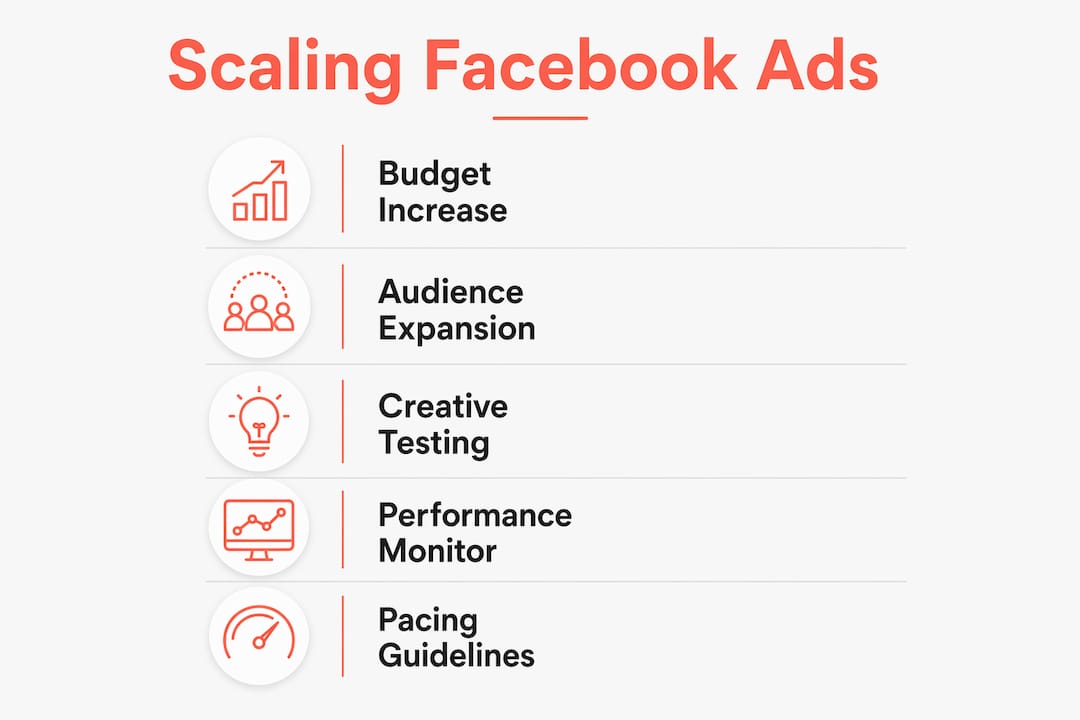
2. Horizontal scaling strategies that expand reach without inflating costs
Horizontal scaling adds volume by opening new audience pools rather than pushing harder into an existing one. It buys time before saturation and keeps CPMs from climbing as your frequency builds.

Start with narrow lookalike audiences, then test broader tiers in sequence against the same winning creatives. The 3% trades some precision for meaningfully more reach. If it holds acceptable performance, the 5% becomes worth testing. Run each tier as a separate ad set so you can read the data cleanly.
For interest-based targeting, test one new variable at a time. Changing audience, creative, and placement simultaneously makes it impossible to know what drove the result. Audience overlap is the hidden cost here: when two ad sets share the same users, they bid against each other, inflating your own costs. Use Meta’s Audience Overlap tool weekly above $5,000 daily spend, and consolidate any audience pairings with high overlap to avoid bidding against yourself.
Broad targeting combined with Meta’s Advantage+ targeting often outperforms tightly layered interest stacks, particularly when you have strong conversion data feeding the algorithm. Under Meta’s current delivery system, creative quality influences audience selection more than detailed targeting, so broad targeting gives the algorithm room to find buyers you would have excluded manually.
Placement expansion is the other horizontal lever most advertisers underuse. Testing Reels, Stories, and Instagram Feed as separate placements surfaces performance differences that a single “all placements” setting obscures. Some formats, particularly Reels, carry lower CPMs and can deliver strong results with the right creative format.
3. Why creative quality is the biggest variable when scaling
Creative is now the primary ranking signal in Meta’s Andromeda algorithm, which launched globally in october 2025. The system scores each creative’s predicted engagement before deciding who sees it, meaning your targeting parameters matter far less than they did three years ago. Practitioners describe this as “creative-as-targeting”: a stronger hook reaches the right audience more effectively than a refined interest stack.

The practical implication is that A healthy pipeline of distinct creative assets per campaign is necessary for stable performance at scale. These are not variations of the same ad with a different headline. Each concept should represent a different value proposition, emotional angle, or format.
A structured testing framework keeps the pipeline moving. The 3-2-2 method works well: for each winning concept, test 3 different hooks, 2 body copy variations, and 2 calls to action. Hooks are worth testing first because they determine whether someone stops scrolling, and the feedback arrives within 3–5 days. Offer and format tests take 5–7 days to generate enough conversion data to call.
Higher frequency signals that creative saturation may be occurring. At scale, fatigue signals arrive faster than at testing budgets. Higher daily budgets reach a substantially larger portion of your target audience in the same timeframe than lower budgets. Pre-build your next creative variant before frequency hits 4.0, not after CTR has already started falling.
Creative fatigue can result in significant drops in CTR and conversion rates after multiple exposures. Spending production effort on new concepts rather than refining a single one is the higher-return activity. For more on building a testing system that supports this, Moormarketing’s guide on how agencies test Facebook ads covers the framework in detail.
4. Performance monitoring and learning phase management
Scaling without a monitoring cadence is how profitable campaigns quietly become unprofitable ones. The DWM framework (Daily, Weekly, Monthly) gives each review layer a distinct purpose and prevents over-optimising on noise.
Daily (5–10 minutes): Check spend pacing, ROAS, delivery rate, and frequency. Flag ad sets where CPA has risen more than 40% day over day, or where delivery rate has dropped below 60%. Do not act on daily signals unless they are extreme. Auction noise looks identical to real problems at the 24-hour window.
Weekly (30–45 minutes): Pull 7-day trailing ROAS, CPA, and frequency for every active ad set. Make budget scaling decisions on qualifying ad sets. Call test winners with 50+ events. Queue the next creative test. Move budget from the bottom decile to the top quartile, but no more than 20% per ad set per week.
Monthly (2–3 hours): Audit campaign structure. Over-segmented accounts waste budget on duplicate learning phases. Refresh lookalike audiences every 90 days with recent customer data. Check creative age: any ad running 60+ days without a refresh is a fatigue risk.
Automated rules handle the gaps between reviews. Configure rules to pause ad sets if CPA exceeds target by 30%, increase budget by 20% when ROAS exceeds target for 3 consecutive days, and alert when frequency crosses 4.0. Cutting losers faster matters more than scaling winners sooner. The easiest efficiency gain is reducing the time between an ad set starting to underperform and getting paused.
5. Budget increase strategies that protect profitability
Budget allocation across the funnel is as important as the rate of increase. A common starting structure for eCommerce accounts is 60–70% to prospecting, 20–30% to retargeting, and 10–15% to retention. Prospecting is the least efficient on a cost-per-action basis but feeds every other stage. Retargeting cannot scale past the prospecting pool that feeds it.
For budget increases, three mechanisms apply depending on the size of the jump:
- Up to 20% per week: Edit the existing ad set. The algorithm keeps its learnings and the learning phase does not reset.
- 20–30% per week: Only when the ad set has been at target CPA for 14+ days. Split the increase across the week (20% on Monday, the remainder on Thursday) to preserve optimiser stability.
- Above 30%: Duplicate the ad set at the new budget level. Accept a fresh learning phase on the duplicate to protect the proven original.
Campaign Budget Optimisation (CBO, now called Advantage Campaign Budget) distributes spend across ad sets in real time based on auction signals. It works better at scale because the algorithm shifts budget toward the best-performing ad set within minutes. Ad Set Budget Optimisation (ABO) gives direct control per ad set, which is better for structured tests requiring equal impressions. The clean rule: start tests in ABO, migrate proven ad sets to CBO once both have passed the 50-conversion threshold.
6. Scaling frequency and pacing guidelines
Pacing determines how evenly Meta distributes your budget across a day or campaign period. Daily budgets with manual pacing give more control than lifetime budgets, which can spend 60% of the total in the first 30% of the period.
Track your spend pacing ratio (actual spend divided by planned spend) daily. A ratio below 0.9 consistently means your budgets or bids are too restrictive. Above 1.1 means your automation rules are scaling too aggressively or your caps are too loose.
For scaling cadence, the 48-hour minimum between budget edits is the practical floor. Editing more frequently than that prevents the algorithm from recalibrating delivery at the new spend level. At higher spend levels, a 2-to-1 vertical-to-horizontal ratio holds CPA flatter than pure vertical scaling. After existing winners reach 20% above last week’s spend, the remaining scale headroom comes from horizontal expansion: a new lookalike, a new geo, or a creative variant targeting a different demographic.
Dayparting is worth testing on mature accounts. If hourly conversion rates between 11 PM and 6 AM run well below the daily average based on 14 days of historical data, applying ad scheduling to pause during those hours redirects spend to peak conversion windows. This is particularly relevant for B2B-adjacent eCommerce categories where purchase decisions happen during business hours.
7. How campaign objectives change your scaling approach
The objective you choose at campaign level determines what Meta’s algorithm optimises for, and that changes how and when you scale.
Conversions campaigns are the standard for eCommerce. The algorithm needs purchase or add-to-cart events to learn, which means the 50-event threshold applies directly. Scale only after 7+ days of stable data above break-even ROAS. These campaigns reward patience before the budget increase and punish premature changes most harshly.
Traffic campaigns optimise for clicks, not purchases. They exit the learning phase faster because click events are more frequent than purchase events, but the signal quality is lower. Traffic campaigns work well for warming audiences before a conversion campaign, or for testing creative hooks at lower cost before committing to conversion optimisation. Do not scale a traffic campaign expecting purchase-level ROAS.
Awareness and reach campaigns operate on CPM rather than CPA. Scaling is straightforward because there is no conversion event to accumulate. The risk is frequency: at scale, awareness campaigns saturate audiences quickly. Cap frequency at 3–4 within a 7-day window and rotate creative on a tighter schedule than you would for conversion campaigns.
For accounts running multiple objectives simultaneously, funnel structure matters. Prospecting campaigns (awareness and traffic) feed the retargeting pool that conversion campaigns draw from. If prospecting stalls, retargeting becomes expensive and the whole funnel contracts. Budget the funnel in that order.
Accurate tracking across all objectives requires both the Meta Pixel and the Conversions API running in parallel. Browser-based pixel data has been unreliable since iOS 14.5. Server-side events through the Conversions API fill the gap and give Meta a more complete view of which ads drive results, which directly improves algorithm performance across every objective type. Tools like Valiz can help teams manage AI-based optimisation across these campaign types more efficiently.
Key takeaways
Profitable Facebook ad scaling requires controlled budget increases, a steady creative pipeline, and a structured monitoring cadence applied consistently across both vertical and horizontal scaling approaches.
| Point | Details |
|---|---|
| Budget increase rule | Raise budgets by no more than 15–20% every 3–5 days to avoid learning phase resets. |
| Learning phase threshold | Each ad set needs 50 optimisation events within 7 days before scaling decisions are reliable. |
| Creative volume at scale | Maintain 10–15 conceptually distinct creative assets per Advantage+ campaign to prevent fatigue. |
| Frequency warning signal | Frequency above 3–4 on cold audiences signals creative saturation; refresh before CTR falls. |
| Monitoring cadence | Run daily 5–10 minute checks, weekly 30–45 minute reviews, and monthly structural audits. |
Ready to scale your Facebook ads with a proven framework?
Moormarketing works directly with eCommerce businesses across Australia to build and execute data-driven Meta Ads strategies that have delivered $2 million in monthly sales for a new toy retailer and $3 million per month for a global furniture brand. Every strategy is built by senior strategists, not outsourced.
If you want to apply these frameworks with expert guidance, Moormarketing’s eCommerce marketing workshops give you the hands-on structure to put profitable scaling into practice. Or if you’re ready to work directly with the team, get in touch here.