
Email marketing returns a high amount for every $1 spent, making it one of the highest-return channels most Australian startups can access right now. Not paid social. Not influencer deals. Email. And the reason is straightforward: you own the list, you control the timing, and every subscriber actively chose to hear from you.
Email is responsible for about 30% of total revenue for many startups across SaaS, eCommerce, and info-products, as shown in case studies linked in this guide. That figure holds across industries because email works at every stage of the customer journey, not just at the top of the funnel. A well-structured programme converts cold leads, activates free trials, recovers abandoned carts, and upsells existing customers, all from the same channel.
The core mechanisms that tie email directly to revenue:
- Welcome sequences convert new subscribers into first-time buyers before interest fades
- Promotional emails drive immediate sales through time-sensitive offers
- Transactional emails triggered by user actions carry the highest open rates of any email type
- Educational series build trust and move leads through longer consideration cycles
- Re-engagement campaigns recover dormant subscribers and extend list lifetime value
- Automated behavioural triggers intervene at the exact moment a user stalls in the funnel
The startups that treat email as a revenue engine rather than a broadcast channel consistently outperform those chasing paid acquisition. The sections below show you exactly how to build that engine.

Five high-converting email sequences every startup needs
1. Welcome sequence
Welcome emails generate significantly more opens and clicks than standard campaigns. That is not a small edge. It reflects the fact that a new subscriber is at peak interest the moment they sign up, and most startups waste that window with a single generic confirmation email. A proper welcome sequence runs multiple emails over the first week, introduces the brand story, surfaces the single most valuable action the subscriber can take, and sets expectations for what comes next.
2. Educational series
An educational series nurtures leads who are not yet ready to buy. Rather than pushing a sale, each email delivers a specific insight, framework, or result the subscriber can use immediately. This builds the credibility that converts a curious opt-in into a paying customer over a four to eight week window. For SaaS startups, this sequence often does more revenue work than any promotional campaign.
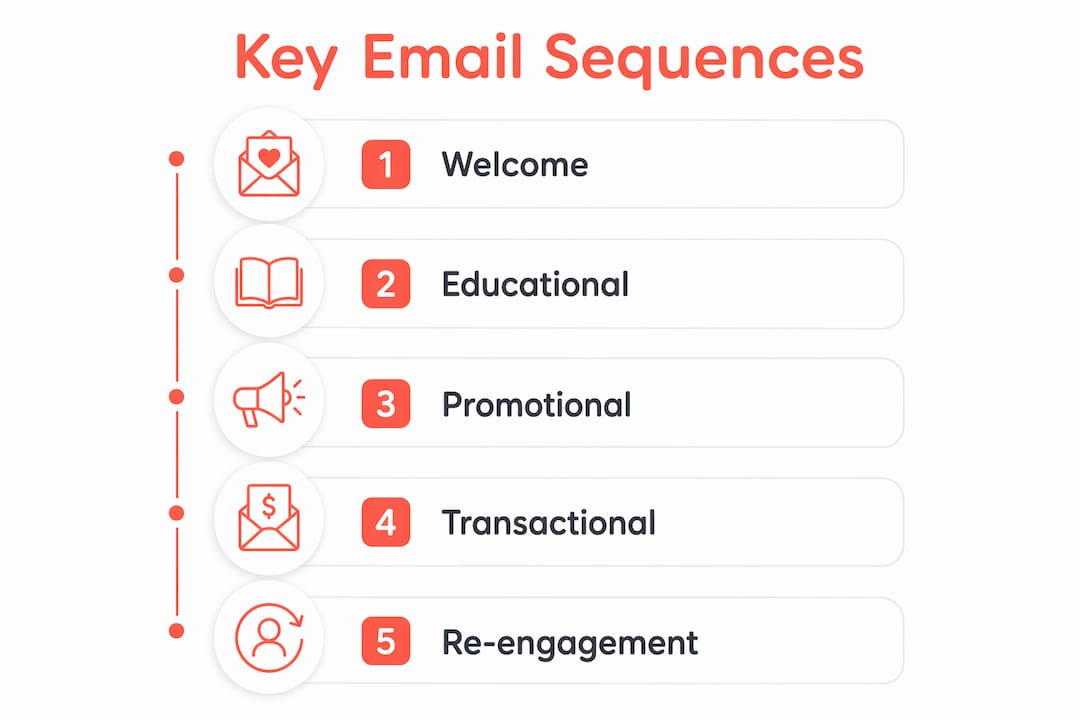
3. Promotional emails
Promotional emails drive direct sales, but the balance matters. Too many and unsubscribe rates climb. Too few and you leave revenue on the table. The most effective promotional emails tie an offer to a specific reason, a product launch, a seasonal moment, or a subscriber milestone, rather than a generic discount. Aligning the email promise with the landing page is where most startups lose conversions; if the email says “get the free template,” the landing page must deliver that template immediately.
4. Transactional emails
Transactional emails, triggered by purchases, sign-ups, password resets, or usage milestones, carry the highest open rates of any email type. That attention is an asset. A post-purchase email that surfaces a complementary product, or an onboarding confirmation that nudges a user toward their first meaningful action, turns a routine notification into an incremental revenue event.
Pro Tip: For B2B SaaS startups, personal-feeling plain-text emails from a founder convert better during onboarding than polished branded templates. The format signals a human is paying attention.
5. Re-engagement campaigns
Inactive subscribers are not lost revenue. They are deferred revenue. A re-engagement campaign targets subscribers who have not opened or clicked in 60–90 days with a direct, low-friction offer: a fresh piece of content, a limited-time incentive, or simply a “still interested?” message. Those who re-engage become active again; those who do not get suppressed to protect deliverability. Both outcomes improve your programme’s performance.
Nine startup email strategies that actually move revenue
Getting the sequences right is only half the job. How you build and run the programme determines whether those sequences reach the inbox and convert.
-
Set goals tied to business outcomes. Open rates are not a business goal. Acquisition, trial conversion, and retention rate are. Map every email sequence to one of these outcomes so you can measure whether email is actually contributing to revenue.
-
Build your list through organic opt-ins. Purchased lists cause higher unsubscribes and spam complaints, damaging your sender reputation before you have earned it. Organic lead magnets, a checklist, a calculator, a gated guide relevant to your ideal customer, build a list of people who genuinely want to hear from you. List quality beats list size every time.
-
Warm your domain before scaling sends. A new domain cannot send thousands of emails on day one without triggering spam filters. Start at a low daily email volume and increase gradually over several weeks. This signals to inbox providers that you are a legitimate sender, not a bot.
-
Authenticate your sending domain. SPF, DKIM, and DMARC records are not optional technical housekeeping. Poor deliverability blocks revenue by sending your emails straight to spam, regardless of how good the copy is. Set these up before your first send.
-
Write subject lines that earn the open. Personalisation in the subject line, using the subscriber’s first name, their recent behaviour, or a specific reference to their situation, consistently outperforms generic broadcast subject lines. Test two variants on every campaign and let the data decide.
-
Track revenue per email, not just opens. Post-Apple Mail Privacy Protection, open rates are unreliable as a primary metric. Click-to-open rate and revenue per email give you a cleaner read on whether your emails are actually driving conversions. Build a dashboard that separates leading indicators from revenue outcomes.
-
Use behavioural triggers, not just time-based sends. An email triggered by a specific user action, reaching 80% of their usage limit, abandoning a cart, failing to complete onboarding, converts far better than a scheduled blast. Automated sequences generate roughly 15% of total email revenue while representing less than 5% of email volume.
-
Integrate email with your other channels. Email works best as the connective tissue between channels, not a standalone tactic. A lead captured via a paid ad or organic search should enter a nurture sequence immediately. A social media audience can be converted to email subscribers through a lead magnet, giving you ownership of that relationship.
-
Comply with the Australian Spam Act 2003. Every commercial email sent to an Australian address must include a clear unsubscribe mechanism, identify the sender, and only go to recipients who have given consent, either express or inferred. Breaches carry serious penalties. Use double opt-in to document consent and honour unsubscribe requests within five business days.
Pro Tip: Before committing engineering resources to a new product feature, email a small segment of your list asking for beta testers. High click-through validates demand. Low click-through saves months of wasted development time.
Why email outperforms other channels for startup growth
The case for prioritising email marketing for startups over paid channels comes down to three structural advantages that no other channel matches simultaneously.
-
You own the audience. A social media following is rented access. An algorithm change, a platform policy update, or an account suspension can cut your reach overnight. Your email list is an asset you control completely, regardless of what any platform decides.
-
Subscribers have higher intent. Users who opt into your list explicitly asked to hear from you. That is a fundamentally different relationship than someone who scrolled past a paid ad. Higher intent leads to higher conversion rates at every stage of the funnel.
-
The economics are hard to beat at startup stage. Email marketing tools are generally affordable, with free or low-cost plans that fit lean budgets. The return on that spend, $36–$44 per $1 invested, dwarfs what most startups see from paid search or paid social, particularly before they have a proven funnel.
The personalised marketing advantage is particularly pronounced in email because segmentation by behaviour, purchase history, and lifecycle stage is built into most platforms. A paid ad targets a demographic. An email targets a specific person at a specific moment in their relationship with your brand.
| Channel | Audience ownership | Average ROI | Targeting depth |
|---|---|---|---|
| Email marketing | Full ownership | $36–$44 per $1 spent | Behaviour, stage, demographics |
| Paid social | Platform-dependent | $2–$5 per $1 spent | Demographics, interests |
| Paid search | Platform-dependent | $2–$3 per $1 spent | Keyword intent |
| Organic social | Algorithm-dependent | Difficult to measure | Broad reach |

How to measure and improve your email marketing ROI
The ROI benchmark of $36–$44 per $1 spent is a useful anchor, but the startups that actually hit those numbers track the right metrics and act on them. Most do not.
Open rates tell you whether your subject line worked. They do not tell you whether the email made money. The metrics that tie email directly to revenue are conversion rate, revenue per email, and pipeline contribution. A practical dashboard separates leading indicators (deliverability, opens, clicks) from revenue indicators (meetings booked, trials started, purchases completed).
Pro Tip: Tag every reply that comes in from an email campaign in your CRM. When a deal closes, keep the source intact. Over time, this builds a clear picture of which sequences are generating pipeline, not just engagement.
One eCommerce brand restructured its email programme around audience segmentation, messaging alignment, and product visibility rather than increasing send volume. Over roughly seven months, email revenue contribution increased from 13% to 30% of total store revenue, generating significant additional revenue without materially increasing the number of emails sent. The lesson: strategy outperforms volume.
To improve ROI, focus on these levers:
- Advanced segmentation sends the right message to the right person rather than blasting the full list
- A/B testing on subject lines, send times, and CTA placement identifies what actually converts for your specific audience
- Deliverability health keeps your hard bounce rate under 2% and your spam complaint rate low, protecting inbox placement
- Conversion rate optimisation on the landing pages your emails point to, because the email is only half the conversion equation
For startups building an eCommerce growth strategy, email ROI compounds over time as your sequences mature, your list quality improves, and your behavioural data deepens.
How segmentation and personalisation scale startup revenue
Segmentation is where email marketing shifts from a broadcast channel to a revenue engine. Sending the same email to your entire list is the fastest way to train subscribers to ignore you.
Platforms like Klaviyo are built specifically for this. According to Klaviyo’s own data, stores using the platform see an average 45% increase in email revenue in the first six months after implementation. Fashion brand Princess Polly increased marketing automation revenue by 162% after full implementation; Pura Vida Bracelets achieved a 131% increase in email campaign revenue. Those are not marginal gains from tweaking subject lines. They come from the platform’s ability to track real-time behaviour and trigger the right message at the right moment.
Campaign Monitor offers a different strength: its template builder and analytics make it accessible for startups without a dedicated email developer, and G2 reviews consistently highlight its ease of use for growing teams. Litmus sits at the testing and quality assurance end, helping startups preview emails across every major email client before sending, which protects deliverability and brand consistency at scale.
The segmentation approaches that drive the most revenue for startups:
- Lifecycle stage segmentation: new subscriber, active trial user, paying customer, and lapsed customer each need a different message
- Behavioural triggers: actions like browsing a specific product category, reaching a usage threshold, or abandoning a checkout trigger automated sequences without manual intervention
- Demographic and firmographic segmentation: for B2B startups, company size, industry, and role determine which value proposition resonates
Treating email as an infrastructure layer that maps to startup lifecycle stages, rather than a broadcast channel, is what separates programmes that generate predictable revenue from those that plateau.
| Segmentation type | Revenue mechanism | Platform example |
|---|---|---|
| Lifecycle stage | Sends relevant offers at the right conversion moment | Klaviyo, Campaign Monitor |
| Behavioural triggers | Intervenes when a user stalls or shows purchase intent | Klaviyo |
| Purchase history | Drives upsell and cross-sell at the highest-intent moment | Klaviyo |
| Engagement level | Suppresses unengaged subscribers to protect deliverability | Litmus, Campaign Monitor |
Pro Tip: Start segmentation with just two groups: subscribers who have purchased and those who have not. That single split will immediately improve relevance and conversion rates before you build anything more complex.
The conversion rate tactics that work in paid channels apply directly to email segmentation: match the message to the moment, reduce friction between the email and the conversion action, and test one variable at a time. Personalisation at scale is not a feature reserved for enterprise budgets. With the right platform and a clear segmentation strategy, a lean startup team can build it in weeks.
Key takeaways
Email marketing drives startup revenue by converting leads at every funnel stage through targeted sequences, behavioural automation, and segmentation, consistently returning $36–$44 per $1 spent.
| Point | Details |
|---|---|
| ROI benchmark | Email returns $36–$44 per $1 spent, outperforming paid social and paid search for early-stage startups. |
| Revenue attribution | Email drives roughly 30% of total revenue for many startups across SaaS, eCommerce, and info-products. |
| Automation efficiency | Automated sequences generate approximately 15% of total email revenue while representing less than 5% of email volume. |
| List quality over size | Organic opt-in lists convert better than purchased lists and protect your sender reputation and deliverability. |
| Segmentation impact | Klaviyo data shows stores using the platform average a 45% increase in email revenue within the first six months. |
Ready to build an email programme that actually drives revenue?
Moormarketing works with Australian eCommerce startups to build email programmes that generate measurable revenue, not just open rates. From sequence architecture to segmentation strategy, the team brings senior-level expertise to every engagement, with no outsourcing and no junior account managers.
If you want a programme built on the frameworks that have helped brands reach $2–$3 million in monthly revenue, the Moormarketing eCommerce workshops are the fastest way to get there. Or, if you are ready to move faster, work with us directly to build a strategy tailored to your startup’s stage and goals.