

Every time someone loads a webpage or types a search query, an automated bidding contest fires off behind the scenes. Ad auction systems are the mechanisms that determine which ad wins that slot and what the advertiser pays, all within under 100 milliseconds. The two core functions are allocation (who wins) and pricing (what they pay). The outcome depends on three things: how much the advertiser bids, how relevant and high-quality the ad is, and the context of the user seeing it. Google Ads and Meta both run these auctions continuously, billions of times per day.
Key things to know upfront:
- Ad auctions run automatically, triggered by a user action such as a search, page visit, or app open.
- The winner is not always the highest bidder. Ad quality and relevance can override a larger bid.
- Auction models vary: first-price, second-price, and modified second-price are the main types.
- Google completed its shift to first-price auctions by the end of 2019.
- Bid strategy must match the auction type, or spend gets wasted.
How does an ad auction actually operate, step by step?
The advertising auction process is sequential and fully automated. Each step happens in real time, usually before the page finishes loading.
- User action triggers an impression opportunity. A person searches on Google, opens an app, or visits a website. That action signals to the publisher’s system that an ad slot is available.
- A bid request is created and broadcast. The publisher’s supply-side platform (SSP) packages data about the user, the page, and the ad slot into a bid request. This goes out to demand-side platforms (DSPs) via the OpenRTB protocol, the IAB Tech Lab standard that enables real-time communication between buyers and sellers.
- DSPs evaluate the impression. Each DSP analyses the bid request against its advertiser campaigns, assessing audience match, budget availability, and expected return. It calculates a bid and responds.
- The auction clears and a winner is selected. The auctioneer collects all bids, applies quality and relevance scores, and ranks them. The highest-ranking ad wins. Floor prices set by the publisher filter out any bid that falls below the minimum CPM threshold.
- The winning ad is served. The creative is delivered to the user’s browser or app. The whole sequence, from user action to ad display, typically completes in 40–120 milliseconds.
- Post-auction reporting fires. Bidders receive win or loss notifications. Advertisers get data on what they paid and how the price was determined, which the MRC’s Digital Advertising Auction Transparency Standards require all auctioneers to provide.
What factors decide who wins a digital ad auction?
Bid amount alone does not win auctions. Platforms weigh several signals simultaneously, and a lower bid with a high-quality ad regularly beats a larger bid attached to a poor one.
- Bid amount. Your maximum bid sets the ceiling. It is the starting point, not the deciding factor.
- Ad and landing page quality. Google uses a Quality Score that reflects expected click-through rate, ad relevance, and landing page experience. Poor-performing ads can lose despite high bids.
- Ad Rank thresholds. Minimum thresholds must be cleared before an ad is eligible to show at all. These vary by placement and context.
- Contextual signals. User location, device type, time of day, and the specific search query all shift the auction outcome. The same bid can win in one context and lose in another.
- Expected impact of ad assets. Ad extensions, sitelinks, and callouts affect how much real estate an ad occupies and how likely users are to engage.
- Audience data signals. First-party data, remarketing lists, and demographic targeting layers influence how platforms value a given impression for a given advertiser.
Quality scores are often pre-calculated and cached offline so they can be applied instantly during the auction without slowing delivery. This means the quality work you do before a campaign launches directly shapes every auction you enter.
| Factor | What it measures | Effect on outcome |
|---|---|---|
| Bid amount | Maximum CPM or CPC the advertiser will pay | Sets the upper bound; higher bids improve rank |
| Quality Score | Relevance, expected CTR, landing page quality | Can multiply or discount the effective bid |
| Ad Rank threshold | Minimum rank required for a placement | Filters out low-quality or low-bid ads entirely |
| Contextual signals | Location, device, time, query | Adjusts bid value per impression |
| Ad assets | Extensions, formats, creative elements | Affects expected engagement and rank |
| Audience signals | Remarketing, demographics, intent data | Increases or decreases impression value |
Pro Tip: Improving your Quality Score is often more cost-effective than raising your bid. A score improvement can lower your cost per click while maintaining or improving your ad position.
What are the main digital ad auction models?
Three auction types dominate the digital advertising ecosystem, and each one demands a different bidding approach.
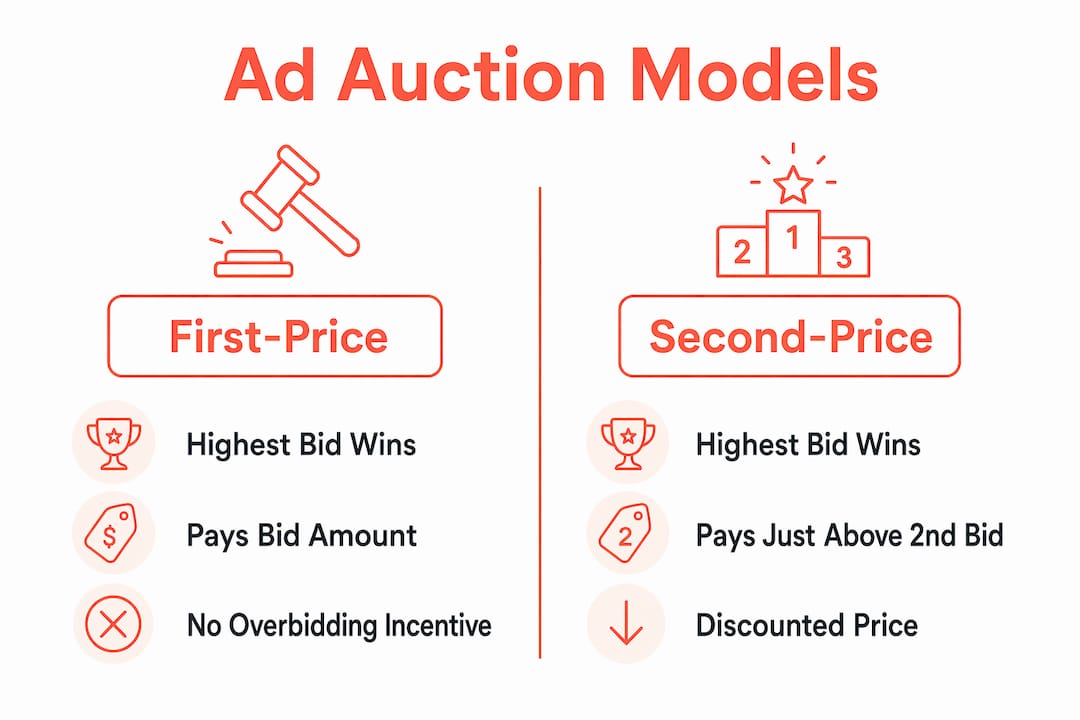
| Auction type | Who wins | What they pay | Bidding implication |
|---|---|---|---|
| First-price | Highest bidder | Their exact bid | Bid shading needed to avoid overpaying |
| Second-price (Vickrey) | Highest bidder | Second-highest bid plus one increment | Bid your true value; no shading required |
| Modified second-price | Highest bidder | Adjusted clearing price based on rules | Varies by platform; requires transparency |

First-price auctions mean the winner pays exactly what they bid. The incentive to overbid disappears, but so does the safety net of the second-price mechanism. Advertisers who bid $10 and win pay $10, even if the next bid was $3.
Second-price auctions (also called Vickrey auctions) give the winner a discount: they pay just above the second-highest bid. This design encourages honest bidding because there is no advantage to bidding above your true value.
Modified second-price variations sit between the two. Platforms apply their own rules to calculate the clearing price, which can include quality adjustments and floor prices.
Google completed its shift to first-price auctions across Google Ad Manager by the end of 2019. The move was partly driven by the complexity that header bidding introduced, where layered auctions made second-price mechanics confusing and prone to manipulation. First-price auctions simplified pricing and improved bid honesty across the supply chain.
The catch with first-price auctions is overpaying. That is where bid shading comes in. Bid shading algorithms use historical auction data and market signals to estimate the lowest bid likely to win, then submit that figure rather than the advertiser’s maximum. It is an AI-driven technique built into most DSPs, and it is now standard practice in programmatic buying.
How does the Google Ads auction system work?
Google runs a separate auction for every single ad placement, every time. There is no carry-over from one auction to the next. Six factors determine where your ad appears and what you pay.
- Bid amount. Your maximum CPC or CPM bid.
- Quality Score. A 1–10 rating based on expected CTR, ad relevance, and landing page experience.
- Ad Rank thresholds. Minimum scores required to appear in specific positions, including the top slots above organic results.
- Search context. The user’s search query, location, device, time of day, and other page signals.
- Expected impact of ad assets. Sitelinks, callouts, structured snippets, and other extensions improve expected engagement and lift Ad Rank.
- User signals. Audience lists, browsing behaviour, and demographic data that Google layers onto the auction in real time.
Ad Rank is the composite score Google calculates from these factors. It determines both whether your ad shows and where it appears. The top positions above organic results have higher Ad Rank thresholds than lower placements, which is why a well-optimised campaign with a moderate bid can outrank a poorly structured campaign with a much larger budget.
Google’s shift to first-price auctions means the price you pay is now closer to your actual bid, moderated by the Ad Rank of the ad below you. Understanding Google Ads nuances across campaign types matters here, because Performance Max and standard Search campaigns interact with the auction differently.
How does Meta’s ad auction system work?
Meta’s auction operates on a different philosophy to Google’s. Rather than matching ads to queries, Meta matches ads to people, specifically the people most likely to take the action an advertiser wants.
- Total value score. Meta combines three things: the advertiser’s bid, the estimated action rate (how likely a specific user is to click, convert, or engage), and ad quality.
- Estimated action rates. Meta predicts, for each user, how likely they are to respond to a given ad. A lower bid paired with a high predicted action rate can beat a higher bid aimed at a less receptive audience.
- Ad quality signals. User feedback, engagement history, and creative quality all feed into Meta’s quality assessment. Ads that users hide or report are penalised.
- Simultaneous value maximisation. Meta’s stated goal is to maximise value for both advertisers and users at the same time. An ad that pays well but annoys users loses ground over time.
The practical implication is that audience targeting quality matters enormously on Meta. Broad, poorly defined audiences dilute your estimated action rates and push up your effective cost per result. Tight, well-matched audiences improve your score even at a lower bid. Ad creative quality is also a direct input into the auction, not just a downstream metric.
Meta’s auction runs at comparable speed to Google’s, completing within the same real-time window. The key structural difference is that Meta does not use a keyword-based trigger. The auction fires based on user profile and behaviour, which means your targeting decisions shape which auctions you even enter.

What bidding strategies work best in digital ad auctions?
Bidding strategy is where understanding the mechanics pays off. The right approach depends on the auction type, the platform, and your campaign objective.
- Manual CPC bidding. You set a maximum bid per click. Gives full control but requires constant monitoring to stay competitive without overpaying.
- Target CPA bidding. The platform’s algorithm adjusts bids automatically to hit a target cost per acquisition. Works well once a campaign has enough conversion data, typically 30–50 conversions per month.
- Target ROAS bidding. Bids are set to achieve a specific return on ad spend. Suited to ecommerce campaigns with clear revenue data.
- Bid shading. In first-price environments, DSPs apply shading algorithms that reduce bids toward the estimated clearing price. This is usually handled automatically by the buying platform, but understanding it helps you interpret why your actual CPMs sit below your maximum bids.
- Dayparting adjustments. Bid multipliers that increase or decrease your bid at specific times of day. Useful when conversion rates vary by hour. Moormarketing covers how dayparting affects bids in detail for advertisers who want to apply it precisely.
- Audience bid adjustments. Layering higher bids onto high-value audience segments, such as past purchasers or cart abandoners, lifts your Ad Rank for the impressions most likely to convert.
Common pitfalls include bidding the same amount across all hours and devices, ignoring Quality Score improvements in favour of bid increases, and using second-price bidding logic in a first-price environment. That last mistake, bidding your true maximum in a first-price auction without shading, consistently leads to overpaying.
How fast do ad auctions actually run?
Speed is not a background detail. It is a structural constraint that shapes every part of how auctions are built.
The full auction process from user action to ad serving typically completes in under 100 milliseconds, with industry benchmarks ranging from 40 to 120 milliseconds. That is faster than a human blink.
Speed benchmark: The MRC’s Digital Advertising Auction Transparency Standards confirm the entire ad auction cycle, from consumer action through to winner selection and ad serving, typically completes in less than 0.1 seconds.
The OpenRTB protocol, managed by IAB Tech Lab, sets strict timing windows for bid responses. DSPs that fail to reply within the timeout window are excluded from that auction regardless of how strong their bid would have been. This is not a minor edge case. Latency in a DSP’s infrastructure directly affects how many auctions it can compete in, which affects reach and campaign delivery.
Quality scores are pre-computed and cached in memory precisely because there is no time to calculate them fresh during the auction. The targeting layer, the bid calculation, and the quality lookup all need to resolve within milliseconds. Auction servers are stateless and horizontally scalable to handle millions of auctions per second across the open web.
How do auction systems differ across other ad platforms?
Google and Meta dominate, but the programmatic ecosystem runs across dozens of platforms, each with its own auction rules.
Microsoft Advertising (formerly Bing Ads) uses a similar Ad Rank model to Google, incorporating bid, quality score, and contextual signals. The auction mechanics are comparable, but the audience skews older and more professional, which shifts competitive dynamics and typical CPCs.
The Trade Desk operates as a DSP across open programmatic inventory. It runs first-price auctions following the industry-wide transition and supports bid shading natively. Advertisers access inventory across display, video, connected TV (CTV), and audio through a unified buying interface.
Amazon Ads runs auctions across its owned properties and the Amazon DSP for off-Amazon placements. The key difference is purchase intent data. Amazon’s auction factors in shopping behaviour signals that no other platform can match, which makes its relevance scoring particularly powerful for retail advertisers.
LinkedIn Ads uses an auction model that weights bid, relevance, and predicted engagement, similar in structure to Meta. The distinction is the professional audience data feeding the relevance calculation. CPCs are higher than most platforms, reflecting the value of B2B targeting precision.
Connected TV platforms such as those using Xandr (now part of Microsoft) run first-price auctions with a 150-millisecond timeout window for bid responses. CTV inventory uses podded bidding, a format where multiple ad slots within a single ad break are auctioned together, which changes how DSPs calculate and submit bids compared to standard display.
Private marketplace (PMP) deals sit alongside open auction buying on most platforms. Publishers offer inventory to a select group of buyers at negotiated floor prices, still using real-time auction mechanics but with pre-agreed rules layered on top. PMPs give advertisers access to premium inventory with more transparency than open exchange buying, and contextual targeting plays a larger role in these environments.
The core mechanics, bid, quality, relevance, and speed, are consistent across platforms. What differs is the data each platform uses to calculate relevance, the auction type in play, and the timeout windows that govern who gets to compete.
Key takeaways
Ad auction systems allocate digital ad inventory in real time by combining bid amount, ad quality, and user context to select the highest-value ad within milliseconds.
| Point | Details |
|---|---|
| Speed is structural | Auctions complete in 40–120 milliseconds; DSPs that miss the timeout window are excluded regardless of bid size. |
| Quality beats bid size | Ad relevance and Quality Score can override a larger bid, making creative and landing page quality direct cost levers. |
| Auction type changes strategy | First-price auctions require bid shading; second-price auctions reward honest bidding at true value. |
| Google shifted to first-price | Google Ad Manager completed its move to first-price auctions by the end of 2019, changing how advertisers should approach bid strategy. |
| Meta weights predicted action | Meta combines bid, estimated user action rate, and ad quality into a total value score, so audience targeting precision directly affects cost. |
Want to put this into practice for your ecommerce brand?
Understanding auction mechanics is one thing. Applying them to a live campaign with real budget pressure is another. Moormarketing works with ecommerce brands to build data-driven ad campaign strategies that account for auction type, quality score, and platform-specific bidding logic from day one.

If you want to understand how these systems apply to your specific ad spend, Moormarketing’s eCommerce marketing workshops walk through auction mechanics, bidding strategy, and campaign structure with hands-on guidance from senior strategists, not junior account managers.