

Ecommerce competitive analysis is the structured process of identifying and evaluating your competitors to sharpen your market positioning and grow sales. Done well, it tells you exactly where rivals are winning, where they are weak, and where you can move in. Most store owners treat it as a one-off task. The ones who treat it as a recurring practice are the ones who consistently outperform their category. This guide walks you through each stage of a step by step ecommerce analysis, from setting goals to turning data into a plan you can act on.
How to set clear goals for your ecommerce competitive analysis
Goal-setting is the step most store owners skip, and it is the reason their analysis produces nothing useful. Without a defined objective, you collect data but never act on it. A focused goal shapes every decision that follows, from which competitors you study to which metrics you track.
Your goals should map directly to a business problem you are trying to solve. Common, well-defined goals include:
- Pricing strategy: Find out whether your prices sit above, below, or in line with the market, and whether that gap is hurting conversion.
- Audience gaps: Identify customer segments your competitors are targeting that you are not yet reaching.
- Product differentiation: Understand which product features rivals promote most heavily, so you can counter or match them.
- Marketing channels: Determine which paid and organic channels drive the most traffic to competitor sites.
- User experience benchmarks: Assess whether your site navigation and checkout flow are competitive.
Each goal should connect to a specific outcome. “Understand competitor pricing” is a goal. “Adjust our pricing tier on mid-range products to sit 5% below the category average” is an outcome. The difference between the two is what separates useful analysis from a report that sits in a folder.
Pro Tip: Write your goals before you open a single competitor website. Doing so stops you from getting distracted by interesting but irrelevant data.
How do you identify the right competitors?
The first step in any competitive analysis for online stores is building a shortlist of the right rivals. Analysing the wrong competitors wastes time and produces misleading conclusions.
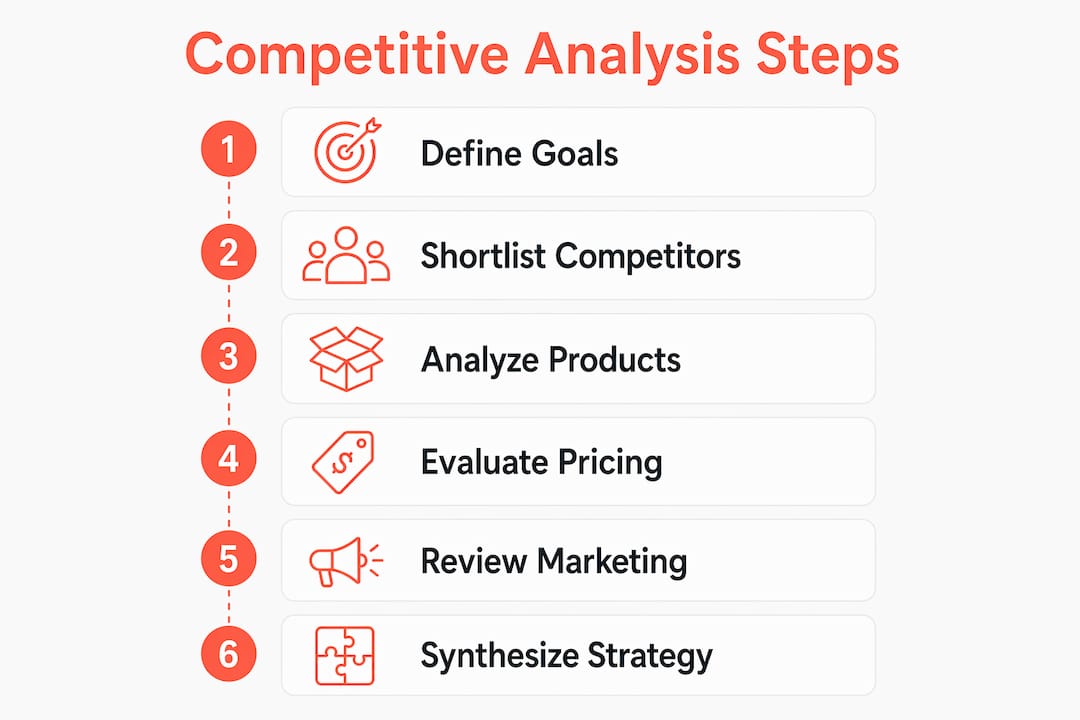
Start with a simple Google search using your primary product keywords. Examine the first 2–3 pages of results and note every store that appears consistently. Repeat the same search on Amazon and any other marketplace where your category is active. The stores that appear across multiple searches are your core competitors.
From there, sort your list into three tiers:
- Primary competitors: Stores selling the same products to the same audience at a similar price point. These are your direct rivals.
- Secondary competitors: Stores selling related products or targeting a slightly different segment. They can steal your customers if your positioning slips.
- Tertiary competitors: Broader category players or large marketplaces. They set the baseline expectations your customers bring to your site.
Analysing 3–10 competitors gives you a sample large enough to spot patterns without creating so much data that the analysis stalls. Fewer than three risks a blind spot. More than ten dilutes your focus.
For a deeper search, keyword research platforms like Semrush reveal which domains rank for the same terms you are targeting. Semrush traffic data shows you competitors you would never find through manual browsing alone. This is particularly useful for identifying fast-growing stores that have not yet appeared on your radar.
| Competitor tier | Example | Analysis priority |
|---|---|---|
| Primary | Direct product rivals, same price range | High |
| Secondary | Adjacent category stores | Medium |
| Tertiary | Large marketplaces, category aggregators | Low |
How do you analyse competitors’ products, pricing, and positioning?
Product and pricing analysis is where most of the strategic value lives. The goal is not to copy rivals but to understand the gap between what they offer and what the market actually wants.
Start with the product itself. For each competitor, record:
- Core product features and how they are described on the product page.
- Quality signals such as materials, certifications, or manufacturing claims.
- Warranty and returns policy, which often signals confidence in product quality.
- Customer support options, including live chat, email response times, and self-service resources.
Comparing product features, warranties, and customer support consistently reveals gaps in the market. A competitor with a strong product but a weak returns policy is vulnerable. That is a positioning opportunity you can take.
Pricing analysis goes beyond listing numbers. Note whether rivals use tiered pricing, bundle discounts, subscription models, or free shipping thresholds. These tactics affect perceived value as much as the price itself.

Pro Tip: Add competitor products to your own cart and go through the checkout process. You will see upsells, trust signals, and friction points that never appear on a product page.
The 4Ps framework (product, price, place, promotion) gives you a consistent structure for recording what you find. Apply it to every competitor so your data stays comparable. When you finish, you will have a clear picture of where your competitive positioning is strong and where it needs work.
How do you evaluate competitors’ marketing and user experience?
Marketing analysis tells you how rivals attract and retain customers. User experience analysis tells you how well their site converts the traffic they earn. Both matter for benchmarking your own performance.
Work through the following in order:
- Organic search: Use a keyword research tool to see which terms drive the most traffic to each competitor. Note the content types ranking well, whether that is product pages, blog posts, or buying guides.
- Paid search: Search your main keywords and screenshot every ad you see. Note the headline, offer, and call to action. Patterns across multiple ads reveal what messaging is working in your category.
- Social media: Review competitors’ social profiles and record posting frequency, engagement rates, and the content formats that generate the most interaction. A brand posting daily with low engagement tells a different story than one posting weekly with high shares.
- Email marketing: Subscribe to every competitor’s newsletter. Track send frequency, subject line style, promotional cadence, and the offers they use to win back inactive subscribers.
- Website experience: Navigate each competitor’s site as a first-time visitor. Note how quickly you find a product, how clear the navigation is, and how the mobile experience compares to desktop.
For a deeper read on user experience, reviewing 10–20 session recordings of real visitors on your own site reveals friction points you cannot see by browsing manually. Heatmaps show where users click and scroll. Session recordings show where they hesitate or abandon. Apply the same critical eye to your competitors’ sites when you visit them.
Understanding ecommerce conversion benchmarks for your category gives you a reference point for judging whether a competitor’s site is likely performing above or below average. That context sharpens your interpretation of everything else you observe.
How do you compile findings into a strategy?
Raw competitor data is not a strategy. The synthesis step is where analysis becomes useful.
Start by organising your findings in a spreadsheet with one row per competitor and columns for each dimension you assessed: products, pricing, marketing channels, social presence, and user experience. This structure makes patterns visible at a glance.
Apply a SWOT analysis to your own business using the competitor data as the benchmark. SWOT and Porter’s Five Forces are the two frameworks Shopify recommends for translating competitor data into clear market strategy. SWOT maps your strengths, weaknesses, opportunities, and threats against what you have learned. Porter’s Five Forces adds a layer of industry-level context, showing where competitive pressure is highest.
| SWOT element | Question to answer | Example finding |
|---|---|---|
| Strengths | Where do you outperform rivals? | Faster shipping, stronger warranty |
| Weaknesses | Where do rivals outperform you? | Weaker SEO content, fewer reviews |
| Opportunities | What gaps exist in the market? | No rival offers a subscription option |
| Threats | What competitor moves could hurt you? | Rival launching a lower-cost range |
Once your SWOT is complete, translate each finding into a specific action. A weakness in SEO content becomes a content brief. A gap in subscription offerings becomes a product development task. A pricing threat becomes a review of your margin structure. The goal is a prioritised list of changes, not a document that describes the market without telling you what to do next.
Causal analysis goes one step further than SWOT. It answers not just what is happening but why, and what would change if you acted. That level of insight is what guides budget decisions with confidence rather than guesswork. Pair it with your go-to-market planning to turn competitor intelligence into a campaign you can launch.
Key takeaways
A step by step ecommerce competitive analysis produces its highest value when it is structured around clear goals, a defined competitor shortlist, and a synthesis framework that connects findings directly to decisions.
| Point | Details |
|---|---|
| Set goals first | Define a specific business problem before collecting any competitor data. |
| Analyse 3–10 competitors | This range gives enough depth without creating unmanageable data volume. |
| Use the 4Ps framework | Apply product, price, place, and promotion consistently across every competitor. |
| Synthesise with SWOT | Map findings to strengths, weaknesses, opportunities, and threats before acting. |
| Make it ongoing | Treat competitive analysis as a recurring practice, not a one-off report. |
Why I think most ecommerce owners get competitive analysis wrong
The most common mistake I see is treating competitive analysis as a research project rather than a decision-making tool. Store owners spend weeks building spreadsheets, then file them away because the data does not tell them what to do next.
The fix is to start with the decision, not the data. Ask yourself what you would change if you knew your competitors were outperforming you on pricing, or on content, or on returns policy. Then go and find out whether they are. That framing keeps the analysis tight and the output useful.
The second mistake is doing it once. Markets shift, new entrants appear, and pricing changes constantly. Ongoing competitor analysis integrated with customer insight creates compounding advantages over time. A quarterly review takes a fraction of the time the first analysis does, and it keeps your strategy current.
The third mistake is measuring the wrong things. Descriptive data tells you what happened. Causal analysis tells you why it happened and what would change if you acted differently. Most store owners stop at descriptive. The ones who move to causal make better budget decisions and grow faster. Focus on fewer competitors, sharper questions, and actions you can take this week.
— Liza
Moormarketing’s ecommerce workshops can sharpen your analysis
Knowing the framework is one thing. Applying it to your specific category, with your specific margins and audience, is where most store owners need support.

Moormarketing’s ecommerce marketing workshops are built for exactly this. Each workshop takes you through the competitive analysis process using your own business data, so you leave with a finished competitor map and a prioritised action list, not a generic template. The senior strategists at Moormarketing have used these frameworks to deliver $3 million a month in sales for a global furniture brand and $2 million a month for a new toy retailer. If you are ready to turn competitor intelligence into a growth strategy that scales, the workshops are the fastest path there.
FAQ
What is ecommerce competitive analysis?
Ecommerce competitive analysis is the process of identifying your rivals and evaluating their products, pricing, marketing, and user experience to improve your own market positioning and sales strategy.
How many competitors should I analyse?
Analysing between 3 and 10 competitors gives a balanced sample. Fewer than three risks missing key patterns; more than ten creates data overload that slows decision-making.
How do I find competitors I do not already know about?
Search your primary product keywords on Google and Amazon, then use a platform like Semrush to identify domains ranking for the same terms. This surfaces fast-growing rivals that manual browsing misses.
How often should I repeat a competitive analysis?
A quarterly review is the standard for most ecommerce businesses. Markets shift quickly, and a regular cadence keeps your pricing, positioning, and marketing aligned with what competitors are actually doing.
What framework should I use to act on my findings?
SWOT analysis is the most practical starting point. Map your strengths, weaknesses, opportunities, and threats against competitor data, then convert each finding into a specific action with a clear owner and deadline.