
Ad creative quality is the single most powerful lever controlling your return on ad spend (ROAS), because it directly determines what platforms charge you to reach the same audience. While most digital marketers chase targeting tweaks and bidding adjustments, creative quality drives 47–70% of sales lift and campaign success across Meta and Google. That figure comes from Nielsen and Meta research, and it means targeting and budget combined account for less than half the outcome. Understanding why ad creative quality affects ROAS is not a creative brief concern. It is a commercial one.
Why ad creative quality affects ROAS through auction mechanics
Ad platforms do not charge every advertiser the same rate for the same placement. Meta and Google both use automated engagement signals, including click-through rate (CTR), watch time, and save rates, to score your creative and set your cost to deliver. Strong creative earns lower CPMs by winning better auction positions through genuine user engagement. Weak creative gets penalised with higher CPMs to keep platform revenue neutral.
Meta’s Andromeda delivery system is the clearest example of this mechanic in practice. Andromeda ranks every ad in real time using complex automated signals. A low-quality creative does not simply underperform. It actively costs more to run, because the platform compensates for poor engagement by raising your delivery price. This makes poor creative doubly expensive: you pay more per impression and convert fewer of those impressions into sales.

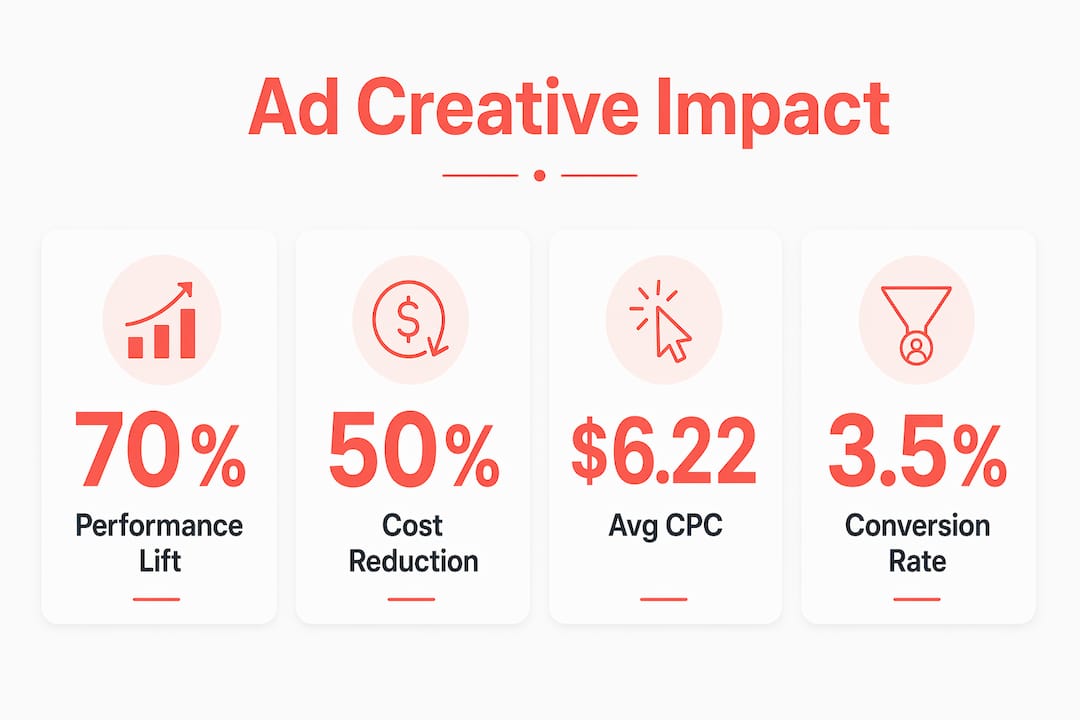
The cost differential is not marginal. Improving ad quality signals can reduce cost-per-click by 30–50% for the same ad position. On identical keywords, a CPC of $6.22 versus $12.34 has been observed purely due to quality score variation. That gap compounds across thousands of clicks and can determine whether a campaign is profitable or not.
| Creative quality level | Approximate CPC | Approximate CPM impact |
|---|---|---|
| High quality score | $6.22 | Lower, competitive CPM |
| Low quality score | $12.34 | Higher, penalised CPM |
Pro Tip: Before adjusting bids or budgets, audit your creative quality scores in Google Ads and your ad relevance diagnostics in Meta Ads Manager. A CPC problem is often a creative problem in disguise.
Do engagement metrics matter more than targeting for ROAS?
The short answer is yes, and the data is unambiguous. Algorithmic targeting has commoditised audience selection, making creative the key variable marketers still control. Meta’s Advantage+ audiences and Google’s Smart Bidding both automate audience finding at scale. The platform finds your buyer. Your creative determines whether that buyer stops scrolling.
Research shows that 70–80% of ad performance variance comes from creative quality, not targeting precision or budget size. That means two advertisers targeting the same audience with the same budget will see dramatically different ROAS based almost entirely on creative execution. The advertiser with stronger creative wins lower CPMs, higher CTR, and more conversions from the same spend.
Creative fatigue compounds this effect over time. Creative fatigue is a measurable decay curve, not just a feeling, and it causes CPM to rise while CTR and conversion rates fall. When the same audience sees the same ad repeatedly, engagement drops, the platform reads this as a quality signal deteriorating, and your costs climb. Only 5–8% of ads on Meta achieve winner status, and about half are switched off before 28 days due to poor performance.
The practical implication is clear: audience targeting is a starting point, not a performance driver. Creative quality is what separates profitable campaigns from expensive ones. For a deeper look at ads insights that move the needle, the pattern holds consistently across platforms and categories.
Best practices for balancing creative variety against targeting:
- Prioritise creative volume over audience segmentation. More creative variants give the algorithm more to work with.
- Rotate creatives before fatigue sets in, not after CTR has already dropped.
- Use broad targeting with strong creative rather than narrow targeting with weak creative.
- Monitor frequency per ad, not just per campaign. High frequency on a single creative is a fatigue warning sign.
- Test creative formats (video, static, carousel) before testing audience segments.
Pro Tip: Set a frequency cap alert at 3.0 per ad. Once a single creative hits that threshold, pull it and replace it, even if overall campaign metrics still look acceptable.
How does systematic creative testing improve ROAS sustainably?
Creative testing is the operational system that prevents ROAS decay. Without it, marketers rely on intuition and react to problems after they have already cost money. With it, you build a repeatable process for finding winners and retiring losers before fatigue sets in.
Testing multiple creative variables simultaneously produces noisy data and misattributed results. The correct method isolates one variable per test batch, whether that is the hook, the visual format, the headline, or the call to action. Each batch should contain 4–6 variants to reach statistical significance without spreading budget too thin.
Calling a winner too early is one of the most common and costly mistakes in creative testing. Winner calling requires statistical thresholds: a minimum of 50 conversions, a 20% ROAS lift over the next best performer, and stability across 5 consecutive days. Calling a winner on day two based on early data noise leads to budget concentration on a creative that regresses to the mean within a week.
Brands running regular creative testing and refresh schedules reduce ad fatigue decay by 30–50%, according to Nielsen and Kantar findings. Fresh creative supply is not a creative department luxury. It is a cost control mechanism. Here is a structured approach to building that system:
- Define your test variable. Choose one element per batch: hook, visual, format, or offer framing. Never test two variables in the same batch.
- Build 4–6 variants. Each variant changes only the defined element. Keep all other elements identical across the batch.
- Set a minimum run period. Allow at least 7 days before drawing conclusions. Platforms need time to exit the learning phase.
- Apply winner criteria strictly. Require 50 conversions, a 20% ROAS lift, and 5 days of stability before declaring a winner.
- Scale winners incrementally. Increase budget by no more than 20% every 48 hours. Doubling budgets causes CPM spikes and ROAS collapse because platforms treat large increases as new campaigns triggering aggressive bidding.
- Brief new creative before you need it. Maintain a pipeline of 2–3 batches in production at all times so you are never scrambling when a winner fatigues.
Pro Tip: Creative hooks that name a buyer’s pain point outperform curiosity hooks and generic benefit hooks. Lead your video or image with the specific problem your product solves, not a teaser.
For a detailed look at how agencies structure this process, Moormarketing’s guide on testing Facebook ads covers the framework used across real eCommerce campaigns.
How does post-click experience affect ROAS?
Strong creative gets the click. What happens after the click determines whether that click becomes revenue. Post-click conversion rate feeds directly back into platform signals, and platforms interpret low conversion rates as evidence that the ad attracted the wrong audience or set false expectations.
A landing page converting at 1.2% costs three times more per purchase than one converting at 3.5% at the same CPM and CTR. That cost difference is not a bidding problem. It is a signal problem. The platform sees low conversion rates and raises CPM to compensate, creating a cycle where poor post-click experience makes your creative more expensive to run.
The landing page must fulfil the promise the ad makes. If your ad leads with a specific product benefit or price point, the landing page must confirm that immediately. Mismatches between ad messaging and landing page content destroy conversion rates and degrade platform trust scores. Fast load times matter too. A page that loads in under two seconds converts at a meaningfully higher rate than one that takes four seconds.
Audience fragmentation creates a parallel problem. Budgets spread over overlapping audiences increase CPM by 30–50% due to self-competition in auctions. Consolidating campaigns reduces this self-competition and lets strong creative perform without inflated delivery costs. The combination of quality creative, a converting landing page, and a consolidated campaign structure is what produces durable ROAS improvement.
Key post-click factors that directly affect ROAS:
- Landing page load speed under two seconds.
- Message match between ad hook and landing page headline.
- A single, clear call to action above the fold.
- Social proof (reviews, ratings) visible without scrolling.
- Mobile-first layout, given that the majority of paid traffic arrives on mobile devices.
For more on quality traffic and conversions, the relationship between creative promise and post-click experience is the most underestimated factor in eCommerce ROAS.
Key takeaways
Ad creative quality is the primary driver of ROAS because it controls both platform costs and conversion rates simultaneously, making it more impactful than targeting, bidding, or budget size.
| Point | Details |
|---|---|
| Creative drives 47–70% of sales lift | Nielsen and Meta research confirm creative outperforms targeting and budget combined. |
| Poor creative raises your CPM | Platforms like Meta penalise weak creative with higher delivery costs, not just lower results. |
| Creative fatigue is measurable | CTR and conversion rates decay on a predictable curve; refresh before the drop, not after. |
| Test one variable at a time | Isolate hooks, formats, or headlines per batch of 4–6 variants to get clean, usable data. |
| Post-click experience feeds platform signals | A landing page converting at 1.2% costs three times more per purchase than one at 3.5%. |
What I’ve learned from watching creative outperform targeting every time
I have sat across the table from eCommerce founders who have spent months adjusting audiences, tweaking bid strategies, and restructuring campaign hierarchies. The ROAS barely moves. Then we rebuild the creative from scratch, and within two weeks the numbers shift in a way that six months of targeting work never achieved.
The uncomfortable truth is that most marketers underinvest in creative because it feels less controllable than a bid cap or an audience exclusion. You can change a bid in 30 seconds. Briefing, producing, and testing new creative takes days. That friction causes people to avoid it, and it is exactly why creative quality remains the biggest untapped lever in most paid accounts.
What I have found actually works is treating creative like an operational system, not a one-off project. You need a pipeline: briefs in progress, variants in testing, winners scaling, and fatigued ads being retired. When that system runs continuously, ROAS stabilises and grows. When it stops, ROAS decays, and no amount of bidding adjustment brings it back. The ecommerce ad creative best practices that Moormarketing publishes reflect exactly this operational mindset, not a list of design tips.
— Liza
How Moormarketing helps eCommerce brands build better creative systems
Moormarketing works directly with eCommerce brands to build the creative testing and campaign structures that produce consistent ROAS growth. The focus is not on one-off creative fixes. It is on building the operational system that keeps winning creative in rotation and retiring fatigued ads before they cost you.
The eCommerce marketing workshops cover creative briefing, testing methodology, and campaign structure in a hands-on format built for founders and in-house marketers. For brands ready to work directly with senior strategists, the digital ad campaign best practices page outlines the structured approach Moormarketing applies across client accounts. Every engagement is run by senior strategists, not outsourced, and every recommendation is grounded in data from real eCommerce campaigns.
FAQ
What percentage of ROAS is driven by creative quality?
Nielsen and Meta research show that creative quality drives 47–70% of sales lift and campaign success. That makes creative the single largest contributor to ROAS, ahead of targeting, reach, and budget.
How does poor creative raise my ad costs?
Platforms like Meta use engagement signals such as CTR, watch time, and save rates to score creative quality. Poor creative earns lower scores, which results in higher CPMs and higher CPCs for the same placements.
How often should I refresh my ad creative?
76% of marketers report that ineffective creative weakens advertising effectiveness, and about half of all ads are switched off before 28 days. Refresh creative before frequency hits 3.0 per ad, not after CTR has already declined.
What is the right way to test ad creative?
Test one variable per batch using 4–6 variants, run for a minimum of 7 days, and only call a winner after reaching 50 conversions, a 20% ROAS lift, and 5 days of stable performance. Changing multiple variables at once produces data you cannot act on.
Does my landing page affect ROAS?
A landing page converting at 1.2% costs three times more per purchase than one converting at 3.5% at the same CPM and CTR. Platforms read low conversion rates as a quality signal and raise your delivery costs in response.