
Ecommerce brand naming and positioning is the process of selecting a distinct, memorable name that reflects your brand’s unique market position and connects with your audience in a way that drives trust and long-term revenue. Known formally as brand identity strategy, this discipline combines market positioning theory with the practical craft of naming to create a brand that stands apart in crowded online markets. Get it right and you build an asset that compounds in value. Get it wrong and you face costly rebranding, legal disputes, and a confused customer base. A 9-step naming framework treats positioning as the foundational input that determines which naming style will resonate with your audience.
What is ecommerce brand positioning and why does it come first?
Brand positioning is your customer’s perceived image of your brand relative to every competitor in your category. It is not your tagline or your logo. It is the mental real estate your brand occupies in the mind of a buyer the moment they consider a purchase. For ecommerce businesses, where a shopper can compare ten alternatives in thirty seconds, that mental position is the difference between a click and a scroll-past.

Positioning must be defined before you name your brand because the name is the first signal your positioning sends. A name like “Koala” signals warmth, Australianness, and approachability before a single product page loads. A name like “BulkOfficeSupply” signals price and utility. Neither is wrong. Both are deliberate. The problem arises when founders choose a name they personally love without first asking what position they are trying to own.
The steps to build a positioning framework are straightforward. Start by identifying your primary customer segment and their core purchase motivation. Then define your brand personality using three to five adjectives that describe how you want customers to feel. Finally, articulate your unique value proposition in one sentence: who you serve, what you offer, and why it is different. That sentence becomes the filter through which every name candidate is assessed.
Pro Tip: Write your positioning statement before you open a naming brainstorm. If you cannot describe your brand’s unique value in one sentence, no name will fix that ambiguity.
How to develop naming strategies for ecommerce that fit your positioning
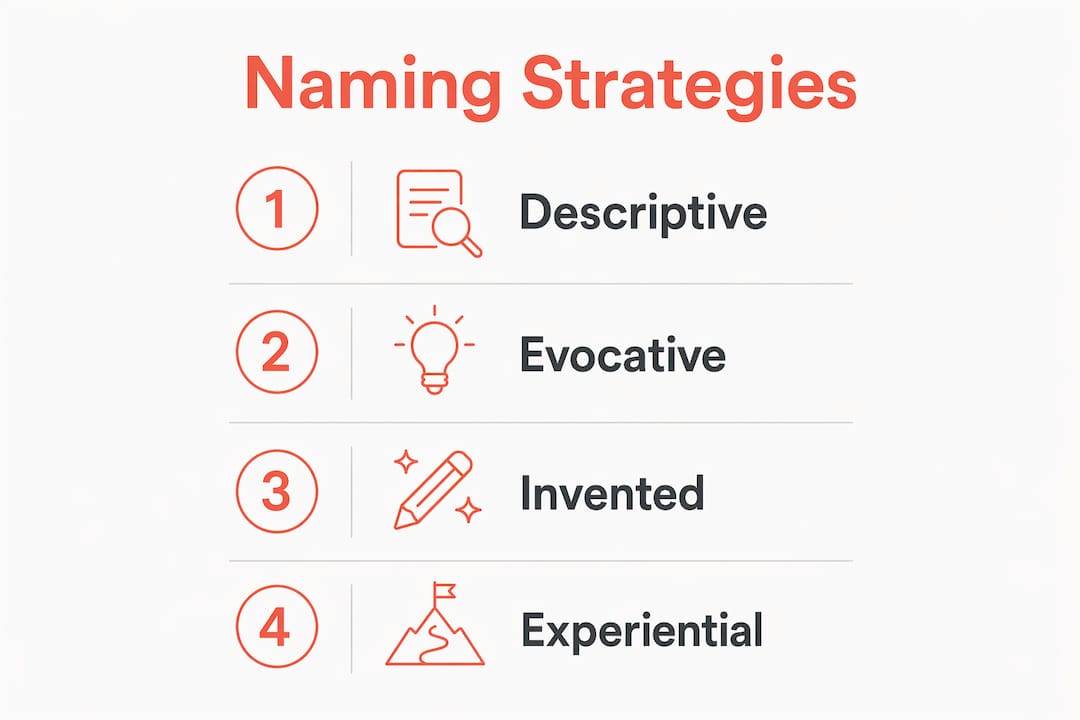
Once your positioning is clear, you choose a naming style that carries it. There are four primary name types used in ecommerce brand naming and positioning, and each carries a different trade-off between clarity and distinctiveness.
- Descriptive names (e.g., “The Iconic”, “Booktopia”) communicate the category directly. They are easy to understand but harder to trademark and easier for competitors to imitate.
- Evocative names (e.g., “Koala”, “Canva”) suggest a feeling or idea without stating the category. They build stronger emotional connection and are far more distinctive, but require more marketing investment to establish category relevance.
- Invented names (e.g., “Etsy”, “Zappos”) are coined words with no prior meaning. They carry zero baggage, trademark easily, and scale across product categories, but demand significant brand-building spend to attach meaning.
- Founder names (e.g., “Zimmermann”) carry personal authority and heritage but can limit scalability if the brand needs to extend beyond its original category or founder.
Names that build curiosity and emotional connection outperform purely descriptive ones in crowded markets. This means evocative and invented names tend to generate stronger long-term brand equity, even though they feel riskier at launch.
| Name type | Clarity | Distinctiveness | Trademark ease | Best for |
|---|---|---|---|---|
| Descriptive | High | Low | Difficult | Utility-focused brands |
| Evocative | Medium | High | Moderate | Lifestyle and premium brands |
| Invented | Low | Very high | Easy | Scalable, category-agnostic brands |
| Founder | Medium | Medium | Moderate | Heritage and personal brands |
When brainstorming, generate at least twenty candidates across all four types before evaluating any of them. Use tools like a thesaurus, foreign language dictionaries, and portmanteau combinations to expand the pool. Group candidates by name type and then filter by positioning fit.
Pro Tip: Read your shortlisted names aloud to someone unfamiliar with your brand. If they ask “what does that sell?”, the name may be too abstract for your positioning. If they say “oh, that sounds like every other brand in that space”, it is too generic.
How to evaluate and select the best ecommerce brand name candidates
Evaluation is where most founders make their worst decisions. They fall in love with a name before checking whether it is usable. A structured screening process prevents that.
- Positioning alignment. Does the name reinforce the brand personality and value proposition you defined? Names discordant with brand positioning risk market confusion and dilution of equity.
- Memorability and pronunciation. Say the name aloud five times. If it requires spelling out every time you say it verbally, it will cost you in word-of-mouth referrals and paid search brand terms.
- Distinctiveness. Search the name on Google. If three competitors appear on page one, the name is not distinctive enough to own in your category.
- Domain availability. Check for a .com.au and a .com. A mismatch between your trading name and your domain creates friction in every marketing channel.
- Social handle consistency. Consistent handles help customers recognise and trust the brand online and prevent fake accounts from exploiting name gaps.
- Simplicity and spelling. If customers cannot spell the name after hearing it once, your SEO brand traffic will fragment across misspellings.
After screening, test your top three candidates with ten to fifteen people from your actual customer segment. Ask them what the name makes them feel, what product they imagine, and whether they would trust a brand with that name. The answers will surface associations you did not anticipate.
Pro Tip: Run a quick Google Trends comparison on your top two name candidates. Even for invented words, trends data can reveal whether similar phonetic patterns are associated with positive or negative search contexts.
Understanding how ecommerce brand equity works will sharpen your evaluation criteria, because a name that cannot carry equity over time is a liability, not an asset.
Why trademark clearance is non-negotiable for ecommerce brands
Trademark clearance is the legal verification process that confirms your chosen name does not infringe on existing registered or common-law marks. Skipping it is the single most expensive mistake in brand naming, and it happens constantly.
A 7-step clearance search covers exact match and conceptual searches across federal, state, and common-law sources, plus domain and social handle availability. The steps include:
- Exact match search across the relevant trademark register (IP Australia for domestic brands)
- Phonetic equivalents search, because names that sound like existing marks can still be blocked
- Conceptual equivalents search, covering names with similar meaning in the same goods or services class
- Common-law search across business directories, social platforms, and marketplaces
- Domain availability check across primary TLDs
- Social handle availability across Instagram, TikTok, Facebook, and LinkedIn
- Marketplace name check on Amazon Australia, eBay, and any relevant vertical platforms
Trademark clearance costs between $0 and $300 for searches, while filing a single-class USPTO application costs $250 to $350, with typical registration timelines of around twelve months without office actions. Filing without clearance risks losing those fees entirely if a conflict is found after submission.
“Similar sounding or meaning names in the same class can block registration, causing hidden risks for ecommerce brands.” — michaelmeyerlaw.com
The phonetic and conceptual equivalents test is where most DIY searches fail. Founders check exact matches and stop there. A competitor with a name that rhymes with yours, or carries the same meaning in another language, can still oppose your registration. Engage a trademark attorney for the full clearance search before you invest in brand assets, packaging, or paid media under the new name.
Brand consistency across all channels depends on owning your name outright. Without trademark protection, a competitor can register a confusingly similar name and legally force you to rebrand after you have already built equity.
Key takeaways
Ecommerce brand naming and positioning requires positioning clarity first, then a name type that carries that position, followed by systematic legal clearance before any brand investment is made.
| Point | Details |
|---|---|
| Positioning precedes naming | Define your unique value proposition before brainstorming any name candidates. |
| Name type determines trade-offs | Evocative and invented names build stronger equity but require more marketing investment to establish category relevance. |
| Evaluation must be systematic | Screen candidates against positioning fit, memorability, domain, social handles, and spelling before shortlisting. |
| Trademark clearance is mandatory | A full 7-step clearance search, including phonetic and conceptual checks, prevents costly rebranding after launch. |
| Naming is brand architecture | Misaligned naming strategy leads to portfolio dilution and limits sub-brand scalability over time. |
Why most ecommerce brands get naming backwards
I have worked with founders across furniture, toys, fashion, and homewares, and the pattern is almost universal. They fall in love with a name in week one, build a Shopify store around it, run ads for six months, and then discover either a trademark conflict or a positioning mismatch that the name has been quietly reinforcing. By that point, changing the name feels like surgery without anaesthetic.
The uncomfortable truth is that naming is not a creative exercise. It is a strategic one. The creativity comes after the strategy is locked. I have seen a beautifully crafted evocative name destroy a brand’s conversion rate because it signalled premium when the product was positioned on value. The customer arrived expecting one thing and found another. That gap between name signal and product reality is where trust breaks down.
The other mistake I see constantly is treating naming as a one-time decision rather than a brand architecture question. If you plan to extend into sub-brands, product lines, or international markets, your master brand name needs to be broad enough to carry that weight. A name like “SydneyBedding” works fine for a local play. It becomes a liability the moment you want to sell in Melbourne, let alone London.
Future-proof your name by asking: “Would this name still make sense if we doubled our product range, entered two new markets, or brought on a co-founder?” If the answer is no, keep brainstorming. The ecommerce growth strategy you build in year one should not be constrained by a name chosen in week one.
— Liza
How Moormarketing helps you build a brand that owns its position
Moormarketing works directly with ecommerce founders and marketing teams to develop brand positioning frameworks and naming strategies that are built for growth, not just launch. The team has helped brands scale from zero to $2 million in monthly sales and supported established retailers in repositioning for competitive global markets.
If you are launching a new store or rebranding an existing one, the eCommerce marketing workshops at Moormarketing give you a structured, hands-on process for defining your positioning, generating and evaluating name candidates, and building the brand architecture that supports long-term growth. No outsourcing. No junior strategists. Senior expertise applied directly to your brand from day one.
FAQ
What is ecommerce brand positioning?
Ecommerce brand positioning is the process of defining how your brand is perceived relative to competitors in the minds of your customers. It covers your unique value proposition, brand personality, and the specific market segment you are targeting.
How do I choose the right name type for my ecommerce brand?
Match your name type to your positioning goals. Evocative and invented names build stronger long-term equity and trademark more easily, while descriptive names offer immediate clarity but limit distinctiveness in competitive categories.
What does a trademark clearance search involve?
A full clearance search covers exact match, phonetic, and conceptual equivalents across trademark registers, common-law sources, domains, and social platforms. Trademark searches cost between $0 and $300, with filing fees of $250 to $350 per class.
How does brand naming affect ecommerce growth?
A name misaligned with your positioning creates a gap between customer expectation and product reality, which reduces conversion rates and brand trust. Strategic naming architecture that precedes SKU and sub-brand decisions protects long-term portfolio clarity.
When should I check domain and social handle availability?
Check domain and social handle availability during the evaluation phase, before you invest in any brand assets. Consistent handles across platforms help customers recognise your brand and prevent competitors or bad actors from registering confusingly similar accounts.