

Contextual targeting is the practice of placing digital ads based on the content of the page a user is currently viewing, not on who that user is or what they have done before. This distinction matters enormously for performance. Contextual ads deliver up to 50% more clicks and double the engagement of non-aligned placements, because the ad matches what the reader is already thinking about. Platforms like Google AdSense and solutions from Integral Ad Science (IAS) have built entire programmatic ecosystems around this principle, using AI-driven semantic and sentiment analysis to match creative to content in real time. For digital marketers managing campaigns in a post-cookie world, understanding why contextual targeting works is no longer optional. It is the foundation of privacy-compliant, high-performance advertising.
Why contextual targeting works in digital ads
Contextual targeting works because it aligns the ad message with the user’s immediate mental state. When someone reads a review of trail running shoes, a running gear ad does not feel like an intrusion. It feels like a natural extension of the page. This alignment between content and creative is what drives the performance lifts the data consistently shows.
The mechanism behind this is more sophisticated than simple keyword matching. AI and natural language processing analyse page meaning, sentiment, and emotion at the point of ad serving, capturing the tone of the content rather than just its surface-level words. A page about “running” could be about exercise, political campaigns, or software processes. Semantic intelligence disambiguates these meanings so the right ad reaches the right context.

Contextual buying operates across multiple levels of granularity: the publisher domain, specific page sections, surrounding keywords, metadata, URL patterns, and full semantic classification. Programmatic systems use these signals to match and deliver ads in milliseconds, without referencing any personal identity data. This is the core structural difference from behavioural targeting, which relies on tracking user history across sessions and devices.
Pro Tip: When setting up contextual campaigns in Google Display Network or a demand-side platform, start at the page-level semantic classification rather than broad topic categories. Granular targeting consistently outperforms broad contextual buckets in both relevance scores and click-through rates.
What advantages does contextual targeting offer over behavioural targeting?
The performance case for contextual advertising is built on engagement, cost, and brand safety data that behavioural targeting struggles to match on all three dimensions simultaneously.
On engagement, contextual ads generate 43% more neural engagement and 2.2x better ad recall compared to non-contextual placements. This is not a marginal lift. It reflects the neurological reality that ads processed alongside relevant content are encoded more deeply in memory. The GumGum and SPARK Neuro research behind this finding used biometric measurement, making it one of the more credible engagement studies in the field.
On cost, the same research shows contextual ads cost 48% less per click and carry a 41% lower cost per viewable impression than non-contextual alternatives. For performance marketers managing tight cost-per-acquisition targets, these figures represent a structural cost advantage, not a one-off campaign result.
On brand safety, contextual targeting has a built-in advantage because it evaluates the content environment before serving the ad. Sentiment analysis and page-level classification allow platforms to avoid serving ads adjacent to negative, controversial, or off-brand content. Behavioural targeting places ads based on user profiles, which means the same user can be reached on a completely inappropriate page.
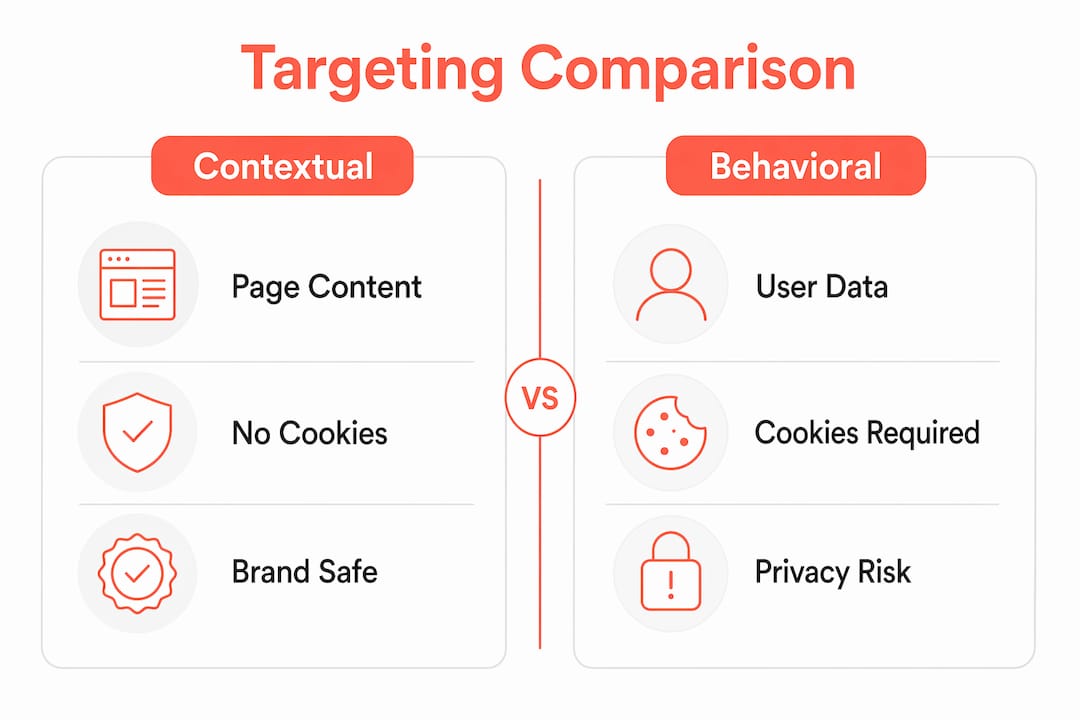
The privacy advantage is equally significant. Contextual targeting requires no cookies, no device fingerprinting, and no personal data collection. This makes it compliant with GDPR, the Australian Privacy Act, and the growing range of state-level privacy regulations in the United States, without any additional technical configuration.
| Dimension | Contextual targeting | Behavioural targeting |
|---|---|---|
| Data required | Page content only | User history and identity |
| Privacy compliance | No personal data needed | Requires consent and cookies |
| Brand safety control | Real-time content evaluation | Placement depends on user profile |
| Ad recall lift | 2.2x versus non-contextual | Varies by audience segment |
| Cost per click | Up to 48% lower | Higher due to audience premium |
| Cross-device consistency | Consistent, content-based | Fragmented without ID matching |
Contextual targeting is not a fallback strategy for a world without cookies. It is a parallel targeting axis with its own reach and relevance advantages that operate independently of personal data. Treating it as a consolation prize misses the point entirely.
What nuances and challenges affect contextual targeting effectiveness?
Contextual targeting is not without its complications. Understanding these limitations is what separates campaigns that perform from those that plateau.
The most common challenge is content availability and quality. Contextual systems need sufficient, well-structured content to classify accurately. Thin pages, paywalled content, and video-heavy environments without transcripts or metadata can limit the system’s ability to determine relevance. This affects scale, particularly in niche verticals where high-quality contextual inventory is limited.
Semantic misinterpretation is a real risk. A page discussing “depression” in the context of economic cycles could be misclassified as mental health content, triggering brand safety exclusions that remove perfectly suitable inventory. Verification tools from DoubleVerify address this by pairing contextual data with measurement and brand suitability verification, but this layer requires deliberate setup and ongoing monitoring.
Personalisation granularity is another genuine limitation. Contextual targeting tells you what someone is reading right now. It does not tell you whether they are a first-time visitor or a loyal customer, whether they are in a research phase or ready to purchase, or whether they have already converted on your site. Layering contextual signals with first-party data from your CRM or customer data platform is the practical solution, but it requires integration work.
- Exclude content categories that are adjacent to your brand but contextually misaligned (e.g., a premium brand excluding discount retail content)
- Build a taxonomy map of your target content environments before launch, not after
- Set up sentiment exclusions at the campaign level to avoid negative adjacency
- Review contextual performance by placement URL weekly during the first month
- Use IAS or DoubleVerify brand suitability reports to identify and act on classification errors
Pro Tip: Do not rely solely on automated brand safety settings at campaign launch. Manually review the top 20 placement URLs by impression volume in the first two weeks. Automated systems catch most issues, but edge cases in your specific category will only surface through direct inspection.
How can marketers apply contextual targeting to improve campaign performance?
The practical application of contextual targeting comes down to three decisions: granularity level, optimisation cadence, and integration with other campaign tactics.
On granularity, campaigns targeting broad awareness benefit from topic-level contextual categories, while direct-response campaigns need page-level semantic classification to drive the specificity required for conversion. Contextually aligned campaigns across FMCG, finance, and edtech sectors have shown CTR increases of up to 55%, view rate improvements from 32% to 47%, and brand suitability scores rising from around 70% to over 95% when content adjacency is tightly managed.
On optimisation cadence, automated performance loops that refresh targeting every seven days can lift conversion rates by 22% while reducing costs by 20%. IAS’s Dynamic Performance Profiles operate on this principle, reallocating budget toward high-performing contextual segments automatically. This is not set-and-forget. It is a structured automation cycle that requires the right parameters to be set at the outset.
On integration, contextual targeting performs best when layered with ad creative best practices that match the tone and format of the surrounding content. An ad that is contextually relevant but visually jarring still underperforms. The creative and the context need to work together.
- Map your target content environments using a taxonomy aligned to your campaign objectives
- Set page-level semantic targeting rather than broad topic categories for direct-response goals
- Configure sentiment exclusions and brand suitability thresholds before launch
- Activate automated optimisation cycles with a seven-day refresh cadence
- Layer first-party audience data where available to add purchase-intent signals to contextual relevance
- Review placement-level performance weekly and update exclusion lists based on actual serving data
The IAS Super Bowl LVIII campaign data makes the performance ceiling concrete. That campaign delivered a 102% ROI increase, a 136% boost in clicks and conversions, and a 47% lower cost per conversion. Samsung achieved triple CTR gains. CPG brands saw cost-per-conversion drop by 39%. These are not outlier results from a single high-profile event. They reflect what happens when contextual targeting is implemented with the right granularity, creative alignment, and optimisation infrastructure.
For marketers reviewing their 2026 digital ad campaign approach, contextual targeting belongs in every media plan, not as a test-and-learn experiment but as a core channel with its own budget allocation and performance benchmarks.
Key takeaways
Contextual targeting works because it aligns ad creative with the immediate content environment, delivering measurable lifts in engagement, recall, and cost efficiency without relying on personal data.
| Point | Details |
|---|---|
| Core mechanism | AI semantic analysis matches ads to page meaning, not user identity, in real time. |
| Engagement advantage | Contextual ads produce 43% more neural engagement and 2.2x better ad recall than non-contextual placements. |
| Cost efficiency | Contextual ads cost up to 48% less per click and 41% less per viewable impression than behavioural alternatives. |
| Brand safety | Real-time sentiment evaluation prevents ads from appearing adjacent to unsuitable or off-brand content. |
| Optimisation cadence | Seven-day automated refresh cycles lift conversion rates by 22% and reduce costs by 20% over time. |
Why I think contextual targeting is being undervalued right now
Most marketers I speak with treat contextual targeting as the privacy-safe fallback they will use once third-party cookies are fully gone. That framing is costing them money today.
The neural engagement research from GumGum and SPARK Neuro changed how I think about this. The fact that contextual ads are encoded more deeply in memory because they sit alongside relevant content is not a privacy story. It is a creative effectiveness story. The context is part of the ad experience, whether you plan for it or not.
What I have observed in practice is that the biggest gains come not from the targeting itself but from the creative alignment that follows. When you know exactly what content your ad will appear alongside, you can write copy and design visuals that feel like a continuation of the page rather than an interruption. That is where the real performance uplift lives.
The role of AI in marketing is making this more achievable at scale. Semantic classification is becoming precise enough that you can target by emotional tone, not just topic. A finance brand can now choose to appear only alongside optimistic, forward-looking financial content rather than anxiety-driven market coverage. That level of nuance was not available three years ago.
My advice: stop waiting for the cookie to die before taking contextual targeting seriously. Run a proper split test against your current behavioural campaigns this quarter. The data will make the argument better than any industry report.
— Liza
Take your contextual ad strategy further with Moormarketing
Contextual targeting is one of the highest-leverage moves available in digital advertising right now, but only when it is implemented with the right granularity, creative alignment, and optimisation infrastructure. Moormarketing works directly with eCommerce brands to build data-driven ad strategies that translate this kind of technical advantage into real revenue growth. From campaign architecture to eCommerce marketing workshops that teach you the frameworks hands-on, the team at Moormarketing brings senior-level expertise to every engagement. No outsourcing, no junior account managers. Just proven strategy that has delivered results like $3 million a month for a global furniture brand.
FAQ
What is contextual targeting in digital advertising?
Contextual targeting is the practice of serving ads based on the content of the page being viewed, using AI and semantic analysis to match ad creative to the topic, sentiment, and meaning of the surrounding content. It does not use personal data or cookies.
How do contextual ads perform compared to behavioural ads?
Contextual ads generate 43% more neural engagement and 2.2x better ad recall than non-contextual placements, while costing up to 48% less per click. Campaigns with tight content adjacency have recorded CTR lifts of up to 55%.
Is contextual targeting compliant with privacy regulations?
Yes. Contextual targeting requires no personal data, cookies, or device identifiers, making it compliant with GDPR, the Australian Privacy Act, and similar frameworks by design rather than by configuration.
How often should contextual campaigns be optimised?
Automated optimisation cycles with a seven-day refresh cadence have been shown to lift conversion rates by 22% and reduce costs by 20%, according to IAS Dynamic Performance Profile data. Manual placement reviews should supplement this automation, particularly in the first month.
What tools support contextual targeting at scale?
IAS, DoubleVerify, and Google AdSense are the primary platforms for contextual targeting at scale. IAS provides semantic intelligence and brand suitability verification. DoubleVerify adds measurement and content classification. Google AdSense powers contextual placement across its display network using topic and keyword signals.