

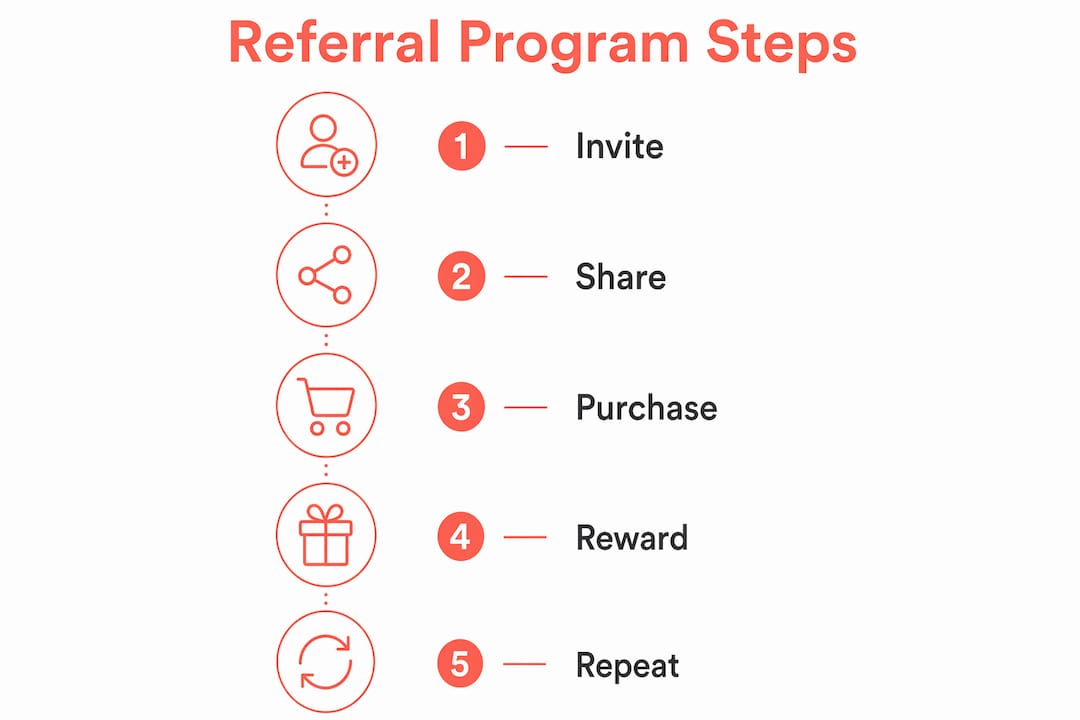
An ecommerce referral program is a structured system where existing customers share unique links or codes with friends, who then receive incentives to make purchases, triggering automated rewards for both parties. Understanding how referral programs work in ecommerce gives you a customer acquisition channel that scales on trust rather than ad spend. Platforms like Shopify, Yotpo, and KickoffLabs have made the mechanics accessible to stores of any size, but the fundamentals remain the same: buy, share, friend buys, reward. The referral loop is fully automated, from identifying the advocate to attributing the purchase and triggering the reward. Get the structure right and you have a self-funding growth engine.
How referral programs work in ecommerce tracking and attribution
Accurate attribution is what separates a referral program that pays out correctly from one that either misses rewards or haemorrhages money on fraudulent claims. Every credible ecommerce referral strategy starts with a unique referral link or discount code assigned to each advocate. When a friend clicks that link, a cookie is set in their browser, and the referral window begins.
Shopify’s attribution uses cookie durations commonly set between 30 and 90 days, with some configurations extending to 125 days. This matters because purchase cycles vary widely. A furniture store may need a 90-day window to capture considered purchases, while a consumables brand can work with 30 days.
Discount-code attribution is an alternative method worth understanding. On Shopify, a referrer’s unique discount code records directly on the order for reporting, which is reliable. The limitation is that friends must manually enter the code at checkout, and if they forget or use a different promotion, the attribution is lost entirely.
- Unique referral links track automatically via cookies and require no action from the new customer beyond clicking.
- Discount codes are visible and shareable on social media but depend on the friend remembering to apply them.
- Last-click attribution is the default in most platforms, meaning the most recent referral source gets credit.
- Cross-device tracking remains a challenge. A friend who clicks on mobile but purchases on desktop may not be attributed correctly without additional session matching.
Pro Tip: Match your referral window to your average time-to-purchase. Pull your store’s data and find the median days between first visit and first order. Set your cookie duration at least 20% above that figure to avoid missing legitimate referrals.
On Shopify specifically, referral codes can conflict with other active promotions. Using combined discounts or automatic discounts at checkout removes that friction and protects attribution accuracy.
What reward structures actually drive referral conversions?
Reward design is where most ecommerce referral programs either succeed or quietly die. The single most important principle is that two-sided rewards convert significantly better, with some programmes seeing 40 to 100% higher conversion rates when both the advocate and the new customer receive an incentive. One-sided rewards ask the advocate to do the work while the friend gets nothing, which removes a key motivation for the friend to act.

The most common reward types in ecommerce referral programmes are store credit, percentage discounts, free shipping, loyalty points, and tiered rewards for advocates who refer multiple customers. Each has a different effect on customer behaviour.
| Reward type | Best use case | Impact on repeat purchase |
|---|---|---|
| Store credit | Brands with repeat purchase potential | High. Credit must be spent in-store. |
| Percentage discount | High-margin products or new customer acquisition | Moderate. One-off use unless stacked. |
| Free shipping | Stores where shipping cost is a barrier | Moderate. Removes friction but no loyalty pull. |
| Loyalty points | Brands with existing loyalty programmes | High. Integrates into ongoing engagement. |
| Tiered rewards | High-volume advocates or brand ambassadors | Very high. Motivates sustained sharing. |
Store credit as a reward lifts repeat purchase rates by 10 to 15% compared to flat discounts. That difference compounds over time because store credit keeps the customer inside your ecosystem rather than simply reducing the price of a single transaction.
Tiered reward structures add another layer of motivation. An advocate who earns $10 credit for their first referral, $15 for their second, and $25 for their fifth has a clear reason to keep sharing. Exclusive access rewards, such as early product releases or VIP status, work particularly well for lifestyle and fashion brands where social status is part of the purchase motivation.
Pro Tip: Align your referral reward with your customer lifetime value calculation. If your average customer spends $300 over their lifetime, a $20 store credit reward to acquire a new customer is an excellent return. If your average order value is $25, that same reward may not be sustainable.
How do you prevent fraud in ecommerce referral programs?
Fraud is not a possibility in referral programmes. It is a certainty once financial incentives exist. Self-referrals, where a customer creates a second account to refer themselves, are the most common form of abuse. Coupon scraping, where codes are shared on deal sites to strangers with no genuine relationship to the advocate, is the second most damaging.
Proactive fraud prevention using device fingerprinting, IP reputation scoring, and cumulative referral limits is the standard approach for programmes that scale. These controls work by identifying patterns that indicate abuse rather than relying on manual review.
Practical fraud controls to implement from day one:
- Device fingerprinting identifies when the same device is used to create multiple accounts, blocking self-referrals even when different email addresses are used.
- IP reputation scoring flags referrals originating from known proxy servers, VPNs, or addresses with a history of abuse.
- Rolling IP limits cap the number of referrals that can be attributed from a single IP address within a defined window.
- Purchase qualification rules require the referred friend to complete a purchase above a minimum order value before any reward is triggered.
- Refund and cancellation exclusions prevent rewards from being issued on orders that are subsequently returned or cancelled.
RewardsWP blocks self-referrals and limits referrals per IP using visit ID cookies and customer detection, running checks automatically at reward claim time. This approach is more reliable than pre-purchase checks because it validates the full transaction before any reward is issued.
The economic argument for fraud prevention is straightforward. A programme that pays out $15 per referral and suffers 20% fraudulent claims is effectively paying $18 per legitimate acquisition. At scale, that difference can make a profitable programme unprofitable.
Where and how to promote your referral programme for maximum participation
The mechanics of a referral programme mean nothing if customers never see it. Surfacing referral calls to action at key journey points dramatically improves sharing rates, and the post-purchase moment is the single highest-leverage touchpoint available.
Here is the sequence that consistently produces the strongest results:
- Post-purchase confirmation page. Display the referral offer immediately after checkout while purchase satisfaction is at its peak. The customer has just committed to your brand. This is the moment they are most likely to share.
- Order confirmation email. Include the referral link in the first email the customer receives. This email has high open rates and the customer is still engaged with the transaction.
- Delivery confirmation email. Delivery confirmation emails achieve open rates of 50 to 70%, making them one of the most effective channels for referral programme promotion. The customer has just received their product and satisfaction is high.
- Account dashboard. Give customers a permanent, accessible place to find their referral link. Many customers want to share but forget where to find their code.
- Dedicated referral landing page. A standalone page allows you to explain the programme clearly, display the reward structure, and give customers multiple sharing options including SMS, email, social media, and a copy-link button.
- Follow-up email sequence. Send a reminder at day 7 and day 21 post-purchase for customers who have not yet referred anyone. Keep the message short and lead with the reward.
Automating referral tracking and reward fulfilment via platforms like Yotpo and KickoffLabs removes the manual workload that kills programmes as they grow. Automation handles link generation, conversion tracking, reward issuance, and customer notifications without requiring intervention for each transaction.
Ongoing programme promotion across email, website, and social channels is what separates programmes that sustain participation from those that spike at launch and fade. Treat your referral programme as a permanent marketing channel, not a campaign. Pair it with your ecommerce retargeting strategy to re-engage customers who saw the offer but did not share.
For stores on Shopify, integrating your referral platform so that rewards trigger automatically on order completion removes the delay between purchase and reward notification. That immediacy reinforces the behaviour you want to encourage.
Pro Tip: Add a referral programme mention to your customer service email signature and chatbot flows. Customers who contact support have a high engagement rate and are often overlooked as a sharing audience.
Key takeaways
Ecommerce referral programmes succeed when two-sided rewards, accurate attribution, fraud controls, and continuous promotion work together as a single system rather than isolated tactics.
| Point | Details |
|---|---|
| Two-sided rewards drive conversions | Both advocate and friend receiving incentives lifts conversion rates by 40 to 100% compared to one-sided offers. |
| Attribution windows must match purchase cycles | Set cookie durations based on your store’s median time-to-purchase to avoid missing legitimate referrals. |
| Store credit outperforms discounts | Store credit lifts repeat purchase rates by 10 to 15% and keeps customers inside your ecosystem. |
| Fraud prevention is non-negotiable | Device fingerprinting, IP limits, and purchase qualification rules protect programme economics from day one. |
| Promotion must be continuous | Post-purchase, delivery confirmation, and account dashboard touchpoints sustain participation beyond the launch spike. |
Why most referral programmes fail before they find their rhythm
I have seen ecommerce brands invest real time in setting up referral programmes and then watch them flatline within six weeks. The pattern is almost always the same. The programme launches with a post-purchase email, gets a small burst of shares, and then disappears from the customer experience entirely. Nobody promoted it again. Nobody checked whether the attribution window matched actual purchase behaviour. The rewards were fine but not compelling enough to make sharing feel worthwhile.
The mistake I see most often is rewarding signups instead of purchases. A new customer who creates an account but never buys is not a customer. Paying out store credit for that action trains your advocates to recruit low-quality leads and drains your reward budget with nothing to show for it. Tie every reward to a completed, non-refunded purchase above your minimum order threshold.
Automation is not optional once you pass a few hundred referrals per month. Manual tracking and reward fulfilment creates delays, errors, and frustrated advocates who stop sharing because they never received what they were promised. Platforms like Yotpo and KickoffLabs exist precisely to remove that friction.
The programmes I have seen perform consistently well share one trait: they treat the referral channel the way they treat email marketing. They test reward structures, they review attribution data quarterly, and they promote the programme at every sensible touchpoint rather than assuming customers will find it themselves. That discipline is what turns a referral programme from a nice idea into a genuine acquisition channel. You can explore how ecommerce psychology influences sharing behaviour to sharpen your reward framing further.
— Liza
Ready to build a referral programme that actually converts?
Understanding the mechanics is the first step. Putting them into practice with the right structure, reward design, and platform integration is where most ecommerce businesses need a clear plan.

Moormarketing works directly with ecommerce brands to build customer acquisition systems that produce measurable revenue growth. From referral programme strategy to full-funnel marketing frameworks, the team brings senior-level expertise without outsourcing. If you want to implement a referral programme that is set up correctly from the start, the eCommerce marketing workshops are a practical starting point. For brands ready to scale, the ecommerce growth strategy service covers referral programme optimisation as part of a broader acquisition plan.
FAQ
How does an ecommerce referral program work?
An ecommerce referral programme works by giving existing customers a unique link or code to share with friends. When the friend makes a qualifying purchase, both the advocate and the new customer receive a pre-defined reward, with the entire process tracked and fulfilled automatically by the referral platform.
What is the best reward for an ecommerce referral program?
Store credit is the most effective reward for ecommerce referral programmes because it lifts repeat purchase rates by 10 to 15% compared to flat discounts and keeps customers spending within your store rather than reducing the cost of a single transaction.
How long should a referral attribution window be?
Referral attribution windows in ecommerce typically run between 30 and 90 days, with some Shopify configurations extending to 125 days. The right window depends on your store’s average time between first visit and first purchase.
How do you prevent fraud in a referral program?
Fraud prevention in referral programmes requires device fingerprinting, IP reputation scoring, rolling IP limits, and purchase qualification rules that only trigger rewards on completed, non-refunded orders. Running these checks at reward claim time rather than at sign-up is more reliable.
When should you promote your referral programme to customers?
The highest-impact moments to promote a referral programme are the post-purchase confirmation page, the order confirmation email, and the delivery confirmation email. Delivery confirmation emails achieve open rates of 50 to 70%, making them particularly effective for referral programme visibility.