

Ecommerce email and ads integration is the process of synchronising email marketing and advertising platforms to leverage behavioural data, automate cross-channel engagement, and maximise sales. Done well, fully integrated programmes generate 30 to 40% of store revenue from email alone, with an average $47 return per $1 spent. Platforms like Klaviyo, Meta Advantage+ Shopping Campaigns, and Shopify have made this kind of unified marketing architecture accessible to brands of all sizes. In 2026, AI-driven behavioural triggers and native platform connections have shifted this from a technical luxury to a competitive necessity.
What are the prerequisites for ecommerce email and ads integration?
First-party data pipelines are the foundation of any future-proof marketing stack. Without them, you are building your integration on borrowed data that iOS restrictions and cookie deprecation will continue to erode. Server-to-server pipelines send hashed customer identities directly to ad platforms, bypassing browser-level tracking gaps. Without such pipelines, iOS tracking restrictions cause 8 to 18% conversion reporting losses. That gap directly distorts your ad bidding and makes your ROAS figures unreliable.
Before you connect a single platform, you need these four foundations in place:
- Centralised product feed: A single, clean product catalogue synced to Google Merchant Center, Meta Commerce Manager, and your email platform. Klaviyo and Shopify both support dynamic product feeds that pull live pricing and inventory.
- Conversion tracking with enhanced data: Google’s Enhanced Conversions and Meta’s Conversions API must both be active. Standard pixel tracking alone is no longer sufficient.
- Customer identity layer: Hashed email addresses passed server-to-server to Meta and Google create the match quality your AI bidding models need to function properly.
- Email authentication protocols: SPF, DKIM, and DMARC records must be configured before you scale any send volume. Non-compliant brands lose 20 to 40% of sends to spam silently, which corrupts your engagement signals.
The platform combination most ecommerce brands rely on in 2026 is Klaviyo for email automation, Shopify as the data source, and Meta Advantage+ plus Google Performance Max for paid channels. This stack gives you a shared data layer where email engagement informs ad targeting and vice versa.
| Platform | Primary role | Integration point |
|---|---|---|
| Klaviyo | Email and SMS automation | Syncs segments and events to Meta and Google |
| Shopify | Customer and order data source | Feeds product catalogue and purchase events |
| Meta Advantage+ | AI-driven paid social | Receives email engagement audiences |
| Google Merchant Center | Shopping feed management | Powers Performance Max and RLSA campaigns |
How to build an integration strategy using behavioural triggers
Behavioural segmentation is where email marketing for ecommerce earns its revenue. The most effective flows are not broadcast emails. They are triggered by specific customer actions, and each one maps directly to a stage in the purchase journey.
The core automation flows every ecommerce brand needs are:
- Welcome series: Triggered on signup. Three to five emails over seven days introducing the brand, social proof, and a first-purchase incentive. Open rates on welcome flows regularly reach 45%, making them the highest-engagement touchpoint in your entire programme.
- Abandoned cart flow: Triggered when a customer adds to cart but does not purchase. A three-email sequence over 24 hours. Abandoned cart conversions reach as high as 7.69% when timed correctly. This is your single highest-ROI automation.
- Browse abandonment: Triggered after a product page view with no cart action. Softer than cart abandonment, but captures intent signals earlier in the funnel.
- Post-purchase flow: Triggered after a completed order. Focuses on onboarding, cross-sell, and review requests. This flow also feeds your ad suppression lists, so you stop paying to acquire customers you already have.
The real power of integrating email with ads comes from using these engagement signals to control your paid media. When a subscriber opens your abandoned cart email but does not convert, that is a strong intent signal. Your ad platform should respond by increasing bid pressure on that person across Meta and Google Search. When a subscriber completes a purchase, your ad platform should suppress them from acquisition campaigns immediately.
Segmentation into engagement tiers using Active, Warm, Cold, and Lapsed categories lets you match both email frequency and ad spend to actual customer value. Active subscribers get full broadcast frequency and are excluded from cold-audience ad campaigns. Lapsed subscribers get a re-engagement sequence and are simultaneously added to a win-back ad audience on Meta.

Pro Tip: Do not over-segment your ad audiences when feeding them from email data. Meta Advantage+ and Google Performance Max perform best with larger, signal-rich audiences. Splitting your email list into dozens of micro-segments and pushing each one to a separate ad set starves the AI of the volume it needs. Aim for three to five consolidated audiences, not twenty.
What ad campaign structures work best with integrated email programmes?
Legacy ad campaign architectures built around dozens of tightly controlled ad sets are now actively counterproductive. AI-driven Meta Advantage+ Shopping Campaigns lower customer acquisition costs by 28 to 41%, but only when the campaign receives enough conversion signal to optimise. That means consolidating your campaigns into three to five signal-rich structures rather than fragmenting spend across many small ad sets.
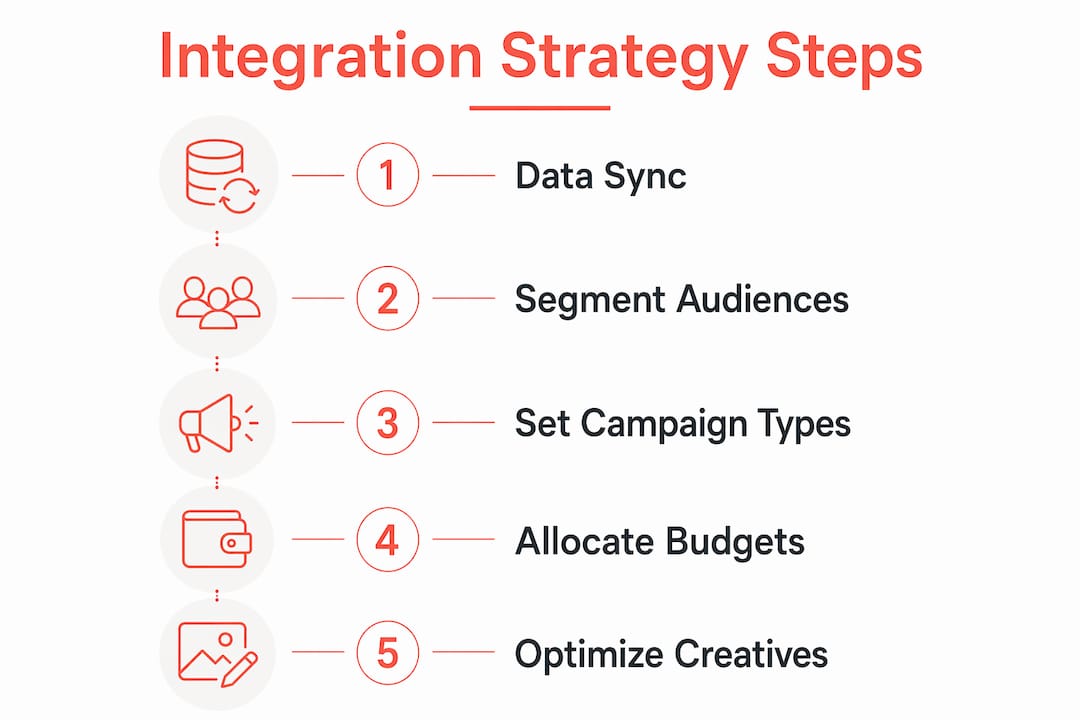
The recommended architecture for an integrated programme looks like this. One Advantage+ Shopping Campaign handles broad acquisition with email-derived lookalike audiences as a signal layer. One retargeting campaign handles cart abandoners and browse abandoners, informed directly by your Klaviyo flow data. One retention campaign targets lapsed customers identified in your email list, with suppression applied to active purchasers. Centralised retargeting cascades built this way boost impression share by 40 to 60% compared to fragmented structures. That is a significant efficiency gain from a structural change alone.
| Campaign type | Audience source | Budget allocation |
|---|---|---|
| Broad acquisition | Lookalikes from email active segment | 60 to 70% of total budget |
| Retargeting | Cart and browse abandoners from Klaviyo | 20 to 25% of total budget |
| Retention and win-back | Lapsed email segment | 10 to 15% of total budget |
Effective budget management allocates 10 to 20% toward acquisition while using behavioural email data to suppress redundant spend on existing customers. That suppression alone can recover meaningful budget that would otherwise be wasted re-acquiring people already in your database.
Dynamic creative optimisation works best when your ad creative reflects the same product the customer viewed or carted. Klaviyo’s dynamic product feeds pass the exact SKU to Meta’s dynamic product ads, so the retargeting creative shows the precise item the customer left behind. You can explore ad creative best practices for how to structure these assets effectively.
Pro Tip: Native integration between Klaviyo and Meta now allows you to auto-trigger Meta Advantage+ campaigns directly from email flows within a single canvas. This removes the manual step of exporting audiences and uploading them to Ads Manager. If your Klaviyo account has access to this beta, activate it. It is the closest thing to a unified marketing operating system currently available.
How to measure and optimise your integrated email and ad programme
The metrics that matter most in an integrated programme are not the same as those you track in siloed channels. You need to watch cross-channel signals together, not in separate dashboards.
Track these metrics as a unified set:
- ROAS by audience source: Separate your ROAS for email-derived audiences versus cold audiences. Email-sourced audiences should consistently outperform cold traffic. If they do not, your data match quality is likely poor.
- Email open and click rates by segment: Declining engagement in your Active segment is an early warning that your ad suppression lists are stale and you may be over-mailing.
- Data match quality scores: Both Meta Events Manager and Google’s enhanced conversion reports show you how well your hashed customer data is matching. Scores below 6 out of 10 indicate a pipeline problem.
- List hygiene metrics: Bounce rates above 2% and spam complaint rates above 0.1% signal deliverability problems that will corrupt your engagement data and reduce the quality of audiences you pass to ad platforms.
Over-managing campaigns manually starves AI models of optimisation data. Ad sets need at least 50 conversion events per week to exit the learning phase and deliver reliable results. Constant budget adjustments and audience edits reset that learning window. Set your campaigns, give them two weeks of clean data, and then evaluate.
Incrementality testing via geo holdout and multi-touch attribution tools like Triple Whale validate true channel contributions. Last-click attribution will always over-credit the final touchpoint and under-credit email’s role in warming the customer. Running a geo holdout test quarterly gives you a defensible view of what your integrated programme is actually contributing to revenue. You can also review a detailed ecommerce retargeting strategy to see how tier-based retargeting fits into your measurement framework.
Key takeaways
Ecommerce email and ads integration drives the strongest results when first-party data, behavioural automation, and consolidated AI-driven ad campaigns operate from a single shared data layer.
| Point | Details |
|---|---|
| First-party data is non-negotiable | Server-to-server pipelines prevent the 8 to 18% conversion loss caused by iOS tracking restrictions. |
| Consolidate, do not fragment | Three to five signal-rich campaigns outperform dozens of small ad sets by giving AI algorithms enough data to optimise. |
| Behavioural triggers drive revenue | Abandoned cart flows convert at up to 7.69% and welcome series open rates reach 45%, making automation your highest-ROI channel. |
| Suppress before you spend | Using post-purchase email data to exclude existing customers from acquisition campaigns directly reduces wasted ad spend. |
| Measure incrementally | Last-click attribution undercounts email’s contribution. Geo holdout tests and tools like Triple Whale give you the real picture. |
Where I think most ecommerce brands are getting this wrong
The brands I see struggling with integrated programmes almost always have the same problem. They have connected the platforms technically but they have not changed how they think about the channels. Email and ads are still being managed by different people with different KPIs, and the data is flowing in one direction only, usually from email into ads, never back again.
The Klaviyo and Meta native integration is genuinely significant, not because of the automation it enables, but because it forces a single canvas view of the customer. When you can see that a customer opened three emails, clicked on a retargeting ad, and then converted through a Google Shopping result, you stop arguing about which channel deserves credit and start asking how to orchestrate the sequence better.
My honest observation after working with ecommerce brands across multiple markets is that the AI in these platforms is more capable than most marketers give it credit for. The instinct to control every variable manually is understandable, but it consistently produces worse results than a well-structured, data-rich campaign left to optimise. The job in 2026 is to feed the machine correctly, not to replace it.
The data privacy concern is real, but it is also largely solved by the server-to-server approach. Hashed emails passed through the Conversions API give you the tracking accuracy you need without relying on third-party cookies. Brands that have not made this infrastructure investment are not just losing attribution data. They are losing bidding efficiency in real time.
The next shift I am watching is the move toward unified marketing operating systems where email flows, ad budgets, and audience triggers are all controlled from a single interface. Klaviyo’s direction with Meta is the clearest signal of where this is heading. Brands that build their stack around open data sharing now will have a significant structural advantage when that consolidation arrives.
— Liza
How Moormarketing can help you integrate email and ads
Moormarketing works directly with ecommerce brands to build the kind of integrated marketing architecture described in this article, from first-party data pipelines through to consolidated ad campaign structures and behavioural email automation.
If you want to understand exactly how to apply these frameworks to your own store, Moormarketing’s ecommerce marketing workshops cover email and ad integration strategy in practical, hands-on sessions built for 2026 campaign realities. For brands ready to scale, the ecommerce growth strategy programme offers a full-stack approach to unifying your marketing channels around shared data and measurable revenue outcomes. Every engagement is led by senior strategists, not outsourced teams.
FAQ
What is ecommerce email and ads integration?
Ecommerce email and ads integration is the synchronisation of email marketing platforms and paid advertising systems to share behavioural data, automate cross-channel triggers, and reduce wasted spend. The result is a unified customer experience across email, Meta, and Google that drives higher conversion rates than either channel achieves independently.
Which platforms support email and ad integration in 2026?
Klaviyo integrates natively with Meta Advantage+ and syncs customer segments to Google Ads. Shopify acts as the central data source, feeding both platforms with purchase events and product catalogue data. Google Merchant Center and Meta Commerce Manager complete the stack.
How does email data improve ad campaign performance?
Email engagement data, including opens, clicks, and purchase history, creates high-quality custom audiences for Meta and Google. These audiences consistently outperform cold traffic because they are built on verified first-party behavioural signals rather than inferred interest categories.
How many conversions does an ad set need to optimise properly?
Ad sets need at least 50 conversion events weekly to exit the learning phase and deliver reliable ROAS. Fragmenting your budget across too many ad sets prevents any single campaign from reaching this threshold.
How do I measure the true impact of my integrated programme?
Use geo holdout incrementality tests and multi-touch attribution tools like Triple Whale rather than relying on last-click attribution. Meta’s Conversion Lift test was updated in 2025 to improve accuracy and gives you a reliable baseline for measuring paid social’s true contribution alongside your email programme.