
A paid media strategy is a structured decision framework that defines how a business allocates budget, selects channels, targets audiences, and measures results across paid advertising campaigns. It is not the same as simply running Google Ads or Meta ads. The strategy is the blueprint that connects every paid media tactic to a specific business objective. In 2026, with AI-driven campaign management, privacy-led attribution shifts, and platform algorithm changes reshaping the space, having a documented paid media strategy is no longer optional. Brands with documented strategies reduce customer acquisition costs by 40% compared to those operating without a formal plan.
What is paid media strategy and how does it differ from paid advertising?
Paid media strategy and paid advertising are not interchangeable terms. Paid advertising refers to the tactical execution: the Google Ads campaigns, Meta ad sets, programmatic display buys, and TikTok video placements. A paid media strategy is the framework that governs all of those decisions before a single dollar is spent.
The core components of a paid media strategy include:
- Audience mapping: Who you are targeting at each stage of the buyer journey, from cold awareness through to conversion and retention.
- Channel selection: Which platforms serve each audience segment best, whether that is Google Search, Meta, LinkedIn, programmatic networks, or YouTube.
- Budget allocation: How much spend is assigned to each channel and funnel stage, and the logic behind those splits.
- Creative direction: What messaging, formats, and offers will resonate with each audience segment.
- Measurement framework: How you will track performance, attribute results, and define success beyond platform-reported metrics.
The difference matters because paid advertising delivers results only when strategic planning, compelling creatives, and continuous optimisation are in place. Without the strategy layer, businesses end up with a collection of disconnected campaigns that compete with each other for budget and audience attention. Aligning your paid media plan to the buyer journey means every dollar has a defined role, whether it is building awareness, nurturing consideration, or closing a sale.
Pro Tip: Document your paid media strategy as a single reference document that your entire team and any agency partners work from. This single step eliminates misaligned campaign objectives and wasted spend faster than any optimisation tactic.
How are paid media budgets allocated across the funnel?
Budget allocation is where strategy becomes concrete. A full-funnel approach divides spend across three stages: awareness, consideration, and conversion. A typical B2B allocation sits at 20 to 30% for awareness, 30 to 40% for consideration, and 30 to 40% for conversion, though eCommerce brands often weight conversion more heavily in competitive seasons.

The 70/20/10 model is a practical framework for channel allocation. Seventy percent of budget goes to proven, high-performing channels where return is predictable. Twenty percent funds emerging channels with strong signals but less historical data. Ten percent is reserved for testing new platforms, formats, or audiences. This model prevents the common mistake of concentrating all spend on one channel while missing growth opportunities elsewhere.
| Budget tier | Allocation | Purpose |
|---|---|---|
| Proven channels | 70% | Scale what already converts reliably |
| Emerging channels | 20% | Build presence in high-potential platforms |
| Test channels | 10% | Validate new audiences, formats, or platforms |
| Awareness stage | 20–30% | Build brand recognition and reach new audiences |
| Conversion stage | 30–40% | Drive purchases, leads, or sign-ups |
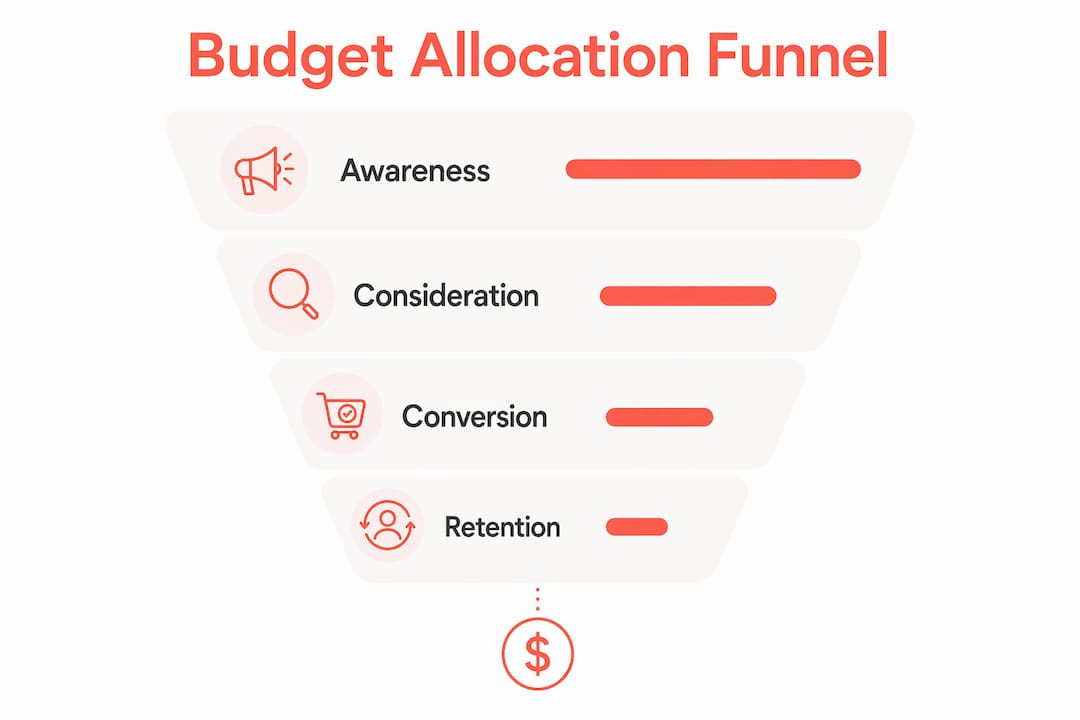
Data-driven allocation improves incremental outcomes because it forces you to evaluate each channel’s contribution rather than defaulting to the most familiar option. For B2B marketers, LinkedIn’s targeting capabilities make it a strong consideration-stage channel, particularly for account-based campaigns where job title and company size targeting is critical.
Pro Tip: Review your funnel-stage budget split every quarter, not just annually. Seasonal demand shifts and platform algorithm changes can make a previously efficient allocation underperform within weeks.
How is AI changing paid media campaign management?
AI has moved from a supporting feature inside ad platforms to the primary management layer for complex paid media campaigns. Autonomous AI agents now handle bid adjustments, budget reallocations, and negative keyword management around the clock, catching performance anomalies that human managers would miss during off-hours.
Tools like Ryze AI operate across Google Ads and other platforms, continuously analysing signals and making micro-adjustments that compound into meaningful efficiency gains over time. The practical impact is that campaigns managed with AI assistance maintain tighter cost-per-acquisition targets and respond to auction changes faster than manual or rule-based automation allows.
The shift also changes what human strategists need to focus on. When AI handles the mechanical optimisation layer, the strategic value moves to:
- Audience architecture: Structuring campaigns so AI has clean, well-defined audience signals to optimise against.
- Creative strategy: Producing the volume and variety of creative assets that AI can test and rotate effectively.
- Measurement design: Setting up the tracking infrastructure that feeds AI systems accurate conversion data.
- Strategic oversight: Reviewing AI decisions, identifying structural issues, and setting the guardrails that prevent automated systems from optimising toward the wrong objectives.
AI-driven automation also reduces operational costs for agencies and in-house teams by removing repetitive manual tasks from campaign management workflows. The businesses that benefit most are those that treat AI as a force multiplier for a sound strategy, not a replacement for having one.
Paid media tactics and channels: how do you choose the right mix?
Channel selection is one of the most consequential decisions in a paid media strategy breakdown. Each major channel serves a different function, reaches different audiences, and operates on different cost models. The right mix depends on your funnel objectives, audience behaviour, and available creative resources.
| Channel | Funnel stage | Cost model | Targeting strength |
|---|---|---|---|
| Google Search | Conversion | CPC | High-intent keyword targeting |
| Meta (Facebook/Instagram) | Awareness to conversion | CPM/CPC | Behavioural and interest targeting |
| YouTube | Awareness/consideration | CPV/CPM | Demographic and interest targeting |
| Programmatic display | Awareness | CPM | Contextual and audience targeting |
| TikTok | Awareness/consideration | CPM | Interest and lookalike targeting |
| Consideration/conversion | CPC/CPM | Professional and firmographic targeting |
Google Search captures existing demand. Users searching for a product or solution are already in the market, making search the highest-intent channel for conversion-stage spend. Meta and TikTok create demand by reaching audiences who are not yet actively searching but can be moved through the funnel with the right creative. Programmatic display extends reach at scale for awareness objectives, while LinkedIn remains the most precise channel for B2B audiences.
Creative strategy is the variable that separates high-performing paid social campaigns from average ones. On Meta and TikTok, brands should introduce 15 to 20 new ad concepts monthly to avoid creative fatigue and maintain performance. This is not about producing expensive productions. It is about creative velocity: testing different hooks, formats, and offers at a pace that keeps the algorithm fed with fresh signals. For eCommerce brands exploring TikTok, Moormarketing’s TikTok ads guide for 2026 covers the creative and targeting frameworks that are working right now.
One important nuance on Meta: retargeting standalone campaigns are largely ineffective for brands spending under $500,000 per month. Modern Meta strategy consolidates spend into Advantage+ Shopping Campaigns that optimise across the full funnel, with retention shifted to owned channels like email and SMS.
How do you measure and optimise paid media results?
Measurement is the most rapidly changing element of paid media strategy in 2026. Privacy regulations, the deprecation of third-party cookies, and platform-level data restrictions have made platform-reported ROAS unreliable as a standalone performance metric. A Meta-reported 4x ROAS may look strong while the actual incremental return is far lower once you account for organic conversions being attributed to paid.
Modern measurement frameworks rely on three methods working together:
- Server-side tracking: Sends conversion data directly from your server to ad platforms, bypassing browser-level restrictions and improving signal accuracy.
- Probabilistic attribution: Uses statistical modelling to estimate channel contribution when direct tracking is unavailable, giving a more realistic view of the customer journey.
- Lift testing: Runs controlled experiments, typically holdout tests, to measure the true incremental impact of a campaign by comparing exposed and unexposed audience groups.
Multi-touch attribution models, whether linear, time-decay, or data-driven, provide a more complete picture of how channels work together across the buyer journey. Organic content builds trust and pattern recognition, while paid amplifies proven content to new audiences. Measuring them in isolation understates the contribution of both.
Practical optimisation follows from clean measurement. Review search term reports weekly to identify wasted spend. Analyse creative performance by hook rate and hold rate, not just click-through rate. Test landing page variants against conversion rate, not just traffic volume. Each of these steps requires the ad campaign best practices discipline that separates brands that scale from those that plateau.
Key takeaways
A paid media strategy works because it connects budget, channels, creative, and measurement to specific business objectives rather than treating paid advertising as a collection of independent tactics.
| Point | Details |
|---|---|
| Strategy vs. tactics | A paid media strategy is the framework governing channel, budget, and audience decisions, not the ads themselves. |
| Budget allocation | Use the 70/20/10 model to balance proven channels, emerging platforms, and test investments. |
| AI management | Autonomous AI tools handle bid and budget optimisation 24/7, freeing strategists to focus on creative and measurement. |
| Creative velocity | Introduce 15 to 20 new ad concepts monthly on paid social to prevent fatigue and maintain algorithm performance. |
| Measurement accuracy | Replace platform-reported ROAS with server-side tracking, probabilistic attribution, and lift testing for true results. |
Why most paid media strategies fail before they start
I have reviewed hundreds of paid media accounts over the years, and the single most common failure is not a bad channel choice or a weak creative. It is the absence of a strategy altogether. What most businesses call a “strategy” is actually a list of platforms they are spending money on. Google Ads: tick. Meta: tick. Maybe TikTok because someone read an article. That is not a strategy. That is a budget distribution.
The second most common failure is retargeting obsession. Marketers become fixated on retargeting because the numbers look good. Of course they do. You are showing ads to people who already visited your site and were likely to convert anyway. For most eCommerce brands under a significant monthly spend threshold, that retargeting budget would generate more incremental return folded into a full-funnel campaign structure.
What I have seen work consistently is treating paid media as one layer of an integrated system. Paid amplifies what organic has already validated. Email and SMS handle retention so paid budget is not wasted on existing customers. Creative is treated as a product, not an afterthought, with a testing cadence that keeps campaigns fresh. Moormarketing’s eCommerce case studies show what this looks like in practice, including a furniture brand generating $3 million per month through a structured, full-funnel approach.
The businesses that get the most from paid media are not necessarily the ones with the biggest budgets. They are the ones with the clearest frameworks.
— Liza
Build a paid media strategy that actually drives revenue
Moormarketing works directly with eCommerce businesses to build paid media strategies that are grounded in data, aligned to the full buyer journey, and designed to scale. No outsourcing, no junior account managers. Every strategy is built and managed by senior strategists who have delivered results like $2 million in monthly sales for a new toy retailer and $3 million per month for a global furniture brand. If you are ready to move from ad-hoc spending to a structured approach, start with Moormarketing’s eCommerce marketing workshops or explore what it looks like to work with the team directly.
FAQ
What is a paid media strategy in simple terms?
A paid media strategy is a documented framework that defines which paid advertising channels to use, how to allocate budget across them, who to target, and how to measure results. It connects every campaign decision to a specific business objective.
What are the main paid media examples?
The main paid media channels include Google Search ads, Meta (Facebook and Instagram) ads, YouTube pre-roll, programmatic display, TikTok ads, and LinkedIn sponsored content. Each serves a different funnel stage and audience type.
How does paid media differ from organic media?
Paid media requires direct spend to reach an audience, delivering immediate visibility and precise targeting. Organic media builds reach through content, SEO, and social engagement over time without direct placement costs, but the two work best when integrated.
How much should a business spend on paid media?
Budget depends on business size, objectives, and competitive environment, but the 70/20/10 allocation model provides a practical starting framework: 70% to proven channels, 20% to emerging platforms, and 10% to testing new approaches.
Why is platform-reported ROAS no longer reliable?
Privacy regulations and cookie deprecation mean ad platforms can no longer track the full customer journey accurately. Server-side tracking and lift testing provide a more accurate view of true incremental return than platform dashboards alone.