

Most Australian small businesses spend between $1,000 and $5,000 a month on Google Ads, with search clicks typically costing $2 to $6 depending on the industry. Management fees sit on top of that ad spend, usually 10 to 20% or a fixed monthly retainer. Read on for the calculator and worked examples further down, or jump straight to setting your budget once you know your target cost per acquisition.
TL;DR:
- Advertisers should set a target cost per acquisition based on their margins rather than relying on generic budget figures.
- CPCs in Australia vary significantly by industry and location, with premium markets like Sydney and Melbourne pushing costs higher than regional areas.
- Effective cost reduction strategies focus on improving relevance through tighter ad groups, focused landing pages, and aggressive use of negative keywords.
- Management fees typically range from 10% to 20% of ad spend, with monthly retainers between $800 and $2,800, depending on campaign complexity.
- Running under a narrow, data-driven campaign for at least 90 days yields better return than broad or poorly targeted advertising, especially when starting in Australia.
Table of Contents
- How does Google Ads pricing actually work?
- What do Google Ads cost in Australia by industry and campaign type?
- How do you calculate your Google Ads budget?
- What do Google Ads management fees cost in Australia?
- How do you lower your effective Google Ads cost?
- Why local benchmarks matter more than global averages
- Get your Google Ads budget and management sorted properly
- Where to check these figures yourself
- Sources
How does Google Ads pricing actually work?
Google Ads runs on an auction, not a price list. Every time someone searches, eligible advertisers get scored on Ad Rank, which combines your bid with your Quality Score (a 1 to 10 rating based on expected click-through rate, ad relevance, and landing page experience). Win the auction and you pay roughly one cent more than the advertiser ranked below you, not your maximum bid. That’s why two businesses targeting the same keyword can pay wildly different amounts for the same click.
You’ll also choose a billing model, and the right one depends on your campaign goal:
- CPC (cost per click) — you pay only when someone clicks, the standard for Search campaigns chasing website visits.
- CPM (cost per thousand impressions) — you pay for visibility, common on Display and YouTube when brand awareness matters more than clicks.
- CPA (cost per acquisition) — Google’s smart bidding aims to hit a target cost per conversion, useful once you have enough conversion data to train the algorithm.
On the payment side, Google’s own documentation confirms advertisers set daily budgets and monthly spending caps themselves, and actual charges depend on auction competition and ad relevance rather than a fixed rate card. Australian accounts can pay by credit card, direct debit, or (for larger spenders) monthly invoicing, which we cover in more detail further down.
The practical takeaway: a benchmark CPC is a starting point, not a guarantee. Your Quality Score, your competitors’ bids, and the time of day you’re advertising all move the number in real time.
What do Google Ads cost in Australia by industry and campaign type?
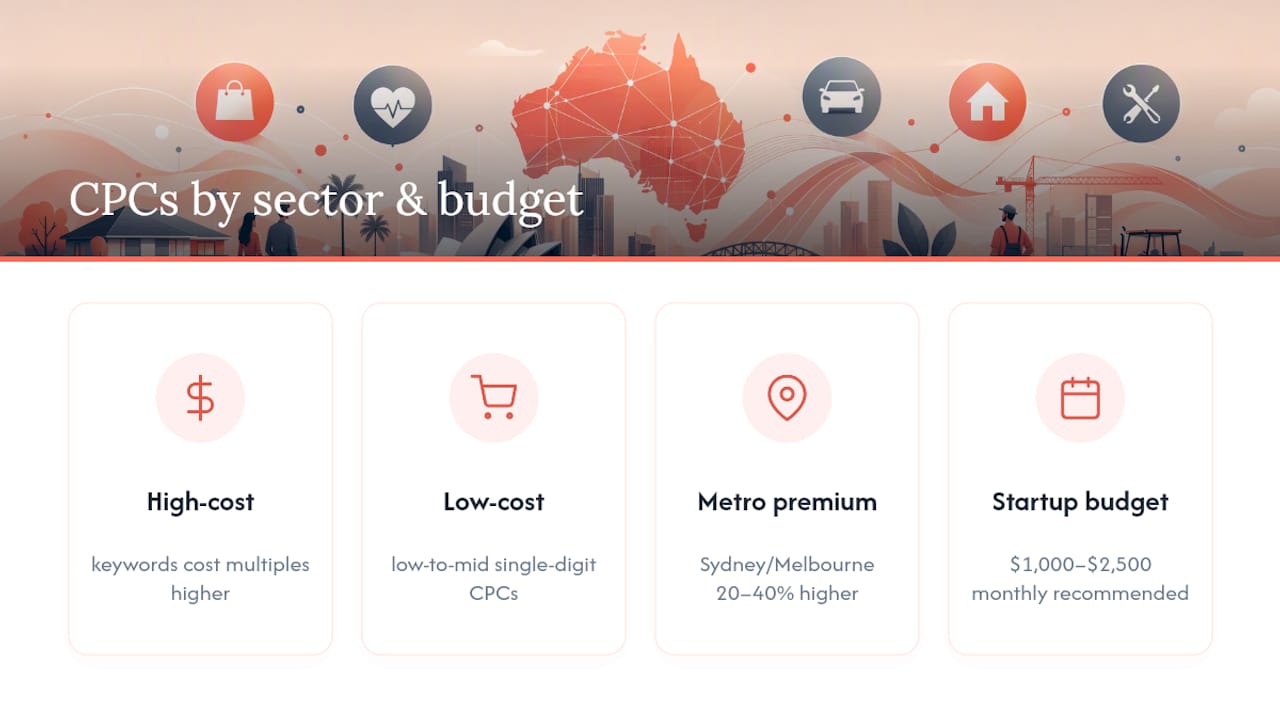
Search advertising in Australia typically runs at CPCs somewhere in the low-to-mid single digits, though the spread between industries is significant. Local guides put national averages in that band while flagging that legal, finance, and insurance keywords can cost multiples of what an eCommerce or hospitality click costs, because the value of a converted lead in those sectors is so much higher. Digitalzoop’s Australian pricing guide recommends new small businesses budget at least $1,000 to $2,500 a month just to gather enough data to optimise properly.
Industry benchmarks compiled from Australian accounts put typical ranges like this:
Sydney and Melbourne carry a real premium. Denser advertiser competition in metro markets pushes CPCs up compared with regional Queensland, Tasmania, or country New South Wales, sometimes by 20 to 40% for the same keyword, according to benchmark data compiled by Spacewolf. If your business trades nationally, expect your blended CPC to sit above a pure regional average.
CPCs also move with the broader economy. Statista’s tracking of CPC shifts by Australian industry shows how sharply sector-level costs can swing when demand or advertiser competition changes, which is a useful reminder not to treat any single benchmark as fixed for the year.
How do you calculate your Google Ads budget?
Work backwards from what a customer is worth to you, not forwards from an arbitrary daily spend figure. That single mindset shift is what separates advertisers who scale profitably from those who burn through budget guessing.
- Set your target CPA. If your average order value is $150 and your margin allows $30 per acquisition, that’s your ceiling cost per sale or lead.
- Pick a realistic average CPC from the benchmark table above for your industry and location.
- Estimate clicks from budget. Divide your monthly budget by your expected CPC to get a rough click volume.
- Apply a conservative conversion rate (2 to 4% is a fair starting assumption for most Search campaigns) to estimate leads or sales, then check whether the resulting CPA fits your target.
Google’s own budget and cost calculator does this same maths using live auction data for your industry and location, which makes it a genuinely useful first stop before you commit real money.
Two worked examples show how differently this plays out:
Before you plug numbers in, gather your actual margin per sale, your historical conversion rate if you have one, and a realistic geographic radius. Guessing any of these three inputs is the fastest way to underfund a campaign that could have worked.
What do Google Ads management fees cost in Australia?
Three fee models dominate the Australian market, and each rewards different behaviour from whoever’s running your account.
- Percentage of ad spend — typically 10 to 20%, scales naturally as your budget grows but can incentivise an agency to spend more rather than spend smarter.
- Fixed monthly retainer — common for small to mid-sized budgets, giving cost certainty regardless of how much you spend on ads.
- Hourly or project-based — suits one-off audits or campaign launches rather than ongoing management.
Compiled Australian agency data puts realistic SMB retainers somewhere between $800 and $2,800 a month, according to Nexiiom’s pricing breakdown, with enterprise accounts running well beyond that once multiple campaign types and markets are involved.
A fair proposal should spell out campaign setup, ongoing bid and budget management, monthly reporting against agreed KPIs, and conversion tracking maintenance. Red flags include vague reporting promises, no mention of who actually touches your account day-to-day, and contracts that lock you in for 12 months with no performance review point.
Pro Tip: Ask any prospective manager to show you a redacted client report before you sign anything. If they can’t produce one, they’re not tracking the metrics that actually matter, like measuring Google Ads performance against cost per acquisition and return on ad spend.
How do you lower your effective Google Ads cost?
Cutting cost per click rarely means bidding less. It usually means becoming more relevant, which Google rewards with cheaper clicks and better placements.
- Tighten your ad groups. Group closely related keywords together so your ad copy and landing page can speak directly to the search term, which lifts Quality Score.
- Match your landing page to the ad. Practitioners report that focused landing page work alone can cut effective CPC by a meaningful margin, sometimes 30 to 50%, once the page genuinely reflects what the ad promised.
- Use negative keywords aggressively. Every irrelevant click you block is budget saved for a search that could actually convert.
- Layer in geo and schedule adjustments. If your trade only services a 30km radius, don’t pay for clicks from across the state; if conversions dry up after 6pm, wind bids down accordingly.
- Exclude poor-fit audiences using demographic and audience exclusions once you have enough data to see who isn’t converting.
- Let automation handle bidding once you have volume, but keep manual control while you’re still building a conversion history. Automated bidding needs data to work with, and guessing too early wastes budget on the algorithm’s learning phase.
The Golden Path Digital guide to landing page Quality Score walks through the specific fixes that move the needle fastest, and it pairs well with reviewing your own landing pages that convert before you touch your bids at all.
Pro Tip: Fix your landing page before you touch your bids. Lowering a bid on a page that isn’t converting just buys you cheaper failure.

Why local benchmarks matter more than global averages
Most of the “average Google Ads cost” figures floating around online come from US data, and applying them to an Australian account is one of the most common budgeting mistakes we see. Australian search volume is smaller, our advertiser pool per keyword is different, and the AUD/USD exchange rate alone can make a benchmark look wrong before you’ve even factored in local competition.
What we’ve found running Australian eCommerce accounts is that the businesses who get the best return aren’t the ones with the biggest budgets. They’re the ones willing to run a genuinely narrow first campaign, tight geography, tight keyword match, a landing page built for that exact search, and only widen out once the data proves the offer works. That discipline matters more than the size of the daily budget.
Our framework for new Australian clients starts with a 90-day test window: set a conservative CPA target based on real margin data, not hope, run tightly matched campaigns, and review weekly rather than monthly so wasted spend gets caught fast. It’s the same approach that helped push one toy retailer client to $2 million in monthly sales conversions, not by outspending competitors but by refusing to run a campaign the data didn’t support yet.
— Liza
Get your Google Ads budget and management sorted properly
Running Google Ads well in Australia takes more than picking a daily budget and hoping the auction sorts itself out. Moormarketing builds the campaign plan around your actual margins first, then sets the budget, bids, and targeting to hit a cost per acquisition that makes sense for your business, not a generic industry average.
A typical engagement starts with an audit of your current account or market position, followed by a 90-day optimisation roadmap covering campaign structure, landing pages, and conversion tracking. You’ll get straight answers on what your budget should realistically achieve before a dollar gets spent. Explore our digital ad campaign best practices for 2026 to see how the framework works, or head to Moormarketing to book a strategy session and get a budget plan built around your actual numbers.
Where to check these figures yourself
For live, personalised estimates, run your own numbers through Google’s budget and cost calculator, which pulls location and industry data straight from the auction. Google’s support documentation on costs and payments explains billing controls in full, and Statista’s CPC tracking is worth bookmarking if you want to watch how your sector’s costs move over the year.
Sources
- Google Ads Budget & Cost Calculator Tool for Ad Spend & …
- Google Ads Cost in Australia 2026: Pricing Guide