

High CPM on Facebook is almost always an auction output first and an account problem second. Check your CPA and cost per optimisation event before touching anything else. If CPA still holds up, the spike is likely auction pressure or seasonality and you can ride it out; if CPA has worsened too, run the full diagnostic checklist below before changing budgets or creative.
TL;DR:
- High CPM on Facebook is often due to auction pressure or seasonality, especially when CPA and ROAS remain stable over time.
- Budget changes, creative fatigue, or audience saturation typically cause CPM jumps once signal strength is confirmed with at least 50 optimization events per week.
- Adjusting placement mix or targeting without fixing underlying signal or creative issues usually has minimal impact on high CPM.
- Monitoring metrics such as frequency, hook rate, hold rate, and placement breakdown helps diagnose whether auction, creative, or saturation problems drive CPM increases.
- The key to reducing CPM is diagnosing its cause first, then matching the fix to the identified layer, rather than making broad or hasty adjustments.
Table of Contents
- Why is my Facebook CPM so high right now?
- What is CPM and what should you expect to pay?
- What’s actually driving your Facebook CPM up?
- How do you actually reduce Facebook CPM after diagnosing the cause?
- When is a high Facebook CPM actually fine to leave alone?
- Real fixes, real results: how this diagnostic plays out
- What most advertisers get wrong about high CPM
- Get an agency team to run this diagnostic for you
- Sources
Why is my Facebook CPM so high right now?
Run this in the next ten minutes before you touch a single setting. Changing budgets or creative before you know the cause almost always makes things worse, because big edits reset the learning phase and destabilise delivery for days.
Start with profit, not cost. A rising CPM that leaves CPA and ROAS untouched is not a problem, it is the market getting more expensive around you. Pull up Ads Manager and check these in order:
- CPA/ROAS trend (last 7 vs previous 7 days): if these are flat or improving, the CPM rise is probably auction driven, not an account fault.
- Optimisation events in the last 7 days: below roughly 50 per ad set, Meta’s algorithm is still guessing, and ad sets typically see a 20–30% efficiency gain once they clear that threshold.
- CTR and hook rate: a CTR under 1% or a hook rate (3 second views over impressions) under 20% usually points to creative fatigue rather than a market shift.
- Frequency: above 2.5 to 3.0 on a cold, prospecting audience is an early warning; above 4 usually means saturation is actively driving your cost up.
- Placement breakdown: check the CPM split across Feed, Reels, Stories and Audience Network. A single expensive placement can drag the blended average up.
- Calendar check: is it the run up to a major shopping event, or has a competitor just entered your category? Seasonality moves CPM independently of anything you did.
Quick stat: Frequency above 2.5–3.0 on cold audiences correlates strongly with falling engagement and rising CPM, and once it passes 4, creative fatigue is doing most of the damage.
The decision tree is simple once you have those six numbers. Signal too thin (under 50 events) and frequency climbing means fix the account. Signal healthy, engagement metrics stable, and CPM still up means accept it as an auction or seasonal move and adjust your bidding or offer instead of your targeting.
What is CPM and what should you expect to pay?
CPM stands for cost per thousand impressions, and Meta calculates it exactly as the name implies: total spend divided by impressions, multiplied by 1,000. What trips advertisers up is treating CPM like a dial they can turn. It is not a setting. It is an output of the auction, produced by your bid, your ad quality score, your audience’s estimated action rate, and every other advertiser bidding for the same eyeballs at the same moment.
That auction mechanic is why two campaigns with identical budgets can post wildly different CPMs. One is fighting for a tight, in-demand audience during a competitive week; the other has a clear run at a less contested pocket of the platform.
Benchmarks help you judge whether your number is actually a problem or just normal for your objective. Blended averages hide enormous variation between what an awareness campaign should cost and what a retargeting campaign should cost, so comparing your conversions CPM to an industry-wide average is close to meaningless.
| Objective/placement | Typical CPM range |
|---|---|
| Awareness | $2–$5 |
| Traffic/engagement | $5 |
| Lead generation/conversions | $20 |
| Retargeting | $30 |
| Reels placement | Often below feed |
| Feed placement | Mid to upper range |
Zoom out and the picture gets wider still. Recent industry data puts the global all-industry median CPM near $20, with sectors like finance and IT running well above that and manufacturing sitting well below it. Country and currency also matter enormously, since advertiser density varies by market.
A few things move CPM regardless of how well your account is set up:
- Q4 and holiday periods push demand and bids up across nearly every industry.
- New competitors entering your category raise the floor for everyone bidding on similar audiences.
- Geo mix matters, since CPMs in high-income, high-competition markets run structurally higher than in smaller markets.
- Platform-wide advertiser demand shifts week to week independent of anything in your account.
None of this means a high number is fine by default. It means you compare your CPM to the right benchmark for your objective and placement, not to a number you saw in a case study for a different industry.
What’s actually driving your Facebook CPM up?
High CPM rarely has one cause. It is closer to a stack, where each layer either sets a floor, raises a ceiling, or adds noise on top of both.
Signal is the floor. Meta’s delivery algorithm needs data to find the right people, and it gets that data from optimisation events. Roughly 50 events in a 7 day window is the practical threshold most diagnostic sources point to for exiting the learning phase cleanly. Fall short of that and the system is bidding semi-blind, which pushes your CPM up because Meta is paying to explore rather than to convert. This is an internal, fixable problem, and it is one of the most common reasons small-budget conversion campaigns report CPMs that look nothing like the benchmarks above.
Creative is the ceiling. Once signal clears the floor, creative quality does most of the remaining work. Weak hooks or poor retention can lift CPM by 30 to 60% inside accounts that already have healthy signal, because Meta’s system reads low engagement as low relevance and charges you more to reach the same person. The numbers worth watching:
- Hook rate (3 second video views divided by impressions): above 35% is strong, below 20% is a warning sign.
- Hold rate (through-plays divided by 3 second views): above 50% is strong, below 30% usually means the message or pacing is failing mid-play.
A creative that hooks well but holds badly is often a targeting mismatch dressed up as a creative problem, since the wrong person clicked play for the wrong reason.
Audience saturation compounds both. Frequency above 2.5 to 3.0 on a cold audience is the early signal; past 4, you are almost certainly burning spend on people who have tuned the ad out. Small audiences hit this ceiling fast. A prospecting audience under roughly 500,000 people will typically saturate within weeks on anything beyond a modest daily budget, and the CPM climb that follows looks identical to an auction problem until you check frequency and realise it is entirely self-inflicted.
Placement mix adds its own layer. Feed placements tend to cost more than Reels or Stories for the same audience, so an ad set that skews too heavily toward premium feed inventory can post a higher blended CPM than an identical ad set with a broader placement spread. This is one of the easier levers to pull because it does not touch your creative or your audience definition at all.
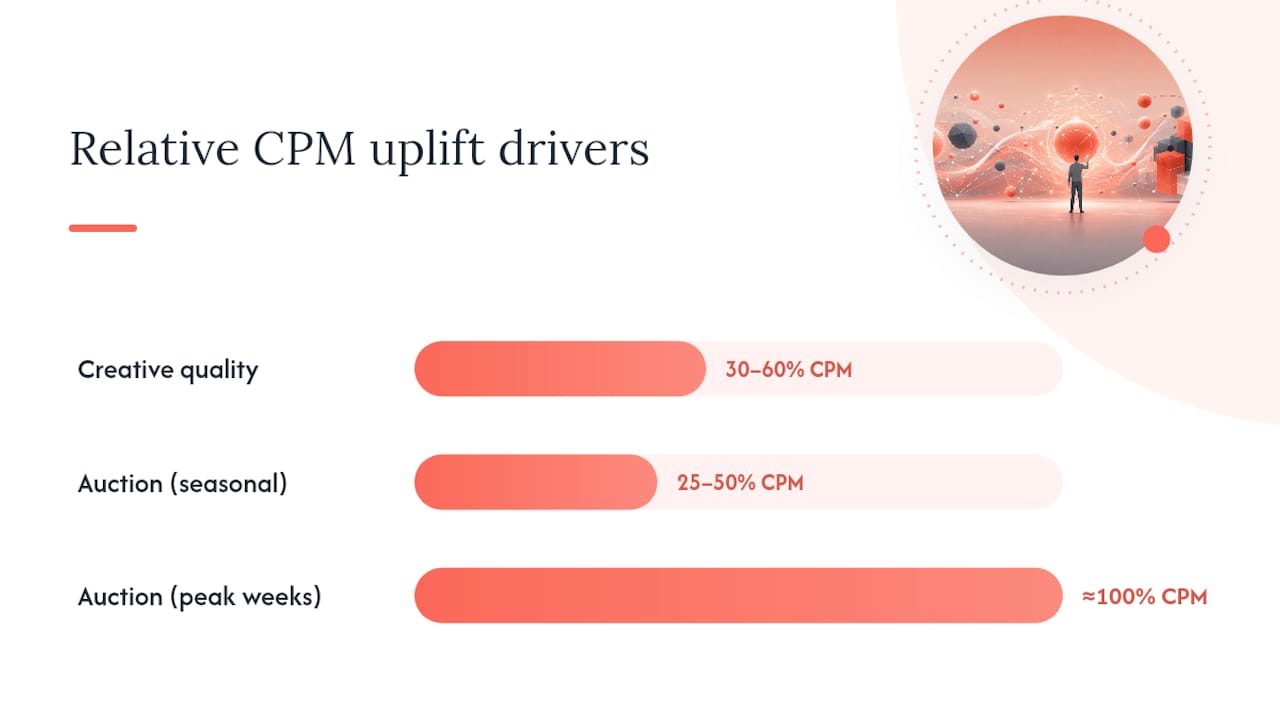
Auction pressure sits on top of everything else. Seasonality, competitor entry, and platform-wide demand swings can push CPM up by 25 to 50% or more in Q4 for retail categories, and peak holiday weeks can push it close to double the low season baseline. No account fix cancels out a genuine seasonal auction spike. The best you can do is recognise it for what it is and adjust your expectations, your offer, or your bidding strategy rather than chase a CPM number that the whole market is currently paying.
The practical takeaway: diagnose in this order, because fixing creative while your signal is still thin wastes the test. Rebalancing placements while your audience is saturated just moves the saturation somewhere else.
How do you actually reduce Facebook CPM after diagnosing the cause?
Match the fix to the layer you diagnosed. Working through these out of order is the single biggest reason advertisers “fix” one thing and watch CPM barely move.
-
Fix signal first if you’re under 50 events/week. Consolidate fragmented ad sets so spend and events pool together rather than splitting across five near-identical audiences. Move your optimisation event up-funnel temporarily (add-to-cart instead of purchase, for example) if your current event volume genuinely cannot support learning. Then leave it alone. Large edits mid-learning reset the phase and you lose the progress you already made.
-
Fix audience saturation once signal is healthy. Broaden lookalike percentages (1% to a 2 to 5% range), increase seed audience size where you’re building custom audiences, and consider Meta’s Advantage+ audience option to let the system find pockets you have not targeted manually. Refresh or rotate audiences roughly every 4 to 6 weeks for always-on campaigns, faster for high-frequency retargeting.
-
Fix creative once you have confirmed weak hook or hold rates. Run a hook-first testing structure: three to five distinct opening 3 seconds against one consistent body and offer, then measure hook rate before you even look at hold rate. Vertical, native-feeling formats and UGC-style creative consistently outperform polished studio ads on hook rate specifically, because they read as content rather than advertising in the first half second. Guidance on formats that hold attention is covered in Moormarketing’s breakdown of social media ad creatives that convert.
-
Fix placement mix if Feed is carrying a disproportionate share of spend. Run a placement breakdown report, then either re-enable Audience Network and Reels where they were previously excluded, or let Advantage+ placements handle the split automatically. Give any placement change at least a week before judging it, since delivery needs time to rebalance.
-
Manage auction and seasonal pressure rather than fight it. Shift budget toward retargeting audiences, which typically convert at a rate that justifies their higher CPM, and consider raising average order value through bundles or minimum-spend offers so a higher CPM still clears your break-even ROAS. Adjust pacing (standard versus accelerated) instead of pausing outright, since a full pause forces you back through learning when you restart.
Pro Tip: Test one variable at a time and give each test a full 5 to 7 day run before judging it. Changing creative, audience and placement in the same week means you will have no idea which change actually moved your CPM.
Readers wanting a fuller playbook on structuring these tests can find more detail in digital ad campaign best practices for 2026.
When is a high Facebook CPM actually fine to leave alone?
CPM only matters in relation to what happens after the impression. The arithmetic is simple: CPM divided by 1,000, multiplied by your click-through and conversion rates, gives you CPA. If your CPA sits comfortably under the value that gets you to your break-even ROAS, a rising CPM is not costing you anything real, it is just costing you more per thousand eyeballs on the way to the same result.
Judge changes over a 28-day window, not three days. Short windows are noisy, and a bad Tuesday can look like a trend that a normal Thursday erases.
Stop making edits once CPA and ROAS have stabilised, even if CPM itself still looks high against a benchmark. Only pause a campaign outright when CPA has genuinely broken through your break-even line for a sustained stretch, not a single bad day. Your dashboard should track CPM, CPA, ROAS and frequency together, plus a quick attribution check to confirm the conversions you are counting actually match what your reporting shows. For a deeper look at translating cost metrics into acquisition targets, see how to lower cost per acquisition in digital ads.
Real fixes, real results: how this diagnostic plays out
This diagnostic sequence is not theoretical. Moormarketing’s senior strategists run this exact checklist, signal, frequency, creative, placement, seasonality, on client accounts before touching a single budget line, because guessing at fixes wastes ad spend that a ten-minute audit would have saved.
Two patterns show up repeatedly across engagements: a toy retailer that scaled to $2 million in monthly sales conversion once the team fixed a thin conversion signal and rebuilt creative around hook-first UGC, and a global furniture brand that reached $3 million a month after a placement rebalance cut its blended CPM significantly. Results like these depend on starting budget, vertical and competitive density, and mentoring programs through Moormarketing’s engagement page walk brands through the same process case by case.
What most advertisers get wrong about high CPM
Most guides on this topic treat CPM as something you fix directly, as if there’s a lever marked “lower CPM” hiding in Ads Manager settings. There isn’t. That framing sends advertisers chasing the wrong problem: pausing campaigns that just needed another few days of learning, or slashing budgets right when a seasonal spike was about to pass anyway.
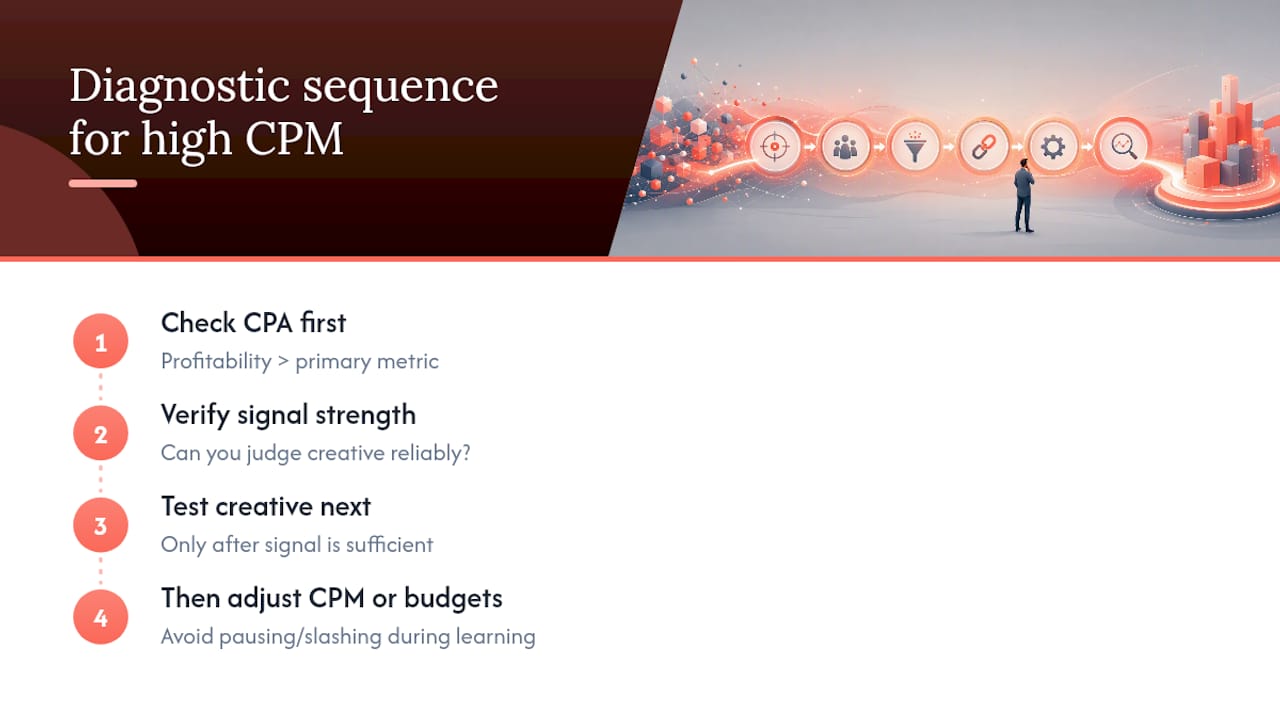
The bigger blind spot is sequencing. Plenty of advertisers know about frequency thresholds and hook rate benchmarks in isolation, but they test creative before checking whether their signal is even strong enough to judge that creative fairly. Fix the layers out of order and you’ll misdiagnose a signal problem as a creative one, rebuild your ads for nothing, and watch the same CPM climb again a month later.
If I had to compress this into one habit: check CPA before you touch anything. CPM is a symptom, not a diagnosis. A number that looks alarming against a generic benchmark can be completely irrelevant to your business if your break-even math still holds. Chase profitability, use CPM as one input among several, and you’ll spend far less time firefighting numbers that were never actually broken.
— Liza
Get an agency team to run this diagnostic for you
Running this checklist properly every week takes time most in-house teams don’t have, and the cost of guessing wrong is real ad spend gone to a fix that missed the actual cause. Moormarketing gives growth-focused eCommerce brands a senior strategist who runs this exact diagnostic on your account, rather than an outsourced junior working from a template.
The difference is direct access to the people doing the work: no account handed off to a junior after the pitch, no guesswork on whether your CPM spike is seasonal or self-inflicted. Moormarketing’s approach has taken a new toy retailer to $2 million in monthly sales conversion and pushed a global furniture brand to $3 million a month, built on the same signal-first, creative-second, placement-third sequence covered above. If your Facebook CPM has been climbing and you’re not sure which layer is driving it, book a look at your account through Moormarketing’s Facebook advertising strategy service and get the diagnostic run properly, once, by someone who does it every day.
Sources
- Why Is My Meta CPM So High in 2026? Causes & Fixes
- Why Is My CPM So High on Facebook? A Diagnosis | PodVector AI
- What Is a Good CPM for Facebook Ads? 2026 Benchmarks & Data