
Organic growth is the expansion a business achieves through its own resources — increasing sales, output, and market presence without relying on mergers, acquisitions, or external capital injections. For new Australian brands, that distinction is everything. Organic growth builds stronger profit margins by avoiding the debt and integration costs tied to acquisitions, and it keeps founders in control of their brand story, values, and direction.
Here is what new founders need to know upfront:
- Organic growth is slower but compounds. A blog post ranking on Google keeps driving traffic for years. A paid ad stops the moment the budget runs out.
- Brand identity stays intact. As John Hall notes, organic growth gives founders the freedom to communicate their mission authentically, without dilution from investor demands.
- Common mistake: defaulting entirely to paid ads before building any organic foundation. Durable brands build audiences first, then layer paid funnels on top.
- Key metrics to track: brand search volume, blended customer acquisition cost (CAC), content output rate, and customer cohort retention.
- Moormarketing has helped clients achieve $2 million in monthly sales for a new toy retailer and $3 million a month for a global furniture brand — results built on data-driven strategy, not ad spend alone.
Table of Contents
- Why prioritising organic growth gives new brands a real edge
- Common pitfalls that derail new brands pursuing organic growth
- How to measure and sustain organic growth in your brand strategy
- What Moormarketing clients show about organic growth in practice
- Key takeaways
Why prioritising organic growth gives new brands a real edge
Paid advertising delivers visibility. Organic growth delivers an asset. That gap matters more than most founders realise at launch.
Organic channels — SEO, content marketing, referrals, and email — produce leads that tend to convert better over time and cost less to retain. Someone who finds your brand through a search query has already identified their problem. They arrive warmer, more informed, and more likely to buy again.
- Brand equity compounds. Content that ranks, an email list you own, a reputation for expertise — none of these disappear when a campaign ends.
- Reduced ad dependency. Excessive paid spend is one of the most common drains on scaling brands. Building organic channels reduces that exposure.
- McKinsey research confirms that companies systematically investing in organic capabilities — resource allocation, innovation, operational excellence — consistently outperform peers on revenue growth.
- The flywheel effect. The most resilient brands treat organic and paid as complementary: build the organic moat first, then use paid to accelerate validated channels once the foundation holds.
- Long-term ROI. Organic growth is slower, but McKinsey’s 15-year analysis of 550 companies found that those with more organic growth generated higher shareholder returns than acquisition-driven peers at every revenue level.
The patience required is real. But the brands that skip this phase and go straight to paid are essentially renting their audience rather than owning it.
Common pitfalls that derail new brands pursuing organic growth
The biggest trap is abandoning organic efforts too early. There is a period — often several months long — where organic work demands consistent input but produces little visible traction. Many founders interpret that silence as failure and pivot to paid ads. That pivot usually costs more in the long run.
- Expecting fast results. Organic channels compound slowly. Founders who measure success at the three-month mark almost always quit too soon.
- Doing too little, too inconsistently. Publishing one blog post a month and calling it a content strategy does not build momentum. Consistent volume matters.
- Ignoring user-generated content (UGC). Sophisticated brands systematically collect customer content and feed it back into their channels. It reduces creative fatigue and builds social proof simultaneously.
- Going purely organic or purely paid. Neither extreme works. Purely organic brands grow slowly and miss revenue windows. Purely paid brands burn cash without building anything durable.
- Skipping community building. An engaged audience — even a small one — is a distribution channel, a feedback loop, and a trust signal all at once.
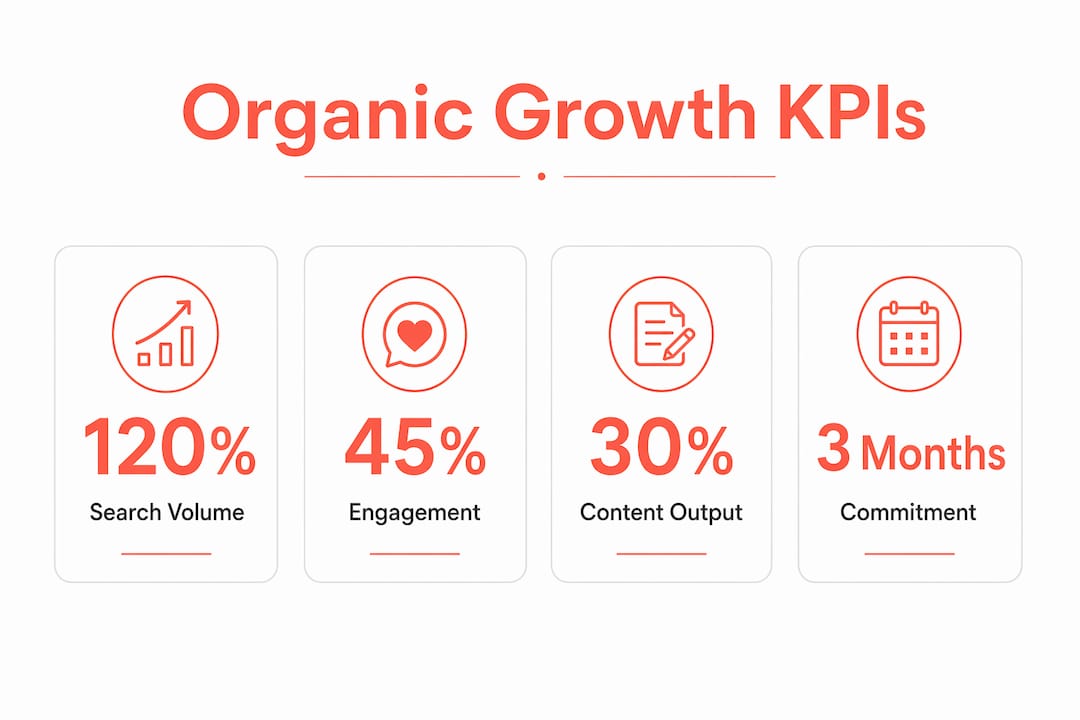
Pro Tip: Set a 90-day content commitment before evaluating organic performance. Track output rate (posts published, emails sent) as a leading indicator, not just traffic or conversions.
Moormarketing’s mentoring approach addresses this directly. Rather than handing clients a generic plan, their senior strategists work through the specific obstacles each brand faces — which is why their client collaboration model produces results that generic agency retainers rarely match. For founders who want structured guidance on building organic capability, eCommerce marketing workshops offer a practical starting point.

How to measure and sustain organic growth in your brand strategy
Organic growth without measurement is just hope. The brands that sustain it treat tracking as seriously as execution.
- Brand search volume: are more people searching your brand name over time? Growth here signals genuine awareness building.
- Blended CAC: as organic channels mature, your blended cost to acquire a customer should fall. Track this monthly.
- Content output rate: how much are you actually publishing? Output is the leading indicator; traffic and conversions follow.
- Customer cohort retention: organic customers tend to retain better. Segment your cohorts by acquisition channel to confirm this in your own data.
- SEO tools: Google Search Console is free and essential. Pair it with a tool like Ahrefs or Semrush to track keyword rankings and content gaps.
| KPI | What it tells you | Review cadence |
|---|---|---|
| Brand search volume | Awareness growth over time | Monthly |
| Blended CAC | Organic channel efficiency | Monthly |
| Content output rate | Execution consistency | Weekly |
| Cohort retention by channel | Organic vs paid customer quality | Quarterly |
| Organic traffic share | Dependency on paid vs owned channels | Monthly |
McKinsey’s Invest, Create, Perform framework applies directly here: allocate resources to organic capability, create content and community systematically, then measure performance to reallocate. Companies that follow this cycle consistently outperform those that treat organic as a set-and-forget activity. Organic lead generation works the same way for service-oriented brands — the process needs to be systematic, not sporadic.
What Moormarketing clients show about organic growth in practice
Moormarketing’s client results demonstrate what happens when organic strategy is built deliberately rather than bolted on as an afterthought.
- A new toy retailer reached $2 million in monthly sales after Moormarketing built and executed a structured growth strategy combining organic brand positioning with targeted paid amplification.
- A global furniture brand scaled to $3 million a month, with organic brand equity playing a central role in sustaining margins as paid costs rose.
- One client grew her revenue to the point where she could leave full-time employment — a result driven by compounding organic channels, not a single ad campaign.
The pattern across these cases is consistent: organic foundations were built first, giving paid spend somewhere to land. Content, community, and brand positioning created the conditions for paid to perform efficiently. That sequencing — organic moat, then paid acceleration — is the eCommerce growth strategy Moormarketing applies across its client base.
For new Australian founders, the lesson is straightforward. Organic growth is not the slow, unglamorous alternative to paid advertising. It is the foundation that makes everything else work better and cost less over time.
If you are building a new brand and want a strategy that compounds rather than evaporates, Moormarketing’s senior strategists can help you build it from the ground up. Explore the eCommerce growth guide to see the frameworks in action, or work with the team directly to get a plan built around your specific brand.
Key takeaways
Organic growth is the most durable foundation a new brand can build — it compounds over time, reduces paid dependency, and produces customers who retain better and cost less to acquire.
| Point | Details |
|---|---|
| Organic growth compounds | Content, SEO, and email build assets that keep working long after creation. |
| Brand identity stays yours | Organic growth lets founders control their story without investor dilution. |
| Sequence matters | Build organic audiences before layering paid spend for maximum efficiency. |
| Measure leading indicators | Track content output rate and blended CAC monthly, not just traffic. |
| Moormarketing results | Clients have reached $2 million in monthly sales for a new toy retailer and $3 million a month for a global furniture brand, using structured organic and paid strategies. |