

A growth hacking strategy is a structured, experiment-driven approach that startups and small businesses use to achieve rapid, cost-effective growth by testing and optimising every stage of the customer journey. The term was coined in 2010 and has since evolved into a rigorous discipline that blends marketing, product development, and data analytics into a single, unified process. Unlike traditional marketing, growth hacking treats every customer touchpoint as an experiment. Techniques like A/B testing, referral loops, and activation optimisation sit at the core of the method. Moormarketing applies this exact thinking to eCommerce brands, helping clients move from flat revenue to compounding growth through disciplined, data-led experimentation.
How does growth hacking differ from traditional marketing?
Traditional marketing prioritises brand awareness and reach. Growth hacking prioritises measurable, rapid movement through the customer lifecycle, and it does so with far fewer resources.
The mindset difference is the sharpest distinction. Traditional campaigns are planned months in advance, run for a fixed period, and measured after the fact. Growth hacking runs weekly experiments, kills what fails, and scales what works within the same cycle. The fastest-growing businesses iterate experiments rapidly instead of spending heavily on campaigns.

Growth hacking also sits inside the product, not beside it. A traditional marketing team runs ads and manages content. A growth team changes onboarding flows, adjusts in-app prompts, and tests checkout sequences. That access to the product experience is what separates genuine growth hacking from standard digital marketing.
| Feature | Traditional marketing | Growth hacking |
|---|---|---|
| Primary goal | Brand awareness and reach | Measurable growth across the full funnel |
| Time horizon | Quarterly or annual campaigns | Weekly sprint cycles |
| Team structure | Marketing silo | Cross-functional: marketing, product, engineering |
| Resource use | Large budgets, broad channels | Low-cost experiments, targeted channels |
| Success metric | Impressions, reach, share of voice | Activation rate, retention, revenue per user |
Pro Tip: If your growth team cannot change the product experience, you are running digital marketing, not growth hacking. Push for cross-functional access before you start.
What are the key components of a growth hacking framework?
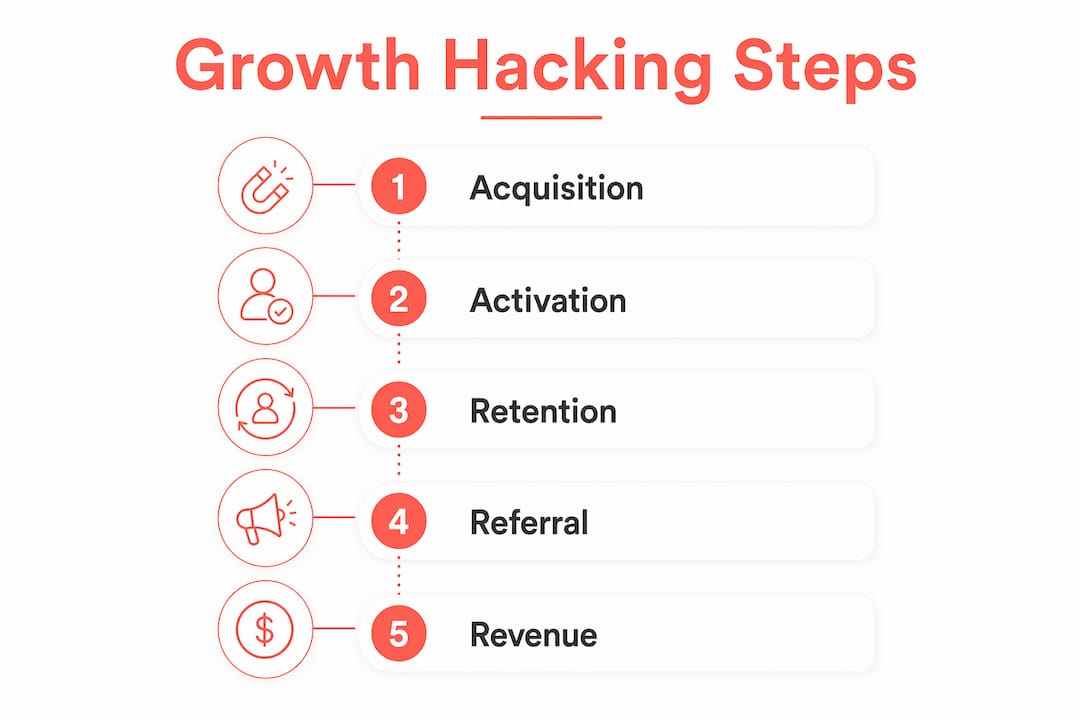
The AARRR funnel, developed by venture investor Dave McClure, is the standard framework for structuring a growth hacking approach. AARRR stands for Acquisition, Activation, Retention, Referral, and Revenue. Optimising the full funnel drives sustainable growth and avoids vanity metric traps like traffic counts that never convert.
Each stage of AARRR represents a distinct bottleneck. Most early-stage startups over-invest in acquisition and neglect activation. Shortening time from signup to first value provides the biggest leverage point for early-stage businesses. A user who reaches their first meaningful outcome within minutes is far more likely to return, refer others, and pay.
Beyond the funnel, sophisticated growth teams focus on building growth loops. A growth loop turns the output of one acquisition cycle into the input for the next. A referral programme is the clearest example: a new user invites a friend, that friend becomes a user, and the cycle repeats. Growth loops create compounding returns whereas funnel analysis serves only as a diagnostic tool.
Your north-star metric anchors the entire framework. This is the single number that best captures the value your product delivers to customers. Every experiment you run should connect back to moving that number.
Key components of an effective growth hacking strategy:
- North-star metric: one number that reflects real customer value, not vanity data
- AARRR funnel mapping: identify which stage is the biggest bottleneck right now
- Growth loops: design systems where existing customers generate new customers
- Experiment backlog: a prioritised list of hypotheses ranked by potential impact
- ICE scoring: rate each experiment on Impact, Confidence, and Ease before committing
- Content marketing loops: SEO-driven content that compounds inbound traffic over time
- Customer retention focus: retaining one existing customer costs far less than acquiring a new one
Pro Tip: Pick one bottleneck in your AARRR funnel and run every experiment against it for four weeks before moving to the next stage. Spreading experiments across all five stages at once produces noise, not insight.
How to implement a growth hacking strategy step by step
Implementation starts with team structure. Cross-functional teams that include marketing, product, and engineering achieve better results by embedding experiments directly into the product experience. If you are a solo founder or a small team, this means you need at least basic access to your website’s backend or app code. Without it, your experiments are limited to ad copy and landing pages.
The weekly sprint is the operational engine of growth hacking. Weekly sprint discipline using ICE scoring for prioritisation, building and launching experiments midweek, and reviewing data on Fridays enforces rapid iteration and prevents wasted effort. Each Friday review produces a binary decision: scale the experiment or kill it. There is no middle ground.
Here is a practical implementation sequence for startups and small businesses:
- Map your current funnel. Identify where customers drop off using analytics tools like Google Analytics 4 or Hotjar.
- Set your north-star metric. Choose one number that reflects genuine customer value, such as weekly active users or repeat purchase rate.
- Build your experiment backlog. Write at least ten hypotheses. Score each one using ICE: Impact (1–10), Confidence (1–10), Ease (1–10). Run the highest-scoring experiment first.
- Assemble your cross-functional team. Include at least one person who can change the product or website experience, not just the marketing channels.
- Run your first sprint. Build the experiment on Monday or Tuesday. Launch by Wednesday. Collect data through Thursday. Review on Friday.
- Scale or kill. If the experiment moves your north-star metric, allocate more resources. If it does not, document the learning and move to the next hypothesis.
- Build loops, not just funnels. Once you find a tactic that works, redesign it as a loop so it generates its own inputs.
A critical pitfall is attempting growth hacking solely through marketing channels without the capacity to modify the product experience. This limits growth opportunities to surface-level changes and misses the compounding gains that come from product-integrated experiments.
Pro Tip: Your first sprint will feel slow. That is normal. The value of the sprint model compounds over time as your team gets faster at building, launching, and reading experiments.
Examples and benefits of growth hacking for startups
The most cited early example of a growth hacking technique is Hotmail’s email footer, which turned every sent email into an acquisition channel. The mechanism was simple: a line of text at the bottom of every message invited recipients to sign up. That single product change drove millions of sign-ups without a dollar spent on advertising. The lesson is not the tactic itself. The lesson is that the product became the distribution channel.
Community seeding is another proven technique. Early-stage businesses identify where their ideal customers already gather, whether that is a Reddit community, a Facebook group, or an industry forum, and they provide genuine value there before promoting anything. This builds trust and generates organic word-of-mouth that paid ads cannot replicate.
SEO content marketing and referral-based viral loops remain highly effective and cost-efficient growth tactics in 2026. Content marketing delivers long-term inbound traffic while referral programmes exploit network effects. Both are loops: content attracts readers who share content, and referred users refer more users.
AI-enabled tools now accelerate personalisation at scale, faster hypothesis generation, and adaptive messaging. AI increases the speed and precision of growth experiments without changing the underlying fundamentals. The discipline of testing, learning, and iterating remains the same.
The core benefits of growth hacking for startups and small businesses:
- Lower cost of growth: experiments replace expensive campaigns, reducing customer acquisition cost
- Speed: weekly cycles compress the learning curve that traditional marketing stretches over quarters
- Compounding returns: loops and referral systems generate growth that accelerates over time
- Product improvement: embedding experiments in the product makes the product better, not just the marketing
- Data clarity: every experiment produces a decision, which builds a library of what actually works for your specific audience
Key takeaways
A growth hacking strategy works because it treats every customer touchpoint as a testable experiment, combining product access, cross-functional teams, and weekly sprint cycles to produce compounding growth.
| Point | Details |
|---|---|
| Definition | Growth hacking is a cross-disciplinary, experiment-driven process covering acquisition, activation, retention, referral, and revenue. |
| Framework | The AARRR funnel maps the full customer lifecycle; your north-star metric anchors every experiment to real value. |
| Team structure | Cross-functional teams with product access outperform marketing-only teams by embedding experiments in the product itself. |
| Sprint discipline | Weekly ICE-scored sprints with a binary scale-or-kill decision enforce rapid learning and prevent wasted effort. |
| Growth loops | Loops generate compounding returns by turning acquisition outputs into new inputs, unlike linear funnel tactics. |
What I have learned about growth hacking that most guides miss
Most articles on growth hacking list tactics. Referral programmes, SEO content, A/B testing. The list is not wrong, but it misses the point entirely. The tactic is never the advantage. The speed of learning is.
I have watched businesses run the right experiment at the wrong cadence and get nothing from it. They test something for six weeks, see ambiguous results, and move on without a clear decision. The weekly sprint model exists precisely to prevent that. When you commit to a Friday review and a binary outcome, you stop tolerating ambiguity and start accumulating real knowledge about your customers.
The other thing most guides get wrong is the funnel versus loop distinction. Funnels are useful for diagnosis. They tell you where customers are leaving. But funnels do not grow by themselves. Loops do. The businesses I have seen achieve genuine compounding growth are the ones that redesigned their acquisition tactics as self-reinforcing systems. A referral feature, a share mechanic, a content loop that attracts the exact customer who will then create more content. That is where the real leverage lives.
In 2026, AI tools make hypothesis generation and personalisation faster than ever. But they do not replace the discipline. If your team cannot commit to a weekly sprint rhythm and a clear north-star metric, AI just accelerates the chaos. Get the process right first, then use the tools to go faster.
— Liza
How Moormarketing helps you build a growth engine
Moormarketing works with eCommerce businesses that are ready to move beyond guesswork and build a real growth system. The team brings senior strategists, not junior account managers, to every engagement. That means the frameworks you get are built for your specific funnel, your specific bottlenecks, and your specific customer base.

If you want to apply growth hacking principles to your eCommerce store, the eCommerce growth strategy service is the right starting point. For founders who want hands-on coaching through the sprint process, the eCommerce marketing workshops provide structured, practical sessions that move from theory to live experiments fast. Moormarketing has helped brands reach $2 million and $3 million in monthly revenue by applying exactly these methods.
FAQ
What is a growth hacking strategy in simple terms?
A growth hacking strategy is a structured process of running rapid, low-cost experiments across every stage of the customer journey to find and scale what drives the fastest growth. It combines marketing, product development, and data analysis into a single, cross-functional discipline.
How does growth hacking differ from digital marketing?
Growth hacking embeds experiments directly into the product experience, including onboarding flows, in-app prompts, and checkout sequences, whereas digital marketing focuses on external channels like ads and content. Without access to modify the product, growth hacking becomes standard digital marketing.
What are the most effective growth hacking techniques in 2026?
Product-led growth loops, community seeding, SEO content marketing, and activation optimisation are the most effective techniques for startups in 2026. Shortening the time between sign-up and first customer value delivers the biggest early-stage leverage.
How long does it take to see results from growth hacking?
The sprint model produces a learning decision every week, but meaningful revenue impact typically builds over two to three months as winning experiments compound. Speed of learning, not speed of results, is the primary advantage.
What is the AARRR funnel and why does it matter?
AARRR stands for Acquisition, Activation, Retention, Referral, and Revenue. It maps the full customer lifecycle and helps growth teams identify which stage is the biggest bottleneck, preventing the common mistake of focusing only on traffic while ignoring activation and retention.