

A post-purchase upsell is a targeted offer shown after a customer completes checkout but before they land on the order confirmation screen, letting them add a product without re-entering payment details. For most Shopify merchants, the fastest path is a thank-you page app block; if you have developer resources, Shopify’s post-purchase checkout extension gives more control. Either way, expect a real but modest lift in average order value once the offer fits the original purchase.
TL;DR:
- Most successful post-purchase upsells recommend low-cost, complementary products priced at 15 to 40% of the initial order, aiming to maximize conversion.
- One-click offers tend to convert better but face gateway limitations on some Shopify Plus setups, while thank-you page upsells are easier to implement without developer help.
- Set up the funnel with a real test order to ensure the offer displays correctly, the changes apply to the order, and revenue is properly tracked before full deployment.
- Running a holdout test on roughly 10% of customers over 90 days provides accurate insights into the true impact of upsell offers on revenue and retention.
- A narrow, data-driven approach focusing on a single SKU and segmenting first-time versus repeat buyers proves more effective than broad, untested upsell strategies.
Table of Contents
- What is a post purchase upsell and which type should you use?
- Why bother with post purchase upsells at all?
- How do you set up a post purchase upsell on Shopify?
- What should you offer and how should you price it?
- How do you measure whether your upsell is actually working?
- What has Moor Marketing seen work in real Shopify accounts?
- Why most merchants get post-purchase upsells backwards
- Ready to stop guessing which offers actually add revenue?
- Where to check the technical details yourself
- Sources
What is a post purchase upsell and which type should you use?
The two main formats work differently under the hood, and picking the wrong one wastes weeks of setup.
One-click post-purchase offers appear in the gap between payment and the order status page. The customer taps once and the item gets added to their existing order, using the card details they already entered. No new payment form, no second transaction. Shopify’s own post-purchase checkout extension framework is built specifically for this moment.
Thank-you page upsells sit further down the funnel, on the order status page itself. Some of these run as a genuinely separate purchase, meaning the shopper enters payment again, which adds friction but also broadens what you can offer.
- One-click offers convert better because there’s no new checkout step to abandon.
- Thank-you page blocks are easier to set up for merchants without a developer.
- One-click extensions currently have gateway restrictions on some Shopify Plus setups, so test before building your funnel around them.
- Apps that support both formats in one dashboard cut the number of tools you need to manage.
Why bother with post purchase upsells at all?
The moment right after checkout is the highest-intent window a merchant gets. The customer has already decided to trust you with their card, and Bluecore’s research found that product recommendations can account for as much as 31% of ecommerce revenue in some studies, largely because this window gets ignored.
The number that matters: well-built post-purchase email flows can lift 90-day repeat purchase rates by 25 to 40 percent and generate $4 to $9 in attributed revenue per recipient within 60 days.
Complementary, low-cost add-ons perform best here, not your highest-margin hero product. The gains disappear fast when merchants skip testing, pitch something unrelated to the original cart, or add so much friction that the customer bails before finishing.
How do you set up a post purchase upsell on Shopify?
Most merchants overthink this. The app route takes an afternoon; the developer route takes longer but gives you more control over the offer logic.
App route (most merchants):
- Pick an upsell app and build your offer funnel inside it, choosing which product triggers which recommendation.
- Add the app’s block to both the Thank You page and Order Status page inside Shopify’s theme editor. This step gets skipped constantly. Oxify’s setup research points to missing block placement as the single most common reason a working offer never actually appears to customers.
- Activate the funnel and place a real test order to confirm the offer displays and adds correctly to the order.
Developer route (post-purchase extensions):
- Generate the checkout extension using Shopify’s CLI and scaffold the offer UI.
- Test the flow end-to-end on a development store before touching anything live.
- Calculate the changeset, accounting for tax and shipping with Shopify’s helper functions, then sign it server-side.
- Request access to enable the extension on a live store, since Shopify gates this for production use.
Pro Tip: Whichever route you choose, place one real test order before launch and check three things: the offer renders, the changeset actually applies to the order total, and the upsell revenue shows up correctly attributed in your reports. Skipping this is how merchants discover a broken funnel two weeks and several hundred missed offers later.
What should you offer and how should you price it?
The offer itself does more work than the app you use to deliver it. Get this wrong and even a flawless one-click flow converts poorly.
- Offer something complementary to what’s already in the cart, not just whatever has the fattest margin.
- Favour low fulfilment complexity: items you can ship in the same box, without extra packaging or a separate warehouse pick.
- Price the upsell well below the original order value. Most merchants land somewhere between 15 and 40% of the initial cart total.
- Discount modestly rather than deeply. A 10 to 20% saving on the add-on reads as generous without training customers to expect it everywhere.
- Consider partner-funded offers or a gift-after-purchase mechanic, which Tyviso’s research on post-purchase monetisation flags as a way to add incremental revenue without discounting your own core catalogue.
- Keep the copy specific: name the exact benefit (“finish the set” or “protect it for 12 months”), not a generic “you might also like.”
- Exclude anyone who already bought the item, and suppress the offer entirely below a minimum cart value where the margin doesn’t justify the friction.
Pro Tip: Segment by first-time versus repeat buyer. A first-time customer responds better to a low-risk, low-price add-on; a repeat buyer will often take a bundle or subscription upsell you’d never show a stranger.
How do you measure whether your upsell is actually working?
Track three numbers weekly: upsell conversion rate, incremental revenue per order, and refund rate on upsold items. If refunds climb alongside revenue, the offer is mismatched to the original purchase.
- Run a holdout: suppress the post-purchase offer for roughly 10% of new customers and compare their 30 to 90-day revenue against the group that saw it.
- Check daily for conversion rate and revenue swings that flag a broken block or a bad offer.
- Review monthly for retention and lifetime value shifts, since those take longer to show up than conversion numbers do.
Timing matters more than most merchants assume: aligning review requests and follow-up offers to actual delivery rather than order date more than doubles early-send conversion rates.
A quarterly holdout, run over a full 90-day window, isolates the funnel’s real impact from noise created by seasonal campaigns or paid acquisition spikes.
What has Moor Marketing seen work in real Shopify accounts?
Post-purchase revenue rarely comes from a single clever offer. It comes from treating the moment after checkout as part of the funnel that helped land a $2 million month for a toy retailer and $3 million a month for a global furniture brand, not as an afterthought bolted onto a thank-you page.
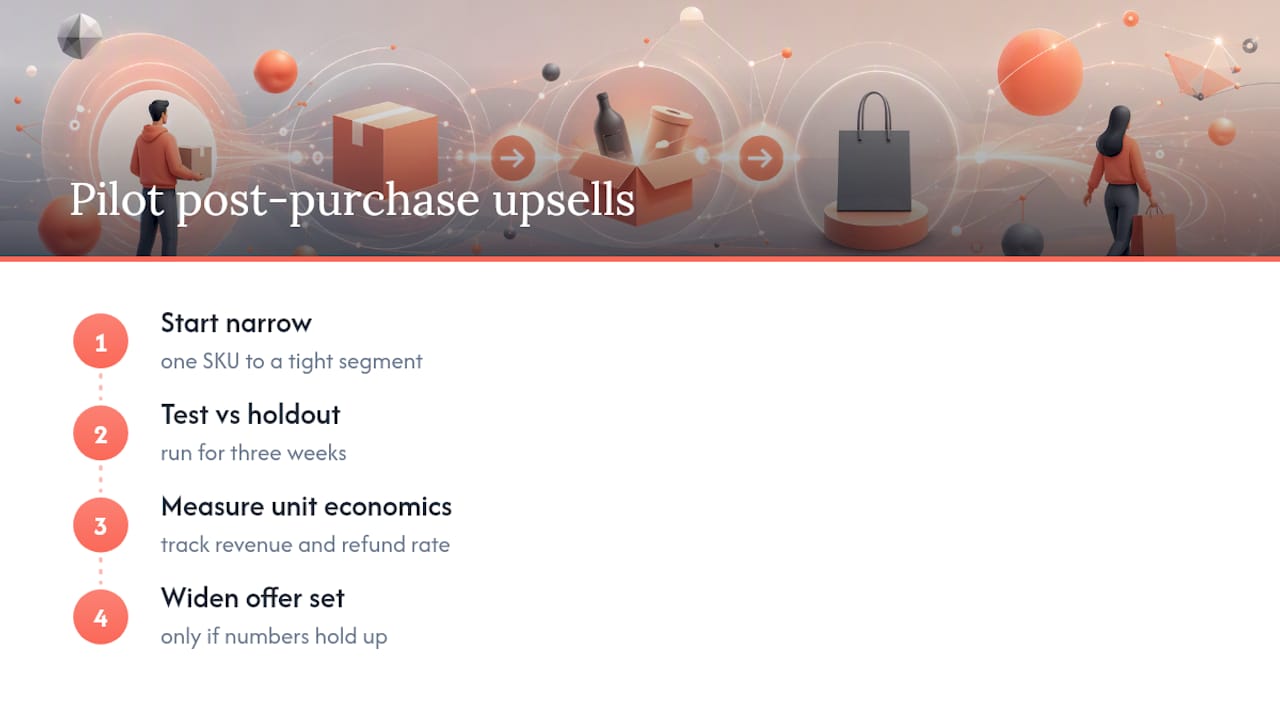
A single SKU, shown to a single tightly defined segment, tested against a genuine holdout, tells you more in three weeks than a dozen untested offers ever will. Prove the unit economics on that narrow slice before spending a cent on broadening it.
Moor Marketing runs pilots this way deliberately. Start narrow, measure refund rate alongside revenue so a discount doesn’t quietly erode margin, then widen the offer set only once the numbers hold up. It’s the same discipline behind the ecommerce growth frameworks that have taken existing brands and roughly doubled their revenue, and it applies just as directly to a $30 thank-you page offer as it does to a six-figure ad account.
Author: Liza
Why most merchants get post-purchase upsells backwards
Merchants tend to treat post-purchase upsells as a technical checkbox: install the app, turn it on, move on. That’s backwards.
The conventional advice to “test everything” is also weaker than it sounds without a holdout. Comparing upsell buyers against non-buyers is not a test. It’s confirmation bias, because the people who click the offer were always going to spend more.
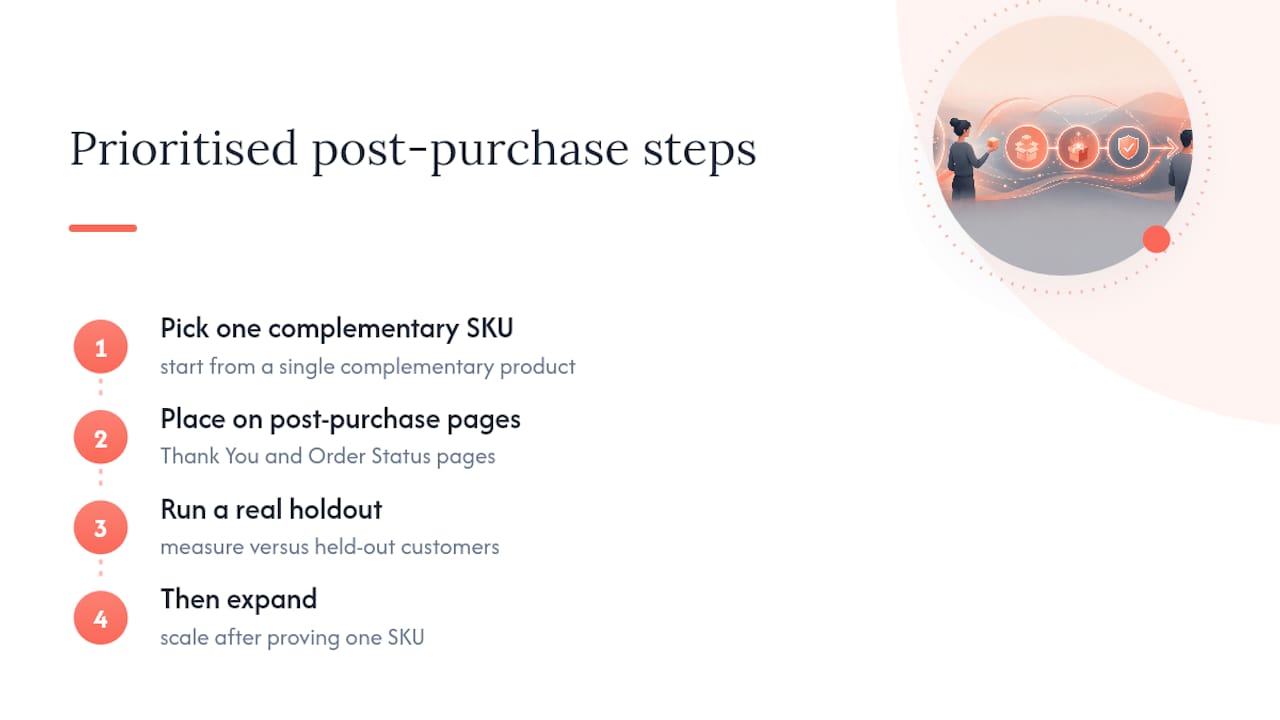
If you’re starting from zero, prioritise in this order: pick one complementary SKU, place it on both the Thank You and Order Status pages, run a real holdout, then expand. Skip straight to a catalogue-wide upsell strategy and you’ll spend months optimising an offer that was never going to convert.
— Liza
Ready to stop guessing which offers actually add revenue?
Moor Marketing builds post-purchase funnels the same way it builds every part of a Shopify growth strategy: pilot first, prove the number, then scale. Instead of installing an app and hoping the default offer performs, you get a strategist who segments your customer base, picks the right SKU pairings, and sets up the holdout test that tells you whether the funnel is genuinely adding revenue or just skimming credit from sales that were already happening.
That’s the difference between a thank-you page block left on autopilot and a funnel actively managed as part of your broader retention and growth plan, alongside work like Facebook and social advertising that feeds the traffic in the first place. If you want a senior strategist to audit your current post-purchase setup and build a pilot funnel around it, book a session with Moor Marketing and get a plan built around your actual order data, not a generic template.
Where to check the technical details yourself
For the extension build process and access requests, see Shopify’s developer documentation. For app-based setup steps, Oxify’s walkthrough covers the block placement step in detail, and Ecommerce Times breaks down flow-based benchmarks.
Sources
- Build a post-purchase product offer checkout extension — Shopify Dev
- How to Build a Post-Purchase Email Flow That Maximizes LTV in 2026 – Ecommerce Times
- How to Add an Upsell to Your Shopify Thank You Page (2026) – Oxify App
- How Post-Purchase Strategies Boost Retention – Bluecore