

Start by verifying conversion signal integrity. If tracking is broken, every other finding in your ad account audit is unreliable. Fixing pixel deduplication, Conversions API coverage, and consent signals first stops wasted spend, restores trustworthy optimisation data, and makes scaling safe. This applies to both Google Ads and Meta reviews under 2026 platform changes, where campaign types lean harder on automated bidding than ever.
TL;DR:
- Ensuring conversion signal integrity is crucial because broken tracking leads to unreliable optimization data and wasted ad spend.
- Conducting a focused audit within 60 to 90 minutes can uncover 15 to 30 percent of spending in fixable issues, primarily in the first hour.
- Verifying deduplication, event match quality, and consent signals in Meta and Google platforms is essential for trustworthy data.
- Structuring campaigns with single goals, enough conversion volume, and clear ownership enhances the effectiveness of bids and automation.
- Regular, short-term audits (weekly, monthly, quarterly) prevent long-term data and performance issues from compounding, maintaining optimal account health.
Table of Contents
- Ad account audit checklist: priority sequence for a rapid pass
- How do you check signal integrity across pixel, CAPI and consent mode?
- Is your account structure actually steerable?
- Where is your search spend actually going?
- Is creative fatigue or a landing-page mismatch hurting you?
- Do your platform numbers match your actual sales?
- How often should you audit your ad accounts?
- Moor Marketing’s take: what a senior-strategist audit finds that a checklist misses
- Why measurement, not creative, is the audit that actually moves revenue
- Book an ad account audit with Moor Marketing
- Sources
Ad account audit checklist: priority sequence for a rapid pass
Run checks in this order: signal, then structure, then creative, then bidding. Fixing tracking before touching bids is the difference between a real fix and a guess, and it’s how 2026 Google Ads audits are meant to be sequenced.
A focused 60 to 90 minute pass looks like this:
- Pull the last 30 to 90 days of data across Google Ads, Meta Ads Manager and your analytics platform.
- Check conversion tracking health — event firing, deduplication, Event Match Quality and enhanced conversions match rate.
- Scan account structure for duplicated campaigns, fragmented ad sets, and anything sitting below the learning-phase threshold.
- Export search terms and sort by spend with zero conversions.
- Eyeball creative frequency and CTR trends for fatigue.
- Reconcile platform-reported conversions against your source of truth.
Most accounts that haven’t been reviewed in six months carry the same problems: broken deduplication, five near-identical campaigns competing for the same auction, and a search terms report nobody has opened in months. A structured audit of this kind typically uncovers 15 to 30% of spend going to fixable waste, and the biggest wins usually surface in the first hour.
How do you check signal integrity across pixel, CAPI and consent mode?
Everything downstream of your ad account, bid strategy, budget pacing, creative testing, depends on accurate conversion data reaching the platform. This is the step most audits skip, and it’s the one that matters most.
Start with deduplication. Meta needs the Pixel and Conversions API firing the same event_id for a single conversion, otherwise you’ll double-count purchases and confuse the algorithm about what’s actually working. A modern Meta audit checks Event Match Quality and deduplication before touching anything else, because poor signal quality makes every optimisation decision downstream unreliable.
Here’s what to check and where:
- Meta Events Manager — look at Event Match Quality score and diagnostics for missing parameters.
- Google Tag Assistant — confirm tags fire correctly and enhanced conversions are configured per Google’s own conversion tracking guidance.
- GA4 comparison — cross-check conversion counts against platform-reported numbers for gaps.
- Consent Mode v2 status — verify
ad_storageandanalytics_storagesignals aren’t being blocked, which quietly throttles the cookie consent purposes your data relies on.
Pro Tip: Check your Event Match Quality score before you check anything else in Meta. A score under 6.0 usually means your bidding algorithm is working with dirty data, and no amount of creative testing will fix that.
Event Match Quality and deduplication thresholds are the two most practical signals for deciding whether a Meta account’s data can be trusted. Fix deduplication and missing events first. Consent and match-rate issues come next.
Is your account structure actually steerable?
Structure decides whether Google’s and Meta’s bidding systems can learn anything useful. A campaign split into six ad sets each getting a trickle of budget never reaches enough conversions to optimise properly, no matter how good the creative is.
Check three things in this order:
- Single-goal mapping. Every campaign should serve one clear business objective. If two campaigns are bidding on the same keywords or targeting the same audience, you’re competing with yourself in the auction.
- The 50-result rule. Ad sets and ad groups need roughly 50 conversion events in a rolling window to exit the learning phase reliably. Anything below that should be consolidated, not left to limp along.
- Naming, ownership and permissions. Messy naming conventions and unclear asset ownership slow down every future audit and often hide duplicate spend.
For Performance Max and Advantage+ campaigns specifically, check brand exclusions (are you paying for searches you’d get for free?) and channel distribution in the insights panel. These 2026 campaign types now expose enough channel-level reporting to actually audit them properly, which wasn’t true a couple of years ago.
Where is your search spend actually going?
Search terms and negative keywords remain the fastest recoverable win in any Google Ads review, and usually the highest-ROI fix in the entire audit, ahead of structural changes that take longer to pay off.
- Export the search terms report for the last 60 to 90 days and sort by cost, descending.
- Flag every term with meaningful spend and zero conversions. A $200 spend with no conversions on an irrelevant term is an easy negative; a $200 spend with no conversions on a relevant term might just need a landing page fix.
- Decide the right level for the negative. Account-level negatives suit clearly irrelevant terms (competitor names you don’t want, job seekers, informational queries). Campaign-level negatives suit terms that are fine for one campaign but wrong for another.
- Audit broad match hygiene. If broad match keywords keep triggering the same irrelevant terms month after month, that’s a structural problem, not a one-off negative fix.
This single exercise, done properly, tends to surface the highest immediate return of the entire audit, before you’ve touched a single bid or piece of creative.
Is creative fatigue or a landing-page mismatch hurting you?
Frequency and click-through rate tell you almost everything about creative health. When frequency climbs above typical levels in a short window and CTR starts sliding at the same time, that’s fatigue, not a targeting problem.
- Check frequency trend over the last 14 days, not just the current snapshot.
- Confirm ad formats match placement (a square image running in a Stories placement is wasted impressions).
- Verify continuity between ad copy and the landing page. If the ad promises “40% off hoodies” and the landing page opens on the homepage, that mismatch alone can crater conversion rate regardless of how good the ad looks.
- Keep three to five live variants per ad set. Fewer than that and you can’t isolate what’s working; more than that and you’re splitting the learning phase across too many entities.
Pro Tip: Don’t refresh creative the moment CTR dips. Check frequency first, if it’s under 2, the problem is probably the offer or the landing page, not fatigue.
Related reading on why ad creative quality affects ROAS covers the format-fit side of this in more depth.
Do your platform numbers match your actual sales?
Pick one source of truth, your CRM, GA4, or your Shopify dashboard, and reconcile every platform’s reported conversions against it. Without this step, you’re optimising towards numbers that might not reflect real revenue.
- Align attribution windows first. Comparing a 7-day click Meta window against a 90-day Google Ads window will never reconcile cleanly, and the “gap” you find is really just a measurement mismatch.
- Set a tolerance threshold before you start. Variance under 10% is usually noise. Variance above 20% between platform-reported conversions and your source of truth is worth investigating properly, and above that, don’t scale spend until you know why.
- Standardise attribution windows across every active campaign. Inconsistent windows between campaigns in the same account make budget comparisons meaningless.
This reconciliation step is exactly what 2026-focused Google Ads audits recommend doing before any structural or creative change, because a bidding target built on unreliable numbers guarantees an unreliable result. For a deeper walkthrough of the reconciliation process itself, see how to measure Google Ads performance.
How often should you audit your ad accounts?
An audit isn’t a once-a-year event, it’s a cadence. Practitioners increasingly treat short, recurring checks as more valuable than a single deep annual review, because small signal problems compound quickly in accounts run on automated bidding.
- Weekly (15 to 20 minutes): pacing versus budget, delivery errors, and any obvious search term anomalies.
- Monthly (45 to 90 minutes): creative performance trends, a full search terms pass, and budget pacing against goals.
- Quarterly (half a day): structural review, attribution sanity check, and, where volume allows, an incrementality read.
- Immediately, off-cycle: whenever budget jumps significantly, conversions drop suddenly, or the platform ships a major change, Consent Mode updates and Performance Max shifts both qualify.
That cadence, more than any single deep dive, is what keeps an ad account audit from becoming a fire drill.
Moor Marketing’s take: what a senior-strategist audit finds that a checklist misses
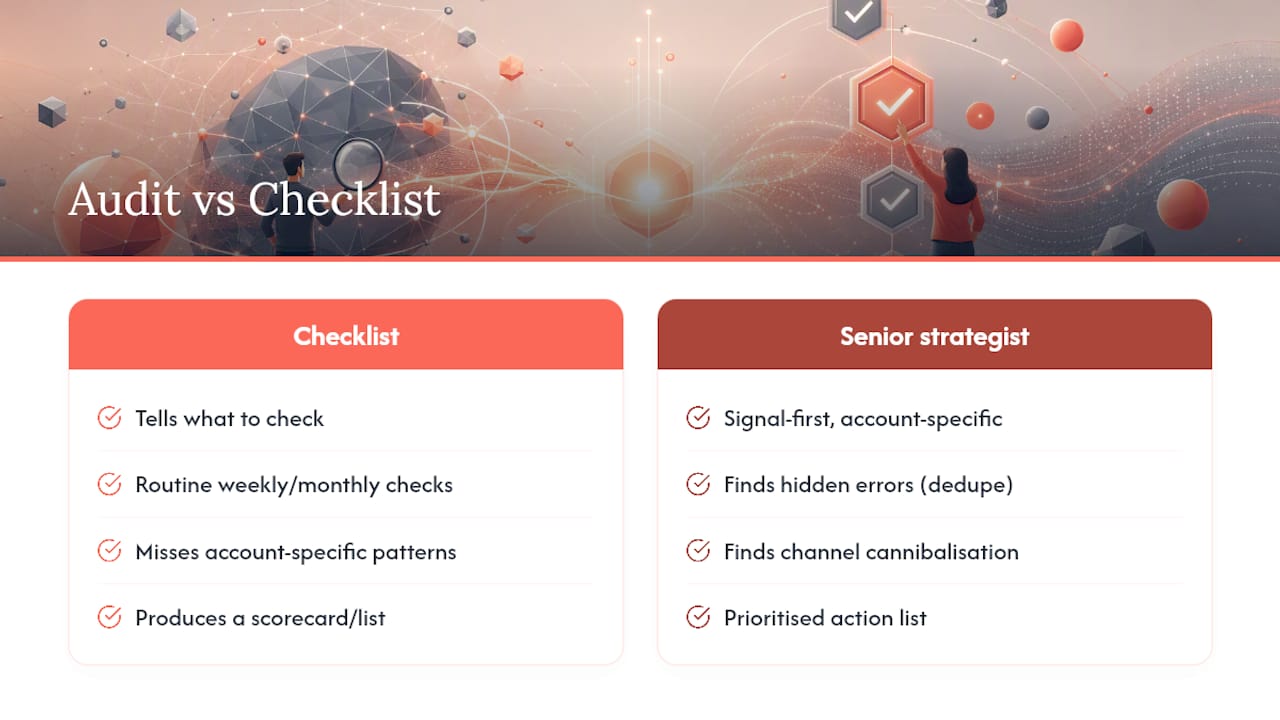
A checklist tells you what to check. It doesn’t tell you which finding actually matters for your account’s specific bidding history, budget, or category. Moormarketing’s audits start with the same signal-first sequence outlined above, but a senior strategist reviewing the account can spot patterns a template can’t: a deduplication error that’s been quietly inflating one campaign’s reported ROAS for months, or a Performance Max channel split that’s cannibalising branded search.
The deliverable is a prioritised, written action list, not a scorecard, ranked by expected impact, with remediation support for the fixes that need platform-side changes. If you can run the weekly and monthly checks yourself, do it. When the account is complex enough that structural and attribution issues are tangled together, that’s when a full ad account audit from a senior strategist earns its cost back fast.
Why measurement, not creative, is the audit that actually moves revenue
Most marketers audit backwards. They start with creative because it’s visible and easy to judge, then move to bidding, and only check tracking if nothing else explains the numbers. That order is exactly wrong. Fixing a deduplication error or a broken enhanced conversions setup improves every campaign in the account simultaneously, because it fixes the data every bidding algorithm relies on. Refreshing a tired ad only fixes that one ad.
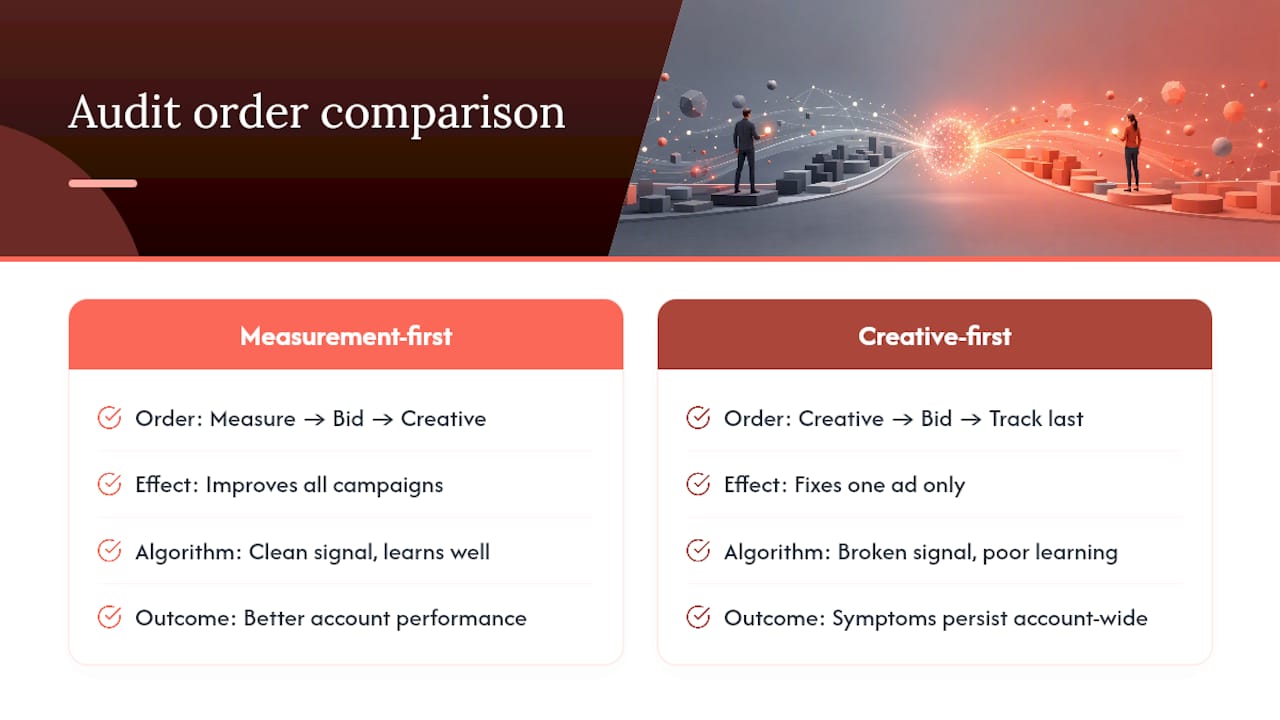
The conventional advice, “test more creative, tighten your targeting”, treats symptoms. It ignores that in 2026, both Google’s and Meta’s systems are effectively AI bidding engines being fed whatever signal your account gives them. Garbage in, garbage optimised. An account with clean signal and mediocre creative will usually outperform an account with brilliant creative and broken tracking, because the algorithm can actually learn from the first one.
If you take one thing from this: audit your measurement before you touch your budget. Everything else is downstream of that decision, and treating it as step four instead of step one is the single most common mistake in accounts that “just aren’t performing” for no obvious reason.
— Liza
Book an ad account audit with Moor Marketing
Moormarketing runs audits the way this article describes: signal first, structure second, creative and bidding last, with senior strategists doing the review instead of outsourced junior analysts running a template. That distinction matters because the fixes that compound, deduplication, match rate, structural consolidation, get missed entirely by generic checklist scans.

Engagements come in three shapes: a one-off audit for accounts that need a diagnostic and a prioritised fix list, an ongoing retainer for teams that want the audit built into monthly operations, and a mentoring program for internal marketers who want to run this process themselves with expert oversight. Every engagement ends with a written, ranked action plan and remediation support for the fixes your team can’t implement alone. If your Google or Meta account hasn’t had a proper signal check in the last quarter, start with a digital ad campaign audit or get in touch to book a review.
Sources
- Admanage
- Google Ads audit: The 2026 Checklist | MarqOps
- Google Ads Audit: A 2026 Field Guide + 12-Step Checklist · d-dat
- Google Ads support — conversion tracking setup