

Content marketing is defined as the practice of creating and distributing valuable content to attract, engage, and convert a target audience into paying customers. The role of content marketing in scaling is not a supporting tactic. It is the primary engine behind sustainable, compounding business growth. Content marketing delivers $7.65 ROI for every $1 invested, compared to $1.80 for paid advertising. That gap does not narrow at scale. It widens. Entrepreneurs and marketing professionals who treat content as infrastructure rather than a campaign expense are the ones building businesses that grow without proportionally growing their ad spend.
How does content marketing generate scalable growth and measurable ROI?
Content marketing outperforms paid advertising on every long-term efficiency metric. Organisations with documented content strategies generate three times more leads per dollar at 62% lower cost than those without one. That is not a marginal advantage. It is a structural one.
The mechanism behind this is trust. 87% of marketers report increased brand awareness from content marketing, and 76% confirm it plays an essential role in lead generation. Buyers who consume educational content from a brand are far more likely to convert than those who see a paid ad. In fact, 64% of buyers trust brands that produce educational content, rising to 73% one week after consumption. Only 4% trust traditional advertising at the same level.

Paid media produces traffic while the budget runs. The moment spend stops, so does the traffic. Content marketing works differently. A well-written article, a detailed guide, or a video tutorial continues attracting organic visitors for months or years after publication. This is the compounding effect that makes content the most cost-efficient growth channel at scale.
The table below shows how the two channels compare across key performance dimensions.
| Dimension | Content marketing | Paid advertising |
|---|---|---|
| ROI per $1 invested | $7.65 | $1.80 |
| Lead cost efficiency | 62% lower cost | Baseline |
| Traffic after spend stops | Continues compounding | Drops to zero |
| Buyer trust rate | 64–73% | 4% |
| Lead volume per dollar | 3x higher | Baseline |
The numbers make the case clearly. Content marketing for growth is not slower than paid advertising. It is more durable.
Pro Tip: Start with one content format you can produce consistently, whether that is a weekly article, a fortnightly video, or a monthly research report. Consistency compounds faster than volume.
What are best practices for scaling content marketing effectively?
Scaling content marketing means increasing volume, maintaining quality, and reducing cost per piece simultaneously. Most businesses get one or two of those right. The ones that get all three follow a documented system.
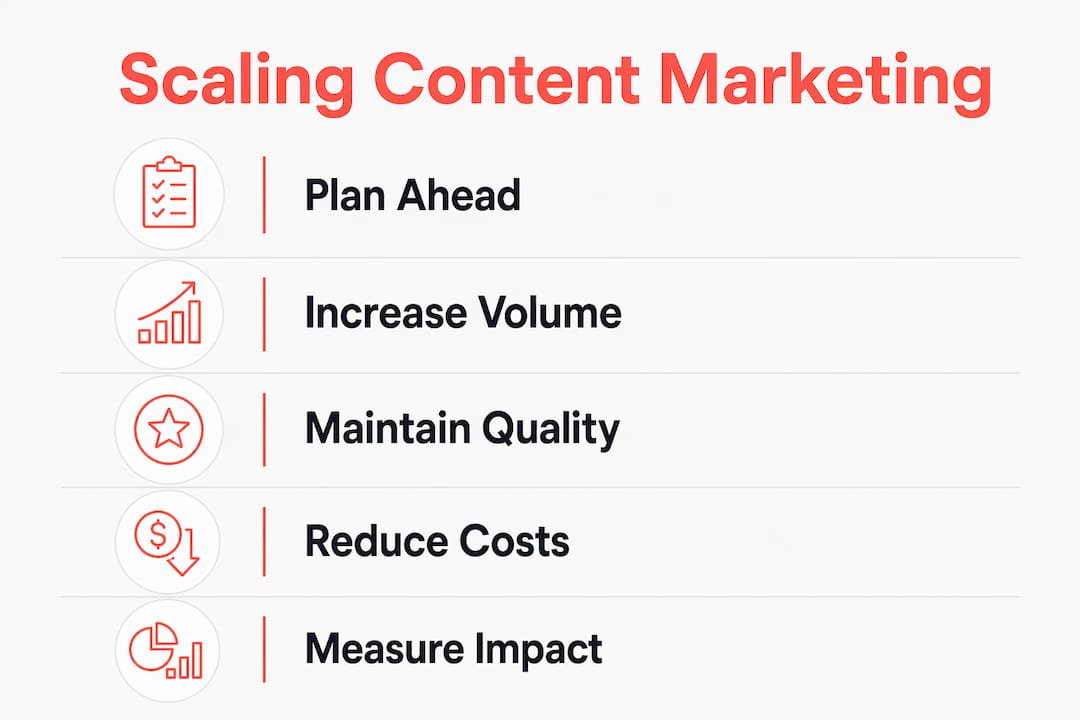
Scaling production from 10 to 50+ pieces monthly reduces cost per article by 30–40% through systematisation and specialised roles. That cost reduction does not happen by accident. It requires separating the roles of research, writing, editing, and distribution so each person works at their highest skill level without bottlenecks.
The budget allocation that supports this model is specific. The most effective split is 45% on content creation, 35% on distribution, and 20% on tools. Most businesses invert this, spending the majority on creation and almost nothing on distribution. That is the single biggest reason content programmes stall. A piece of content that nobody sees produces no return regardless of its quality.
The timeline to operational maturity is also predictable. Businesses that follow a documented content strategy typically reach full operational efficiency within 6–7 months. The first two months are the slowest. By month four, the compounding effect on organic search and brand search begins to show measurable results.
The following steps outline how to build a content system that scales:
- Document your content strategy before producing a single piece. Define your audience, your core topics, your publishing cadence, and your distribution channels.
- Build a content hub around two to three pillar topics relevant to your business. Long-form hub content drives the most organic authority and gives you material to repurpose across formats.
- Separate creation from distribution. Assign dedicated responsibility for getting content in front of audiences, not just publishing it.
- Introduce specialised roles as volume increases. A generalist writer producing 10 pieces a month cannot maintain quality at 50 pieces without support.
- Review and refine monthly. Track which content drives pipeline movement, not just page views.
Pro Tip: Build your content calendar three months in advance. This removes the weekly scramble for topics and gives your team time to produce genuinely researched, original work.
What challenges arise when scaling content marketing?
The most common failure mode in scaling content is prioritising volume over distribution. Teams celebrate hitting a publishing target of 20 articles a month while those articles sit unread because no budget or process exists to promote them. Teams that avoid this trap allocate 35–50% of their budgets to distribution to maximise the visibility of every piece produced.
The second major risk is AI-generated content without human oversight. AI tools lower production costs significantly, but inauthentic AI content can decrease brand trust by 40%. The competitive bar has not dropped because AI exists. It has risen. Generic, undifferentiated content now floods every channel. The only way to stand out is with original thinking, proprietary data, and a clear editorial voice. Every piece of AI-assisted content requires 100% human review before publication.
The third challenge is measuring the wrong things. Page views, social shares, and email open rates are not business outcomes. Executive leadership now measures pipeline contribution and customer lifetime value rather than vanity metrics. If your content reporting does not connect engagement to sales conversions and repeat purchases, you are optimising for the wrong signal.
The practical warnings for any scaling content programme are:
- Never publish content without a distribution plan attached to it.
- Never use AI-generated content without a senior editor reviewing it for accuracy, brand voice, and original insight.
- Never report on traffic alone. Report on leads, pipeline movement, and revenue attributed to content.
- Never scale volume before your quality control process is documented and tested.
How can businesses implement content marketing for compound growth?
Content marketing should be treated as long-term growth infrastructure, not a transient expense. Paid advertising is a tap. Turn it off and the water stops. Content is a well. The more you dig, the more it produces, and it keeps producing after you stop digging.
The practical implementation of this mindset starts with tracking the right compound indicators. Organic brand search volume, return visitor rate, and content-attributed pipeline value are the metrics that reveal whether your content programme is building an asset or just filling a calendar. Track these over a 6–12 month window to see the compounding effect clearly.
Original research and proprietary data are the primary differentiators in a market flooded with AI-generated content. 86% of marketers are increasing their research budgets to produce content that cannot be replicated by a language model. A survey of your own customers, an analysis of your own sales data, or a benchmark report from your industry produces content that earns links, builds authority, and positions your brand as a genuine source of knowledge.
Community and conversation amplify distribution without additional production cost. Building a layer of community engagement around your content, whether through a newsletter, a LinkedIn community, or a dedicated forum, turns passive readers into active distributors. Social media listening helps you identify where your audience already gathers and what questions they are already asking.
Account-level content engagement tagging identifies which specific pieces of content move pipeline opportunities forward. This lets you cut non-contributing assets and reinvest in the formats and topics that actually drive revenue. The result is a content programme that gets more efficient over time, not less.
| Growth stage | Primary focus | Key metric |
|---|---|---|
| Months 1–3 | Strategy and hub content | Organic traffic growth |
| Months 4–6 | Distribution and community | Lead volume and email subscribers |
| Months 7–12 | Measurement and compounding | Pipeline contribution and content ROI |
For eCommerce businesses specifically, the content marketing for ecommerce startups framework from Moormarketing provides a structured path from zero to a fully operational content programme with measurable revenue outcomes.
Key takeaways
Content marketing scales because it builds compounding organic assets that generate leads and revenue long after the initial investment, unlike paid advertising which stops the moment spend does.
| Point | Details |
|---|---|
| ROI advantage is structural | Content marketing delivers $7.65 per $1 invested versus $1.80 for paid ads. |
| Distribution is non-negotiable | Allocate 35–50% of your content budget to distribution, not just creation. |
| Quality over volume | Inauthentic AI content reduces brand trust; every piece needs human editorial review. |
| Measure pipeline, not pageviews | Link content engagement to sales conversions and customer lifetime value. |
| Compound returns take 6–12 months | Track organic brand search and pipeline contribution over time to see the real return. |
What I have learned about content marketing that most articles will not tell you
The conversation about content marketing almost always focuses on production. How many articles per month? What word count? Which formats perform best? Those questions matter, but they are the wrong starting point.
The businesses I have seen scale fastest with content are the ones that treat distribution as the primary job and creation as the input. They publish less than their competitors and get more reach because they spend real budget and real time getting each piece in front of the right people. The publishing treadmill, where you produce constantly and distribute minimally, is the most common and most expensive mistake in content marketing.
The second thing most articles skip is the measurement shift. Tracking traffic feels productive. It is not. The question that matters is: which piece of content influenced a purchase decision? That requires tagging content at the account level and connecting it to your CRM. It is more work to set up. The payoff is that you stop funding content that looks good in a dashboard and start funding content that actually closes deals.
AI has changed the production economics completely. The cost to produce a mediocre article is now close to zero. That means mediocre content has no competitive value. The only content worth producing in 2026 is content that contains something a language model cannot generate: your original data, your genuine opinion, your hard-won experience. That is the bar. Everything below it is noise.
The ecommerce growth strategy frameworks Moormarketing uses with clients are built on this principle. Content is not a marketing activity. It is a revenue asset. Build it like one.
— Liza
How Moormarketing helps businesses scale with content
Content marketing produces its best results when strategy, production, and distribution work as a single system. Most businesses have pieces of that system. Few have all three working together from the start.
Moormarketing works directly with eCommerce businesses to build content programmes that generate measurable revenue, not just traffic. The eCommerce marketing workshops cover the full content scaling framework, from documented strategy and hub content creation through to distribution, community building, and pipeline measurement. Every workshop is run by senior strategists, not outsourced to junior staff. If you want a content programme that compounds over time and connects directly to revenue, work with Moormarketing to build it properly from day one.
FAQ
What is the ROI of content marketing compared to paid ads?
Content marketing delivers an average ROI of $7.65 for every $1 invested, compared to $1.80 for paid advertising. Organisations with a documented content strategy also generate three times more leads per dollar at 62% lower cost.
How long does it take for content marketing to show results?
Most content programmes reach operational maturity and measurable compounding returns within 6–7 months. Organic brand search growth and pipeline contribution are the clearest indicators of progress during this period.
What is the biggest mistake businesses make when scaling content?
The most common mistake is allocating nearly all budget to content creation while neglecting distribution. Teams that scale successfully allocate 35–50% of their content budget to distribution to ensure each piece reaches its intended audience.
Does AI-generated content hurt brand trust?
Inauthentic AI-generated content can decrease brand trust by 40%. AI tools are useful for reducing production costs, but every piece requires full human editorial review to maintain accuracy, brand voice, and original insight.
What metrics should I use to measure content marketing success?
Measure pipeline contribution, content-attributed revenue, and customer lifetime value rather than page views or social shares. Account-level engagement tagging connects specific content pieces to sales outcomes and reveals which assets actually drive revenue.