

A media buying strategy is the plan that defines where, how, and what ad inventory to purchase, along with how to manage and optimise campaigns to achieve goals at the lowest cost. It covers platform selection, buying method, audience targeting, pricing model, and performance targets. Whether you are running Google Ads, Facebook Ads, or YouTube pre-rolls, every placement decision sits inside this plan. Without it, ad spend becomes guesswork and budgets disappear without measurable return. A well-built media buying strategy connects your business goals to every dollar spent on advertising.
What is a media buying strategy and how does it work?
A media buying strategy is the operational framework behind every paid advertising campaign. It answers three questions: where will ads appear, how will placements be purchased, and how will performance be measured and improved. The industry term for the broader discipline is media buying, and it sits within the wider world of paid media strategy.
A media buy is the purchase of ad space or time, negotiated to reach target audiences cost-effectively across traditional and digital platforms. Pricing is managed through models including CPM (cost per thousand impressions), CPC (cost per click), or CPA (cost per acquisition), depending on the campaign objective. Each model suits a different goal. CPM works for brand awareness, CPC for traffic, and CPA for direct conversions.
The strategy also defines how campaigns are monitored after launch. Effective media buying is not a single transaction. It is a system that includes monitoring, optimising performance, and reporting to keep campaigns on track. Marketers who treat a media buy as a one-off purchase consistently underperform those who build ongoing review cycles into their process.
How does media buying differ from media planning?
Media planning and media buying are two distinct roles that work together. Confusing them leads to gaps in execution and wasted budget.
Media planning defines marketing goals, budgets, and audiences. Media buying executes the purchasing and optimisation based on that plan. Planning sets the map; buying manages the trip. A media planner analyses audience data, selects channels, and sets the budget framework. A media buyer then negotiates placements, activates campaigns, and adjusts bids based on live performance.
| Aspect | Media planning | Media buying |
|---|---|---|
| Primary focus | Strategy and audience analysis | Execution and placement purchase |
| Key outputs | Channel mix, budget allocation, KPIs | Confirmed placements, live campaigns |
| Tools used | Audience research, market data | DSPs, ad platforms, publisher portals |
| Timing | Before campaign launch | During and after campaign launch |
| Success measure | Plan accuracy and goal alignment | Cost efficiency and performance results |
The two roles overlap most during campaign setup. A planner who does not communicate clearly with the buyer produces a plan that cannot be executed as written. The best campaigns treat planning and buying as a continuous conversation, not a handover.
What are the main types of media buying methods?
Two methods dominate the media buying process: direct buying and programmatic buying. Each suits different campaign goals, budgets, and team capabilities.
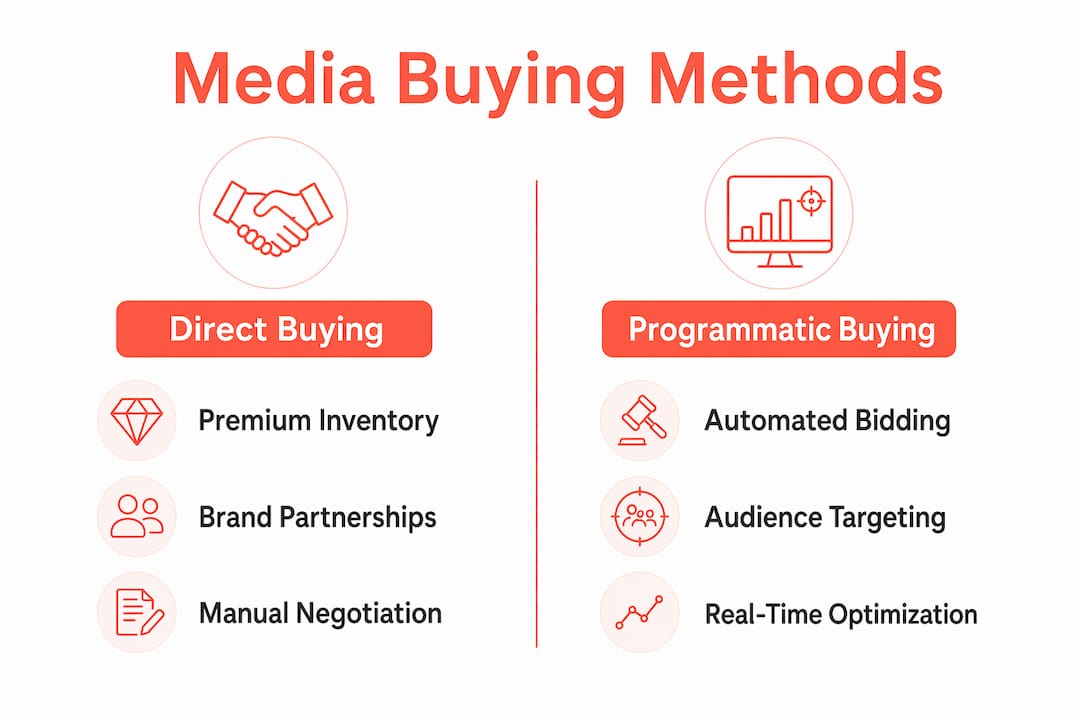
Direct buying involves negotiating placements directly with publishers or platforms. A media buyer contacts a website, podcast network, or broadcaster and agrees on placement, price, and duration. Direct buying gives you full control over where your ad appears and often includes guaranteed inventory. It works well for brand partnerships, sponsorships, and campaigns where brand safety is a priority.
Programmatic buying uses automated technology to purchase ad impressions through demand-side platforms (DSPs) such as The Trade Desk or Google Display and Video 360. Instead of negotiating with a human, the DSP bids on impressions in real time based on audience signals and bidding rules you set.
- Real-time bidding (RTB) is the auction mechanism inside programmatic. The process completes in under 120 milliseconds, meaning an ad impression is evaluated, bid on, and served before a page finishes loading.
- DSP strategy involves configuring data signals, targeting criteria, and bidding constraints that determine which impressions are purchased in real time.
- Programmatic offers superior scale and targeting precision but requires more technical setup and ongoing management.
- Direct buying offers relationship-based advantages including premium placements, fixed pricing, and creative control.
- Common pricing models across both methods include CPM, CPC, and CPA, with CPM most common in programmatic display.
Understanding how dayparting works in digital advertising helps you apply time-based controls to both direct and programmatic buys, reducing waste during low-conversion periods.
Pro Tip: Use direct buying for high-value brand partnerships and programmatic for audience-driven performance campaigns. Running both in parallel gives you brand control and scale without sacrificing either.
How to create an effective media buying strategy
Building a media buying strategy from scratch follows a clear sequence. Skipping steps early creates problems that are expensive to fix mid-campaign.
-
Define your performance targets first. Set specific goals before touching a platform. Are you driving awareness, traffic, or purchases? Your goal determines your pricing model, platform choice, and success metrics. Vague objectives produce vague results.
-
Research your audience and select platforms accordingly. A B2B audience skews toward LinkedIn. A younger consumer audience skews toward Meta and TikTok. An intent-driven audience is best reached through Google Search. Platform selection follows audience behaviour, not personal preference.
-
Allocate budget with a testing reserve. Split your budget between proven placements and a testing pool. A common approach is to allocate the majority to known performers and reserve a portion for new placements or formats. Never spend the full budget on untested channels from day one.
-
Negotiate or configure your placements. For direct buys, negotiate rate cards, added value, and exclusivity. For programmatic, configure your DSP with audience segments, bid caps, frequency limits, and brand safety settings. Both require deliberate setup, not default configurations.
-
Build your measurement system before launch. Planning documents alone do not ensure execution efficiency without integrated measurement and attribution frameworks. Set up conversion tracking, define attribution windows, and establish a reporting cadence before the first impression is served.
-
Run, review, and adjust on a fixed cycle. Weekly reviews catch problems early. Monthly reviews assess trend performance. Quarterly reviews inform budget reallocation. Strategic alignment upfront is critical, but ongoing alignment through data is what separates profitable campaigns from expensive ones.
Pro Tip: Document every optimisation decision and the result it produced. After three months, this log becomes your most valuable planning asset for the next campaign cycle.
Avoid the most common pitfall in the media buying process: under-planning by focusing on negotiation and budget management without aligning sufficiently to marketing goals. Placement economics matter, but they cannot compensate for a strategy that targets the wrong audience or measures the wrong outcome.
What are the best media buying tips for 2026?
The digital advertising environment in 2026 rewards precision and patience over volume and speed. These techniques reflect what is working now across eCommerce and performance marketing campaigns.
- Use automation with defined guardrails. DSP automation improves efficiency, but only when bidding rules and audience parameters are set correctly. Automation without constraints wastes budget on low-quality impressions.
- Apply contextual targeting alongside audience targeting. Contextual signals place ads next to relevant content, which improves engagement without relying solely on third-party cookie data.
- Implement frequency capping on every campaign. Showing the same ad to the same person more than three times in a week typically drives diminishing returns and increases negative brand sentiment.
- Use dayparting to concentrate spend during high-conversion windows. Analyse your conversion data by hour and day, then shift budget toward periods where your audience is most likely to act.
- Align media buying with your eCommerce retargeting cycle. An eCommerce retargeting strategy that sequences prospecting, consideration, and conversion ads across channels produces better results than isolated campaigns.
- Test before scaling. Run new placements, formats, or audiences at low spend for two to four weeks. Document what works, then scale with confidence.
Cross-channel media buying is about message consistency, connected timing, and frequency across placements rather than being everywhere at once. Precision in targeting and sequencing enhances media buy effectiveness far more than simply increasing the number of channels.
Key takeaways
A media buying strategy works because it connects business goals to specific placements, pricing models, and measurement systems before a single dollar is spent.
| Point | Details |
|---|---|
| Definition is the foundation | A media buying strategy defines where, how, and what ad inventory to purchase and how to optimise it. |
| Planning and buying are distinct | Media planning sets goals and budgets; media buying executes and optimises placements based on that plan. |
| Two core buying methods exist | Direct buying offers control and relationships; programmatic buying offers scale and real-time targeting. |
| Measurement must come before launch | Set up conversion tracking and reporting cadence before the first impression is served. |
| Optimisation is ongoing | Media buying functions as a continuous system, not a one-off transaction. |
Where strategy meets reality in media buying
I have worked with enough eCommerce brands to know that the gap between a well-written media strategy and a well-run campaign is wider than most marketers expect. The plan looks clean on paper. Then the campaign goes live and the data tells a completely different story.
The brands that close that gap fastest share one habit: they treat every campaign as a learning system, not a delivery mechanism. They are not trying to be right on day one. They are trying to be less wrong each week. That mindset shift changes how you approach budget allocation, how you read performance reports, and how quickly you make decisions.
The other thing I have seen consistently is that negotiation and placement economics critically influence campaign success, independent from creative or messaging quality. A brilliant ad in the wrong placement at the wrong price will underperform a decent ad in a well-negotiated, well-targeted slot. Most marketers over-invest in creative and under-invest in placement strategy. That is the wrong order.
Media buying is not a set-and-forget task. It functions as an ongoing operating system, and the marketers who budget time for iterative optimisation are the ones who build campaigns that compound over time. Patience and data hygiene are not glamorous skills, but they are the ones that actually move revenue.
— Liza
Moormarketing’s approach to media buying for eCommerce
Moormarketing works with eCommerce brands that need more than a media plan. They need a system that connects ad spend to revenue outcomes and keeps improving.
The eCommerce marketing workshops at Moormarketing are built for marketing professionals and business owners who want to move from theory to execution. Each workshop covers media buying frameworks, platform-specific tactics, and the measurement systems that make campaigns accountable. Moormarketing’s senior strategists have helped brands reach $2 million and $3 million in monthly sales by applying the same principles covered in this article. If you want to put a proper media buying strategy to work for your business, explore the digital ad campaign best practices Moormarketing has developed for 2026.
FAQ
What is media buying in simple terms?
Media buying is the process of purchasing advertising space or time across digital or traditional platforms to reach a target audience. It includes negotiating placements, setting bids, and optimising campaigns for the best return on spend.
What is the difference between media planning and media buying?
Media planning defines the goals, audience, and budget framework for a campaign. Media buying executes that plan by purchasing placements and adjusting performance in real time.
What is programmatic media buying?
Programmatic media buying uses automated technology and demand-side platforms to purchase ad impressions through real-time auctions. The process typically completes in under 120 milliseconds per impression.
What pricing models are used in media buying?
The three main pricing models are CPM (cost per thousand impressions), CPC (cost per click), and CPA (cost per acquisition). The right model depends on whether your campaign goal is awareness, traffic, or direct conversion.
How do I start building a media buying strategy?
Define your performance targets first, then select platforms based on audience research, allocate budget with a testing reserve, configure placements, and build your measurement system before launch.