
Programmatic advertising is the automated, real-time auction-based process of buying and placing digital ads using software and data signals to match the right ad to the right audience in milliseconds. It is the dominant method for digital display buying, with over 91% of US digital display ad spend flowing through programmatic channels by 2026. The ecosystem runs on three core pillars: demand-side platforms (DSPs), supply-side platforms (SSPs), and ad exchanges. Understanding how these components interact is the foundation of any serious digital advertising strategy.
How programmatic advertising works: the real-time auction explained
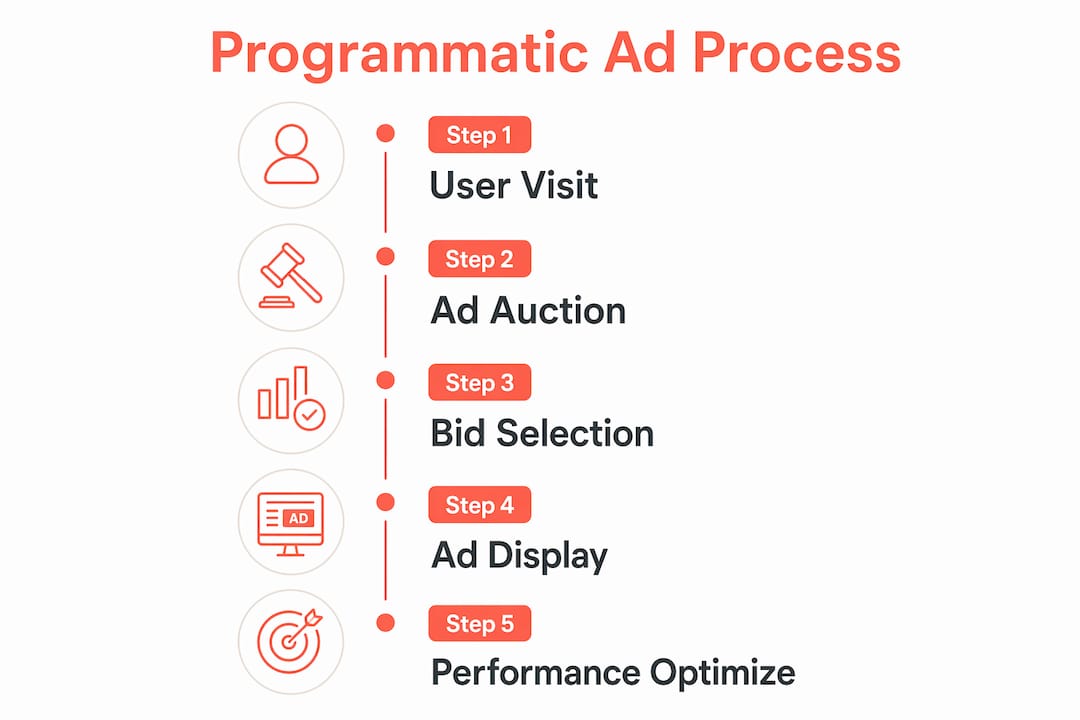
Every programmatic ad impression follows the same sequence, and it happens faster than a human blink. When a user loads a webpage, the publisher’s SSP sends an auction request to an ad exchange. The ad exchange broadcasts that request to dozens of DSPs simultaneously. Each DSP evaluates the user’s data profile, the placement context, and its advertiser’s bid rules, then submits a bid price. The entire auction completes in under 100 milliseconds, before the page finishes loading.

That speed is not a technical footnote. It means billions of individual auctions run every day across the internet, each one making a data-driven decision about which ad to serve and at what price. The DSP algorithm weighs signals like browsing history, device type, location, time of day, and audience segment membership. The highest qualifying bid wins, the ad is served, and the user sees it as part of a normal page load. The process is invisible to the user and nearly instantaneous for the advertiser.
Here is the step-by-step sequence every marketer should understand:
- User loads a page. The publisher’s SSP detects an available ad slot and sends a bid request to the ad exchange.
- Ad exchange broadcasts the request. Multiple DSPs receive the request simultaneously, each with user and placement data attached.
- DSPs evaluate and bid. Each DSP’s algorithm assesses the impression against its advertiser’s targeting criteria and maximum bid.
- Winning bid is selected. The ad exchange picks the highest qualifying bid, typically using a second-price auction model.
- Ad is served. The winning creative loads in the ad slot before the page render completes.
Pro Tip: Set up frequency caps inside your DSP from day one. Without them, the same user can see your ad dozens of times in a single session, which wastes budget and damages brand perception.
What are the main benefits of programmatic advertising?
Programmatic’s primary advantage is decision speed at scale. Algorithmic optimisation happens in minutes rather than the days or weeks required for manual media buying. That speed compounds over a campaign’s life, producing better results with less wasted spend.
The cost benefits are concrete. Advertisers typically achieve 25% to 45% lower CPM rates with programmatic compared to traditional direct-buy display methods. Auction dynamics replace fixed-rate negotiations, so you pay closer to the true market price for each impression rather than a rate card inflated by agency margins.
Targeting precision is where programmatic separates itself from legacy media buying. You can reach audiences based on behavioural signals, purchase intent, demographic data, and contextual relevance. Contextual targeting in digital ads adds another layer, matching your ad to page content rather than relying solely on user data. The performance outcomes reflect this precision.
Key benefits marketers consistently report include:
- Lower CPMs. Auction efficiency reduces cost per thousand impressions by 25% to 45% versus direct buys.
- Higher click-through rates. Programmatic ads achieve 200% higher click-through rates than non-targeted ads.
- Stronger return on ad spend. Retargeting through programmatic channels delivers 2 to 4 times return on ad spend on average.
- Real-time budget control. You can shift spend, pause underperforming placements, or redirect budget within hours, not weeks.
- Cross-channel reach. One DSP can serve ads across display, video, audio, and connected TV from a single campaign interface.
What types of programmatic buying models are available?
Programmatic is a buying method, not an ad format. It spans multiple formats including video, audio, connected TV (CTV), digital out-of-home (DOOH), and standard display. The buying model you choose determines your balance of cost, scale, and control.
| Buying model | Scale | Cost | Brand safety | Best use case |
|---|---|---|---|---|
| Open auction | Very high | Lowest | Lower | Broad awareness, prospecting |
| Private marketplace (PMP) | Medium | Mid-range | High | Premium publishers, brand-sensitive categories |
| Programmatic guaranteed | Low to medium | Fixed, higher | Highest | Reserved placements, tentpole campaigns |
Open auctions offer the largest scale and the lowest cost, but they come with less control over where your ads appear. Private marketplaces give you access to premium publisher inventory through a negotiated deal, with far better brand safety. Programmatic guaranteed works like a traditional direct buy but executed through programmatic pipes. You reserve specific inventory at a fixed price, which suits campaigns where placement certainty matters more than cost efficiency.
The format layer adds further choice. CTV programmatic reaches audiences on streaming platforms. DOOH programmatic serves ads on digital billboards and transit screens. Audio programmatic places ads inside podcasts and streaming music. Each format runs through the same DSP and SSP infrastructure, which means paid eCommerce advertising channels can be managed from a single platform rather than juggled across separate media buys.
Practical tips and common pitfalls for marketers
The biggest mistake marketers make with programmatic is treating it as a set-and-forget system. Effective campaigns require active bid management and creative rotation. Assuming automation handles everything leads to rapid performance decay.
Creative fatigue is the most common and most avoidable problem. Refresh your ad creatives every 7 to 14 days to prevent performance drops. The algorithm can only optimise what you give it. Stale creative limits what the machine learning can achieve, regardless of how well your targeting is set up.
Budget thresholds matter more than most marketers realise. Programmatic platforms perform optimally at daily spend thresholds around $1,000, because machine learning requires sufficient data volume to make reliable optimisation decisions. Below that threshold, the algorithm lacks enough signal to learn effectively. If your budget is smaller, consider concentrating spend on a single format or tighter audience segment rather than spreading it thin across multiple placements.
Brand safety requires active management, not passive trust. Without exclusion lists, ads in open auctions risk appearing on low-quality or irrelevant sites. Build a robust exclusion list before your campaign launches. Add an allow-list for your most important brand-sensitive campaigns. When premium placement matters, move to a private marketplace rather than relying on open auction filters alone.
Practical steps to protect your campaigns:
- Build exclusion lists before launch. Block categories like misinformation, adult content, and low-quality news aggregators from day one.
- Use allow-lists for sensitive campaigns. Restrict delivery to a pre-approved set of publishers when brand context is critical.
- Set frequency caps. Limit impressions per user per day to avoid waste and negative brand associations.
- Review placement reports weekly. Identify and exclude underperforming or inappropriate domains on an ongoing basis.
- Test creatives in parallel. Run two to three creative variants simultaneously so the algorithm can identify the best performer early.
Pro Tip: Use dayparting in your campaigns to concentrate spend during the hours when your audience is most likely to convert. Most DSPs allow hourly bid adjustments, and this single tactic can meaningfully improve your cost per acquisition.
Key takeaways
Programmatic advertising delivers better ad performance than traditional buying because it combines real-time auction efficiency, data-driven targeting, and continuous algorithmic optimisation across every major digital format.
| Point | Details |
|---|---|
| Auctions run in milliseconds | The full bidding process completes in under 100 milliseconds, serving ads before the page loads. |
| Cost efficiency is measurable | Programmatic delivers 25% to 45% lower CPMs than traditional direct-buy display methods. |
| Buying model choice matters | Open auctions maximise scale; private marketplaces and programmatic guaranteed prioritise brand safety. |
| Human oversight is non-negotiable | Creative refresh every 7 to 14 days and active bid management prevent performance decay. |
| Budget thresholds affect learning | Daily spend around $1,000 gives machine learning algorithms enough data to optimise reliably. |
Why programmatic still needs a human hand
I have worked with enough digital campaigns to know that the automation promise of programmatic is real, but it is also overstated in the way it gets sold to marketers. The speed and scale are genuinely impressive. The ability to shift budget in real time based on performance data is something manual media buying simply cannot match. But I have seen too many campaigns go sideways because someone assumed the platform would handle everything.
The truth is that programmatic rewards the marketers who stay engaged. The algorithm learns from the signals you give it. If your creative is stale, your exclusion lists are thin, or your audience segments are too broad, the machine will optimise toward the wrong outcomes with great efficiency. The technology is a multiplier. It amplifies good strategy and bad strategy equally.
What I find most underused is the private marketplace. Marketers default to open auctions because the CPMs look attractive, but for eCommerce brands where trust and context matter, appearing on premium publisher inventory consistently outperforms the cheapest available placement. The digital ad campaign best practices that actually move revenue combine programmatic efficiency with deliberate placement choices. That blend is where the real gains sit.
— Liza
How Moormarketing can help you get programmatic right
Programmatic advertising gives you the tools to reach the right audience at the right price. Getting the strategy, setup, and ongoing management right is where most businesses leave money on the table.
Moormarketing works directly with eCommerce businesses to build and manage programmatic campaigns that are grounded in data and built for revenue growth. The team does not outsource. Senior strategists handle your campaign from audience architecture through to creative rotation and placement management. Whether you are running your first programmatic campaign or looking to improve an existing one, the eCommerce marketing workshops cover programmatic strategy in practical, hands-on sessions. You can also review the full digital ad campaign best practices guide to see how programmatic fits into a broader paid media plan.
FAQ
What is programmatic advertising in simple terms?
Programmatic advertising is the automated buying and selling of digital ad space using software and real-time auctions. It replaces manual negotiations with algorithmic bidding that matches ads to audiences in under 100 milliseconds.
How does programmatic advertising differ from Google Ads?
Google Ads operates within Google’s own inventory ecosystem, while programmatic advertising runs across thousands of publishers through open ad exchanges and private marketplaces. Programmatic gives you broader reach across the open web, CTV, audio, and DOOH formats from a single DSP.
What budget do I need to run programmatic advertising effectively?
Programmatic platforms typically perform best at daily spend thresholds around $1,000, because machine learning algorithms need sufficient data volume to optimise reliably. Smaller budgets work better when concentrated on a single format or tightly defined audience segment.
Is programmatic advertising safe for my brand?
Open auctions carry brand safety risks without active management. Using exclusion lists, allow-lists, and private marketplaces significantly reduces the risk of your ads appearing on low-quality or inappropriate sites.
What ad formats does programmatic cover?
Programmatic covers display, video, connected TV, audio, and digital out-of-home advertising. All formats run through the same DSP and SSP infrastructure, enabling unified campaign management across channels.