

Content marketing for ecommerce startups is the process of creating and deploying targeted digital assets to educate audiences, drive conversions, and build lasting customer loyalty. Unlike paid advertising, content compounds over time. A well-structured blog post, automated email flow, or buyer guide keeps working long after you publish it. Tools like Klaviyo and Shopify make it possible to connect content directly to revenue, tracking exactly which assets move shoppers from interest to purchase. The startups that win are not the ones producing the most content. They are the ones producing the right content, at the right stage of the buyer journey, with automation doing the heavy lifting.
What tools do ecommerce startups need for content marketing?
The right foundation makes every content effort measurable and repeatable. Without it, you are producing content that disappears into the void.
Platform and automation setup
Shopify is the default ecommerce platform for most startups, and it integrates directly with Klaviyo for email and SMS automation. This pairing gives you the ability to trigger content based on real shopper behaviour, not just demographics. Before you write a single blog post, connect these two platforms and confirm your events are firing correctly.

Events and tracking you must configure
These are the minimum tracking events your store needs before running any content marketing flows:
- Added to Cart — triggers abandoned cart sequences in Klaviyo
- Checkout Started — used by Shopify’s default checkout abandonment flow
- Order Placed — fires post-purchase content sequences
- Viewed Product — enables browse abandonment and retargeting content
Each event should carry product properties (name, price, image URL, category) so your flows can personalise content at the product level. Product-specific flows require this data to be recorded early enough to trigger meaningful segmentation filters.
UTM parameters and analytics
Tag every content asset with UTM parameters before it goes live. Use a consistent naming convention across campaigns, channels, and content types. Mis-tagging causes revenue to appear under Direct or Referral in Google Analytics, which makes your content look less effective than it actually is. Standardised UTM conventions are the single biggest lever for accurate attribution in Shopify.
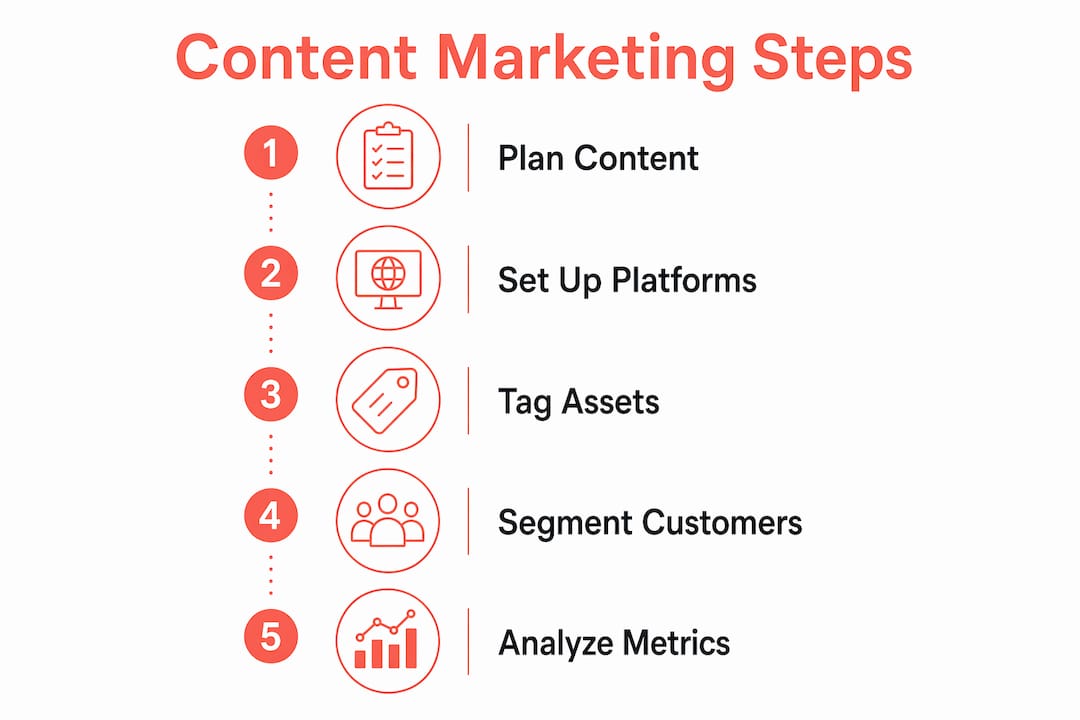
Pro Tip: Build a simple UTM naming spreadsheet before you launch your first campaign. Consistent naming from day one saves weeks of data cleaning later.
Customer profiles and segmentation
Klaviyo builds customer profiles automatically as shoppers interact with your store. Use these profiles to segment by purchase history, product interest, and engagement level. Segmentation is what separates a generic newsletter from a content flow that converts.
How to structure content aligned with the buyer journey
Content marketing for ecommerce works best when you treat it as a revenue funnel system, not just a blog programme. Each stage of the buyer journey needs a different content type.
-
Awareness stage. Shoppers do not know your brand yet. Blog posts, buying guides, and how-to articles bring them in through organic search. Focus on questions your ideal customer is already typing into Google. A furniture startup might publish “how to choose a sofa for a small living room” before ever mentioning their products.
-
Consideration stage. Shoppers are comparing options. Category pages, comparison articles, and “X vs Y” content work here. This is where ecommerce content strategies show their sharpest conversion payoff. A shopper reading “timber bed frame vs metal bed frame” is close to buying.
-
Decision stage. Shoppers are ready to purchase. Product pages with clear benefit-driven copy, trust signals (reviews, guarantees, returns policy), and strong calls to action close the sale. Weak product copy at this stage is the most common and most costly mistake startups make.
-
Post-purchase stage. Most startups ignore this entirely. Post-purchase email sequences that thank customers, explain product care, and introduce complementary products drive repeat purchases and reduce refund rates. This content costs almost nothing to produce and delivers outsized returns.
“Content marketing is best treated as a revenue funnel system integrating discovery, conversion, and retention rather than just a blog program.” — Revenue funnel approach
Owned channels like email and SMS are the most direct way to deliver stage-specific content. Use Klaviyo flows to send the right message at the right moment, based on where each shopper sits in the journey. For a deeper look at how the funnel connects, the marketing funnel explained by Moormarketing is worth reading alongside this.
How to build and automate high-impact content flows
Automation is where content marketing shifts from a cost centre to a revenue engine. The abandoned cart flow is the best place to start.
Step-by-step: your first abandoned cart flow
- Set the trigger. Use the Added to Cart event in Klaviyo, not Checkout Started. Added to Cart captures earlier intent and a larger pool of shoppers.
- Send one email, two hours after abandonment. Include a product block showing the exact item left behind, a clear CTA, and no discount yet. Klaviyo’s recommendation for a first flow is a single email at the two-hour mark with a product image and button.
- Add a second message at 24 hours. If the shopper has not purchased, send a follow-up. This is where you can introduce a small incentive if your margins allow it.
- Cap the sequence at three messages. More than three messages in an abandonment flow damages brand trust and increases unsubscribes.
- Add flow filters. Exclude anyone who has already purchased since triggering the flow. This prevents the embarrassing scenario of sending “you forgot something” to a customer who already bought.
- Enable Smart Sending. Smart Sending in Klaviyo prevents multiple back-to-back messages to the same subscriber when several flows are active simultaneously.
Flow overlap and guardrails
A single shopper can trigger browse abandonment, added-to-cart, and checkout abandonment flows in one session. Without filters and smart sending, that shopper receives five or six messages in 24 hours. That is not content marketing. That is spam.
| Flow type | Trigger event | Recommended delay | Max messages |
|---|---|---|---|
| Browse abandonment | Viewed Product | 1 hour | 1–2 |
| Added to cart | Added to Cart | 2 hours | 2–3 |
| Checkout abandonment | Checkout Started | 1 hour | 2–3 |
| Post-purchase | Order Placed | Immediate | 3–5 (series) |
Pro Tip: Test your first abandoned cart flow without a discount. Many shoppers convert on the reminder alone. Introduce a discount only in message two or three, after you have data showing the first message is not enough.
Common mistakes in ecommerce content marketing execution
Most startup content marketing fails not because of bad ideas, but because of poor execution habits. These are the mistakes worth fixing first.
-
UTM mis-tagging. Skipping or inconsistently applying UTM parameters means your attribution data is wrong from day one. Revenue appears under the wrong channel, and you make budget decisions based on bad information. Treat UTM tagging as non-negotiable, not optional.
-
Content overload. Startups often try to publish daily across every channel and burn out within six weeks. A simple weekly cadence works better: one SEO article, one product education email, and a handful of social proof posts. Predictable output beats irregular bursts every time.
-
Low-value content. Google’s Helpful Content system evaluates your entire site, not just individual pages. Publishing thin, keyword-stuffed articles to chase traffic can suppress rankings across your whole domain. Every piece of content you publish should genuinely help the reader.
-
Ignoring flow hierarchy. Running multiple Klaviyo flows without a clear hierarchy creates message fatigue. Decide which flow takes priority and build your filters accordingly.
-
Chasing traffic instead of conversions. A blog post with 10,000 monthly visitors that converts nobody is less valuable than a product page with 500 visitors and a 4% conversion rate. Focus content effort on assets closest to the point of purchase.
Pro Tip: Audit your existing content quarterly. Remove or rewrite any page that gets traffic but no conversions. Dead weight content drags down your whole site’s performance under Google’s site-wide evaluation.
How to measure ecommerce content marketing results
Measurement is where most startups either give up or get it wrong. The goal is not perfect data. The goal is directionally accurate data that improves over time.
Key metrics to track
Use Klaviyo’s built-in reporting to monitor open rates, click rates, and revenue per recipient for every flow and campaign. These numbers tell you which content is working and which is not. For SEO content, track organic sessions, time on page, and assisted conversions in GA4.
Attribution discrepancies
Shopify and GA4 will never agree perfectly on revenue attribution. Shopify and GA4 differ in how they assign credit to the last touchpoint, which means the same sale can appear under different channels in each platform. Treat both dashboards as complementary views, not competing truths.
| Metric | Where to track | What it tells you |
|---|---|---|
| Revenue per recipient | Klaviyo | Email and SMS content effectiveness |
| Organic sessions | GA4 | SEO content reach |
| Conversion rate by content type | Shopify + UTMs | Which content drives purchases |
| Flow open and click rate | Klaviyo | Message relevance and timing |
| Assisted conversions | GA4 | Content’s role in multi-touch journeys |
Consistent UTM parameter tagging across every campaign is the foundation of reliable attribution. Without it, you cannot trust any of the numbers above. Build the habit early and your data quality compounds over time, just like your content.
For startups integrating email with paid channels, the email and ads integration guide from Moormarketing covers how to connect these data streams effectively.
Key takeaways
Content marketing for ecommerce startups works when content is mapped to the buyer journey, automated through tools like Klaviyo and Shopify, and measured with consistent UTM tracking from day one.
| Point | Details |
|---|---|
| Start with automation | Build an abandoned cart flow first — it delivers the fastest revenue return for the least effort. |
| Map content to the journey | Awareness, consideration, decision, and post-purchase stages each need a different content type. |
| Tag everything with UTMs | Consistent UTM parameters are the only way to know which content is actually driving revenue. |
| Prevent message fatigue | Use Smart Sending and flow filters in Klaviyo to stop shoppers receiving multiple messages in one session. |
| Keep your cadence simple | One SEO article and one email per week beats irregular high-volume output every time. |
Why I think most startups get content marketing backwards
Here is what I have seen again and again working with ecommerce startups: they spend months building a content library nobody reads, then wonder why their revenue has not moved. The problem is not the content. The problem is the order of operations.
Most founders start with awareness content because it feels productive. Blog posts, social media, YouTube. All of that has its place, but none of it pays the bills in month three. The fastest path to revenue is bottom-of-funnel content: product pages that actually sell, abandoned cart flows that recover lost revenue, and post-purchase sequences that turn one-time buyers into repeat customers.
Startups should build narrow, high-signal audiences and have real conversations with specific prospects rather than chasing broad visitor numbers before they have found product-market fit. I have watched founders obsess over organic traffic while their cart abandonment rate sits at 70% with no recovery flow in place. Fix the leaks before you fill the bucket.
The other thing I would tell every startup founder is this: content compounds. A well-written product page or a properly structured email flow keeps generating revenue for years. Paid ads stop the moment you stop paying. The founders who commit to content early, even imperfectly, are the ones who have a real asset base 18 months later.
— Liza
Moormarketing’s ecommerce marketing workshops
Moormarketing works directly with ecommerce startups to build content marketing systems that generate measurable revenue, not just traffic. The ecommerce marketing workshops cover everything in this article in hands-on detail: buyer journey mapping, Klaviyo flow setup, UTM tracking, and content cadence planning.
Every workshop is run by senior strategists, not junior staff, and is built around your specific store, products, and growth stage. Moormarketing has helped brands reach $2 million and $3 million in monthly sales by applying exactly these frameworks. If you are ready to build a content system that actually scales, the ecommerce growth strategy page is a good place to see what that looks like in practice.
FAQ
What is content marketing for ecommerce startups?
Content marketing for ecommerce startups is the practice of creating digital assets, such as blog posts, email flows, and product guides, to educate shoppers and convert them into paying customers. It works best when content is mapped to each stage of the buyer journey.
How does an abandoned cart flow work in Klaviyo?
An abandoned cart flow triggers when a shopper adds a product to their cart but does not purchase. Klaviyo sends a timed sequence of emails or SMS messages, starting around two hours after abandonment, to bring the shopper back.
How many emails should an abandoned cart flow include?
A first abandoned cart flow should include one to three messages. Start with a single reminder email at two hours, add a follow-up at 24 hours, and introduce an incentive only if the first two messages do not convert.
Why do Shopify and Google Analytics show different revenue figures?
Shopify and GA4 use different attribution models and last-touch logic, which means the same sale can be credited to different channels in each platform. Consistent UTM tagging and regular data reconciliation reduce this gap over time.
How often should an ecommerce startup publish content?
A simple weekly cadence works best for most startups: one SEO-focused article, one product education email, and a small number of social proof posts. Consistent output over time outperforms irregular high-volume bursts.