

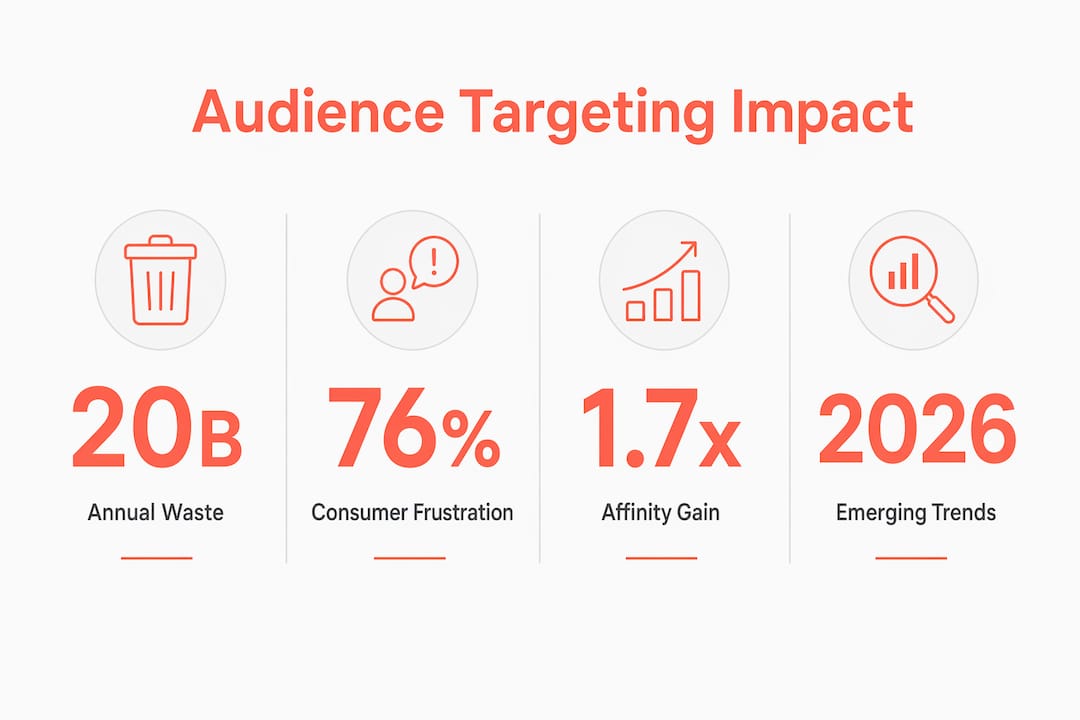
Audience targeting in digital advertising is the practice of delivering ads to precisely defined consumer groups based on demographics, behaviour, and interests to maximise engagement and conversions. The role of audience targeting in digital ads goes far beyond basic segmentation. 23% of open web programmatic ad spend is wasted on irrelevant impressions, costing the industry approximately $20 billion annually. That figure alone makes a compelling case for precision. Add to that the McKinsey finding that 71% of consumers expect personalised brand interactions, and the cost of ignoring audience intelligence becomes impossible to justify.
What are the main audience targeting methods used in digital advertising?
Audience targeting, known in the industry as audience segmentation, divides a broad pool of potential customers into smaller groups that share meaningful characteristics. Each segment receives ads tailored to its specific profile, which lifts relevance and reduces wasted spend.
The six core segmentation types each serve a different purpose.
| Targeting type | What it uses | Best for |
|---|---|---|
| Demographic | Age, gender, income, education | Mass consumer products, life-stage offers |
| Behavioural | Purchase history, browsing patterns | Retargeting, upsell campaigns |
| Psychographic | Values, lifestyle, attitudes | Brand positioning, premium products |
| Technographic | Device type, software used | App installs, SaaS trials |
| Firmographic | Industry, company size, revenue | B2B eCommerce, wholesale |
| Intent-based | Active search signals, content consumption | Bottom-of-funnel conversion ads |
Behavioural and intent-based targeting tend to deliver the strongest conversion results for eCommerce marketers. They capture people who are already in a buying mindset, rather than those who simply fit a demographic profile.

Moving from raw data to a usable buyer persona requires three steps: collect first-party signals (site visits, purchase events, email engagement), layer in third-party behavioural data where available, then validate the persona against actual campaign performance. Skipping the validation step is where most teams go wrong.
Pro Tip: Build custom audiences from your own customer lists before touching interest stacks. First-party data produces higher match rates and lower cost-per-click than platform-inferred audiences, because the signal comes directly from people who have already engaged with your brand.
How does precise targeting improve ad performance and reduce waste?
Precise audience targeting produces measurable gains across every key campaign metric. Well-executed targeting can deliver up to 150% conversion lift and a 30–60% reduction in cost-per-acquisition. Those are not marginal improvements. They represent the difference between a campaign that funds itself and one that drains budget.
The performance gains compound across the funnel:
- Conversion rate: Ads shown to high-intent segments convert at a significantly higher rate than broad-reach placements.
- Return on ad spend (ROAS): Tighter audience definitions reduce impressions on low-probability buyers, pushing ROAS upward.
- Customer lifetime value: Targeting lookalike audiences modelled on your best existing customers attracts buyers with similar spending patterns.
- Cost-per-acquisition: Eliminating irrelevant impressions cuts the cost of every conversion.
- Ad relevance scores: Platform algorithms reward high engagement rates with lower auction costs, creating a compounding efficiency benefit.
The waste problem is structural, not accidental. Approximately $20 billion is lost annually because ads reach people with no genuine interest in the product. Precise segmentation addresses this directly by restricting delivery to audiences with demonstrated relevance signals.
Consumer expectations reinforce the business case. 76% of consumers express frustration when brand interactions are not personalised. Frustration translates to lower click-through rates, higher bounce rates, and damaged brand perception. Targeting is not just a performance tactic. It is a customer experience decision.
What are the emerging trends in audience targeting for 2026?
The biggest shift in 2026 is the move away from restrictive audience stacks toward broader prospecting guided by creative. Meta’s 2026 targeting approach advocates using audience signals as starting priors for its AI rather than hard constraints. The platform expands reach strategically, and the ad creative itself qualifies or disqualifies prospects. This means your creative brief is now as important as your audience brief.
Signal loss is reshaping strategy across every platform. Cookie deprecation and privacy regulation have reduced the volume of third-party tracking data available to advertisers. Successful brands now combine technical tracking with deep understanding of user motivations and emotional states to predict outcomes before platform learning cycles complete. Knowing why your audience buys, not just who they are, has become a targeting input in its own right.
A second major trend is the shift from channel-first to audience-first budget allocation. Moving budget decisions from channels to consumer behaviour signals reduces wasted spend and surfaces growth opportunities that channel-based planning misses entirely. An eCommerce brand that allocates budget by platform (Facebook, Google, TikTok) will consistently underperform one that allocates by audience segment and then selects the channel where each segment is most active.
Niche publisher placements are also gaining ground. Smaller niche publishers deliver 1.7x higher audience affinity than major publishers despite far lower traffic volumes. For B2B eCommerce and specialised product categories, a tightly aligned niche audience outperforms a massive but loosely matched one every time.
Pro Tip: Test one variable per ad set when measuring audience performance. Change the audience segment OR the creative, never both simultaneously. Then use holdout and lift studies rather than last-click attribution to measure true incremental impact, because last-click attribution routinely misrepresents the actual value each audience segment contributes.
How can eCommerce marketers implement effective audience targeting strategies?
Implementation starts with a clear picture of who you are already converting. Pull your customer data, identify your top 20% of buyers by revenue, and map their shared characteristics across demographics, purchase behaviour, and product preferences. That profile becomes your seed audience.
- Audit your first-party data. Export purchase history, email engagement, and site behaviour from your eCommerce platform. Identify patterns in your highest-value customer cohort.
- Build your core segments. Create at minimum three segments: existing customers (for upsell and retention), warm prospects (cart abandoners, product page visitors), and cold prospecting audiences (lookalikes modelled on your best customers).
- Match segments to platforms. High-intent search behaviour suits Google Ads. Social discovery and interest-based prospecting suits Meta. Use contextual targeting for display placements where behavioural data is limited.
- Assign budget by segment priority. Allocate the largest share to your warm prospect segment first. It converts fastest and validates your creative before you scale cold prospecting spend.
- Set measurement rules before launch. Define your success metric per segment (conversion rate for warm, cost-per-new-customer for cold). Use platform lift studies or holdout groups to measure true incremental performance, not just attributed conversions.
- Iterate on a four-week cycle. Review segment performance every four weeks. Reallocate budget toward segments beating their benchmark. Pause or rebuild segments that consistently underperform after two cycles.
Audience-first budget planning is the structural change that separates high-performing eCommerce ad accounts from average ones. Platforms change. Audiences do not. Building your strategy around who you are reaching, rather than where you are placing ads, creates a durable competitive advantage.
For Shopify-based eCommerce businesses, pixel-based custom audiences and catalogue-driven dynamic ads work together to close the loop between product browsing and purchase. An eCommerce retargeting strategy that layers behavioural signals onto product-level data consistently outperforms generic retargeting.
Key takeaways
Audience targeting is the single highest-leverage activity in digital advertising, directly reducing wasted spend and lifting conversion rates when applied with first-party data, clear segmentation, and audience-first budget allocation.
| Point | Details |
|---|---|
| Waste is quantifiable | Poor targeting wastes approximately $20 billion annually. Precise segmentation directly addresses this loss. |
| Performance gains are significant | Well-executed targeting delivers up to 150% conversion lift and 30–60% lower cost-per-acquisition. |
| Creative now qualifies audiences | On Meta in 2026, ad creative acts as the audience filter. Your brief must reflect this shift. |
| First-party data outperforms inferred data | Custom audiences built from your own customer lists produce higher match rates and lower costs. |
| Measure incrementally | Last-click attribution misrepresents targeting value. Use holdout studies to see true impact. |
What I have learned from watching targeting done well and done badly
The gap between a campaign that scales and one that stalls almost always comes down to how well the team understands its audience before it touches the platform. I have seen eCommerce brands with genuinely great products burn through five-figure monthly budgets because they built their targeting around platform-suggested interest categories rather than their own customer data. The platform does not know your customer. You do.
The other pattern I keep seeing is marketers treating audience targeting as a technical setup task rather than an ongoing strategic discipline. They build their segments at campaign launch and never revisit them. Audiences shift. Buying behaviour changes with seasons, economic conditions, and product life cycles. The brands that consistently outperform their benchmarks treat audience analysis as a monthly practice, not a one-time configuration.
Signal loss is real, and it is accelerating. But I think the marketers who are most anxious about it are the ones who were over-reliant on third-party data to begin with. The brands with strong first-party data assets, built through email programmes, loyalty schemes, and direct customer relationships, are largely insulated. Privacy changes hurt lazy targeting strategies far more than they hurt well-built ones.
The creative brief and the audience brief need to be written together. Knowing that your audience is motivated by status, not savings, should change every headline, image choice, and call to action in your ad. That connection between audience psychology and creative execution is where the real performance gains live in 2026.
— Liza
How Moormarketing helps eCommerce professionals master audience targeting
Moormarketing works directly with eCommerce businesses to build audience targeting strategies grounded in first-party data and real buying behaviour, not platform defaults. Senior strategists, not junior account managers, handle every engagement.
The eCommerce marketing workshops cover audience segmentation, creative briefing, and budget allocation frameworks that have contributed to results including $3 million per month in revenue for a global furniture brand. For marketers who want a deeper look at what is working in 2026, the digital ad campaign best practices guide is a practical starting point. If you are ready to build a targeting strategy around your specific audience and product category, connect with the Moormarketing team to discuss what that looks like for your business.
FAQ
What is audience targeting in digital advertising?
Audience targeting is the process of delivering ads to specific consumer groups defined by demographics, behaviour, interests, or intent signals. It replaces broad reach with precision, improving relevance and reducing wasted impressions.
Why does audience targeting matter for eCommerce campaigns?
Poor targeting wastes approximately $20 billion in ad spend annually. For eCommerce businesses, precise segmentation directly improves conversion rates, lowers cost-per-acquisition, and increases return on ad spend.
What is the most effective audience targeting method?
Behavioural and intent-based targeting consistently deliver the strongest conversion results because they reach people already in a buying mindset. First-party data audiences built from your own customer lists outperform platform-inferred interest audiences.
How has audience targeting changed in 2026?
Meta’s 2026 approach uses audience signals as AI priors rather than hard restrictions, with creative messaging doing the qualification work. Signal loss from privacy changes has pushed successful brands toward motivational and emotional audience insights alongside technical tracking data.
How do I measure whether my audience targeting is actually working?
Last-click attribution routinely misrepresents the true value of audience segments. Use holdout tests and platform lift studies to measure incremental impact. Define your success metric per segment before launch and review performance on a four-week cycle.