
Post-purchase emails are the messages a brand sends after checkout, covering both the transactional updates a buyer expects and the engagement emails that build loyalty. The immediate move: set up three transactional emails (confirmation, shipping, delivery) alongside two or three engagement emails (thank you, review request, cross-sell), because this combination lifts repeat purchase rate and average customer lifetime value.
TL;DR:
- Transactional emails like confirmation, shipping, and delivery are non-negotiable, trigger instantly, and should be kept separate from promotional content.
- Engagement emails such as reviews, cross-sells, and loyalty invites significantly boost lifetime value due to higher open and click rates during the customer’s moment of attention.
- Timing and segmentation are critical; reviews should be requested weeks after delivery, and flows should differ for first-time versus returning customers and based on purchase value.
- Connecting post-purchase emails to carrier webhooks improves accuracy and customer experience, enabling prompt onboarding and reducing support tickets.
- Continuous measurement, testing, and adjustment—using metrics like repeat purchase rate, flow revenue, and unsubscribe rate—maximize the effectiveness of post-purchase email sequences.
Table of Contents
- What are post purchase emails and how do they fit the customer lifecycle?
- Why do post purchase emails matter for retention and revenue?
- What are the core post purchase email types and when should you send them?
- How should you segment post purchase flows by customer type?
- What subject lines and templates work for post purchase emails?
- How do you measure and test whether post purchase flows work?
- How do carrier webhooks and integrations improve post purchase emails?
- What Moor Marketing sees when brands build these flows
- How Moor Marketing builds post purchase flows that hold up
- Sources
- FAQ
What are post purchase emails and how do they fit the customer lifecycle?
A post-purchase email is anything sent after someone hits “buy”, and it falls into one of two camps. Transactional emails confirm what’s happening with the order: payment received, item shipped, package delivered. Engagement emails do something different. They’re not reporting on the order, they’re building a relationship with the person who placed it.
The distinction matters more than most marketers treat it. Transactional messages are table stakes. Customers expect them within minutes, and skipping them creates support tickets and anxiety, not opportunity. Shopify’s guidance is explicit on this: keep transactional flows separate from marketing content, and trigger them off platform events rather than bundling promotional copy into a shipping notice.
Engagement emails are the optional layer that actually drives revenue growth. A thank you note, a review request, a cross-sell suggestion, a replenishment reminder. None of these are expected the way a shipping update is expected, but together they’re where the profit sits. Klaviyo’s research on post-purchase emails frames this shift plainly: moving from transactional-only messaging into relationship-building content in the post-purchase window is what captures higher lifetime value and stronger brand affinity.
A quick word on data use: if your post-purchase flow references order history, browsing behaviour, or personal details for personalisation, disclose that in your privacy policy and give customers a clear way to opt out of marketing (while keeping transactional messages, which they can’t opt out of since they’re order related).
Before building anything, get the split clear in your head:
- Transactional: order confirmation, shipping notice, delivery confirmation, return/refund updates. Non-negotiable, triggered by events, zero promotional content.
- Engagement: thank you, onboarding, review request, cross-sell/upsell, loyalty invite, replenishment reminder, win-back. Optional, timed for relevance, built to convert or retain.
Why do post purchase emails matter for retention and revenue?
The case for post-purchase flows isn’t theoretical. It’s a numbers argument, and the numbers favour the messages nobody’s fighting for budget over.
The engagement gap is real: post-purchase automations consistently see materially higher open and click rates than average marketing campaigns, according to Klaviyo’s post-purchase email data. That’s because these messages arrive at a moment of genuine attention. The customer just spent money and wants to know what happens next; they’re not scrolling past you the way they scroll past a generic newsletter.
That attention window is the whole opportunity. A customer checking their inbox for a shipping update is far more receptive to a review request or a cross-sell suggestion than someone who hasn’t thought about your brand in three weeks. Waste that window with silence, and you’re relying entirely on organic repeat visits or paid retargeting to bring them back, both of which cost more than an email ever will.
Post-purchase flows also reduce the pressure on acquisition spend. Every dollar of lifetime value you extract from an existing customer is a dollar you don’t need to spend chasing a new one through paid ads. If your customer retention strategy leans on post-purchase emails to lift repeat purchase rate even modestly, that shows up directly in your customer acquisition cost ratio, because the denominator (revenue per customer) grows while the numerator stays flat.
Track these signals to know whether the flow is actually working, not just running:
- WISMO ticket volume (“where is my order”) — should drop once shipping and delivery emails are reliable and well timed.
- Repeat purchase rate within 60 and 90 days of first order — the clearest sign engagement emails are doing their job.
- Flow revenue per recipient — attributes actual dollars to the sequence, not just opens.
- Review conversion rate — how many delivered orders convert into a submitted review.
- Unsubscribe rate from engagement emails specifically — a spike here means you’re over-sending or under-targeting.
What are the core post purchase email types and when should you send them?
Every post-purchase flow is built from the same basic parts. The skill isn’t inventing new email types, it’s sequencing the ones that already work and matching timing to what the customer is actually experiencing at that moment.
The transactional foundation
- Order confirmation — sent instantly at checkout. Confirms the purchase, sets expectations on delivery timing, gives the customer a receipt they’ll reference if anything goes wrong.
- Shipping update — sent when a shipping label is generated or the carrier scans the parcel. Includes tracking, expected delivery window.
- Delivery confirmation — sent on the actual delivery event, not a guessed date. This is the moment the customer holds the product, and it’s the highest-attention transactional touch in the whole sequence.
- Return or refund notice — sent whenever a return is initiated or a refund processed. Transactional, factual, no upsell content.
The engagement layer
- Thank you email — sent within a day or two of purchase, separate from the confirmation. Pure relationship building: no hard sell, maybe a small unexpected gesture.
- Onboarding or how-to content — timed to land close to actual delivery, walking the customer through getting the most from what they bought.
- Review request — sent after the customer has had time to use the product, not immediately after delivery.
- Cross-sell or upsell — suggests a complementary product once the customer has had a positive first experience.
- Loyalty or referral invite — introduces a rewards programme or asks the customer to refer a friend, usually after a second purchase or a strong engagement signal.
- Replenishment reminder — relevant only for consumable or finite-life products, timed to the product’s expected usage cycle.
- Win-back email — triggered when a customer who was previously active goes quiet past their typical repurchase window.
A workable sample timeline, adapted from Twilio’s post-purchase email research, looks like this:
- Day 0: order confirmation, sent instantly.
- When label created: shipping update.
- On delivery event: delivery confirmation plus onboarding content.
- 7 to 14 days after delivery: review request.
- 12 to 14 days after delivery: cross-sell suggestion, for most product categories.
- 30 to 45 days: loyalty or referral invite, if engagement has been positive.
- Product-specific interval: replenishment reminder, timed to expected usage.
- 60 to 90 days of silence: win-back sequence begins.
The rationale behind each window matters as much as the window itself. Review requests sent too early catch customers before they’ve actually used the product, which is why timing off the delivered date rather than the shipped date materially increases review conversion. Cross-sell emails sent too close to the original purchase feel opportunistic; sent a couple of weeks later, once the customer has had a good experience, they read as helpful.
How should you segment post purchase flows by customer type?
Nobody buying for the first time should get the same sequence as someone on their fourth order. Klaviyo’s flow-building guidance recommends conditional splits by order count and order value, and this is the single highest-leverage change most stores can make to an existing flow without touching a line of copy.
Three splits are worth building before anything else:
- First-time vs returning customers — a first-timer needs education and trust-building; a returning customer already trusts you and responds better to loyalty framing or faster cross-sells.
- Low, mid and high AOV tiers — a customer who spent $400 shouldn’t get the same generic thank you as someone who spent $35. High-tier customers merit a more personal tone and earlier loyalty invitations.
- Product-type differences — consumables need replenishment logic; durable goods need onboarding and warranty content instead.
Conditional splits by order count and spend let the post-purchase experience evolve as loyalty grows, rather than sending the same static sequence to every customer regardless of history.
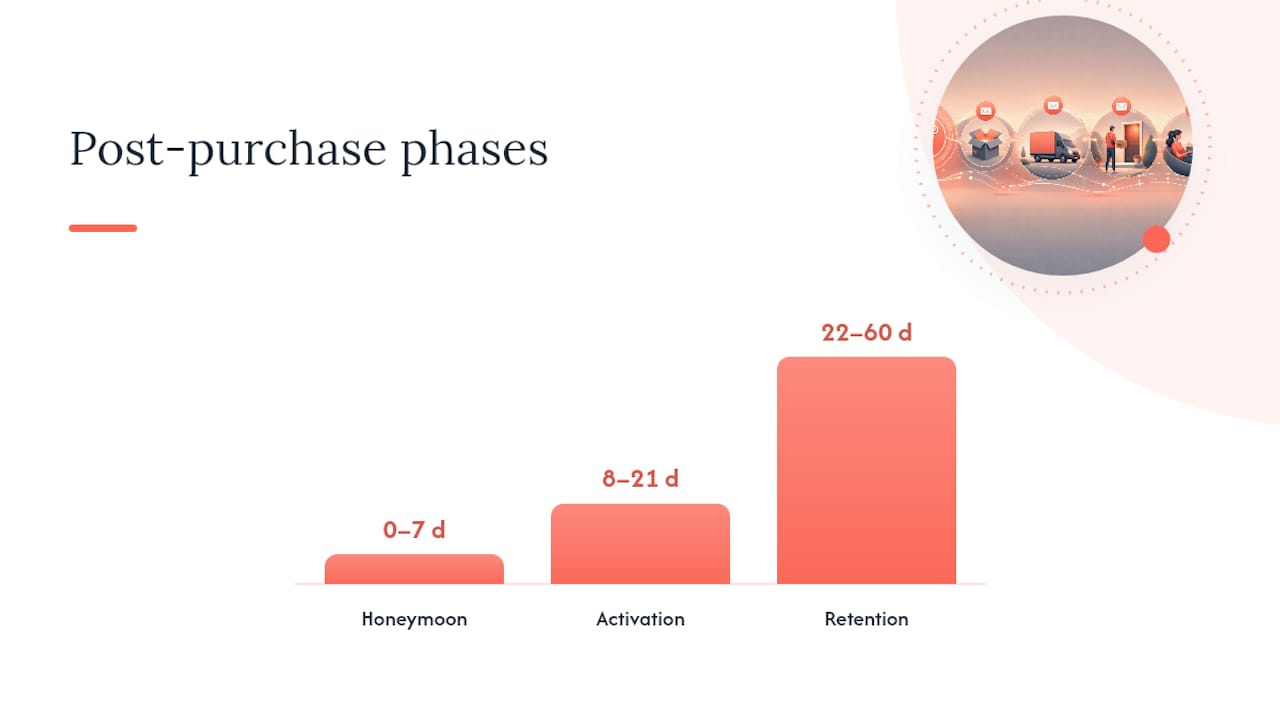
A practical three-phase structure, adapted from the Ecommerce Times flow model, maps well onto most stores:
Honeymoon (Day 0 to 7): transactional messages plus the thank you email. First-timers get an educational onboarding email here; returning customers can skip straight to a lighter check-in.
Activation (Day 8 to 21): review request and cross-sell, branched by AOV. High-AOV customers get a curated, smaller set of recommendations rather than a generic “you might also like” block; low-AOV customers get broader, higher-volume suggestions since the goal is getting them to a second purchase at all.
Retention (Day 22 to 60): loyalty invite for engaged customers, replenishment reminder for consumables, and the start of a win-back branch for anyone who hasn’t opened an email in that window.
Pro Tip: Build an exit condition into every branch. If a customer converts on a cross-sell email, pull them out of that branch immediately and drop them into a fresh post-purchase sequence for the new item, rather than letting two flows run in parallel and double up on their inbox.
The most common failure in flow design isn’t missing an email type, it’s overlap. Two flows firing at once because a customer bought twice in the same week, or a win-back email landing the same day as a legitimate shipping update, does real damage to open rates and trust. Cap total post-purchase sends per week and build suppression logic so a customer never receives more than one non-transactional email in any 48-hour window.
What subject lines and templates work for post purchase emails?
Copy is where most flows quietly fail, not because the strategy is wrong but because the execution is generic. Below are formulas and short templates for five of the highest-impact emails in the sequence.
Order confirmation subject lines:
- “Order #[number] confirmed — here’s what’s next”
- “You’re in! Order #[number] is on its way”
- “Confirmed: your order is being prepared”
Preheader: keep it under 50 characters and use it to reinforce delivery timing, e.g. “Estimated delivery: [date range]”.
Thank you email subject lines:
- “Thanks for choosing us”
- “You just made our day”
- “A small thank you from the team”
Body template: “Hey [first name], your order just landed with us and we wanted to say thanks before anything else. No upsell here, just appreciation. If you need anything at all while you wait, reply to this email and a real person will read it.”
Onboarding subject lines:
- “Getting the most out of your ”
- “Before you unbox, read this”
- “3 things to do with your new ”
Review request subject lines:
- “How’s treating you?”
- “60 seconds for a favour?”
- “We’d love your honest take on ”
Body template: “It’s been about two weeks since your arrived, so we’re hoping you’ve had a chance to properly try it out. A quick review helps other customers make a confident decision, and it takes less time than boiling the kettle.” For brands wanting a lower-friction path to feedback, tools like QR code feedback surveys can turn a packaging insert into an instant response channel that feeds the same review pipeline.
Cross-sell subject lines:
- “Pairs perfectly with your ”
- “You bought . These go well with it.”
- “Complete the set”
Body template: “Since you picked up product], we thought you’d want to know about [complementary product]. Customers who bought both tell us it changed how they use [category].” Dynamic recommendation blocks pulled from a product feed, sometimes generated with [AI-assisted product copy tools, can personalise this section at scale without a copywriter rewriting it for every SKU.
How do you measure and test whether post purchase flows work?
Five metrics tell you almost everything you need to know about a flow’s health: open rate, click rate, review conversion rate, repeat purchase rate, and flow revenue per recipient. The first two tell you whether the copy and subject lines are landing. The last three tell you whether the flow is actually changing customer behaviour, which is the only number that matters to the business.
Post-purchase automations already outperform standard campaigns on open and click rates, so treat those benchmarks as a floor, not a ceiling. If a specific email in your sequence underperforms your other post-purchase messages, that’s the one to rebuild first.
A/B testing inside these flows works differently than campaign testing because volume per send is usually lower. A few practical rules:
- Test subject lines on high-volume emails first (order confirmation, shipping update) since they get enough sends to reach significance quickly.
- Test timing windows on the review request and cross-sell emails, comparing a 7-day trigger against a 14-day trigger for the same product category.
- Run each test for a minimum of two to four weeks, or until each variant has enough sends to compare confidently, whichever comes later.
- Don’t test more than one variable per email at a time, or you won’t know which change moved the number.
The single most useful test most brands never run is a holdout. Suppress the entire post-purchase flow for roughly 10% of new customers, let both groups run for 90 days, then compare repeat purchase rate and total revenue per customer between the two groups. This is the only way to isolate the flow’s actual contribution from everything else happening in the business at the same time, and it’s a recommended methodology for proving flow-attributed lifetime value lift rather than assuming it.
How do carrier webhooks and integrations improve post purchase emails?
Static time delays are the laziest way to trigger a post-purchase flow, and they’re also the most common reason delivery confirmations arrive a day early or three days late. A better approach ties the delivery confirmation email directly to carrier delivery webhooks, so the email fires the moment the carrier marks the parcel delivered rather than on a guessed schedule.
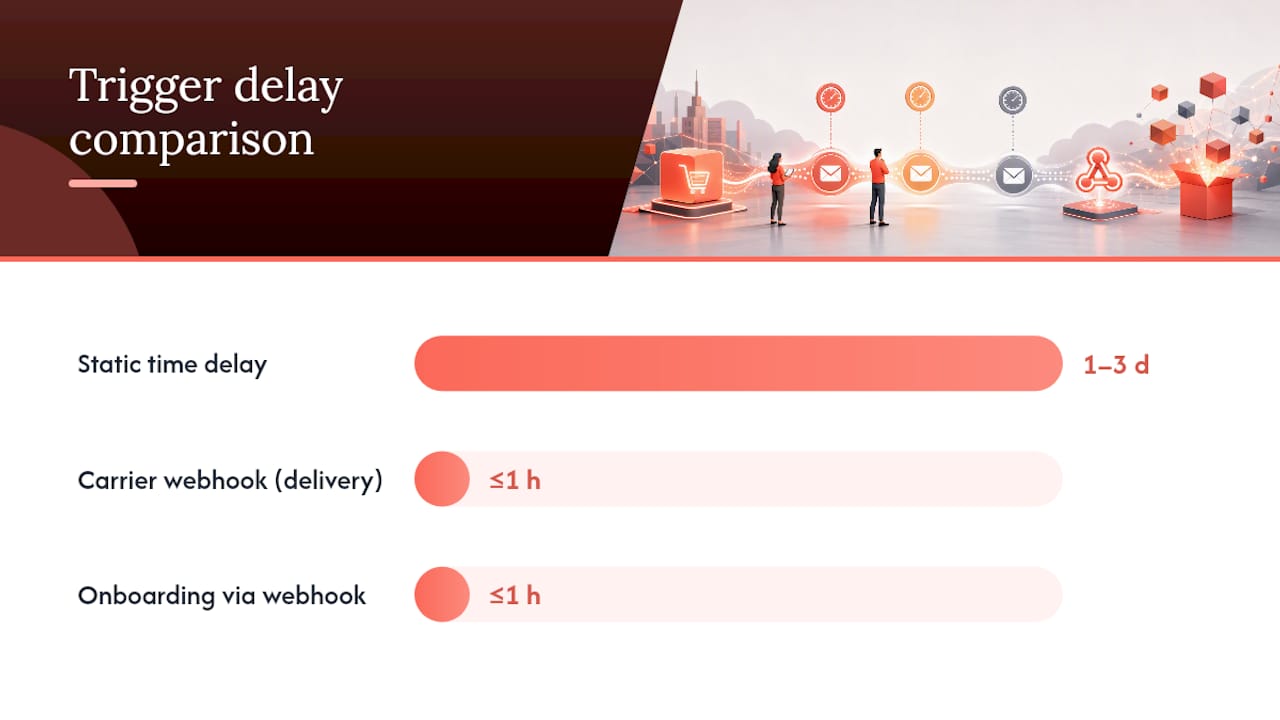
The payoff is bigger than just accuracy. Triggering onboarding content off that same webhook event means the customer receives quick-start material within the hour they’re physically holding the product, which is the highest-attention moment in the entire sequence.
Getting this right means your ESP, your shipping platform, and often a product recommendation engine need to share data cleanly. At minimum, synchronise:
- Order ID and SKU-level purchase data (for accurate cross-sell logic).
- Delivery status events (for triggering delivery and onboarding emails on the right hour, not the right day).
- Customer lifetime order count and total spend (for the segmentation splits covered earlier).
- Product category (to route consumables into replenishment logic and durables into warranty or care content).
Pro Tip: If your ESP doesn’t support webhook triggers natively, a lightweight middleware step (even a basic automation tool) that listens for the carrier’s “delivered” event and fires a flow trigger is usually cheaper to build than it sounds, and it fixes the single biggest timing complaint in most post-purchase sequences.
Mobile rendering deserves its own line of attention. Roughly three-quarters of post-purchase email opens happen on mobile, based on platform data cited by Ecommerce Times, which means single-column templates, a minimum 16px body text size, and a clearly tappable call-to-action button aren’t nice-to-haves, they’re the default you should design for first and adapt down to desktop, not the other way around. Run every template through a basic accessibility check too: sufficient colour contrast, alt text on images, and a subject line that makes sense even if images don’t load.
What Moor Marketing sees when brands build these flows
Most brands don’t fail at post-purchase emails because the idea is hard. They fail because they build the transactional emails, stop, and call it done. That’s the single biggest gap we see across the ecommerce brands we work with: a shipping confirmation and nothing else, while the review requests, cross-sells, and win-backs that actually drive revenue sit untouched.
The second mistake is treating every customer the same. A store running one flow for every buyer regardless of order value or purchase history is leaving segmentation gains on the table, and those gains compound. A third-time customer who gets treated like a stranger every single email is a customer who eventually stops opening them.
None of this requires guesswork. Run the holdout test. Watch the repeat purchase number for 90 days. Adjust the branch that underperforms. The brands that treat their post-purchase sequence as a living system, not a set-and-forget automation, are the ones where this channel quietly becomes one of the highest-margin levers in the business.
— Liza
How Moor Marketing builds post purchase flows that hold up
Most agencies will sell you a templated flow and move on. Some agencies build the segmentation logic, carrier webhook triggers, and holdout testing structure into the strategy from day one, because a flow that isn’t measured is just a guess dressed up as automation. That’s the gap between a store running one generic thank you email and one running a branched sequence that adjusts to order count, AOV, and product type automatically.
Our senior strategists work hands-on with your team to map the flow, write the copy, wire up the technical triggers, and set the KPI targets before a single email goes live. If your post-purchase sequence has stalled at “order confirmed” and nothing else, that’s the exact gap our ecommerce growth strategy work is built to close. Book a session through Moor Marketing’s team and get a straight assessment of what your current flow is missing, and what it’s likely costing you in repeat revenue.
Sources
- Post-purchase email guide: examples + expert advice
- How to create a post-purchase flow | Klaviyo Help Center
- How to improve the post-purchase experience (Shopify blog)
- How to build a post-purchase email flow that maximizes LTV in 2026 – Ecommerce Times
FAQ
What are examples of post-purchase questions?
Post-purchase questions typically ask about order status (“where is my order”), satisfaction (“how are you enjoying your purchase”), and feedback (“would you recommend this to a friend”). Review request emails often phrase these directly, asking the customer to rate specific aspects like fit, quality, or ease of use.
What does “post-purchase” mean?
Post-purchase refers to the period and every interaction that happens after a customer completes a transaction, covering everything from the order confirmation to reviews, replenishment reminders, and win-back attempts months later.
What is a good template for a post-purchase thank you email?
A strong thank you template keeps the tone personal and skips the sales pitch entirely: acknowledge the order, express genuine appreciation, and offer an easy way to reach a real person. Something like “Thanks for choosing us, your order just landed with our team and we wanted to say thanks before anything else” performs better than a generic “thank you for your purchase” line because it reads as human rather than automated.
What is an example of post-purchase behaviour?
Post-purchase behaviour includes actions like tracking a shipment, leaving a product review, buying a complementary item through a cross-sell email, joining a loyalty programme, or returning to repurchase a consumable product. Repeat purchase rate is the clearest aggregate measure of positive post-purchase behaviour across a customer base.