

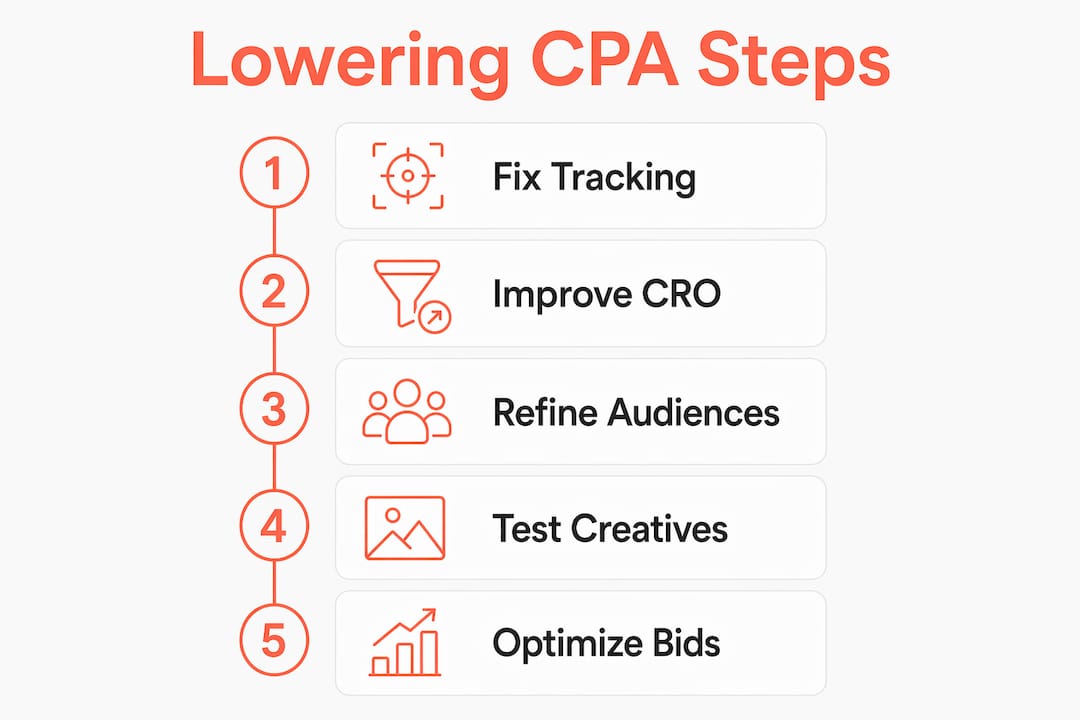
The fastest way to reduce CPA in your digital ads is to work five levers simultaneously: tighten audience targeting, fix conversion tracking, improve landing page relevance, sharpen creative message match, and run structured channel pilots before committing budget. Do all five at once and you compound the gains. Focus on just one and you often plateau.
Here is what to action in the next 7–14 days:
- Audit your conversion tracking first. Broken or duplicated GA4 events give you a false CPA baseline. Fix this before touching bids.
- Run a negative keyword sweep on Google Search. Remove irrelevant match types draining spend on low-intent queries.
- Check audience exclusions. Suppress existing customers from prospecting campaigns to stop paying to re-acquire people you already have.
- Test one landing page change — headline or hero image swap — on your highest-traffic ad destination.
- Review dayparting and geo bid adjustments. Cut or reduce bids during hours and locations with consistently high CPA and low conversion rate.
- Allocate 10–15% of acquisition budget to a channel pilot (Google Demand Gen is worth testing if you are currently Meta-heavy).
- Set a target CPA bid strategy on any campaign already hitting 50+ conversions per month — let the platform’s learning phase work with real data.
The testing rule that underpins all of this: run structured pilots rather than sweeping cuts. Cutting spend aggressively mid-campaign disrupts platform learning phases and can spike CPA in the short term. Keep core spend stable while you test at the margins.
Table of Contents
- What is cost per acquisition and how do you calculate it?
- What does ‘good’ CPA look like, and why does it vary so much?
- Prioritised tactics to reduce CPA: quick wins first
- Platform-by-platform tactics: Google, Meta, TikTok and beyond
- How landing pages and CRO directly reduce your CPA
- Measurement, attribution and bidding: get the foundations right
- How to test changes properly and balance CPA with LTV
- How to segment audiences effectively to reduce CPA
- How to use customer journey data to optimise ad spend
- Strategies for ad frequency and timing to avoid ad fatigue
- Key takeaways
- What Australian advertisers actually get wrong about CPA
- Moormarketing helps eCommerce brands lower CPA with hands-on pilots
- Useful sources and further reading
What is cost per acquisition and how do you calculate it?
CPA is your total ad spend divided by the number of conversions that spend produced. For this guide, a conversion means a sale, a qualified lead, or any committed action you have defined as valuable in GA4.
The formula:
A quick example in AUD: you spend $2,000 on Google Search in a month and generate 40 purchases. Your CPA is $50. If you improve your landing page and generate 50 purchases from the same $2,000, your CPA drops to $40, with no change to ad spend at all.
CPA is related to, but distinct from, three other metrics worth knowing:
- CAC (Customer Acquisition Cost) includes all marketing and sales costs, not just paid media. CPA is a subset of CAC.
- ROAS (Return on Ad Spend) measures revenue generated per dollar spent. A high ROAS does not guarantee a healthy CPA if your order values are low.
- LTV (Lifetime Value) is what a customer is worth over their entire relationship with your brand. A $90 CPA looks expensive against a $100 average order value but perfectly reasonable against a $600 LTV.
CPA alone can mislead you. An advertiser who optimises purely to the lowest CPA often ends up acquiring bargain-hunters and one-time buyers, which hollows out long-term revenue. Industry guidance consistently recommends tracking CPA alongside LTV and ROAS so you are measuring profitable acquisition, not just cheap acquisition.
GA4 is the measurement reference point for this guide. Set up conversion events for each committed action (purchase, lead form submit, phone call) and verify they are firing correctly before drawing any conclusions about CPA movement.
What does ‘good’ CPA look like, and why does it vary so much?
There is no universal benchmark. CPA varies by channel, product category, average order value, funnel stage, and margin. A $15 CPA for a $29 impulse-buy product is a disaster; the same $15 CPA for a $300 product with a 60% margin is excellent.
That said, directional ranges are useful for calibrating expectations:
| Channel | Typical CPA range (AUD) | Best use case |
|---|---|---|
| Google Search | $20–$120+ | High-intent prospecting and retargeting |
| Google Demand Gen | $30–$90 | Mid-funnel prospecting, visual discovery |
| Google Performance Max | $20–$100+ | Full-funnel, feed-driven eCommerce |
| Meta (Facebook/Instagram) | $15–$80 | Prospecting and retargeting, social discovery |
| TikTok Ads | $12–$60 | Upper-funnel awareness, younger demographics |
| Retargeting (any channel) | $5–$30 | Warm audiences, cart abandonment |
These are directional, not prescriptive. Australian CPAs tend to run slightly higher than US benchmarks due to smaller audience pools and higher CPMs on Meta.
Independent agency benchmarks have reported blended customer acquisition cost drops when brands shifted a significant portion of Meta prospecting spend into Google Demand Gen over a few months. One brand example showed new-customer CAC decreased significantly. These figures reflect a specific test scenario, not a guaranteed outcome, but they signal that channel mix matters as much as in-channel optimisation.
Translating benchmarks into your target CPA:
A practical rule of thumb is to set your target CPA at no more than 20–30% of your product’s average order value for a first purchase, then adjust upward if your LTV data supports it. For subscription or repeat-purchase products, many brands accept a CPA at or above AOV because the LTV:CPA ratio over 12 months justifies the upfront cost. A 3:1 LTV:CPA ratio is a commonly cited starting point for eCommerce, though high-margin categories can sustain lower ratios.
Prioritised tactics to reduce CPA: quick wins first
Conversion rate improvements often deliver the biggest CPA reduction for the same traffic spend. A 10% lift in conversion rate produces roughly a 10% drop in CPA, with no change to your bids or audience. Start there, then layer in the targeting and bidding fixes.
Quick wins (days 1–14)
- Negative keywords: Remove irrelevant search terms immediately. Practitioners report CPC reductions within 1–2 weeks from a thorough negative keyword sweep, with CTR improvements that feed back into Quality Score gains.
- Ad group message match: Tighten the connection between keyword, ad copy, and landing page headline. Mismatched messaging kills Quality Score and conversion rate simultaneously.
- Long-tail keyword shifts: Long-tail keywords can cost 40–60% less than head terms and often convert at higher rates because the intent is more specific.
- Exclusion lists: Suppress existing customers, recent converters, and irrelevant demographics from prospecting campaigns.
- Dayparting and geo bid adjustments: Reduce bids during hours and locations with consistently poor CPA. A dayparting audit takes a few hours and often surfaces obvious waste.
- Ad extensions / assets: Add sitelinks, callouts, and structured snippets to improve CTR, which lifts Quality Score and reduces effective CPC.
Mid-term moves (weeks 2–6)
- Creative testing roadmap: Rotate at least two creative variants per ad set. Test headline, hero image, and CTA copy as separate variables, not all at once.
- Lookalike and seed audience hygiene: Build lookalikes from your best customers (high LTV, repeat purchasers), not your full customer list. A seed audience of 1,000–5,000 high-value customers produces tighter lookalikes than a broad list of 50,000.
- Dynamic product ads (DPA): For eCommerce on Meta and Google, DPAs retarget users with the exact products they viewed. Retargeting CPAs are typically 60–70% lower than cold prospecting.
- Retargeting windows: Shorten retargeting windows for high-intent audiences (7–14 days for cart abandoners) and lengthen them for content engagers (30–60 days). Blanket 180-day windows waste budget on cold audiences.
Pro Tip: When switching to a Target CPA bid strategy, give the platform a minimum of two weeks without major changes. Cutting budget or adjusting targets during the learning phase resets the algorithm and can spike CPA temporarily. Set a performance slack of 20–30% above your target CPA for the first two weeks, then tighten gradually.
Platform-by-platform tactics: Google, Meta, TikTok and beyond
Search is intent-driven; social is discovery-driven. The optimisation mindset for each is fundamentally different, and applying search logic to social (or vice versa) is one of the most common reasons CPA stalls.
Google Search, Demand Gen and Performance Max
For Search, the Quality Score levers are your first port of call: ad relevance, expected CTR, and landing page experience. Improving Quality Score by a single point can reduce CPC by an estimated 16–22%. Long-tail, exact-match keywords at lower CPCs often outperform broad match on CPA, especially for smaller budgets.

Google Demand Gen is worth piloting if you are currently Meta-heavy. Brands shifting 30–40% of Meta prospecting spend into Demand Gen have reported meaningful blended CAC reductions over 90 days. Independent agency benchmarks reported blended CAC drops between 18% and 31% when moving Meta prospecting spend into Demand Gen. Individual brand examples showed new-customer acquisition cost reductions (eg $61 → $38 in one case). To exit the learning phase, Demand Gen campaigns need at least 50 conversions per month, so size your pilot budget accordingly. Google also offers new customer acquisition modes that improved new customer ratio by 11.5% and reduced new-customer acquisition cost by about 3% on average in Google’s own reporting.
Performance Max works best when your product feed is clean, your conversion tracking is accurate, and you have enough conversion volume for the algorithm to learn. Without those three conditions, PMax tends to over-invest in branded and retargeting traffic, inflating apparent CPA while underperforming on true new-customer acquisition.
Meta (Facebook and Instagram)
Message match between your ad creative and landing page is the single biggest lever on Meta. A scroll-stopping creative that lands on a generic homepage destroys conversion rate. Match the visual, the offer, and the headline.
Advantage+ campaigns can lower CPA for established accounts with strong conversion history, but they reduce your control over audience segmentation. Run Advantage+ alongside manual campaigns and compare CPA by audience type before consolidating. For value-based bidding on Meta, you need purchase value data flowing back via the Conversions API (CAPI) — without it, the algorithm cannot optimise for high-value buyers.
Creative fatigue on Meta is fast. Frequency above 3–4 within a 7-day window typically signals audience saturation. Rotate creatives proactively rather than waiting for CPAs to spike. A structured Facebook testing approach helps you build a creative pipeline rather than scrambling when performance drops.
TikTok and retail media
TikTok Ads work best as an upper-funnel channel for brands targeting under-35 audiences. CPAs are often lower than Meta for awareness objectives, but the platform requires native-feeling creative — polished brand videos underperform against authentic, fast-cut content. Pilot with 10–15% of your acquisition budget before scaling.
Retail media (Google Shopping, Meta Shops) suits eCommerce brands with clean product feeds and strong AOV. CPAs on shopping formats tend to be lower than display because the user is already in a buying mindset.
Channel comparison
| Channel | Best use | Targeting precision | Creative format | Bidding options | Measurement complexity | Time to impact |
|---|---|---|---|---|---|---|
| Google Search | High-intent prospecting | High | Text, responsive search ads | Target CPA, Max conversions, manual CPC | Moderate (GA4 + conversion tags) | 1–2 weeks |
| Google Demand Gen | Mid-funnel discovery | Medium–High | Image, video, carousel | Target CPA, Max conversions | Moderate–High (CAPI recommended) | 4–8 weeks |
| Performance Max | Full-funnel eCommerce | Algorithm-driven | Feed + creative assets | Target ROAS, Max conv. value | High (feed + offline convs) | 4–6 weeks |
| Meta (FB/IG) | Prospecting + retargeting | High | Image, video, carousel, DPA | Target CPA, value-based, manual | High (CAPI required for accuracy) | 2–4 weeks |
| TikTok Ads | Upper-funnel awareness | Medium | Short-form video | Target CPA, Max conversions | Moderate | 4–8 weeks |
| Retargeting (any) | Warm audience conversion | Very high | Dynamic, personalised | Target CPA, manual | Low–Moderate | 1–2 weeks |
Running a channel pilot: allocate 10–15% of your monthly acquisition budget, run for a minimum of four weeks (eight weeks for Demand Gen or TikTok), and define your success metric before you start. A pilot without a pre-defined CPA target is just spending money.
How landing pages and CRO directly reduce your CPA
Improving conversion rate is often the fastest lever to lower CPA for the same traffic spend. If your landing page converts at 2% and you lift it to 3%, your CPA drops by roughly 33% with zero change to your ad spend or bids. That arithmetic is why CRO deserves budget and attention alongside media buying.
CRO checklist
- Message match: The headline on your landing page should mirror the promise in your ad. If your ad says “Free shipping on orders over $75,” your landing page should say the same thing above the fold.
- Load speed: A one-second delay in page load time reduces conversions. Use Google PageSpeed Insights to identify and fix render-blocking resources. For Shopify stores, image compression and app bloat are the most common culprits.
- Form friction: Every additional field in a lead form reduces completion rate. Start with name, email, and one qualifying question. Test removing fields one at a time.
- Trust signals: Reviews, security badges, money-back guarantees, and recognisable payment options (Afterpay, PayPal) all reduce purchase anxiety, particularly on mobile.
- Mobile-first design: More than half of Australian eCommerce traffic arrives on mobile. If your page is not designed for thumb navigation and fast mobile load, you are losing conversions before the user reads your offer.
- Single, clear CTA: One action per page. Multiple competing CTAs split attention and reduce conversion rate.
Two A/B test setups to run now
Test 1: Headline and hero image swap
Hypothesis: Replacing a generic product image with a lifestyle image showing the product in use will increase conversion rate by 10–20%.
Setup: Split traffic 50/50 between the control (product image) and variant (lifestyle image). Run until each variant has at least 300–500 conversions, or four weeks, whichever comes first. Check for statistical significance at 95% confidence before calling a winner.
Test 2: Simplified form vs full form
Hypothesis: Removing two optional fields from the lead capture form will increase form completion rate by 15%.
Setup: Same 50/50 split. Minimum 200 form submissions per variant before drawing conclusions. Track not just form completions but lead quality downstream — a shorter form sometimes attracts lower-intent leads.
A 10% lift in conversion rate reduces CPA by approximately 10%. Prioritise tests on pages with the highest traffic volume first; a 10% lift on a page receiving 5,000 visits per month moves the needle far more than the same lift on a 200-visit page.
Measurement, attribution and bidding: get the foundations right
Fix your measurement before you draw conclusions about CPA movement. A misconfigured GA4 event or a duplicated conversion tag can make a campaign look twice as efficient as it actually is, leading to budget decisions based on fiction.
Measurement QA checklist
- Verify GA4 conversion events are firing on the correct trigger (purchase confirmation page, not the checkout page).
- Check for duplicate conversions — a common issue when both GA4 and a platform pixel fire on the same event without deduplication.
- Set attribution windows that match your sales cycle. A 7-day click window is standard for most eCommerce; extend to 28 days for considered purchases.
- Implement server-side Conversions API (CAPI) for Meta and Google. Browser-based pixels lose 20–40% of conversion signals due to iOS privacy changes and ad blockers. CAPI restores that signal and improves bidding accuracy.
- Upload offline conversions if your funnel includes phone calls, in-store visits, or CRM-qualified leads. Without this, your CPA data excludes a portion of real conversions.
- Cross-device deduplication: confirm that a user who clicks on mobile and converts on desktop is counted as one conversion, not two.
For a full campaign measurement checklist, the fundamentals apply across every platform.
Bidding strategy choices
Maximise Conversions is the right starting point for new campaigns or those with fewer than 30–50 conversions per month. It gets you data without requiring a CPA target you cannot yet validate.
Target CPA makes sense once you have 50+ conversions per month and a reliable CPA baseline. Set your initial target at your current average CPA, not your aspirational CPA. Tighten it by 10–15% every two weeks as the algorithm learns.
Value-based bidding (Target ROAS or Maximise Conversion Value) is the right move when you have purchase value data flowing back accurately and your products have meaningfully different margins. It shifts the algorithm from “get the most conversions” to “get the most valuable conversions,” which is where you want to be once your tracking is solid.
Switching bidding strategies mid-campaign resets the learning phase. Plan transitions carefully: increase budget slightly when switching to give the algorithm room to learn, and allow two to four weeks before evaluating performance.
How to test changes properly and balance CPA with LTV
Run controlled, incremental tests with defined hypotheses, minimum sample sizes, and holdout groups. A result without statistical significance is not a result — it is noise.
Step-by-step testing framework
- Write a hypothesis: “Changing the CTA button from ‘Buy Now’ to ‘Get Yours Today’ will increase conversion rate by 8% because it reduces purchase pressure.”
- Define minimum sample size: For a conversion rate test, aim for at least 300–500 conversions per variant before drawing conclusions. For awareness or reach tests, use impression-based thresholds.
- Set experiment duration: Most eCommerce tests need a minimum of two weeks to account for day-of-week variation. Some channel tests (Demand Gen, TikTok) need 60 days to exit learning phases and generate reliable data.
- Run holdout groups: For budget reallocation tests, keep a holdout group on the original channel mix to measure true incrementality, not just in-channel performance.
- Check statistical significance: Use a 95% confidence threshold before calling a winner. A result at 80% confidence is directional, not conclusive.
- Scale incrementally: When a test wins, increase budget by 20–30% per week rather than doubling overnight. Rapid scaling can disrupt the algorithm’s learned patterns.
Moormarketing’s view on CPA and LTV: The brands that consistently lower CPA over 12 months are not the ones chasing the cheapest click. They are the ones who know what a customer is worth over two years and set acquisition targets accordingly. A $120 CPA that brings in a customer worth $800 over 24 months beats a $40 CPA that brings in a one-time buyer every time. The Google Ads case studies Moormarketing has run in Australia consistently show that the biggest CPA improvements come from fixing measurement first, then tightening audience quality, not from cutting bids.
Expert guidance recommends using LTV-informed CPA targets and treating CPA as one input into overall unit economics. A practical starting ratio: aim for LTV to be at least 3x your CPA. For subscription products, 5x is achievable and worth targeting.
QA checks to avoid misattributing results:
- Check for seasonality overlap (a test running across a sale period will skew results).
- Watch for audience cannibalisation between test and control groups.
- Confirm no other major changes (new creative, budget shifts, platform updates) ran concurrently.
Pro Tip: Before scaling any winning test, run it for one additional week with no changes. A result that holds for a second week is far more likely to be real than one that peaked in week one and drifted back. Platform algorithms sometimes produce short-term anomalies that look like wins.
How to segment audiences effectively to reduce CPA
Audience segmentation is where most Australian SMEs leave money on the table. Running a single broad prospecting campaign against your entire potential market means you are paying the same CPA for your best-fit customer and your worst-fit customer.

Start by segmenting your existing customer base by LTV. Your top 20% of customers by lifetime spend are your seed audience for lookalikes. Build a separate lookalike from your full customer list and compare CPA and average order value between the two over 30 days. The high-LTV lookalike almost always produces a lower CPA against a comparable revenue target.
Layering behavioural and intent signals on top of demographic targeting sharpens results further. On Meta, combine interest targeting with website visitor retargeting to create tiered audience segments: cold (lookalikes), warm (site visitors, video viewers), and hot (cart abandoners, product page viewers). Each tier warrants a different creative, offer, and bid strategy. Suppressing existing customers from cold prospecting campaigns is one of the fastest ways to reduce wasted spend, and it is a step the Adobe Experience Platform blueprint specifically calls out as a core acquisition efficiency lever.
On Google, use Customer Match to upload your existing customer list and exclude them from new-customer campaigns. Combine this with in-market audience overlays to prioritise spend on users who are actively researching your product category.
How to use customer journey data to optimise ad spend
Most advertisers look at last-click attribution and draw the wrong conclusions. A customer who converts via a Google Search ad after seeing three Meta ads and a Demand Gen video did not come from Search alone. Last-click attribution assigns 100% of the CPA to Search and zero to the channels that built intent.
GA4’s data-driven attribution model distributes credit across touchpoints based on actual conversion path data. Switch to it if you are still on last-click. It will typically show Meta and upper-funnel channels contributing more than last-click suggests, which changes how you should allocate budget.
Map your customer journey by pulling the top conversion paths report in GA4. Look for the sequences that produce the lowest CPA and highest AOV. Common patterns for Australian eCommerce: Meta video ad (awareness) → Google Search (consideration) → retargeting ad (conversion). Once you know the sequence, you can invest in the entry point (Meta video) knowing the downstream conversion will follow, rather than cutting it because it does not show direct conversions.
Cohort analysis takes this further. Group customers by acquisition channel and track their 90-day and 180-day LTV. A channel that looks expensive on CPA often produces higher-LTV customers than a cheaper channel. Measuring campaign KPIs across the full funnel, not just the last click, gives you a far more accurate picture of where your acquisition budget is actually working.
Strategies for ad frequency and timing to avoid ad fatigue
Ad fatigue is one of the most underestimated drivers of rising CPA. When the same audience sees the same creative repeatedly, click-through rates fall, conversion rates drop, and CPAs climb, often without any obvious signal in your campaign dashboard until the damage is done.
On Meta, watch frequency at the ad set level. A frequency above 3–4 within a 7-day window for a cold audience is a reliable signal that your creative is wearing out. For warm retargeting audiences, you can push to 5–6 before fatigue sets in, because the audience has prior brand familiarity. The fix is not always a new campaign — sometimes rotating two or three creative variants within the same ad set is enough to reset effective frequency.
Timing matters as much as frequency. Australian eCommerce sees distinct conversion patterns: weekday evenings (6–9 PM AEST) and Sunday afternoons tend to produce lower CPAs than Monday mornings for most consumer categories. Use dayparting to reduce bids during low-conversion windows rather than running at full spend 24/7. This is not about cutting reach — it is about concentrating spend where your audience is most likely to act.
On Google Search, ad fatigue manifests differently: as declining CTR on previously strong ad copy. Refresh responsive search ad headlines every 60–90 days and monitor the “Ad strength” indicator. A drop from “Excellent” to “Good” often precedes a CTR decline. For Display and Demand Gen, set frequency caps at the campaign level and rotate creative assets every 3–4 weeks.
Key takeaways
Reducing CPA in digital ads comes down to fixing measurement first, then improving conversion rate, then refining audiences and bidding — in that order.
| Point | Details |
|---|---|
| Fix tracking before optimising | Broken GA4 events or missing CAPI give you a false CPA baseline; fix these in week one. |
| CRO beats bid cuts | A 10% lift in conversion rate reduces CPA by approximately 10% with no change to ad spend. |
| Channel mix changes CPA | Brands shifting 30–40% of Meta prospecting spend into Demand Gen have achieved blended CAC drops between 18% and 31% in independent agency benchmarks. |
| Balance CPA with LTV | A 3:1 LTV:CPA ratio is a practical starting target; optimising for the cheapest CPA alone attracts low-value customers. |
| Moormarketing’s approach | Moormarketing runs structured pilots, measurement audits, and CRO for Australian eCommerce brands to reduce CPA while protecting customer quality. |
7-day priorities: Fix conversion tracking, run a negative keyword sweep, implement one CRO quick win on your highest-traffic landing page.
30-day priorities: Launch a structured channel pilot (Demand Gen or TikTok), run two creative A/B tests, refine lookalike seed audiences and exclusion lists.
90-day priorities: Scale winning channels, implement value-based bidding where conversion volume supports it, embed LTV cohort tracking in GA4.
Three rules to carry forward: test incrementally, measure across the full funnel, and prioritise conversion rate improvements before cutting bids.
What Australian advertisers actually get wrong about CPA
The most common mistake I see in Australian eCommerce accounts is optimising CPA in isolation from LTV. A brand running Meta prospecting at $35 CPA looks efficient on paper. But if those customers have a 90-day LTV of $60 and a 30% return rate, the economics are poor. Meanwhile, a Google Demand Gen campaign running at $55 CPA might be bringing in customers with a $280 LTV and a 15% return rate. Last-click attribution and a narrow CPA focus hide this completely.
Australian advertisers also tend to underestimate the impact of local seasonality on CPA benchmarks. The pre-Christmas period (late October through December) compresses audience pools and drives CPMs up sharply on Meta, sometimes by 40–60% compared to Q1. Running the same CPA targets year-round sets you up for disappointment in Q4. Build seasonal CPA allowances into your planning rather than treating a Q4 CPA spike as a campaign failure.
Privacy and consent behaviour in Australia is shifting. The rollout of stricter consent requirements and growing consumer awareness of data tracking means browser-based pixel data is increasingly incomplete. Server-side CAPI implementation is not optional for serious advertisers — it is the baseline for accurate measurement. Accounts without it are making budget decisions on partial data.
Finally, A/B testing across Australian time zones is genuinely tricky for brands targeting both east and west coast audiences. A test running Monday to Friday AEST will underrepresent WA audiences who are two to three hours behind. Run tests for full calendar weeks, not business days, and segment results by state when sample sizes allow.
Moormarketing works with Australian eCommerce brands on exactly these problems: measurement gaps, seasonal planning, and channel pilots that account for local market conditions. The Moormarketing insights library has practical guides on each of these areas.
Moormarketing helps eCommerce brands lower CPA with hands-on pilots
Spending more to acquire fewer customers is a solvable problem. Moormarketing works directly with Australian eCommerce brands to find the specific levers — measurement gaps, audience quality, creative relevance, or channel mix — that are driving CPA up and fix them through structured pilots and hands-on strategy work.
The engagement starts with a measurement and campaign audit: we identify where your tracking is broken, where your budget is leaking, and which channel or CRO test is most likely to move CPA fastest. From there, clients can move into a 12-week pilot programme or an ongoing retainer, depending on what the audit reveals. Moormarketing’s eCommerce growth strategy work has produced results including $3 million per month for a global furniture brand and a new toy retailer reaching $2 million in monthly sales.
If you want a senior strategist to look at your account and tell you exactly what to fix first, book a discovery call with the Moormarketing team.
Useful sources and further reading
- What is cost per acquisition advertising: 2026 guide — Moormarketing’s own explainer on CPA fundamentals, formula, and Australian eCommerce context.
- Google Ads Case Study — Moormarketing — Before-and-after CPA improvement examples from real Australian campaigns.
- Digital ad campaign best practices for 2026 — Practical checklist for measurement, creative, and campaign structure.
- How an advertising agency tests Facebook Ads — Structured pilot methodology and optimisation cadence for Meta campaigns.
- How dayparting works in digital advertising — Practical guide to scheduling and bid adjustments for Australian time zones.
- Moormarketing insights library — Thought pieces and practical guides on Australian eCommerce marketing.
- Cost Per Acquisition (CPA) — AgencyAnalytics — Clear definition and context for tracking CPA alongside LTV and ROAS.
- Google’s Demand Gen campaigns reshaping DTC acquisition costs — Ecommerce Times — Independent agency benchmarks on Demand Gen vs Meta prospecting CPA.
- New customer acquisition modes — Google Business — Google’s own data on new-customer mode performance improvements.
- Reduce Customer Acquisition Cost — Adobe Experience Platform — Blueprint for suppression, audience precision, and acquisition efficiency.
- Maximising cost per acquisition — HubSpot — Expert guidance on balancing CPA with LTV and unit economics.