

Niche targeting accelerates growth by cutting customer acquisition cost (CAC), lifting conversion rates through hyper-relevant messaging, and raising lifetime value (LTV) because specialists command both loyalty and premium pricing. This is not theory. The evidence is consistent across industries and business sizes.
- HubSpot’s niche marketing research shows niche-targeted content produces higher user engagement and ad conversion rates than broad-topic content, because the message matches the reader’s exact situation.
- Shopify’s merchant guidance confirms that merchants who focus on a niche can charge premiums and build repeat business, two outcomes that compound into stronger unit economics over time.
- Moormarketing’s client work demonstrates the same pattern in practice: a new toy retailer reached multi-million dollar monthly sales, and a global furniture brand reached multi-million dollar monthly sales, both driven by focused positioning and targeted paid media rather than broad-market spray.
The rest of this guide covers the causal mechanisms in detail, a 30–90 day validation playbook, the channels that work best in niches, the metrics to watch, the real risks, and concrete examples you can learn from.
Table of Contents
- Why niche targeting accelerates growth: the core mechanisms
- How to choose and validate a niche in 30–90 days
- Which channels work best for a niche audience?
- What metrics to track and when to expect results
- When niche targeting can backfire
- Real examples of niche-led growth
- Moormarketing client outcomes from niche-led strategy
- Key takeaways
- The case for going narrow: a practitioner’s view
- Moormarketing helps eCommerce brands grow through focused strategy
- Useful sources and further reading
Why niche targeting accelerates growth: the core mechanisms
Niche targeting lowers CAC
When you define a narrow audience, every ad dollar goes to people who actually have the problem you solve. Broad targeting wastes spend on users who will never buy. Narrow targeting concentrates budget on high-intent prospects, which means fewer impressions per conversion and a lower cost per acquisition. DTC brands running hyper-niche audience campaigns in early 2026 reported substantially better return on ad spend compared with broad targeting approaches. The mechanism is simple: relevance drives click-through rate up, and a higher click-through rate lowers your cost per click on every major ad platform.

Niche targeting speeds product–market fit
A broad audience gives you noisy feedback. A niche audience gives you a signal. When you sell to a specific segment with a specific problem, you learn faster what works and what does not, because the feedback loop is tight. You are not averaging across dozens of different buyer types. Narrowing your addressable market intentionally produces sharper product, messaging, and distribution strategies that outperform broad offerings, precisely because the team is optimising for one clear use case rather than trying to satisfy everyone.

Specialists command higher prices
Niche customers view a brand that speaks their language as a specialist authority, not a commodity. That perception shifts the pricing conversation entirely. Generalists compete on price; specialists compete on value. A boutique accountancy firm that serves only e-commerce founders charges more than a generalist firm, and clients pay it because the specialist understands their specific compliance and cash-flow challenges. Shopify notes that niche merchants can charge premiums and build repeat business, which is the pricing power and retention combination that improves LTV simultaneously. For a deeper look at how this plays out in practice, Moormarketing’s eCommerce pricing strategy guide covers the mechanics.
Retention and advocacy compound the advantage
Niche customers have stronger preference intensity than mass-market buyers. They chose you because you fit their world precisely, so they have less reason to switch. That retention lifts LTV directly. Beyond retention, niche buyers tend to evangelise: they share recommendations within their community because finding a brand that truly gets them feels worth telling others about. Shopify’s research on niche brands highlights community and membership identity as a retention engine, and the referral behaviour that follows creates a defensible moat that larger, less-focused competitors struggle to replicate.
Defensibility against incumbents
Large competitors optimise for the average customer. That leaves the edges of the market underserved. A niche brand that owns one of those edges is difficult to dislodge because the incumbent would have to de-average its product and messaging to compete, which risks alienating its core base. Micro-niche specialists become the authoritative choice in their segment and reduce head-to-head competition, which means they can grow without fighting for the same keywords, shelf space, or ad inventory as the market leaders.
Stat: DTC brands running hyper-niche audience campaigns reported notably higher ROAS compared with broad targeting in early 2026 campaigns, with the improvement attributed directly to audience specificity rather than creative quality alone.
Pro Tip: Before you run any paid test, write a one-sentence hypothesis in this format: “We believe [niche audience] will convert at [target rate] because [specific reason they need this]. Our CAC target is $X, which is less than one-third of our target LTV of $Y.” That single sentence forces you to validate the math before you spend a dollar.
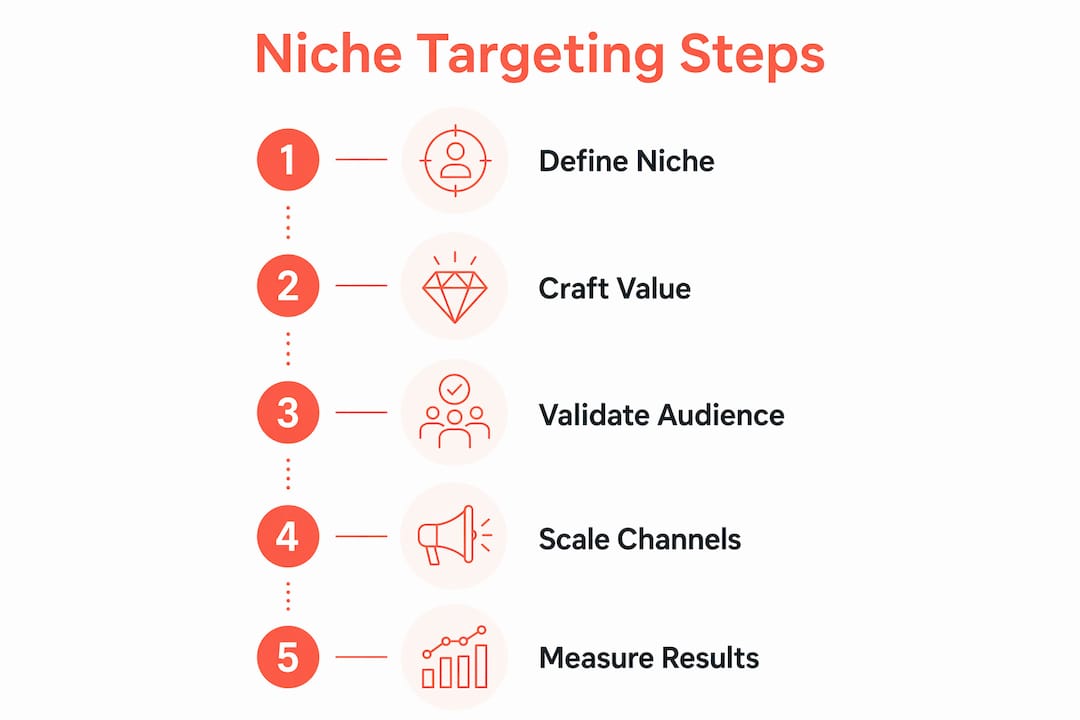
How to choose and validate a niche in 30–90 days
Step 1: Define the candidate niche
Start with two variables: a specific audience and a specific problem. “Women aged 25–45 who run” is an audience. “Women aged 25–45 who run ultramarathons and struggle with gut issues during long training blocks” is a niche. The problem must be specific enough that your solution is the obvious answer, not one of fifty options.
Step 2: Craft a razor-sharp value proposition
Write one sentence: “We help [niche audience] achieve [specific outcome] without [common frustration].” If you cannot complete that sentence without using vague words like “better” or “easier,” the niche is not defined tightly enough yet.
Step 3: Estimate the math
Before testing, check whether the niche is commercially viable:
- Total addressable market (TAM): How many people in Australia (or your target geography) fit the audience definition?
- Reachable buyers: What percentage can you reach via the channels you plan to use?
- Target LTV: What is a realistic repeat purchase value over 12 months?
- CAC ceiling: Your target CAC should sit at no more than one-third of LTV for a healthy payback period.
If the math does not work on paper, the niche is either too small or the product economics need rethinking before you test.
Step 4: Run three quick experiments
-
Targeted ad test. Build a single landing page with your value proposition. Run a low-budget paid social or Google campaign targeting the niche audience for 14–21 days. Measure click-through rate, landing page conversion rate, and cost per lead. A conversion rate meaningfully above your current broad-market baseline is a positive signal. Budget: $500–$1,500 AUD is enough for a directional read.
-
Micro-launch or pre-sell. Offer the niche a limited version of your product or service at a small discount in exchange for early feedback. Measure purchase rate and the quality of feedback. If buyers give you detailed, specific feedback, they are genuinely engaged with the problem.
-
Five qualitative interviews. Recruit five people who fit your niche definition and ask them to describe the problem in their own words, what they have tried before, and what a perfect solution would look like. Listen for language patterns. If three of the five describe the problem almost identically, you have found a real, shared pain point.
Decision thresholds
- Go signal: Landing page conversion rate above your broad-market baseline, CAC below one-third of target LTV, and at least three of five interview subjects describing the same core problem.
- No-go signal: Conversion rate at or below baseline after two weeks of optimisation, CAC above half of LTV, or interview subjects describing fundamentally different problems.
- Minimum viable repeat purchase rate: For consumable or subscription products, at least 30% of first-time buyers should repurchase within 90 days for the unit economics to hold.
Which channels work best for a niche audience?
| Channel | Why it suits niches | Quick tactical tip |
|---|---|---|
| Long-tail SEO | Low competition keywords, high intent | Use content gap analysis to find terms your niche searches but no one ranks for |
| Paid social (Meta, TikTok, Pinterest) | Narrow interest and behaviour targeting | Stack two or three audience signals (interest + behaviour + lookalike from buyers) |
| Niche communities (Reddit, Facebook Groups, Slack) | Trust-based, high engagement | Contribute value for 30 days before promoting; let the community pull you in |
| Micro-influencers | Highly engaged, trusted by niche | Prioritise engagement rate over follower count; 10k followers in-niche beats 500k generalist |
| Niche podcasts | Captive, self-selected audience | Sponsor 3–5 episodes with a niche-specific offer code to measure direct response |
| Referral programmes | Niche buyers evangelise naturally | Offer a referral incentive that fits the niche identity (not just a discount) |
| Email and SMS | Owned channel, high LTV impact | Segment by purchase behaviour and send content that speaks to niche-specific outcomes |
HubSpot recommends content gap analysis and long-tail keyword strategies as effective ways to reach niche audiences within months, because the competition for specific terms is far lower than for broad category terms. Niche influencer strategies on social platforms increase ROI because of highly engaged, trust-based audiences, which means a smaller influencer in the right niche often outperforms a large generalist one.
Creative angles that convert in niches
Niche messaging works when it feels like the brand has been watching the customer’s daily life. Three creative angles that consistently perform:
- Identity: “Built for [specific role/identity].” The customer sees themselves in the headline before they read a word of copy.
- Outcome specificity: Name the exact result, not a vague benefit. “Reduce gut issues on runs over 30km” beats “better performance.”
- Ethnographic detail: Use the language, references, and frustrations the niche uses internally. If your audience calls something a “bonk” rather than “hitting the wall,” use their word.
Measurement and attribution
Tag every niche campaign with UTM parameters that capture audience segment, channel, and creative angle. Track cohorts by acquisition source so you can compare LTV across niche versus broad audiences over 90 and 180 days. Attribution windows for niche funnels are often longer than for impulse purchases, so a 28-day click window is more appropriate than a 7-day one for considered purchases.
Where to start: If your niche audience discovers solutions via search (they are actively looking), start with long-tail SEO and Google Search ads. If they congregate in communities (they are not yet searching, but they are talking), start with community engagement and micro-influencers. Moormarketing’s Facebook advertising approach covers the narrow-targeting setup in detail for brands running paid social.
What metrics to track and when to expect results
| Phase | Timeframe | Primary signals |
|---|---|---|
| Initial signal | Weeks 2–8 | CTR uplift vs broad baseline, landing page conversion rate, cost per lead |
| Validation | Months 1–3 | CAC vs LTV ratio, repeat purchase rate, referral rate |
| Compounding growth | Months 6–12 | LTV trend, organic referral share, CAC declining as brand recognition builds |
The KPIs that matter most
CAC is your first health check. If niche targeting is working, CAC should fall within the first 4–8 weeks of a focused campaign compared with your broad-market baseline, because relevance lifts click-through rate and conversion rate simultaneously.
Conversion rate is the fastest feedback signal. Niche-targeted content consistently shows higher conversion rates than broad content, because a visitor who sees their exact situation described in the headline has already cleared the scepticism barrier before they read the offer.
Average order value (AOV) and LTV take longer to validate, typically 90–180 days, but they are the metrics that determine whether the niche is worth owning long-term. Niche customers who feel understood tend to buy more and buy again.
Repeat purchase rate is the retention signal. For eCommerce, a repeat purchase rate above 30% within 90 days suggests genuine product-market fit within the niche.
Referral rate is the advocacy signal. If niche customers are recommending you without being prompted, the community identity mechanism is working.
Dashboard structure
Build a simple cohort dashboard that separates niche-acquired customers from broad-acquired customers. Track CAC, 30-day repeat rate, 90-day LTV, and referral source for each cohort. Review it monthly for the first six months. The comparison between cohorts will tell you more than any single metric in isolation.
Stat: Niche-targeted website content shows consistently higher user engagement and ad conversion rates compared with broader content, a pattern that holds across both B2C and B2B contexts.
When niche targeting can backfire
Niching is a deliberate strategy, not a constraint you set and forget. These are the real risks.
Common risks
- Market too small: A niche with fewer reachable buyers than your revenue target requires cannot sustain growth, no matter how well you execute. Validate TAM before committing.
- Over-specialisation: A brand so narrowly defined that it cannot expand into adjacent segments will hit a growth ceiling. The niche should be a starting point, not a permanent boundary.
- Pricing ceiling: Some niches have strong price sensitivity despite the specialist positioning. If the audience cannot or will not pay a premium, the LTV math may not hold.
- Competitor focus: If a well-resourced competitor decides to own the same niche, the defensibility advantage erodes. Monitor competitor positioning quarterly.
- Supply or sourcing limits: For product businesses, a niche product may have supply constraints that cap growth even when demand is strong.
Mitigation checklist
- Validate TAM with real data before scaling spend (ABS data and platform audience estimates are useful starting points for Australian markets).
- Map a staged expansion path before you launch: niche one leads to adjacent niche two, which leads to a broader category.
- Build retention infrastructure (email, SMS, loyalty) from day one so LTV compounds even if CAC rises.
- Set a monitoring trigger: if month-on-month growth plateaus for three consecutive months despite optimisation, run a niche expansion review.
- Track competitor positioning every quarter using a simple share-of-voice check on your core niche keywords.
When to expand or exit
Expand the niche when: you have reached 70–80% of your estimated reachable audience, CAC is rising despite creative refresh, and LTV has plateaued. The signal is not failure; it is saturation, which means you have won the niche and can use that credibility to enter the next one.
Exit the niche when: unit economics are unsustainable after six months of optimisation, the audience is too fragmented to reach efficiently, or the core problem you solve is disappearing due to market or technology shifts.
Real examples of niche-led growth
-
Australian activewear brand: A small activewear label narrowed from “women’s sportswear” to “activewear for postpartum women returning to exercise.” The specific audience meant every ad, email, and product description spoke directly to recovery, comfort, and confidence after birth. CAC dropped because click-through rates on niche-specific creative were significantly higher than on generic activewear ads, and repeat purchase rates were strong because the brand felt like it was made for them.
-
B2B SaaS, payroll software: A payroll software provider stopped targeting “small businesses” and focused exclusively on dental practices. They rewrote their homepage, case studies, and onboarding emails around dental-specific compliance requirements. Organic search rankings for dental-specific terms improved within three months because the content gap was wide open, and sales cycle length shortened because prospects arrived already convinced the product understood their industry.
-
eCommerce homewares: A homewares brand selling across all categories narrowed to “Japandi-style homewares for apartment dwellers.” The aesthetic niche attracted a highly engaged social following, micro-influencer partnerships with interior design accounts, and press coverage in niche design publications. AOV increased because customers bought complete room sets rather than single items.
-
Subscription food box, Australia: A meal kit company targeting “busy families” repositioned for “families managing multiple food allergies.” The niche was underserved, the problem was urgent, and word-of-mouth within allergy parent communities drove a referral rate well above the company’s previous broad-market baseline.
-
Micro-niche services: Micro-niche specialists consistently report deeper customer connections and operational efficiency gains, because the team stops solving for the average customer and starts solving for the specific one. The result is faster iteration, clearer messaging, and a brand that feels authoritative rather than generic.
Moormarketing client outcomes from niche-led strategy
Moormarketing’s approach to eCommerce growth is built on the same mechanics described in this guide: define the niche, validate the economics, then scale with focused paid media and conversion optimisation. Two client outcomes illustrate how this plays out.
Toy retailer: $2 million monthly sales from a standing start
A new toy retailer entered a competitive market with no existing brand recognition. Rather than competing broadly across all toy categories, Moormarketing worked with the brand to identify a specific product positioning and audience segment, then built a paid media and conversion funnel around that niche. The result was $2 million in monthly sales. The speed of that outcome was directly tied to the clarity of the niche: the messaging was specific, the audience targeting was tight, and the landing pages were built for one buyer type rather than many. You can read more about the eCommerce growth strategy behind results like this.
Global furniture brand: $3 million per month
A global furniture brand engaged Moormarketing to scale revenue in a competitive category. The strategy focused on brand positioning within a defined aesthetic and buyer segment, supported by targeted Google and social media advertising. Monthly revenue reached $3 million. The key lever was not budget; it was the specificity of the audience definition and the creative alignment between ad, landing page, and product positioning.
Moormarketing proof: The agency attributes outcomes like these to focused strategy, hands-on execution, and senior strategist involvement at every stage, with no outsourcing of the work that matters. See the full case study overview for more detail.
Both engagements followed the same pattern: niche definition first, validated economics second, scaled media spend third. That sequence is what separates sustainable growth from expensive guesswork.
For brands at an earlier stage, Moormarketing’s Shopify coaching programme covers niche positioning and conversion optimisation for founders who want hands-on support without a full agency retainer.
Key takeaways
Niche targeting accelerates growth because it improves CAC, conversion rate, and LTV simultaneously, and the three effects compound over time rather than operating in isolation.
| Point | Details |
|---|---|
| CAC falls with relevance | Niche-specific creative lifts click-through rate, which lowers cost per acquisition on every major ad platform. |
| Validate before scaling | Run a 14–21 day ad test, a micro-launch, and five customer interviews before committing significant budget to a niche. |
| Specialists command premiums | Niche brands are perceived as authorities, which shifts pricing conversations away from cost and toward value. |
| Measure cohorts, not averages | Separate niche-acquired customers from broad-acquired customers and track CAC, repeat rate, and LTV for each cohort over 90–180 days. |
| Moormarketing operationalises this | Moormarketing’s client outcomes, including $2M and $3M monthly revenue results, follow a niche-first, validate-then-scale sequence with senior strategists at every step. |
The case for going narrow: a practitioner’s view
The most common objection to niching is the fear of leaving money on the table. It feels counterintuitive to deliberately exclude potential customers. But that framing misunderstands what a niche strategy actually does. You are not turning customers away; you are choosing which customers to pursue first, and you are choosing the ones where your message lands hardest, your product fits tightest, and your economics work best.
What most guides understate is how much the niche changes the internal clarity of a business, not just the marketing. When a team knows exactly who they are building for, product decisions get faster, creative briefs get sharper, and customer service gets better because everyone is solving for the same person. That operational clarity is a compounding advantage that does not show up in a CAC spreadsheet but absolutely shows up in growth rates over 12–18 months.
The other thing worth saying plainly: niching is not permanent. The brands that have grown fastest from a niche start, including some of the most recognisable names in eCommerce, used their first niche as a beachhead. They won it completely, then used the credibility, the customer data, and the cash flow to expand into adjacent segments. The niche is not the destination. It is the fastest route to a position of strength from which you can grow deliberately rather than desperately.
If you are sitting on a business that is growing slowly despite solid effort, the most likely diagnosis is not that you need more budget. It is that your message is too broad for any one person to feel like it was written for them. Narrowing that message is usually the highest-leverage move available.
Moormarketing helps eCommerce brands grow through focused strategy
Broad-market campaigns burn budget. Moormarketing’s approach starts with niche discovery and validation, then builds the paid media, conversion infrastructure, and creative around a defined audience so every dollar works harder from day one.

The agency’s services cover the full niche-to-scale sequence: audience and niche discovery, validation experiments, and full website design & marketing to support niche targeting with integrated digital marketing and web presence, plus targeted social media campaigns on Meta, TikTok, and Pinterest, Google Ads, Shopify conversion optimisation, email and SMS automation, and hands-on mentoring. All work is handled by senior strategists, not outsourced. Clients have reached $2 million and $3 million in monthly revenue using this focused approach.
If you are ready to test whether a niche strategy can accelerate your growth, book a discovery session with the Moormarketing team. Or start with the eCommerce growth guide to see the full methodology before you commit.
Useful sources and further reading
- HubSpot: Niche marketing strategy guide — Practical frameworks for niche content, long-tail SEO, and conversion improvement, with research on engagement and conversion benchmarks.
- Shopify: Niche market definition and examples — Merchant-focused guidance on niche selection, pricing power, and community-driven retention.
- DTC Times: Hyper-niche audiences and ROAS — Early 2026 campaign data on the ad efficiency gains from hyper-niche audience targeting.
- Faster Than Normal: Niche down framework — Explains the “grow faster by shrinking your target” principle with a practical framework.
- Entrepreneur: Micro-niche strategy — Arguments for micro-niche positioning, including defensibility and operational efficiency benefits.
- Sprout Social: Niche marketing and influencer strategy — Analysis of niche influencer ROI and social targeting for engaged audiences.
- Forbes Business Council: Why small businesses need a clear niche — Practical perspective on niche focus for small and growing businesses in competitive markets.
- Moormarketing: eCommerce growth strategy — Client outcomes and the agency’s niche-first methodology for scaling eCommerce brands.