

Seasonal advertising is one of the most reliable levers for shifting revenue curves, but only when the timing, offer structure, and measurement are right. The role of seasonal advertising in revenue is not simply about running a Christmas sale or a EOFY promotion. It is about matching your ad spend to windows of concentrated buyer intent, so every dollar works harder than it would in a flat-demand period. Peak seasonal windows consistently deliver higher return on ad spend (ROAS) and lower customer acquisition costs (CAC) because shoppers arrive already motivated to buy. Three things determine whether you capture that lift or leave it for someone else: how early you launch, whether your offer structure protects margin, and whether you have a holdout test running so you can prove the revenue was incremental.
Three immediate actions:
- Launch early. Businesses that automate and launch seasonal campaigns ahead of the demand curve report higher seasonal revenue than those who start when the event is already trending.
- Tier your offers. Flat discounts erode margin fast. Loyalty tiers, value bundles, and early-bird pricing protect rate integrity while still driving conversion.
- Run a holdout. Without an incrementality test, you cannot separate seasonal lift from organic demand. Set one up before the campaign starts, not after.
Table of Contents
- What seasonal advertising and revenue seasonality actually mean
- How seasonality changes the advertising funnel and revenue mechanics
- Typical seasonal revenue patterns for Australian businesses
- What to measure: KPIs and attribution for seasonal campaigns
- Practical strategies to optimise seasonal advertising for revenue
- How to forecast seasonal revenue and set budgets
- Common pitfalls with seasonal advertising and how to avoid them
- Short evidence examples and Moormarketing case notes
- How to test and attribute seasonal lift (holdouts, A/B, incrementality)
- Key takeaways
- What seasonal advertising has taught me about revenue
- Moormarketing’s seasonal revenue planning for eCommerce brands
- Further reading and Australian resources
What seasonal advertising and revenue seasonality actually mean
Seasonal advertising refers to campaigns deliberately timed to align with predictable shifts in consumer demand, whether driven by a calendar event, a weather pattern, a school term, or a cultural moment. It is distinct from always-on advertising because the creative, offer, budget, and targeting all change to match a specific window.
Revenue seasonality is the pattern of sales concentration across a year. For most Australian retailers, a disproportionate share of annual revenue lands in a handful of weeks. For service businesses, the pattern might be inverted: a landscaper peaks in spring and summer; a tax accountant peaks around the end of the financial year.
The key distinction is that seasonal promotions are most effective when they align to product cycles. Not every holiday suits every category.
Australian seasonal moments worth planning for:
- EOFY (June): The single biggest tax-driven purchase window for B2B, tech, office supplies, and considered consumer purchases. Buyers are motivated by deadlines, not just deals.
- Boxing Day and Christmas/New Year: Gift-led categories, apparel, homewares, and travel all see strong post-Christmas spend. Boxing Day is Australia’s equivalent of the US post-Thanksgiving rush.
- Black Friday/Cyber Monday (BFCM): Now firmly embedded in Australian retail. Electronics, fashion, and beauty see the sharpest spikes.
- Mother’s Day and Father’s Day: Gift categories, experiences, and food and beverage. Mother’s Day in particular drives strong florist, jewellery, and beauty spend.
- Easter and ANZAC Day: Travel, food, and hospitality benefit. Retail is more mixed because of trading restrictions in some states.
- School terms and summer holidays: Travel, childcare, education products, and family entertainment follow the school calendar closely.
A brand selling winter apparel has no business running a heavy BFCM push if its core product is irrelevant to a November buyer. Picking the right events for your category is the first strategic decision, and it matters more than creative polish.
How seasonality changes the advertising funnel and revenue mechanics
The mechanics behind seasonal revenue lift come down to one thing: concentrated intent. During a peak window, a larger share of the addressable market is actively considering a purchase in your category. That shifts every metric in the funnel.

Conversion rates rise because the traffic arriving at your site is warmer. A shopper clicking a gift-guide ad in the week before Mother’s Day is far closer to a purchase decision than the same person browsing in February. Higher intent means less persuasion work per conversion, which is why peak periods deliver markedly higher ROAS and lower CAC than flat-demand periods.
The auction dynamics cut both ways, though. CPMs and CPCs rise during peak windows because every competitor in your category is bidding for the same eyeballs. The net effect is still positive for well-prepared advertisers, because the conversion rate improvement outpaces the cost increase. Advertisers who enter peak windows with tested creative, warm audiences, and pre-loaded inventory capture the lift. Those who scramble to launch at the last minute pay elevated CPMs for cold traffic and wonder why ROAS disappointed.
Operational effects are just as real as media effects. A campaign that drives a 3x spike in orders is worthless if fulfilment cannot keep pace. Stockouts, delayed shipping, and overwhelmed customer service teams all reduce realisable revenue and generate returns and refunds that eat into the headline number. Seasonal advertising planning must include an inventory and fulfilment conversation, not just a media plan.
Typical seasonal revenue patterns for Australian businesses
The table below maps the major seasonal windows to the categories most affected, along with the typical revenue driver and the lead time needed for effective campaign preparation.
| Season / Event | Categories most affected | Primary revenue driver | Recommended lead time |
|---|---|---|---|
| EOFY (June) | B2B tech, office, software, financial services | Tax deadline urgency | 8–10 weeks |
| Christmas / New Year | Gifts, apparel, homewares, travel, food | Gift-giving and celebration | 10–12 weeks |
| Boxing Day | Apparel, electronics, travel, homewares | Post-gift clearance and self-purchase | 6–8 weeks |
| BFCM (November) | Electronics, fashion, beauty, homewares | Discount-driven volume | 10–12 weeks |
| Mother’s Day (May) | Flowers, jewellery, beauty, experiences | Gift-giving | 4–6 weeks |
| Father’s Day (September) | Tech, outdoor, food and beverage | Gift-giving | 4–6 weeks |
| Easter / ANZAC | Travel, hospitality, food | Long weekend leisure | 4–6 weeks |
| Summer holidays (Dec–Jan) | Travel, childcare, family entertainment | School holiday leisure | 6–8 weeks |
| School terms (Feb, Jul) | Education products, uniforms, stationery | Back-to-school necessity | 4–6 weeks |
| Winter (Jun–Aug) | Homewares, health, indoor leisure | Weather-driven category shift | 4–6 weeks |
A few category notes worth calling out. Gift-led categories (jewellery, beauty, experiences) are almost entirely event-driven: the revenue spike is sharp and the shoulder is thin. Perennial categories like homewares still see seasonal spikes, but the baseline is higher year-round, so the incremental lift from seasonal advertising is proportionally smaller. Seasonal services like landscaping, pool maintenance, and tax accounting have near-zero off-season demand in their core offering, which makes the off-season a critical window for brand building and forward bookings rather than direct conversion.
What to measure: KPIs and attribution for seasonal campaigns
Getting the measurement right is where most seasonal campaigns fall apart. The headline ROAS number looks great during peak, but without proper attribution you cannot tell how much of that revenue would have arrived anyway.
Core KPIs for seasonal windows
| KPI | What it tells you | Seasonal interpretation |
|---|---|---|
| ROAS | Revenue per dollar of ad spend | Higher during peak; benchmark against your own prior-year seasonal average, not a flat annual figure |
| CAC | Cost to acquire a new customer | Should fall during peak due to concentrated intent; rising CAC mid-peak is a signal of creative fatigue or auction saturation |
| Conversion rate | Percentage of sessions that purchase | The clearest signal of intent concentration; track by channel and audience segment |
| AOV (average order value) | Revenue per transaction | Bundles and tiered offers should lift AOV; flat AOV during a promotion means the offer is not working |
| Incremental revenue | Revenue above the organic baseline | The only metric that proves the campaign caused the lift |
| LTV by cohort | Long-term value of customers acquired in a seasonal window | Seasonal acquirees often have lower LTV; track separately to assess true profitability |
| Fill rate | Percentage of orders fulfilled without stockout | Operational metric that caps realisable revenue |
Attribution approaches that matter
Last-click attribution is particularly misleading during seasonal windows because shoppers touch multiple channels before converting. A customer who sees a Facebook ad, reads a review, clicks a Google Shopping result, and then converts via email will show as an email conversion in a last-click model. Multi-touch attribution, even a simple linear or time-decay model, gives a more accurate picture of which channels are driving the lift.
Cohort analysis is underused for seasonal campaigns. Segment customers acquired during each seasonal window and track their 90-day and 12-month LTV separately. Brands that run deep discounts during BFCM often find that cohort has the lowest LTV of the year, which changes the economics of the campaign entirely.
Pro Tip: Set your attribution window to match the purchase cycle of your category. A considered purchase like furniture may need a 30-day click window; an impulse gift purchase may only need 7 days. Using the wrong window inflates or deflates attributed revenue.
Reporting cadence: During a peak window, review ROAS, CAC, and conversion rate daily. AOV and fill rate weekly. LTV by cohort at 30, 90, and 180 days post-campaign.
Practical strategies to optimise seasonal advertising for revenue
1. Use a four-phase budget framework
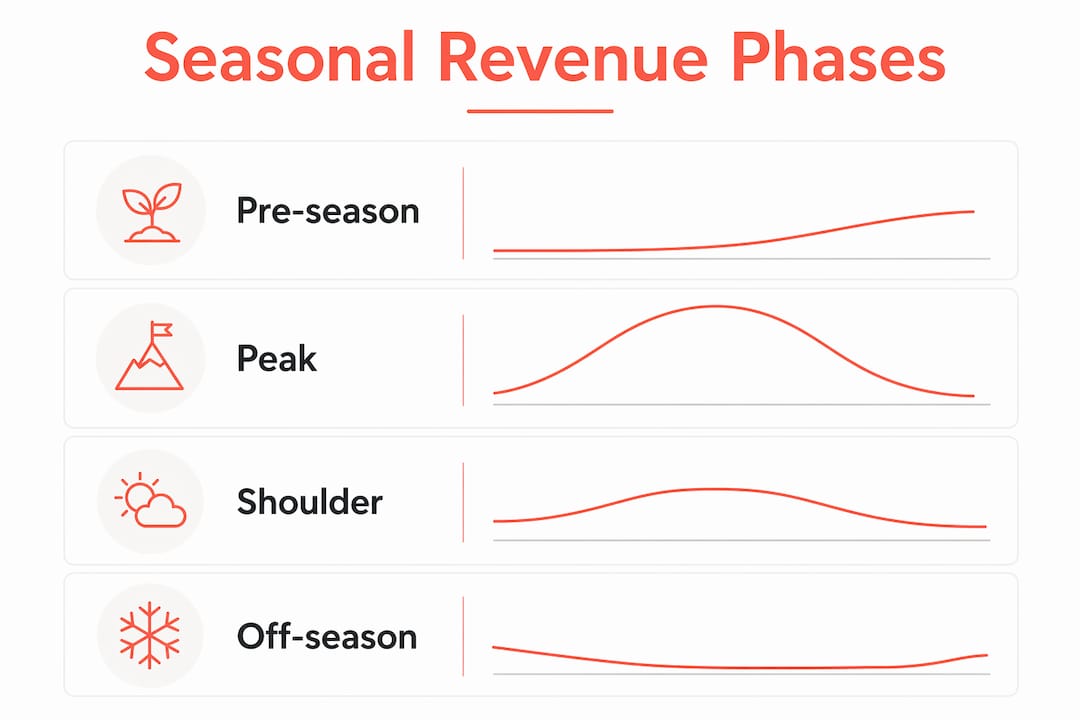
The most durable framework for seasonal budget allocation splits the year into four phases: pre-season, peak, shoulder, and off-season. A suggested allocation from the Adwave seasonal advertising framework puts 35% of budget in pre-season, 35% in peak, 15% in shoulder, and 15% in off-season. The logic is that pre-season and off-season CPMs are cheaper, so awareness bought then compounds into lower CAC when peak demand arrives.
2. Sequence your creative and offers
Do not open with your deepest discount. An early-bird offer (say, 10% off for the first week) creates urgency without training your audience to wait for a bigger deal. Progressive discounting, where the offer deepens as the event approaches, captures both early buyers and last-minute shoppers. VIP or loyalty-first access, where your email list gets the offer 24–48 hours before the public, rewards retention and drives email list growth ahead of the next season.

For ecommerce ad creative during seasonal windows, swap creative at least twice: once at launch and once mid-campaign when frequency fatigue sets in. Static creative that worked in week one will underperform by week three.
3. Segment audiences by intent and timing
| Audience segment | Timing | Channel | Offer type |
|---|---|---|---|
| Lapsed customers (12+ months) | Pre-season | Email, paid social | Win-back offer, early access |
| Active loyalty customers | Pre-season | Email, SMS | VIP early access, exclusive bundle |
| High-intent site visitors (30-day) | Peak | Retargeting, search | Direct conversion offer |
| Lookalike audiences | Pre-season ramp | Paid social | Awareness and consideration |
| Cart abandoners | Peak | Email, retargeting | Urgency reminder, free shipping |
Loyalty-first tactics consistently outperform cold acquisition during shoulder windows. Email and SMS campaigns to past customers convert at much higher rates than paid channels during pre-season and shoulder periods, and the cost per conversion is a fraction of paid media.
4. Align pricing and inventory before you spend
A promotion that sells out in 48 hours and leaves customers with backorder notices is a brand problem, not just an operational one. Before committing to a seasonal media budget, confirm your inventory position, your fulfilment capacity, and your customer service headcount. If you cannot fulfil the volume a successful campaign would generate, cap the promotion or phase the offer rollout.
Hospitality and service businesses face a different version of this: tiered discounts and experience bundles protect rate integrity better than across-the-board rate cuts. A hotel that drops its rack rate by 40% during a slow period trains guests to never pay full price. A package that adds breakfast, a late checkout, and a local experience maintains perceived value while still moving inventory.
Pro Tip: For perishable or time-sensitive products, front-load your promotional spend in the days immediately before the event. For storable goods, a longer pre-season ramp is more cost-effective because buyers can stockpile and intent is spread across a wider window.
How to forecast seasonal revenue and set budgets
1. Choose your baseline
Start with your prior-year seasonal average for the same window, not your trailing 52-week average. A trailing average will understate peak potential and overstate off-season expectations. If you have two or more years of data, average them and weight the most recent year more heavily.
2. Model three scenarios
Build a conservative, expected, and aggressive scenario for each major seasonal window. Conservative assumes flat year-on-year growth. Expected incorporates your planned media investment and any category tailwinds. Aggressive models the outcome if conversion rates hit the upper end of your historical range and CAC falls to its seasonal low.
3. Allocate budget across phases
Apply the four-phase split (35% pre-season, 35% peak, 15% shoulder, 15% off-season) as a starting point, then adjust based on your category’s demand curve. A category with a very sharp peak (BFCM electronics) may warrant a heavier peak allocation. A category with a long consideration cycle (travel) benefits from a longer pre-season ramp.
4. Pre-fund the ramp from peak revenue
Treat next year’s pre-season ramp as a cost of this year’s peak months. When peak revenue lands, set aside a marketing reserve to fund the following season’s early spend. This avoids the cash-flow problem of spending ahead of revenue realisation, which catches many SMEs off guard in January when they need to fund a February back-to-school campaign.
5. Build a planning timeline
For a major window like BFCM or Christmas, work backwards from the campaign launch date:
- 12 weeks out: Confirm inventory, set budget, brief creative.
- 8 weeks out: Creative production complete, audiences built, landing pages live.
- 6 weeks out: Pre-season campaign live (awareness and list building).
- 4 weeks out: Early-bird offer live for loyalty segment.
- 2 weeks out: Peak campaign live, holdout test running.
- Post-event: LTV tracking begins, learnings documented for next season.
Black Friday/Cyber Monday readiness requires this kind of structured timeline. Retailers who start the creative and inventory conversation in August consistently outperform those who begin in October.
Common pitfalls with seasonal advertising and how to avoid them
Over-discounting and conditioning buyers. Running deep public discounts every season trains your audience to wait. Once customers learn that 30% off is coming in November, they stop buying in October. The fix is to vary your offer structure: early-bird access, bundles, and loyalty tiers rather than a single headline discount that repeats identically each year.
Going dark off-season. Cutting spend to zero between peaks is one of the most expensive mistakes in seasonal advertising. When you restart, you pay elevated CPMs to rebuild the audience recognition you let decay. Low-frequency off-season spend at around 20–30% of peak levels retains awareness, keeps your pixel warm, and buys brand-building CPMs at their cheapest point in the year.
Operational failures during peak. Stockouts, delayed fulfilment, and overwhelmed customer service teams destroy the revenue a successful campaign generates. Monitor fill rate and fulfilment SLAs daily during peak windows. If stockouts are imminent, pause the campaign rather than take orders you cannot fulfil.
Red flags to watch in real time:
- CAC rising faster than conversion rate during peak (signal: creative fatigue or audience saturation).
- ROAS declining mid-campaign without a corresponding drop in spend (signal: offer fatigue or competitor price matching).
- Cart abandonment rate spiking (signal: checkout friction, shipping cost surprise, or stock uncertainty).
- Customer service ticket volume exceeding capacity (signal: operational risk to revenue and reviews).
Quick corrective plays: Rotate creative immediately when frequency hits 3+ per user per week. Introduce a free-shipping threshold or a bundle offer if cart abandonment spikes. Pause spend on underperforming ad sets rather than cutting budget across the board.
Short evidence examples and Moormarketing case notes
The concentration of revenue in peak seasonal windows is well-documented. Research applying the Seasonal Marketing Impact Framework (SMIF) to Walmart’s weekly sales data confirmed that holiday campaigns significantly increase sales even after controlling for macroeconomic variables including CPI, temperature, fuel prices, and unemployment. The study found that temperature and CPI exert a stronger influence during holiday weeks than in non-holiday periods, which means the effectiveness of seasonal advertising is moderated by economic conditions. In a high-CPI environment, consumers are more tolerant of price fluctuations for seasonal needs, which partially offsets inflationary headwinds for well-positioned seasonal campaigns.
A separate study on promotional timing in grocery retail, using six years of transaction data from an Austrian retail chain, found that pre-holiday promotions are particularly effective for fresh products due to consumer urgency from store closures and perishability. Frozen products showed more stable demand with less sensitivity to promotional timing. The practical implication for Australian retailers: if your product is perishable or time-sensitive, front-load your promotional spend in the days immediately before the event.
Moormarketing’s client results reflect this pattern directly. A new toy retailer reached $2 million in monthly sales, and a global furniture brand scaled to $3 million per month, both through data-driven seasonal and growth strategies. The Moormarketing Google Ads case study shows how structured campaign frameworks, timed to demand windows, drive measurable revenue outcomes rather than vanity metrics.
How to test and attribute seasonal lift (holdouts, A/B, incrementality)
Proving that your seasonal campaign caused the revenue lift, rather than just coinciding with it, requires a structured testing approach. Here is a practical framework.
1. Choose your test type
- Geographic holdout: Suppress ads in a matched control region while running normally in the test region. Compare revenue growth between the two. Works well for businesses with regional concentration.
- Audience holdout: Randomly exclude 10–20% of your target audience from seeing ads. Compare conversion rates between the exposed and holdout groups. The cleanest method for e-commerce.
- Creative A/B vs holdout: Test two creative variants against each other and against a holdout group. Isolates both creative performance and incremental lift simultaneously.
2. Set up the test before the campaign launches
A holdout test set up after the campaign starts is worthless. The holdout group must be defined and suppressed from day one. For a major seasonal window, define your holdout at least two weeks before launch.
3. Define your metrics and minimum detectable lift
Decide in advance what you are measuring (incremental revenue, incremental conversions, or incremental ROAS) and what lift would be meaningful enough to act on. For most e-commerce businesses, a minimum detectable lift of 10–15% on incremental revenue is a reasonable threshold for a seasonal window test.
4. Run the test for the full campaign window
Do not call the test early because early results look good. Seasonal campaigns often have a slow start and a sharp peak. Cutting the test short biases the result toward the peak and overstates lift.
5. Analyse and document
Compare the holdout and exposed groups on your pre-defined metrics. Calculate incremental revenue as the difference in conversion rate multiplied by the exposed audience size and average order value. Document the result, the audience definition, the creative used, and the offer structure. This becomes the baseline for next season’s planning.
6. Fold learnings into next season
An incrementality test that shows strong lift validates the channel and the offer. One that shows weak lift tells you the organic demand was doing most of the work, and you should either reduce spend or change the offer structure. Either result is valuable. The performance of search versus always-on channels during seasonal windows is one of the most common questions this testing framework answers.
Key takeaways
Seasonal advertising reliably lifts revenue when timing, offer structure, and incrementality testing are aligned to concentrated demand windows in your category.
| Point | Details |
|---|---|
| Launch early, not at peak | Pre-season campaigns buy cheaper CPMs and build warm audiences before auction costs spike. |
| Protect margin with tiered offers | Loyalty tiers, bundles, and early-bird pricing outperform flat discounts and avoid training buyers to wait. |
| Measure incrementality, not just ROAS | Run an audience holdout test from day one to separate campaign lift from organic seasonal demand. |
| Pre-fund next season from peak revenue | Set aside a marketing reserve during peak months to cover the following season’s pre-season ramp. |
| Moormarketing’s approach | Moormarketing applies data-driven seasonal frameworks to eCommerce brands, with client results including $2M and $3M monthly revenue milestones. |
What seasonal advertising has taught me about revenue
Most marketers treat seasonal campaigns as a calendar exercise. They see the date, they build the creative, they press go. What they miss is that the season is not the strategy. The season is just the window. What you do in the six weeks before the window opens determines whether you capture the lift or watch a competitor take it.
The brands that consistently win seasonal periods share one habit: they treat the off-season as a preparation phase, not a rest phase. They are building audiences, testing creative, and locking in inventory while their competitors have gone quiet. By the time the peak window opens, they have warm audiences, proven creative, and a fulfilment operation that can handle the volume. The campaign itself almost becomes a formality.
The other thing worth saying plainly: deep discounting is a trap that compounds over time. Every time you train your audience to expect 30% off, you raise the floor for next season. The brands with the healthiest seasonal economics are the ones that compete on access, experience, and timing rather than price. A loyalty-first early-access offer costs less than a public discount and builds the kind of customer relationship that generates repeat revenue across multiple seasons.
Seasonal advertising is not about the peak. It is about what you build before it and what you retain after it.
Moormarketing’s seasonal revenue planning for eCommerce brands
Seasonal campaigns that actually move revenue require more than a promotional calendar. They need a structured approach to timing, creative sequencing, audience segmentation, and incrementality testing, all coordinated before the demand window opens.
Moormarketing works with eCommerce brands to build exactly that. The team handles seasonal campaign planning, budget phasing across the four-season framework, creative sequencing and testing, and holdout-based attribution so you know what the campaign actually drove. Client results include a new toy retailer reaching $2 million in monthly sales and a global furniture brand scaling to $3 million per month, both through structured, data-led seasonal and growth strategies.
If you are heading into a major seasonal window and want a campaign built to capture incremental revenue rather than just ride the organic wave, work with Moormarketing to get a plan in place before the window opens.
Further reading and Australian resources
- Seasonal Marketing Impact Framework (SMIF) study — empirical analysis of holiday campaign effects on weekly retail sales, controlling for CPI, temperature, and unemployment.
- Promotional timing for fresh and frozen products — six-year grocery retail study on how pre-holiday timing affects perishable versus storable product sales.
- Adwave seasonal advertising framework — four-phase budget allocation model and off-season frequency guidance.
- BigCommerce: seasonal promotions glossary — practical definitions and alignment guidance for promotional event selection.
- Mailchimp seasonal marketing resources — email and SMS tactics for shoulder-season conversion and loyalty campaigns.
- Talon.One: seasonal promotion strategies for hospitality — loyalty tier and value bundle approaches for protecting rate integrity.
- Moormarketing: digital ad campaign best practices — campaign structure, creative testing, and audience strategies for Australian eCommerce brands.
- Moormarketing: eCommerce email and ads integration guide — how to coordinate owned channels with paid media across seasonal windows.
- Moormarketing: Black Friday/Cyber Monday readiness checklist — pre-season preparation guide for Australia’s biggest retail event.
- Moormarketing case studies — client revenue outcomes from structured seasonal and growth campaign frameworks.
- Selloop.ai: advertising automation alternatives — overview of AI-powered tools that can accelerate seasonal campaign launches and behavioural segmentation.