
For a new brand with no audience and no track record, influencer marketing is one of the fastest ways to build awareness, trust and category positioning, often faster than paid search or display for product-led businesses. The role of influencer marketing for new brands is not to replace paid channels but to do something paid channels struggle with: make strangers care.
Your next several days:
- Define one campaign goal (awareness, credibility, or direct sales) before you brief a single creator.
- Pick your primary platform: Instagram for lifestyle and visual products, TikTok for discovery-led categories and younger audiences, YouTube for considered purchases that need explanation.
- Start with micro-creators in your niche. They cost less, convert better in tight communities, and give you real data before you scale.
- Set a test budget you can afford to learn from, not one you need to profit from immediately.
Table of Contents
- What influencer marketing actually means for a new brand
- Why the role of influencer marketing matters more for new brands
- Which creator tier should you use, and when?
- How creator partnerships build brand image and trust
- How to run your first influencer programme: a practical checklist
- Budget models and realistic timelines for Australian brands
- KPIs and measurement: tracking what actually matters
- Australian disclosure and advertising law: what you must know
- Common mistakes that waste budget and damage new brands
- What works in practice: how Moormarketing approaches new-brand programmes
- Key takeaways
- Why I’d tell every new brand to start smaller than they think
- Moormarketing can help you build your first influencer programme
- Useful sources and further reading
What influencer marketing actually means for a new brand
Influencer marketing is the practice of partnering with creators who have an established, engaged audience, so that their content and credibility distribute your brand to people who already trust them. The operational definition that matters for a brief: creator content plus creator audience plus a measurable activation (a link, a code, a landing page).
That framing separates it from both paid social and traditional PR. Paid social puts your creative in front of strangers with no prior relationship. PR earns coverage in publications your audience may or may not read. Influencer marketing does something different: it borrows an existing relationship. The creator has already done the trust-building work with their audience. You are accessing that trust, not manufacturing it from scratch.
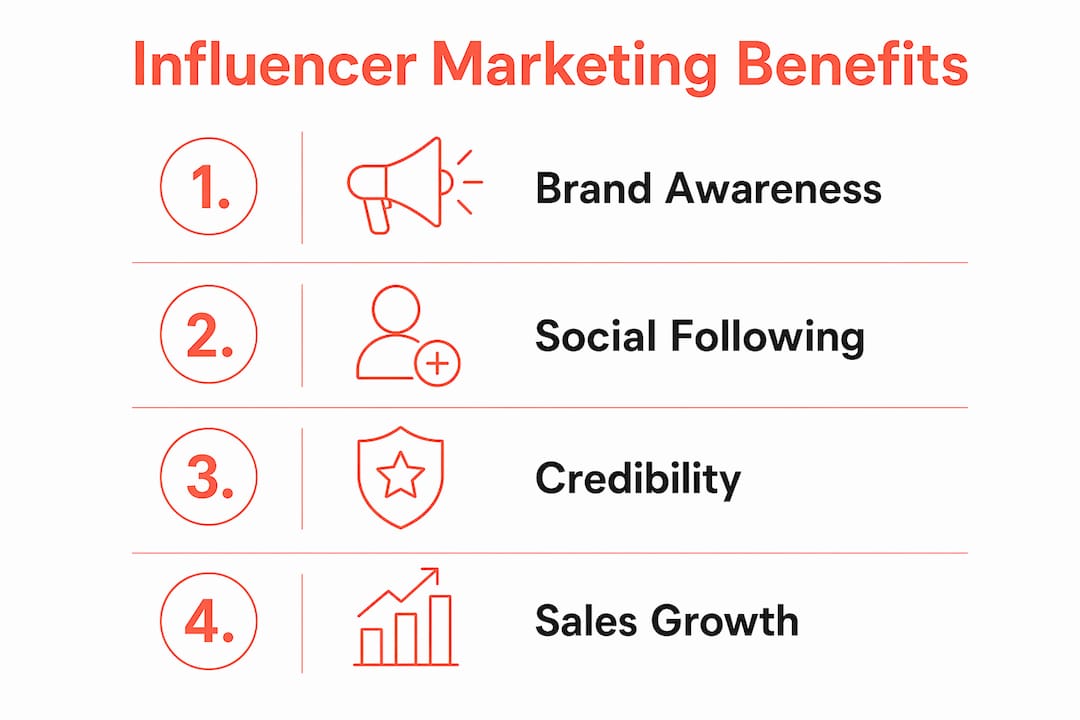
Three outcomes a well-run programme can deliver for a new brand: a spike in brand search and social following after a coordinated creator drop; a library of UGC assets you can repurpose into paid ads and email; and direct sales via affiliate codes attributable from day one.
Why the role of influencer marketing matters more for new brands
New brands face a specific problem: no one knows you exist, and no one has a reason to trust you yet. Paid search captures demand that already exists. Influencer marketing creates it.

Creators bypass the feed friction that kills cold-audience paid social. A creator’s audience has opted in to their content. When that creator introduces your brand, it arrives with context and credibility attached. That is a fundamentally different entry point than an ad interrupting a scroll.
The social proof effect is real and measurable. Research synthesising influencer marketing effectiveness across 251 papers finds that follower characteristics and social identity are among the strongest drivers of consumer attitudes and purchase intent, meaning the audience’s relationship with the creator shapes how they receive your brand. A third-party voice speeds trust-building in a way a brand’s own posts simply cannot replicate.
Discovery is the other lever. One in four adults discover products via influencers, with rates significantly higher among Gen Z. For any brand targeting under-35 consumers in Australia, that is not a secondary channel.
Key reasons to prioritise influencer marketing early:
- Creators deliver niche audiences that paid targeting approximates but rarely matches precisely.
- Authentic third-party endorsement shortens the consideration phase for new-to-brand buyers.
- Creator content doubles as owned-channel creative, reducing production costs elsewhere.
- Early creator partnerships, before a brand scales to Series B, often carry better terms and more creative flexibility.
Which creator tier should you use, and when?
Not all influencers serve the same purpose. Choosing the wrong tier for your launch goal is one of the most common budget mistakes new brands make.
| Creator tier | Typical following | Best for | Trade-off |
|---|---|---|---|
| Nano | smaller followings | Hyper-local trust, UGC volume, product seeding | Very limited reach per creator |
| Micro | moderate followings | Niche engagement, cost-effective credibility | Moderate reach; needs volume |
| Mid-tier | larger moderate followings | Awareness + credibility balance | Higher fee; less niche |
| Macro | large followings | Broad awareness, status signalling | Lower engagement rates |
| Mega/Celebrity | very large followings | Mass reach, brand legitimacy signals | Expensive; low engagement |
Meta-analysis data consistently shows smaller creators produce higher engagement rates, while larger creators drive broader awareness and purchase intent. For a new brand in launch mode, that points to micro and mid-tier creators as the primary workhorses, with nano creators filling the UGC and seeding layer.
Platform selection in brief:
- Instagram suits lifestyle, fashion, beauty, food, and home categories. Strong for visual storytelling, Reels discovery, and creator-to-paid whitelisting.
- TikTok is the discovery engine for younger Australian audiences. Organic reach is still generous relative to other platforms, and short-form video drives fast awareness spikes.
- YouTube earns its place for considered purchases: tech, fitness equipment, supplements, or anything that benefits from a detailed review or tutorial. Longer shelf life than any other platform.
Pro Tip: Structure your launch programme across three tiers: one or two mid-tier anchor creators for credibility and reach, a pool of six to ten micro-creators for engagement and niche penetration, and a base of nano-creators or UGC contributors for content volume and seeding. This architecture gives you scale without betting everything on one creator.
How creator partnerships build brand image and trust
The mechanism is not mysterious, but it is worth understanding precisely so you can brief for it.

Social proof and third-party validation work because consumers discount brand claims and weight peer or expert opinions more heavily. When a creator your audience already follows says your product solved a problem for them, that statement carries a credibility premium no ad can manufacture. Research on influencer credibility and purchase intention confirms that trust and perception are the primary psychological mechanisms through which influencer content shapes buying decisions, not just engagement metrics.
Storytelling and brand interpretation are where creators add value that a brief cannot fully specify. A creator translates your brand’s meaning into their own voice and context. That translation is what makes the content feel native rather than sponsored. A skincare brand becomes “the thing that fixed my texture issues after six months of trying everything.” A furniture brand becomes “how I finally made my rental feel like home.” The brand positioning lands through lived narrative, not a tagline.
UGC and content reuse extend the value well beyond the original post. Creator content can feed paid social campaigns, email sequences, and product pages. A single well-briefed creator video can become six months of creative assets across channels.
Research from UConn supports this: pairing an influencer with selected engaged followers amplifies spread more than influencer-only activation, making seeding a practical tactic for launch spikes rather than an optional extra.
How to run your first influencer programme: a practical checklist
Running a first programme without a plan produces one-off posts that generate no lasting value. Here is the operational sequence that works.
-
Set one primary goal. Awareness (reach, impressions), credibility (sentiment, brand search lift), or conversion (affiliate sales, new customers). Every other decision flows from this. Measuring conversion metrics for an awareness campaign is how brands end up concluding influencer marketing “doesn’t work.”
-
Map your audience before you search for creators. Know the demographics, interests, and platforms of the people you want to reach. Use social listening tools to find where conversations about your category are already happening.
-
Discover creators by audience resonance, not follower count. Search by niche hashtags, competitor brand tags, and category keywords. Vet each creator’s audience demographics (ask for a media kit), engagement quality (real comments vs. generic emoji), and content consistency.
-
Write a brief that protects positioning and invites creativity. Include: brand story and tone, key message or claim, mandatory disclosures, what to avoid, and the creative freedom you are granting. A brief that scripts every word produces stiff content. A brief with no guardrails produces off-brand content.
-
Agree on compensation and usage rights upfront. Flat fee, product-for-post, or a hybrid with affiliate commission. Secure written permission to repurpose content in paid channels before you launch. This is non-negotiable for brands planning to integrate creator content into paid campaigns.
-
Use a pre-launch creative scorecard to gate content before it goes live. Check brand safety, disclosure compliance, claim accuracy, and creative quality before approving any post.
-
Launch with seeding. Coordinate the influencer post with a seeding activation: share the post with engaged community members, run a paid boost on the creator’s content (whitelisting), and time the drop with any owned-channel activity.
-
Measure early signals at weeks two and four, not day one. Brand search volume, follower growth, affiliate link clicks, and content saves are leading indicators. Conversion data takes longer to stabilise.
Pro Tip: Brands that run always-on influencer programmes rather than episodic campaigns report lower blended customer acquisition costs and stronger compounding returns over time. Even a modest always-on programme with six to eight creators outperforms a single large campaign spend.
Budget models and realistic timelines for Australian brands
Budget planning for influencer marketing is less about hitting a number and more about structuring for learning.
Compensation models:
- Product-for-post: Works for nano and some micro creators, especially at launch when your product is genuinely novel. Does not scale and creates tax and disclosure obligations regardless of cash changing hands.
- Flat fee: The most common model for micro and mid-tier creators. Gives you predictable costs and clear deliverables. Expect to negotiate on usage rights separately.
- Hybrid (fee plus affiliate/commission): Aligns incentives. The creator earns more when they drive results. Useful for conversion-focused campaigns and for building longer-term creator relationships.
- Equity-for-content: Rare but used by venture-backed consumer brands in early stages. Gives creators skin in the game; works best when the brand has a compelling growth story.
Venture-backed consumer brands are increasingly allocating meaningful portions of early launch budgets to creator partnerships because the earned-media value relative to equivalent paid placements is strong, particularly before a brand reaches Series B and rates rise.
Timeline expectations for a pilot programme:
- Weeks 0–2: Creator discovery, outreach, and initial negotiation.
- Weeks 2–4: Contracting, product seeding, and brief delivery.
- Weeks 4–6: Content creation, review, and approval cycles.
- Weeks 6–8: Content goes live; monitor early engagement signals.
- Weeks 8–12: Affiliate and conversion data stabilises; assess for scale or pivot.
Do not expect meaningful conversion data before week eight. Brands that kill a programme at week three because “nothing happened” are measuring the wrong thing at the wrong time.
KPIs and measurement: tracking what actually matters
The biggest measurement mistake is applying the wrong metric to the wrong goal. Here is how to align them.
| Objective | Primary KPI | How to collect |
|---|---|---|
| Awareness | Impressions, reach, CPM, brand search volume | Creator reporting, Google Search Console |
| Credibility | Sentiment, share of voice, saves, comments quality | Social listening tools, manual audit |
| Conversion | Affiliate sales, new customers, revenue per creator | Unique promo codes, UTM links, affiliate platform |
| Long-term value | Cohort LTV, repeat purchase rate | CRM or eCommerce analytics |
Attribution is where most brands undercount influencer value. A viewer watches a TikTok, searches your brand name three days later, and converts via Google. Last-click attribution gives Google the credit. UTM parameters on creator links, unique promo codes, and cohort analysis (comparing new customers acquired during a creator campaign versus baseline) give you a more honest picture.
Dark social is the other blind spot. Content shared via DMs, WhatsApp, or private stories generates traffic that appears as direct in analytics. If you see a spike in direct traffic during a creator campaign, that is almost certainly influencer-driven.
Pro Tip: Run a simple brand-lift check before and after a pilot: track branded search volume in Google Search Console and your social follower growth rate. These two metrics move faster than sales and tell you whether awareness is building before conversion data arrives. Pair this with your brand awareness campaign planning to set realistic benchmarks.
Australian disclosure and advertising law: what you must know
Australia’s disclosure requirements are not optional, and ignorance of them is not a defence. The Australian Competition and Consumer Commission (ACCC) and the Australian Association of National Advertisers (AANA) Code of Ethics both require that paid commercial relationships are clearly disclosed to audiences.
Core obligations for Australian brands:
- Any paid partnership, gifted product, or affiliate arrangement must be disclosed clearly and prominently, not buried in hashtags or below a “more” fold.
- Disclosures must be understandable to a general audience. “Ad,” “Paid partnership,” or “Sponsored” are acceptable. “#collab” or “#gifted” buried in a list of tags is not sufficient under AANA guidance.
- Product claims made by creators must be substantiated. If a creator says your supplement “cures” anything, that is a claim your brand is responsible for under Australian Consumer Law.
- Platform-specific conventions: Instagram’s “Paid partnership” label, TikTok’s branded content toggle, and YouTube’s paid promotion disclosure checkbox are required in addition to, not instead of, verbal or caption disclosures.
Contract essentials for new brands:
- Approval rights before posting (mandatory for claim-sensitive categories).
- Content usage rights and duration (specify paid social, email, and website use).
- Exclusivity clauses (limit to your direct category, not a blanket ban on all brand work).
- Recall and takedown clauses if a creator’s behaviour creates reputational risk.
Seek formal legal advice for complex deals, exclusivity arrangements, or any campaign involving therapeutic goods, financial products, or health claims.
Common mistakes that waste budget and damage new brands
Most influencer marketing failures are predictable. They follow the same patterns.
Mistake 1: No clear goal. “Get us some exposure” is not a brief. Without a defined objective, you cannot measure success, and you will almost certainly optimise for the wrong thing (usually follower count on the creator’s profile, not yours).
Mistake 2: Chasing follower count. 2026 industry benchmarks show consumers increasingly value subject-matter relevance and authenticity over raw audience size. A creator with 40,000 highly engaged followers in your exact niche will outperform a creator with 400,000 general lifestyle followers for almost any new-brand objective.
Mistake 3: One-off posts with no content rights. A single post disappears in 48 hours. If you have not secured usage rights, you cannot repurpose the content. You have paid for a moment, not an asset.
Mistake 4: Weak contracts. No approval rights, no usage rights, no recall clause. These are not bureaucratic niceties; they are the difference between a controlled brand launch and a crisis you cannot contain.
Red flags when vetting creators:
- Engagement rate dramatically out of proportion to follower count (suggests pods or purchased engagement).
- Comments that are generic (“Great post!” “Love this!”) with no specific reference to the content.
- Sudden follower spikes visible in audience analytics tools.
- Unwillingness to share audience demographic data before contracting.
What works in practice: how Moormarketing approaches new-brand programmes
Moormarketing’s approach to influencer marketing for new brands starts with programme architecture rather than individual creator selection. The structure that consistently produces results for launch-stage eCommerce brands is a three-tier model: one or two mid-tier anchor creators who establish credibility and generate reach, a pool of micro-creators who drive niche engagement and affiliate conversions, and a base of nano-creators or UGC contributors who supply content volume and seeding capacity.
The measurement gates matter as much as the structure. Moormarketing sets performance gates at weeks four and eight: if early engagement signals (saves, comments, brand search lift) are not moving, the programme is adjusted before the full budget is committed. This test-and-scale discipline is what separates a pilot that generates learning from one that simply generates spend.
Moormarketing’s pilot programme checklist:
- Two anchor mid-tier creators briefed on brand story, key claim, and category positioning.
- Six to ten micro-creators with affiliate codes and UTM tracking in place from day one.
- A UGC seeding plan that activates creator content across owned channels within 48 hours of posting.
- Performance gates at weeks four and eight with defined pass/fail criteria.
- Content usage rights secured for a minimum of 12 months across paid and owned channels.
Moormarketing has delivered outcomes including $2 million in monthly sales for a new toy retailer and $3 million per month for a global furniture brand, using frameworks that integrate creator-led awareness with eCommerce growth strategy at every stage. You can see how this applies to a real brand in the Coco case study.
Key takeaways
Influencer marketing builds brand awareness, trust, and category positioning for new brands faster than most paid channels when it is structured as a repeatable programme rather than a one-off campaign.
| Point | Details |
|---|---|
| Start with one clear goal | Define awareness, credibility, or conversion before briefing any creator. |
| Favour micro and mid-tier creators | Smaller creators drive higher engagement; mid-tier adds reach. Use both in a tiered structure. |
| Secure content rights upfront | Always negotiate usage rights for paid social, email, and owned channels before launch. |
| Measure the right metrics | Match KPIs to your goal: impressions for awareness, affiliate sales for conversion, sentiment for credibility. |
| Moormarketing’s starting point | Run a 6–8 week pilot with two anchor creators and six to ten micro-creators, with performance gates at weeks four and eight. |
Why I’d tell every new brand to start smaller than they think
There is a version of influencer marketing that looks impressive on a pitch deck and produces almost nothing: one big creator, one post, no tracking, no usage rights, no follow-up. It happens constantly, and it is almost always the result of confusing visibility with strategy.
The brands that actually build something from creator partnerships are the ones who treat the first pilot as a learning exercise. They pick a small, tight creator cohort. They set up tracking before anything goes live. They brief for authenticity rather than scripting every word. And then they measure what actually moved, not what looked good in a screenshot.
The other thing most articles won’t tell you: the content is often worth more than the post. A well-briefed creator video, properly licensed, can run as a paid ad for six months. It can anchor an email sequence. It can sit on a product page and lift conversion rates. The brands that understand this stop thinking about influencer marketing as a media spend and start thinking about it as a content production model with a built-in distribution channel.
Start with three creators, not thirty. Get the measurement right. Then scale what works.
Moormarketing can help you build your first influencer programme
New brands that get influencer marketing right from the start spend less to acquire their first customers and build creative assets that compound across every channel. Moormarketing works with launch-stage and scaling eCommerce brands to design creator programmes that are built for measurement from day one, not retrofitted after the spend is gone.
The approach is hands-on: senior strategists design the programme architecture, set the performance gates, and manage the creative approval process so founders are not doing it alone. Whether you need a pilot designed from scratch or a strategy session to pressure-test what you already have, the starting point is a conversation.
If you want to pair your creator programme with a scalable social media strategy or explore how influencer content feeds into paid amplification, Moormarketing’s team can map that out for you. Start the conversation here and get a programme structure built around your launch goals.
Useful sources and further reading
- Influencer marketing effectiveness: a meta-analytic review — Synthesises 251 papers on what drives influencer marketing outcomes; essential reading for understanding the evidence base.
- Frontiers: influencer marketing and Gen Z purchase intentions — Structural model examining how creator credibility and content quality drive purchase intent among Gen Z consumers.
- YouGov: influencer marketing insights — Survey data on product discovery via influencers across generations.
- Sprout Social: 2026 influencer marketing report — Industry benchmarks on consumer attitudes, follower-count relevance, and investment trends.
- UConn: influencer-plus-follower seeding research — Academic evidence for the seeding amplification technique.
- AANA Code of Ethics — The primary self-regulatory standard for advertising and influencer disclosure in Australia.
- ACCC: influencer marketing guidance — Australian Competition and Consumer Commission guidance on misleading conduct and disclosure obligations.
- Pre-launch creative scorecard — POPJAM.IO — Practical creative readiness checklist for gating influencer content before launch.
- How to build an influencer programme that compounds — Programme architecture and always-on strategy benchmarks.
- Moormarketing: eCommerce growth guide — Framework for integrating influencer activity with broader eCommerce growth levers.