

Cost per acquisition (CPA) advertising is defined as the total marketing spend divided by the number of new customers or leads acquired through a specific campaign or channel. Known in the industry as CPA, this metric tells you exactly how much it costs your business to persuade someone to take a revenue-relevant action, whether that is completing a purchase, signing up for an account, or submitting a lead form. CPA is calculated by dividing total campaign cost by the number of acquisitions. For example, $1,000 spent to generate 50 conversions produces a CPA of $20. Understanding what is cost per acquisition advertising is the foundation of every profitable eCommerce budget decision you will make.
How to calculate cost per acquisition effectively
The CPA formula is straightforward: total campaign cost divided by total acquisitions. The full formula encompasses media spend, labour, and technology costs, not just raw ad spend. That distinction matters because undercooked CPA figures lead to overconfident budget decisions.
Step-by-step CPA calculation
- Define your acquisition. Decide which action counts: a completed purchase, a paid subscription, a booked consultation, or a filled-in lead form. Every campaign needs one clear definition before you spend a dollar.
- Total your costs. Add direct ad spend plus any agency fees, creative production costs, and platform fees attributable to the campaign.
- Count your acquisitions. Pull the confirmed conversion count from your analytics platform for the same period.
- Divide. Total costs divided by total acquisitions equals your CPA.
A practical example: you run a Google Ads campaign for a furniture eCommerce store. You spend $5,000 on ads, $500 on creative, and $500 on platform management fees. The campaign generates 120 purchases. Your CPA is $6,000 divided by 120, which equals $50 per customer acquired.
| Cost component | Amount |
|---|---|
| Ad spend | $5,000 |
| Creative production | $500 |
| Platform management | $500 |
| Total campaign cost | $6,000 |
| Acquisitions | 120 |
| CPA | $50 |

Consistency in defining what counts as an acquisition and which costs to include matters more than absolute precision. Pick your method and stick to it across every campaign so your comparisons stay valid.
Pro Tip: Set your acquisition definition in writing before a campaign launches. Changing it mid-flight corrupts your historical data and makes month-on-month comparisons meaningless.
CPA versus customer acquisition cost
CPA and customer acquisition cost (CAC) are related but not interchangeable. CPA is a tactical, campaign-level metric. CAC is a business-level metric that factors in every sales and marketing expense across the organisation. Knowing the difference stops you from making budget calls based on the wrong number.
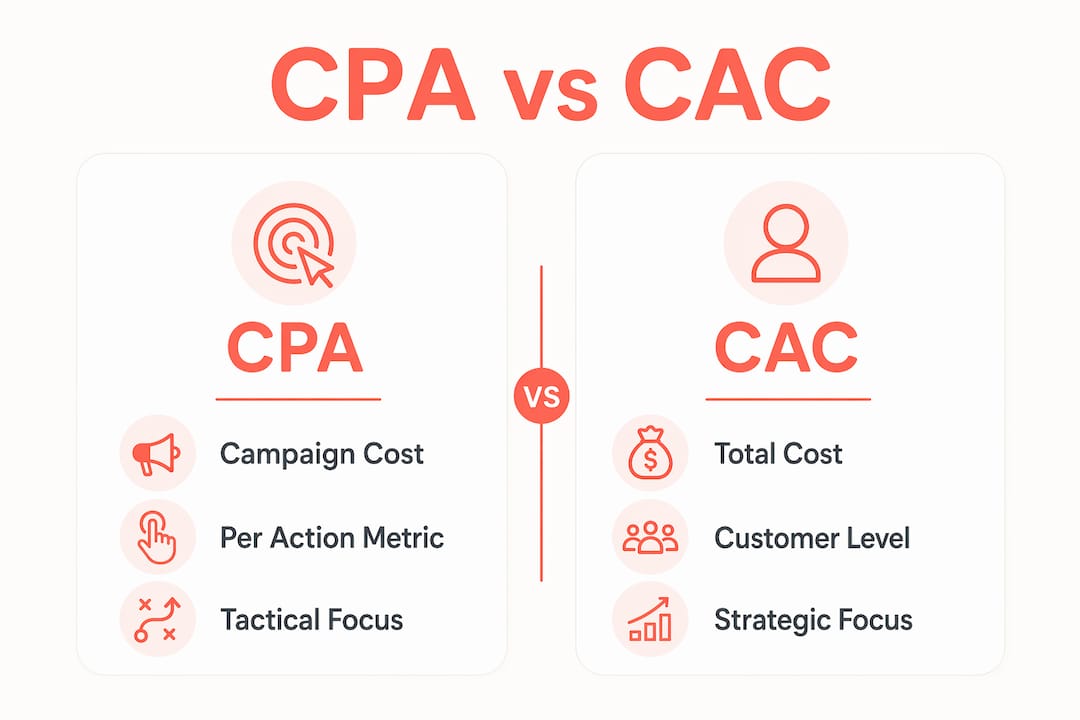
What is the difference between CPA and CAC?
CPA tracks specific campaign actions such as sign-ups or purchases per channel. CAC measures all marketing and sales expenses holistically, including salaries, software subscriptions, events, and overheads. The two metrics answer different questions.
Use CPA when you want to know whether a specific ad campaign or channel is pulling its weight. Use CAC when you want to know whether your entire go-to-market model is financially sustainable.
“CPA and CAC serve very different strategic and tactical roles. Misunderstanding them leads to ineffective budget decisions.” — Brandwatch
Key distinctions to keep in mind:
- Scope. CPA is campaign or channel-specific. CAC covers the whole business.
- Cost inputs. CPA typically includes direct campaign costs. CAC includes all sales and marketing overheads.
- Decision use. CPA informs ad optimisation. CAC informs pricing, margin, and growth strategy.
- Time horizon. CPA is measured per campaign or period. CAC is usually measured quarterly or annually.
- Audience. CPA is the metric for your media buyer or campaign manager. CAC is the metric for your CFO or growth lead.
A business can have a low CPA on a single Facebook campaign while carrying a high CAC because of expensive sales team overheads. Reporting only the CPA to leadership creates a false picture of profitability. Both numbers belong in the conversation.
What makes a good CPA in eCommerce marketing?
A good CPA is one that leaves enough margin after the cost of acquiring a customer to generate a profit over that customer’s lifetime. There is no universal benchmark. Your acceptable CPA depends on your product margins, average order value, and how often customers return to buy.
Profitable businesses maintain a Customer Lifetime Value (CLV) at least three times higher than their acquisition costs. That ratio accounts for hidden expenses including technology, onboarding, and admin overheads. If your CLV is $150, a CPA above $50 starts compressing your margins to an unsustainable level.
Factors that shape your acceptable CPA threshold:
- Average order value. A store selling $300 products can sustain a higher CPA than one selling $30 products at the same margin percentage.
- Profit margin. A 60% gross margin gives you more room than a 20% margin before CPA becomes a problem.
- Customer return rate. High repeat purchase rates increase CLV, which raises the CPA ceiling you can afford.
- Channel intent. Search ads attract buyers ready to purchase. Social media ads often reach people earlier in the decision process, which can lower CPA at the top of the funnel but require more touchpoints to convert.
- Lead quality. High-quality acquisitions contribute directly to revenue rather than just increasing funnel volume. A low CPA built on poor-quality leads produces worse ROI than a higher CPA built on buyers who actually spend.
Pro Tip: Calculate your maximum allowable CPA before you launch any campaign. Divide your average order value by three as a starting benchmark, then refine it using your actual margin and CLV data.
Benchmarking your CPA against profitability, not against industry averages, is the more reliable approach. Industry averages vary wildly by category, geography, and season. Your own historical data is the most relevant reference point you have.
Effective CPA advertising strategies for eCommerce
Reducing CPA without sacrificing acquisition quality requires deliberate choices at every stage of a campaign. The following strategies are ordered from foundational to advanced.
- Define your acquisition before you spend. Every campaign needs a single, revenue-relevant conversion event. Purchases outperform add-to-carts as acquisition definitions because they tie directly to revenue.
- Segment your audience tightly. Broad targeting increases reach but raises CPA. Narrower audience segments, built from first-party customer data, consistently produce lower acquisition costs because the message matches the buyer.
- Choose your channel based on intent. Scaling campaigns often increases CPA as targeting broadens. Search ads carry higher intent and can justify a higher CPA per click. Social media ads work better for awareness and retargeting at lower cost per touchpoint.
- Use dayparting to cut wasted spend. Dayparting schedules your ads to run only during periods when your audience is most likely to convert. Removing low-converting time slots reduces total spend without reducing acquisition volume.
- Test creative systematically. Run two or three ad variations at a time with a single variable changed per test. Winning creative reduces CPA by improving click-through and conversion rates without increasing spend.
- Track attribution consistently. Monitoring CPA by channel highlights cost-effectiveness and enables data-driven budget reallocation. Without consistent attribution, you cannot tell which channel is earning its spend.
- Manage CPA expectations when scaling. Expanding a campaign to new audiences almost always raises CPA initially. Build that expectation into your scaling plan so you do not pull budget from campaigns that are working correctly.
For eCommerce stores running Google Ads, comparing campaign structures is worth the time. The Google Performance Max versus Adwords breakdown shows how campaign type affects CPA at different funnel stages. Email marketing also plays a role. A well-built email sequence lowers CPA on repeat purchases because the cost per send is a fraction of paid acquisition. The eCommerce email kit from Moormarketing covers the sequences that drive the highest return per dollar spent.
For real-world results, the Moormarketing Google Ads case study shows how CPA measurement and optimisation played out across a live campaign.
Pro Tip: Set a CPA ceiling for each campaign before launch. If CPA exceeds that ceiling for three consecutive days without improvement, pause and audit before spending further.
My honest take on CPA advertising after years in eCommerce
The single biggest mistake I see eCommerce marketers make with CPA is treating it as a fixed target rather than a dynamic signal. A CPA of $40 is not inherently good or bad. It is only meaningful when you know the margin, the CLV, and the channel it came from.
The second mistake is conflating CPA with CAC in reporting. I have sat in meetings where a campaign CPA of $15 was celebrated while the actual CAC, once salaries and tools were included, was sitting above $90. Those are two very different business situations. Keeping the metrics separate in your reporting prevents that confusion from driving bad decisions.
Platform-specific CPA variation also catches people off guard. A Facebook campaign and a Google search campaign for the same product will almost never produce the same CPA. That is not a failure. It reflects the difference in user intent and funnel stage. The right response is to set channel-specific CPA targets, not a single number applied across every platform.
The businesses I have seen get CPA right share one habit: they define their acquisition event precisely, they include all relevant costs, and they review CPA weekly rather than monthly. That cadence gives them enough data to act before a poor-performing campaign burns through budget. Slow reporting cycles are where CPA discipline breaks down.
— Liza
Moormarketing’s workshops for eCommerce marketers
Understanding CPA at a conceptual level is one thing. Applying it to live campaigns, real budgets, and actual product margins is where most marketers need structured support.

Moormarketing’s eCommerce marketing workshops are built specifically for eCommerce professionals who want to move from theory to measurable results. Each workshop covers CPA calculation, channel-specific benchmarking, and campaign optimisation frameworks used by Moormarketing’s senior strategists across clients generating millions in monthly revenue. The sessions are hands-on, not lecture-based, so you leave with a working plan for your own campaigns. If you want to apply digital ad campaign best practices to your next spend cycle, the workshops are the fastest path to doing that with confidence.
Key takeaways
Cost per acquisition advertising is only useful when your acquisition definition, cost inputs, and reporting cadence stay consistent across every campaign you run.
| Point | Details |
|---|---|
| CPA formula | Divide total campaign cost by total acquisitions to get your cost per customer. |
| CPA versus CAC | CPA measures campaign-level efficiency; CAC measures total business acquisition cost including all overheads. |
| Acceptable CPA threshold | A sustainable CPA sits below one-third of your Customer Lifetime Value, accounting for margins and overheads. |
| Quality over quantity | High-quality acquisitions drive revenue; low-quality leads inflate volume without improving ROI. |
| Scaling raises CPA | Expanding targeting almost always increases CPA initially, so build that expectation into your scaling plan. |
FAQ
What is cost per acquisition in advertising?
Cost per acquisition (CPA) is the total marketing spend divided by the number of customers or leads acquired through a specific campaign. It measures the average cost to persuade one person to complete a defined revenue-relevant action.
How do I calculate CPA for my eCommerce campaigns?
Add all campaign costs including ad spend, creative, and fees, then divide by the number of confirmed acquisitions in the same period. A $6,000 campaign that generates 120 purchases produces a CPA of $50.
What is the difference between CPA and customer acquisition cost?
CPA is a campaign-level metric tracking the cost of specific actions per channel. Customer acquisition cost (CAC) is a business-level metric that includes all sales and marketing overheads across the organisation.
What is a good CPA for an eCommerce store?
A good CPA is one that stays below one-third of your Customer Lifetime Value. The right number depends on your product margin, average order value, and how frequently customers return to purchase.
Why does CPA increase when I scale my campaigns?
Scaling campaigns broadens targeting beyond your highest-intent audience, which raises the average cost per conversion. Managing CPA expectations during scaling is part of a healthy growth plan, not a sign that the campaign is failing.