

An ecommerce customer retention strategy is a deliberate system of interconnected tactics that increases repeat purchase rates and maximises customer lifetime value. Most ecommerce businesses pour budget into acquisition while ignoring the far cheaper lever sitting right in front of them. Retaining a customer costs 5–7 times less than acquiring a new one, and a 5% lift in retention can increase profits by 25–95%. That gap between what retention delivers and what most brands invest in it is where the real opportunity lives.
Which customer retention tactics deliver the highest return on investment?
Email automation is the single highest-ROI retention channel available to ecommerce businesses. It delivers $36 for every $1 spent, with automated flows lifting repeat purchase rates by 20–30%. No other channel comes close on that ratio.

The four flows every store needs are: a welcome series, an order confirmation sequence, a post-purchase education flow, and a win-back campaign. Each targets a different stage of the customer relationship. Together, they create a continuous conversation that keeps your brand front of mind without requiring manual effort.
Post-purchase email flows generate 3.5 times higher revenue per recipient than promotional emails. That is because they reach customers at peak engagement, right after a buying decision. Most stores send a single confirmation email and stop there. That is a significant missed opportunity.
Subscription models are the second major lever. Subscribers show 3–5 times higher lifetime value than one-time buyers, particularly for consumables with 30–90 day replenishment cycles. The recurring revenue also makes forecasting and inventory planning far more predictable.
Pro Tip: Start with email automation before building a loyalty program. The setup time is lower, the ROI is immediate, and the data you collect feeds every other retention tactic you build later.
| Tactic | Impact on retention | Implementation effort | Time to results |
|---|---|---|---|
| Email automation flows | Very high | Low | 2–4 weeks |
| Subscription model | Very high | Medium | 4–8 weeks |
| Loyalty program | High | Medium to high | 8–16 weeks |
| Post-purchase experience | High | Low to medium | 2–6 weeks |
| Community building | Medium | High | 3–6 months |
How to use behavioural data and personalisation to keep customers engaged
Generic segmentation, such as splitting customers by age or location, produces generic results. The brands winning at retention use stated-preference personalisation, which means collecting data customers actively give you rather than inferring it from demographics.
Onboarding quizzes and product recommendation flows are the most effective zero-party data tools. Personalising emails based on stated preferences collected through onboarding quizzes increases engagement by delivering content that is directly relevant to each customer. A skincare brand asking about skin type at signup can then send targeted replenishment reminders and product education that feels personal rather than broadcast.
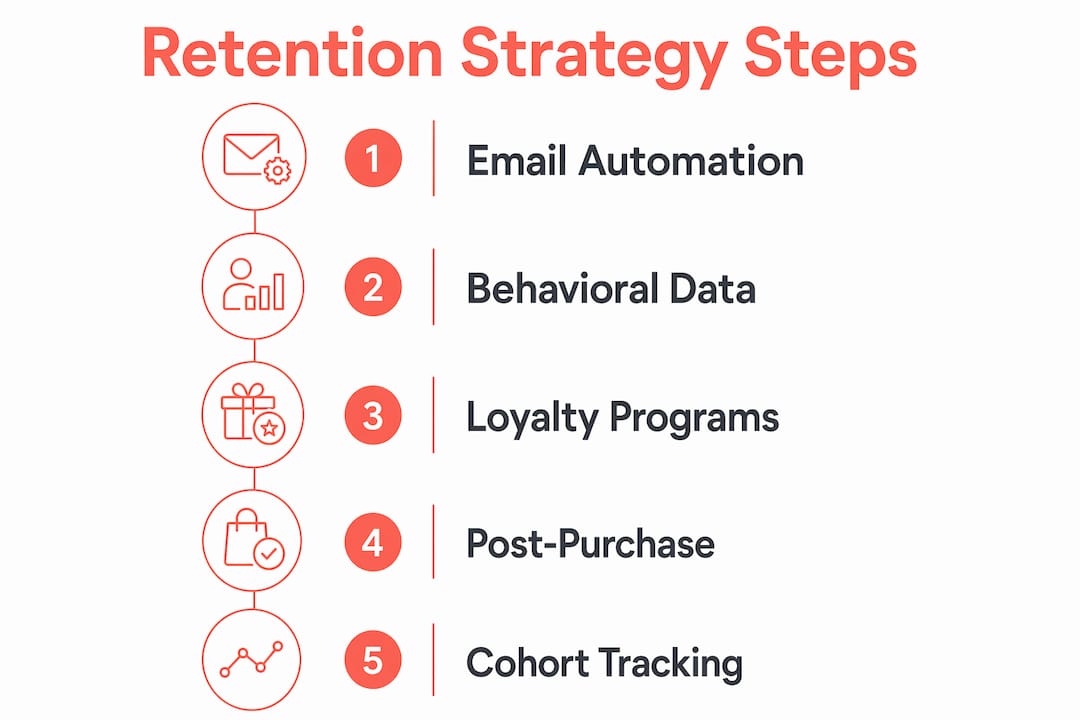
The next step is integrating that data with your email service provider and SMS platform. Integrating loyalty data with your ESP allows for triggered communication based on tier status and points balance. Without that integration, your loyalty program and your email channel operate in silos, and you lose the compounding effect of both working together.
Behavioural triggers are the practical engine of personalisation. These include:
- Purchase history triggers: send a replenishment reminder 25 days after a 30-day consumable purchase
- Browse abandonment: follow up within one hour for high-intent visitors who did not convert
- Category affinity: surface new arrivals in the category a customer buys from most
- Engagement drop: flag customers who have not opened an email in 60 days for a re-engagement sequence
Pro Tip: For subscription businesses, smart dunning is a hidden revenue lever. Effective dunning processes recover 55–80% of failed subscription payments. Set up a sequence of card update requests, retry logic, and pause offers before cancelling a subscriber.
What makes a loyalty program truly effective in retaining customers?
The most effective loyalty programs have moved well past points and discounts. Utility-focused programs built around free shipping, exclusive access, and personalised experiences outperform simple discount structures in driving long-term loyalty. Discounts train customers to wait for a deal. Utility rewards make membership feel valuable every single day.
The shift matters because discount-heavy programs erode margin. A free shipping threshold, early access to new products, or a members-only content library costs far less per customer than a blanket 15% off. It also creates a reason to stay that competitors cannot easily match with a lower price.
Effective loyalty programs have evolved from simple rewards into sophisticated engagement mechanisms integrated with the full marketing technology stack. That means your loyalty platform needs to talk to your email tool, your SMS provider, and your ecommerce platform. Tier milestones should trigger automated congratulation emails. Points balances should appear in cart abandonment messages. The programme should feel alive, not static.
Loyalty programme best practices worth building into your design:
- Set tier thresholds based on your actual customer purchase frequency data, not industry benchmarks
- Offer a non-monetary benefit at every tier so value is felt immediately, not just at redemption
- Use referral programme mechanics to let loyal customers earn rewards by bringing in new buyers
- Send a personalised tier progress email 30 days before a customer’s anniversary date
- Review redemption rates quarterly. Low redemption means customers do not understand or value the reward
Community-driven brands see 19% higher retention rates because community creates switching costs that price cannot overcome. A private customer group, a members-only event, or a brand ambassador tier all build emotional attachment that a discount never could.
How to optimise the post-purchase experience to maximise repeat purchases
The 24–48 hours after a customer places an order is the highest-leverage window in the entire customer lifecycle. 53% of shoppers say delivery experience directly influences whether they buy again. Most brands treat this window as logistics. The best brands treat it as marketing.
Proactive shipping communication is the foundation. Customers who receive timely, clear updates about their order status report higher satisfaction and are more likely to return. Waiting for a customer to chase you about their delivery is a retention failure. Automated shipping notifications at dispatch, in transit, and out for delivery cost almost nothing to set up and pay dividends in trust.
The unboxing experience is the physical equivalent of a welcome email. Branded packaging, a handwritten-style thank you card, and a clear product guide all signal that the purchase was worth making. These details increase the probability of a social share, a review, and a second order. They are not luxuries reserved for premium brands.
A well-sequenced post-purchase flow looks like this:
- Order confirmation email: sent immediately, includes order summary and expected delivery window
- Shipping dispatch notification: sent at fulfilment, includes tracking link
- Delivery confirmation: sent on delivery, includes product setup guide or usage tips
- Review request: sent 5–7 days after delivery, personalised to the specific product purchased
- Cross-sell recommendation: sent 10–14 days after delivery, based on purchase history and category affinity
- Replenishment reminder: sent based on average consumption cycle for the product category
Pro Tip: Add a short video or PDF product guide to your delivery confirmation email. Customers who understand how to get the most from a product are significantly more likely to repurchase and less likely to return it.
Common mistakes to avoid: sending the review request before the product has arrived, using generic cross-sell recommendations that ignore what the customer just bought, and failing to suppress post-purchase flows for customers who have already made a second purchase.
How to measure and track the effectiveness of your retention strategy
Tracking a single headline retention rate tells you almost nothing useful. Cohort retention curves at 30, 60, 90, 180, and 365 days reveal where customers are actually dropping off and which acquisition cohorts are performing best. That granularity is what makes optimisation possible.
The LTV to CAC ratio is the most important single metric for understanding retention health. If your customer acquisition cost is rising while lifetime value stays flat, your business model is under pressure regardless of what your headline retention rate says. Track this ratio monthly, not quarterly.
Granular cohort analysis rather than aggregate rates reveals the true health of your retention engine. A store with a 35% repeat purchase rate might look healthy until cohort data shows that rate is driven entirely by one acquisition channel from two years ago, and every cohort since has been declining.
| Metric | What it measures | Diagnostic value |
|---|---|---|
| Repeat purchase rate | Percentage of customers who buy more than once | Baseline retention health |
| Cohort retention curve | Retention at 30, 60, 90, 180, 365 days by cohort | Identifies drop-off points and channel quality |
| LTV:CAC ratio | Lifetime value relative to acquisition cost | Profitability and business model sustainability |
| Returning customer revenue % | Share of revenue from existing customers | Measures dependence on acquisition vs. retention |
Review these metrics weekly, not monthly. Early detection of a declining cohort gives you time to intervene with a win-back campaign or a product experience fix before the trend compounds. Pair your ecommerce growth strategy with these metrics to see where retention fits within your broader revenue picture.
Key takeaways
A retention engine built on email automation, behavioural personalisation, utility-driven loyalty, and cohort measurement consistently outperforms acquisition-only growth strategies in ecommerce.
| Point | Details |
|---|---|
| Email automation first | Start with automated flows; they deliver $36 per $1 spent and lift repeat purchases within weeks. |
| Post-purchase window matters | The 24–48 hours after purchase is your highest-leverage retention moment. Act on it with proactive communication. |
| Loyalty beyond discounts | Utility rewards like free shipping and exclusive access outperform points-based discount structures. |
| Measure by cohort | Headline retention rates hide problems. Cohort curves at 30, 60, 90, and 365 days reveal the real picture. |
| Retention is a system | Isolated campaigns underperform. Build an integrated engine connecting email, loyalty, and behavioural data. |
What I’ve learnt about building a retention engine that actually compounds
The most common mistake I see ecommerce businesses make is treating retention as a campaign rather than an operating model. They run a win-back email in march, see a short-term lift, and then move on. Three months later, the churn problem is back and nothing has changed structurally.
Retention is the highest ROI marketing lever in ecommerce, yet most brands still allocate 80% of their budget to acquisition. That imbalance is not a strategy. It is a habit. Breaking it requires dedicating a specific budget line, a specific tool stack, and a specific person responsible for retention metrics every single week.
The brands I have seen compound their LTV fastest are the ones that integrate their loyalty data with their email platform early. That single integration unlocks a level of personalisation that no amount of creative work can replicate. When a customer gets an email that references their tier, their points balance, and a product recommendation based on their last purchase, the click rate is not marginally better. It is dramatically better.
Treat retention with the same rigour you give acquisition. Set a target repeat purchase rate. Build a budget around hitting it. Measure weekly. The compounding effect on profitability is real, and it shows up faster than most business owners expect.
— Liza
How Moormarketing workshops help you build a retention engine
Building a retention engine requires more than good intentions. It requires the right sequence, the right tools, and someone who has done it before to keep you from wasting months on the wrong priorities.
Moormarketing’s ecommerce marketing workshops are built specifically for ecommerce business owners who want to implement retention systems that produce measurable results. Each workshop covers email automation setup, loyalty programme design, behavioural data integration, and the metrics framework you need to track progress. Sessions are run by senior strategists, not junior account managers, and every recommendation is tailored to your margin structure and customer base. If you are ready to shift budget from acquisition to retention and see the compounding effect on your revenue, a workshop is the fastest way to get there.
FAQ
What is an ecommerce customer retention strategy?
An ecommerce customer retention strategy is a system of interconnected tactics designed to increase repeat purchase rates and customer lifetime value. It includes email automation, loyalty programmes, post-purchase experience design, and behavioural personalisation working together as a single engine.
How much can retention improvements affect profitability?
A 5% increase in retention rates can lift profits by 25–95% through higher purchase frequency, larger basket sizes, and lower service costs. Retaining existing customers also costs 5–7 times less than acquiring new ones.
What is the most effective retention tactic for ecommerce?
Email automation delivers the highest immediate ROI, returning $36 for every $1 spent. Automated welcome, post-purchase, and win-back flows can lift repeat purchase rates within weeks of setup.
How do I measure whether my retention strategy is working?
Track cohort retention curves at 30, 60, 90, 180, and 365 days rather than a single headline rate. Pair this with your LTV to CAC ratio and returning customer revenue percentage for a complete picture of retention health.
When should I invest in a loyalty programme?
Build your email automation flows first and collect at least three months of cohort data before launching a loyalty programme. That data tells you where customers are dropping off, which shapes the programme design and tier thresholds.