

Ecommerce pricing strategy is the deliberate process of setting product prices to maximise profit, attract customers, and hold a defensible market position. Understanding how ecommerce pricing strategy works means combining cost analysis, competitor research, customer psychology, and continuous testing into a single, repeatable system. A 1% improvement in pricing efficiency delivers an average 11.1% increase in net profit. That figure alone explains why pricing is the highest-leverage decision you make as an ecommerce operator. The models covered here, from cost-plus to value-based to dynamic pricing, each serve a specific purpose, and the most profitable stores use all of them together.
What are the main types of ecommerce pricing models?
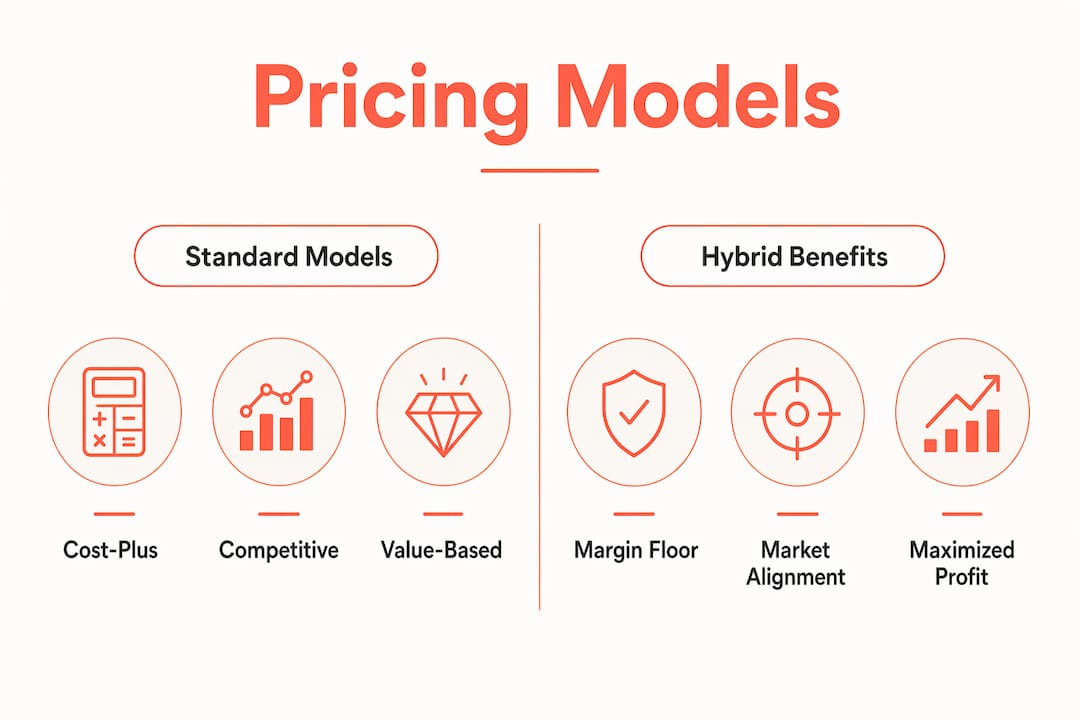
The three foundational pricing models in ecommerce are cost-plus, competitive, and value-based pricing. Each suits a different product type, margin profile, and brand goal. Most successful stores do not pick just one.
Cost-plus pricing: your margin floor
Cost-plus pricing guarantees a minimum margin but ignores customer willingness to pay and competitor pricing. You add a fixed percentage to your landed cost and call it a price. That approach works well as a floor, meaning the lowest price you will ever accept, but it leaves money on the table for products where customers would happily pay more.
Competitive pricing: reading the market
Competitive pricing sets your price relative to what rivals charge for the same or similar products. Tools like Price Patrol automate this by monitoring competitor prices in real time and alerting you when the market shifts. The risk is that matching competitors on price alone triggers a race to the bottom. Differentiation through quality, reviews, bundling, or brand reputation is what justifies charging more than the cheapest option in your category.
Value-based pricing: what the customer believes it’s worth
Value-based pricing sets prices on the product’s perceived value to the customer, not on your costs or competitor benchmarks. It works best for unique, differentiated, or problem-solving products where you can clearly articulate what the customer gains. Executing it well requires deep customer research: surveys, reviews analysis, and conversations that reveal what problem your product solves and what it costs the customer to go without it.
Hybrid approaches outperform single models
Hybrid pricing strategies combining cost-plus floor, competitive positioning, and value-based pricing maximise ecommerce profitability. A practical example: use cost-plus to set your floor on commodity items, competitive pricing to position mid-range products, and value-based pricing on your hero or proprietary products. This mix protects margins across your entire catalogue.
| Model | Key Advantage | Best Used When | Main Risk |
|---|---|---|---|
| Cost-plus | Guarantees minimum margin | Commodity or high-volume SKUs | Ignores customer willingness to pay |
| Competitive | Aligns with market expectations | Crowded categories with price-sensitive buyers | Triggers price wars |
| Value-based | Captures maximum willingness to pay | Unique or differentiated products | Requires deep customer insight |
| Hybrid | Balances margin, market, and perception | Diverse product catalogues | Complexity in execution |
Pro Tip: Assign each SKU in your catalogue to one of these three models based on its margin profile and competitive intensity. Review the assignment every quarter as market conditions shift.
How do dynamic pricing and psychological pricing techniques work?
Advanced ecommerce pricing techniques go beyond setting a number and leaving it. They treat price as a variable that responds to demand, competition, and buyer psychology in real time.

Dynamic pricing: revenue upside with real risks
Dynamic pricing adjusts prices automatically based on demand signals, competitor moves, stock levels, and time of day. Dynamic pricing raises revenue by an average of 12.3%, but it also increases cart abandonment by 8.7% when customers perceive prices as volatile or unfair. That trade-off is the central challenge. The solution is automated dynamic pricing with rule-based guardrails combined with AI-driven fine-tuning to prevent margin loss and customer backlash. Set a floor and ceiling price for every SKU so the algorithm cannot price you out of profit or into a customer service crisis.
Psychological pricing tactics that move conversions
Psychological pricing works by shaping how buyers perceive value before they consciously evaluate it. The most widely used techniques in ecommerce include:
- Charm pricing: Pricing at $19.99 instead of $20.00 triggers the left-digit effect. Charm pricing increases sales by 3.2%–24% depending on product category and baseline price. The range is wide because category matters enormously.
- Anchor pricing: Showing a higher “was” price next to the current price frames the deal. Platforms like Shogun make it straightforward to display original and sale prices side by side on product pages.
- Bundle pricing: Grouping complementary products at a combined price increases average order value. A skincare brand selling a cleanser, toner, and moisturiser as a bundle at $79 instead of $95 individually captures more revenue per transaction.
- Tiered pricing: Offering three options (good, better, best) nudges buyers toward the middle tier, which is typically your highest-margin product.
- Decoy pricing: Adding a third, less attractive option makes your preferred option look like the obvious choice by comparison.
Pro Tip: Charm pricing’s effectiveness diminishes for luxury or premium products, where it can signal cheapness rather than value. Test it on your specific segment before rolling it out across premium lines.
The key with psychological pricing is that no tactic works universally. What lifts conversions for a $30 phone case may actively damage trust for a $500 watch. Testing is not optional.
Why does continuous testing make or break your pricing?
Pricing tests are the mechanism that turns theory into profit. Without them, you are guessing. With them, you are compounding small gains into significant revenue growth over time.
The standard for a valid pricing test requires 2 weeks of consistent traffic, 95% confidence, and 100 conversions per variant. Running a test for three days because you are impatient produces noise, not insight. That noise drives bad decisions.
Here is a practical testing sequence for ecommerce stores:
- Set your floor and ceiling prices first. Define the minimum margin you will accept and the maximum price your market will bear for each SKU. This creates a safe testing range and prevents automated tools from causing damage.
- Run sequential price tests. Change one price point at a time across a defined period. Measure conversion rate, average order value, and net profit, not just revenue.
- Test bundle configurations. Experiment with which products to bundle and at what combined price. Bundles often reveal willingness to pay that individual product prices obscure.
- Use cohort analysis for repeat buyers. Segment returning customers separately. They behave differently from first-time visitors and skew your aggregate data if lumped together.
- Validate with statistical significance before acting. Use a statistically valid A/B testing framework to confirm results before changing prices site-wide.
Tools like Shogun support price display testing directly on product pages, while Price Patrol handles competitor price monitoring to keep your competitive pricing inputs accurate. Both reduce the manual workload of ongoing optimisation.
Pro Tip: Track net profit per variant, not just conversion rate. A lower price can lift conversions while destroying margin. The metric that matters is profit per visitor, not orders per visitor.
How do you balance pricing with brand positioning?
Pricing is a brand signal. Every price point tells your customer something about who you are and what you stand for. Getting this wrong costs more than margin.
Penetration pricing gains market share rapidly but risks anchoring a “cheap” brand perception that is hard to reverse. A furniture brand that launches at 40% below market to win early customers often finds it nearly impossible to raise prices later without losing the audience it built. The short-term volume gain becomes a long-term positioning trap.
The practical considerations for aligning price with brand:
- Price above cost-plus but below perceived value. This is the sweet spot where you capture margin without triggering the “too expensive” response.
- Use your pricing to signal quality. In categories where buyers use price as a quality proxy, being the cheapest option actively reduces trust.
- Differentiate beyond price. Faster shipping, superior packaging, extended warranties, and genuine customer service all justify a price premium without requiring you to compete on cost.
- Monitor your key competitors selectively. Track the two or three competitors your customers actually compare you against, not every player in the category. Reacting to every price move in a crowded market is how margins erode.
- Protect your brand positioning when running promotions. Frequent discounting trains customers to wait for sales. Moormarketing’s work with a global furniture brand generating $3 million a month demonstrates that brand positioning and pricing must be developed together, not as separate decisions.
Competitive pricing risks include price wars and margin erosion when brands match cuts without a clear differentiation strategy. The stores that win long-term compete on value delivered, not price alone.
Key takeaways
Ecommerce pricing strategy works best as a hybrid system combining cost-plus floors, competitive positioning, and value-based pricing, validated continuously through statistically sound testing.
| Point | Details |
|---|---|
| Pricing is your top profit lever | A 1% improvement in pricing efficiency produces an average 11.1% increase in net profit. |
| Hybrid models outperform single strategies | Combine cost-plus, competitive, and value-based pricing across your catalogue by product type. |
| Dynamic pricing needs guardrails | Set floor and ceiling prices for every SKU before enabling automated repricing tools. |
| Test with statistical rigour | Run pricing tests for at least 2 weeks with 100+ conversions per variant before acting on results. |
| Pricing signals brand value | Penetration pricing wins short-term volume but risks anchoring a cheap brand perception permanently. |
Pricing is not a set-and-forget decision
I have worked with ecommerce businesses at every stage, from scrappy startups to brands turning over millions a month, and the single most common pricing mistake I see is treating price as a launch decision rather than an ongoing discipline.
Operators spend weeks agonising over their launch price, then leave it untouched for 18 months while costs rise, competitors shift, and customer expectations evolve. That is not a pricing strategy. That is a pricing assumption.
The second mistake is blind competitor matching. Watching what the market charges and staying within 5% of it feels safe. It is not. It is a slow path to margin compression, because you are anchoring your profitability to someone else’s cost structure and brand positioning, neither of which you control.
What actually works in 2026 is a hybrid model with a testing cadence built in. Use cost-plus as your floor so you never accidentally sell at a loss. Use competitive data to understand where the market sits. Then use value-based thinking to find the ceiling, the price at which your specific customer, for your specific product, stops buying. The gap between your floor and that ceiling is your testing range.
AI-powered repricing tools are genuinely useful now, but only with guardrails. I have seen automated repricing destroy margin in under 48 hours when someone forgot to set a floor price. The technology is not the risk. The lack of rules around the technology is.
The stores I have seen grow fastest treat pricing as a continuous ecommerce growth process, not a one-time configuration. They test, measure net profit per visitor, adjust, and repeat. That compounding discipline is what separates the brands that scale from the ones that plateau.
— Liza
Take your pricing further with Moormarketing
Pricing strategy does not exist in isolation. It connects directly to your ad spend efficiency, your conversion rate, and your brand’s long-term positioning in the market. Getting the numbers right is only half the work.

Moormarketing’s ecommerce marketing workshops cover pricing models, testing frameworks, and conversion tactics in practical, hands-on sessions designed for business owners who want results, not theory. The same frameworks have helped clients generate $2 million a month in new toy retail sales and $3 million a month for a global furniture brand. If you are ready to build a pricing system that actually compounds, explore how Moormarketing works with ecommerce businesses at moormarketing.com.au.
FAQ
What is ecommerce pricing strategy?
Ecommerce pricing strategy is the structured process of setting product prices based on costs, competitor positioning, and customer perceived value to maximise profit and conversions. It combines multiple models rather than relying on a single approach.
Which pricing model works best for ecommerce startups?
A hybrid model using cost-plus as a margin floor, competitive pricing for market alignment, and value-based pricing for hero products gives ecommerce startups the best balance of protection and upside. One-size-fits-all pricing is a documented mistake.
How does dynamic pricing affect cart abandonment?
Dynamic pricing raises average revenue by 12.3% but increases cart abandonment by 8.7% when customers perceive price volatility as unfair. Using rule-based guardrails with AI-driven adjustments reduces this risk significantly.
How long should a pricing test run?
A valid pricing test requires at least 2 weeks of consistent traffic, 95% statistical confidence, and a minimum of 100 conversions per variant before you act on the results. Shorter tests produce noise, not reliable data.
Does charm pricing work for all products?
Charm pricing lifts sales by 3.2%–24% in many categories, but its effectiveness diminishes for luxury or premium products where a $199.99 price point can signal cheapness rather than quality. Always test charm pricing within your specific product segment before rolling it out broadly.