

Ecommerce brand authority is the measurable trust, credibility, and recognised expertise that causes customers to choose you over cheaper or better-known alternatives. When you build ecommerce brand authority deliberately, you affect three numbers that matter most: conversion rate, average order value, and repeat purchase rate. Brands that get this right do not just win one sale. They create customers who return, refer others, and resist competitor offers. The tactics covered here are grounded in data from Shopify, Google’s E-E-A-T framework, and real buyer behaviour signals, so you can act on them today.
What does it take to build ecommerce brand authority?
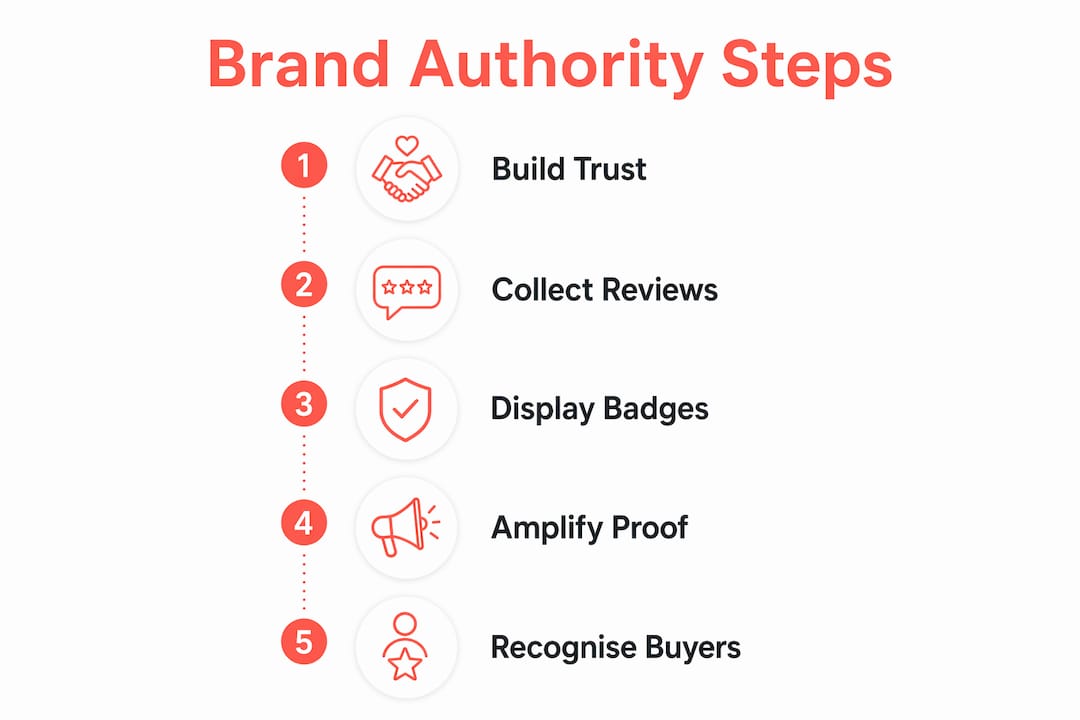
Brand authority in ecommerce rests on a trust infrastructure that must exist before any marketing can work. Google’s E-E-A-T framework identifies trustworthiness as the foundation of all other authority signals. That means clear policies, secure checkout, and real contact information are not optional extras. They are the floor every other tactic stands on.
Without that floor, social proof, badges, and content all underperform. A customer who cannot find your returns policy or a working phone number will not trust your five-star reviews. Smaller brands can absolutely compete with larger players by building strong first-party evidence and demonstrating reliability consistently. Experience and trustworthiness offset lower external authoritativeness, especially in AI-driven search results.
The review threshold you must hit
Reviews are the most visible trust signal on any product page. 97% of consumers read reviews before buying, and 47% will not purchase from a business with fewer than 20 reviews. That second number is the one to act on. Reaching 20 reviews per product category is not a vanity goal. It is the minimum credibility threshold that stops hesitant buyers from walking away.
Shopify’s native review features, Yotpo, and Okendo all make it straightforward to collect and display reviews at scale. The platform you choose matters less than the consistency of your collection process.
Trust badges as compliance artefacts
Trust badges from providers like McAfee, Norton, and Trustpilot signal security and legitimacy at the moment a customer is deciding whether to enter their payment details. The critical mistake most stores make is treating these badges as static design elements. They are not. Third-party badges require active renewal and verification. An expired badge is worse than no badge because it signals that nobody is minding the store.

Pro Tip: Set a calendar reminder 60 days before each badge or certification renewal date. A lapsed badge can quietly drain conversions for weeks before anyone notices.
Recognition layers like Shop Pay add another dimension. When a returning buyer is recognised at checkout, the friction of re-entering details disappears. That recognition directly influences order size and repeat behaviour, which the next section covers in detail.
How can social proof strengthen your brand reputation online?
Social proof is the mechanism by which other people’s behaviour and opinions reduce a new customer’s perceived risk. Effective social proof includes customer reviews, user-generated photos and videos, bestseller tags, and expert endorsements. Each type works at a different stage of the buying decision.
The most effective approach is to build what practitioners call a proof ladder: social proof that appears at every touchpoint from product discovery through to checkout. Here is how to construct one:
- Product pages: Display star ratings, written reviews, and customer photos directly beneath the product description. Photo reviews convert better than text alone because they show the product in real use.
- Navigation and category pages: Add bestseller badges to your top performers. Buyers use these as shortcuts when they are unsure which product to choose.
- Checkout: Include a trust summary near the payment fields. A short line like “Joined by 14,000 happy customers” reduces last-second abandonment.
- Post-purchase: Send a review request within 7 days of delivery. Multichannel requests via email and SMS consistently outperform single-channel requests.
- Social channels: Reshare tagged customer content on Instagram and TikTok. User-generated content with photos and videos amplifies social proof by demonstrating real satisfaction to new audiences.
Consistent messaging and early amplification of even small amounts of proof builds long-term credibility. If you are launching a new product with no reviews yet, incentivised video testimonials from early buyers give you something credible to display immediately.
Pro Tip: Respond publicly to every review, positive or negative. Responses signal to prospective buyers that a real team stands behind the product. This is one of the fastest ways to establish online brand credibility without spending a dollar on ads.
You can also explore ecommerce branding tips that cover how to present social proof consistently across your store and marketing channels.
How do you maintain brand authority as your store scales?
Building authority is not a one-time project. It is an ongoing programme that requires scheduled maintenance and regular strategy adjustments. The three areas that most commonly slip as stores grow are badge renewals, review freshness, and messaging consistency.
- Badge and certification renewals: Create a renewal calendar that tracks every third-party badge, SSL certificate, and payment security certification. Assign ownership to a specific team member. Poorly maintained badges quietly undermine trust because customers notice expired or missing verification marks, even if they cannot articulate why they feel uneasy.
- Review freshness: A product with 50 reviews from three years ago looks less credible than one with 15 reviews from the past six months. Recency signals that the product is still actively sold and that customers are still satisfied. Build a rolling review request process rather than a one-off campaign.
- Messaging consistency: As your customer base grows, your brand voice must stay coherent across email, ads, social media, and your website. Inconsistency reads as unprofessionalism. Audit your brand messaging every quarter and update it to reflect your current positioning.
The table below summarises the maintenance cadence that keeps authority signals active:
| Authority Signal | Recommended Review Frequency | Owner |
|---|---|---|
| Trust badges and certifications | Every 60 days | Operations or marketing lead |
| Product review recency | Monthly | Customer experience team |
| Brand messaging audit | Quarterly | Brand or content lead |
| Buyer recognition data review | Monthly | Marketing or CRM lead |
Shopify’s buyer network data gives you a practical edge here. Recognised buyers behave differently from anonymous visitors, and that data can inform your retargeting and email segmentation to keep repeat customers engaged.
Does brand authority actually move the revenue numbers?
The short answer is yes, and the data is specific. Shop Pay buyer recognition can triple average order values and increase repeat purchases by 61–74%. That is not a marginal improvement. It is the difference between a store that grows and one that stalls.
“Buyer recognition infrastructure is a powerful yet often underleveraged asset for eCommerce brand authority and growth.” — Shopify Enterprise Blog
The mechanism is straightforward. When a customer is recognised at checkout, they experience less friction and more confidence. Both factors increase the likelihood of completing the purchase and spending more. Recognised buyers also respond better to personalised marketing because the brand already feels familiar to them.
Trust also directly reduces cart abandonment. The primary reason shoppers abandon carts is uncertainty, whether about security, delivery, or returns. A store with visible trust badges, recent reviews, and clear policies removes those objections before they form. Brand credibility grows through visible proof, transparent engagement, and a professional presence across platforms. Each of those elements compounds over time.
There is an SEO dimension too. Stores with strong E-E-A-T signals rank higher in organic search and appear more frequently in AI-generated answers. That means authority-building work pays dividends in traffic, not just conversion. Understanding how ecommerce brand equity works gives you a clearer picture of how these signals accumulate into long-term competitive advantage.
What mistakes quietly kill ecommerce brand authority?
Most authority problems are not dramatic failures. They are slow leaks that compound over months. These are the mistakes that cost stores the most:
- Treating badges as decoration: A trust badge that has expired or links to a broken verification page actively damages credibility. Customers who click to verify and find nothing lose trust faster than if no badge existed.
- Ignoring review quality and recency: Quantity alone is not enough. A product with 200 reviews from 2022 and none from 2025 signals abandonment. Prioritise recency in your review collection strategy.
- Hiding policies: Vague or buried returns and shipping policies are a conversion killer. Place links to your policies in your site header, footer, and checkout page. Transparency is a trust signal in itself.
- Skipping buyer recognition infrastructure: Many stores collect email addresses but never build the recognition layer that turns one-time buyers into repeat customers. Shop Pay and similar tools do this automatically, but only if you set them up correctly.
- Inconsistent social proof across channels: Displaying five-star reviews on your website but having no presence on Google Reviews or Trustpilot creates a credibility gap. Prospective buyers cross-reference sources.
Pro Tip: Run a monthly trust audit. Visit your own store as a first-time customer and check every trust signal: badge validity, review recency, policy visibility, and checkout friction. What you find will surprise you.
Pairing your authority-building work with strong ad creative practices and social proof strategies gives you a complete picture of how trust signals work across paid and organic channels.
Key takeaways
Building ecommerce brand authority requires a maintained system of trust signals, social proof, and buyer recognition, not a single campaign.
| Point | Details |
|---|---|
| Trust infrastructure comes first | Clear policies, secure checkout, and real contact info are the foundation every other tactic depends on. |
| Hit the 20-review threshold | Reaching 20 or more reviews per product category is the minimum needed to convert hesitant buyers. |
| Treat badges as live compliance | Schedule badge renewals every 60 days to prevent silent trust drops that drain conversions. |
| Build a proof ladder | Place social proof at every touchpoint from product pages through to checkout for maximum impact. |
| Buyer recognition drives repeat revenue | Shop Pay recognition can increase repeat purchases by 61–74% and triple average order values. |
Brand authority is a programme, not a project
I have worked with enough ecommerce brands to know that the ones who treat authority-building as a one-time setup always hit the same wall. They launch with great reviews, solid badges, and a clean checkout, then six months later their conversion rate quietly drops and nobody can explain why. Nine times out of ten, a badge has lapsed, their reviews have gone stale, or their messaging has drifted.
The brands that scale consistently treat authority as an ongoing programme with scheduled reviews and clear ownership. They assign someone to check badge validity. They run monthly review collection campaigns. They audit their brand voice every quarter. It sounds unglamorous, but it is what separates stores doing $50,000 a month from those doing $500,000.
The other thing I have seen underestimated repeatedly is buyer recognition. Most store owners know they should collect emails. Far fewer have built the infrastructure to recognise returning buyers at checkout and use that signal to personalise their marketing. The revenue difference between stores that do this and those that do not is not small. It is the kind of gap that shows up in your annual numbers and makes you wonder what you missed.
My honest advice: start with your trust floor, build your proof ladder, and then invest in recognition infrastructure. Do all three consistently, and brand authority becomes a compounding asset rather than a recurring problem.
— Liza
Ready to build brand authority that actually scales?
Knowing the tactics is one thing. Implementing them in a way that compounds across your specific store, audience, and category is where most brands need support.

Moormarketing’s ecommerce marketing workshops are built specifically for ecommerce entrepreneurs who want to move fast without guessing. The workshops cover review collection systems, trust badge management, buyer recognition setup, and social proof strategy, all delivered by senior strategists who work hands-on with your business. Moormarketing has helped brands go from standing start to $2 million in monthly sales, and the same frameworks are available to you. If you are ready to build brand authority that converts, explore the workshops and see which programme fits your stage of growth.
FAQ
What is ecommerce brand authority?
Ecommerce brand authority is the level of trust, credibility, and recognised expertise your store holds in the minds of customers and search engines. It directly influences conversion rates, repeat purchases, and organic visibility.
How many reviews does a product need to build credibility?
Research shows 47% of consumers will not buy from a business with fewer than 20 reviews. Reaching 20 or more reviews per product category is the minimum threshold for credible social proof.
How often should trust badges be renewed?
Trust badges from providers like McAfee, Norton, and Trustpilot require active renewal and verification. Reviewing and renewing every 60 days prevents expired badges from silently undermining customer confidence.
Can a small ecommerce brand compete on authority without a big backlink profile?
Yes. Smaller brands can compete by building strong first-party evidence through reviews, clear policies, and consistent messaging. Google’s E-E-A-T framework rewards experience and trustworthiness even when external authoritativeness is lower.
What is the fastest way to increase repeat purchases through brand authority?
Setting up buyer recognition infrastructure, such as Shop Pay, is the fastest lever. Recognised buyers show repeat purchase uplifts of 61–74% and significantly higher average order values compared to unrecognised visitors.