

Dynamic product advertising (DPA) is an automated ad format that pulls product details from a catalogue and uses real-time shopper behaviour to assemble personalised ads without creating one static ad per SKU. Platforms including Meta, Google Ads, and Amazon Ads all support DPAs natively, making them a core tool for eCommerce marketers who need to scale personalised advertising without scaling their workload. The format is especially powerful for remarketing and abandoned cart recovery, where showing a shopper the exact product they viewed drives significantly higher conversion rates than generic retargeting. This guide covers how dynamic product ads work, their key benefits, platform differences, and the practical steps that separate high-performing campaigns from mediocre ones.
How do dynamic product ads work?
Dynamic product advertising works by combining three components: a product catalogue, behavioural signals, and a creative template. The catalogue is the source of truth. It contains every product’s name, image, price, and availability. When a shopper views a product on your site, adds it to their cart, or completes a purchase, a tracking pixel or server-side event records that action and ties it to a specific product ID.
At the moment an ad is served, the platform matches the shopper’s behaviour to the catalogue and assembles the creative at serve-time using a predefined template. The result is a personalised ad showing the exact product that shopper interacted with, complete with live pricing and current availability. No manual ad creation is required per product.

The mechanics rely on precise ID matching. Every pixel event must pass a content_id that matches the product ID in the catalogue exactly, including case sensitivity. A mismatch means the platform cannot connect the shopper’s behaviour to the right product, and the personalisation breaks silently. The ad still serves, but it loses its targeting precision.
Pro Tip: Set up a regular audit comparing the content_ids firing in your pixel events against the IDs in your product feed. Even a small formatting discrepancy, such as “SKU-001” versus “sku001”, will cause silent personalisation failures that are easy to miss in standard reporting.
Key data points that feed into a DPA campaign include:
- Product catalogue fields: name, image URL, price, availability, product URL, and category
- Pixel events tracked: ViewContent, AddToCart, Purchase, and Search
- Behavioural signals used: which products were viewed, how recently, and whether a purchase followed
- Creative template elements: product image, headline, price overlay, and call-to-action button
What are the benefits of dynamic ads for eCommerce?
Dynamic product advertising delivers measurable advantages over static ad campaigns, particularly for eCommerce businesses with large product catalogues. The format removes the need to build individual ads for every SKU, which is the single biggest operational benefit for teams managing thousands of products.
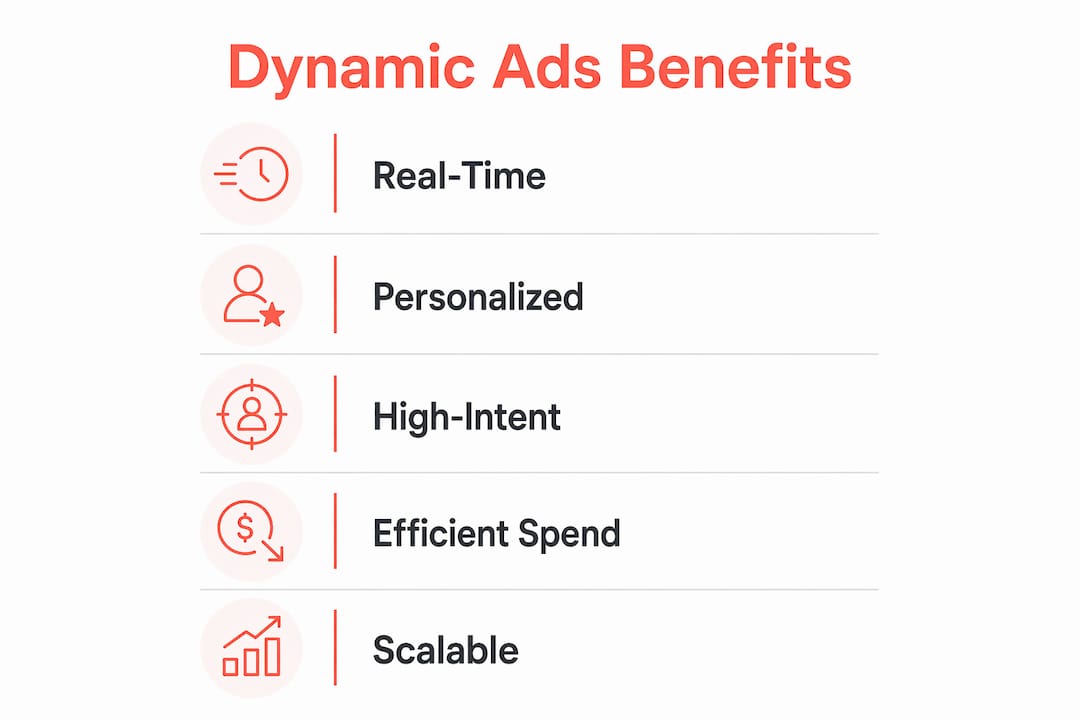
The most effective use cases are remarketing and abandoned cart recovery. DPAs show shoppers the exact products they previously viewed or carted, using the feed as the accurate source for ad elements. This specificity is what separates DPAs from generic retargeting ads that show a brand logo and a discount code. Showing a shopper the precise blue running shoe they viewed on Tuesday is far more persuasive than a banner saying “Come back and shop.”
The top reasons marketing professionals use dynamic product ads:
- Abandoned cart recovery: Re-engage shoppers who added products but did not purchase, with ads showing those exact items.
- Personalised recommendations: Serve ads for products related to what a shopper has already browsed, increasing average order value.
- Catalogue-scale efficiency: Run one campaign structure across thousands of products without building individual ad sets.
- Budget precision: Spend is directed toward products shoppers have already shown interest in, reducing wasted impressions.
- Automation of creative updates: Price changes and stock updates in the feed flow through to live ads automatically.
High-intent audiences generated from product views, cart adds, and purchases are the primary drivers of DPA campaign success. Broad prospecting with DPAs is possible, but the format performs best when behavioural signals are strong and recent.
Pro Tip: Segment your DPA audiences by recency. Shoppers who viewed a product in the last three days convert at a much higher rate than those who viewed it 30 days ago. Build separate ad sets for 0–7 days, 8–14 days, and 15–30 days, and adjust your bids accordingly.
How do dynamic ads differ across meta, google, TikTok, and amazon?
Dynamic product advertising works across Meta, Google, TikTok, Pinterest, Snapchat, and Amazon, but each platform has its own feed format, tracking requirements, and creative templates. Understanding these differences prevents wasted setup time and campaign errors.
| Platform | Ad Format Name | Feed Format | Key Tracking Requirement | Best Use Case |
|---|---|---|---|---|
| Meta (Facebook/Instagram) | Advantage+ Catalog Ads | Meta Commerce Manager catalogue | Facebook Pixel or Conversions API (CAPI) | Remarketing and prospecting |
| Google Ads | Dynamic Remarketing | Google Merchant Centre feed | Google Tag with dynamic remarketing parameters | Remarketing across Display and Shopping |
| TikTok | Dynamic Showcase Ads | TikTok catalogue via Business Centre | TikTok Pixel or Events API | Product discovery for younger audiences |
| Dynamic Shopping Ads | Pinterest catalogue | Pinterest Tag | Visual product discovery | |
| Amazon Ads | Dynamic Ads | Amazon product listings | Native to Amazon ecosystem | On-platform remarketing for Amazon sellers |
Meta’s implementation is the most widely used outside of Amazon’s ecosystem. Meta’s Advantage+ Catalog Ads automate catalogue-based dynamic ads with enhanced machine learning for targeting, delivery, and creative optimisation compared to manual catalogue ads. The underlying feed and pixel mechanics remain the same, but Advantage+ removes much of the manual audience and placement configuration.
Google separates its dynamic ad products into two distinct formats. Dynamic Remarketing uses a Merchant Centre feed to show previous site visitors the specific products they viewed, similar to Meta DPAs. Dynamic Search Ads, by contrast, generate ad copy from your website’s content and are not product-feed-driven. Conflating the two is a common mistake.
TikTok’s Dynamic Showcase Ads follow the same catalogue-plus-pixel model but are optimised for vertical video formats. The creative templates pull product images and overlay them with pricing and branding, making feed image quality especially important on this platform.
What challenges and best practices apply to dynamic ad campaigns?
Running effective dynamic product ad campaigns requires more than connecting a feed and activating a campaign. The most common failure points are feed quality, ID mismatches, and weak behavioural signal volume.
Feed quality and update frequency directly determine ad accuracy. A feed that updates once a week will serve ads for out-of-stock products, incorrect prices, and broken URLs. These errors do not just waste budget. They damage trust when a shopper clicks an ad and finds the product unavailable or priced differently.
Best practices for high-performing DPA campaigns:
- Update your feed daily or in real time if your inventory changes frequently. Most platforms support scheduled feed fetches or API-based updates.
- Match content IDs exactly between your pixel events and your catalogue. Case sensitivity matters. Test this with Meta’s Event Testing Tool or Google Tag Assistant before launching.
- Stack Pixel and CAPI on Meta to improve signal quality. Using both the browser pixel and the Conversions API (CAPI) reduces signal loss from browser restrictions and ad blockers.
- Tier your retargeting audiences by intent level. Separate cart abandoners from product viewers, and product viewers from general site visitors. Each tier warrants different creative messaging and bid levels.
- Invest in creative wrapper quality. The template frame around your product image, including the headline, overlay text, and call-to-action, has a significant impact on conversion rates. Test multiple wrapper variants rather than accepting the platform default.
- Monitor for performance degradation. DPA campaigns can decline gradually as audience pools shrink or feed errors accumulate. Set weekly performance reviews and alert thresholds for cost-per-purchase increases.
Poor ID matching causes broken personalisation that limits ad effectiveness without triggering obvious errors in campaign dashboards. This is the silent killer of DPA performance. A campaign can appear to be running normally while serving generic or mismatched products to every shopper.
Pro Tip: Treat your product feed as a live business asset, not a one-time setup task. Assign ownership of feed maintenance to a specific team member and build feed health checks into your weekly marketing operations routine.
Key takeaways
Dynamic product advertising succeeds when feed quality, precise ID matching, and tiered audience signals work together as a system, not as isolated setup tasks.
| Point | Details |
|---|---|
| Feed is the foundation | Update your product catalogue daily to prevent stale pricing, broken URLs, and out-of-stock ads. |
| ID matching is non-negotiable | Pixel content_ids must match catalogue product IDs exactly, including case, to preserve personalisation. |
| Audience tiering lifts performance | Segment retargeting audiences by recency and intent level to improve bid efficiency and conversion rates. |
| Platform choice shapes execution | Meta, Google, TikTok, and Amazon each require different feed formats, tracking setups, and creative templates. |
| Automation needs strong signals | DPA machine learning performs best when pixel and CAPI data is clean, complete, and high volume. |
Why most DPA campaigns underperform (and what i’ve learned about it)
After working with eCommerce brands across furniture, toys, fashion, and homewares, the pattern I see most often is this: marketers set up dynamic product ads correctly on day one and then treat them as a passive channel. The feed gets stale. The pixel starts dropping events. The audience pools shrink. And the campaign slowly bleeds budget while reporting looks acceptable on the surface.
The uncomfortable truth about dynamic product marketing is that the automation handles creative assembly, not campaign health. You still need to own the inputs. A feed with 200 out-of-stock products and a pixel missing 30% of AddToCart events will produce a campaign that technically runs but practically underperforms. I have seen brands spending $50,000 a month on Meta DPAs with broken ID matching, wondering why their ROAS had dropped from 4x to 1.8x over six months.
The brands that get the most from DPAs treat their product feed as a live business system. They audit it weekly. They test creative wrappers quarterly. They build audience tiers that reflect actual purchase intent, not just “everyone who visited the site.” Meta’s Advantage+ Catalog Ads have made the targeting side more forgiving, but they cannot compensate for a broken feed or a pixel that is not firing correctly.
My advice: before you touch your bidding strategy or your creative, audit your feed and your pixel. Fix the foundation. The performance gains from clean data outperform any bid adjustment you will ever make.
— Liza
Take your dynamic ad strategy further with Moormarketing
If you are managing eCommerce ad campaigns and want to move beyond basic setup into genuine performance, Moormarketing’s eCommerce marketing workshops are built for exactly that. The workshops cover feed optimisation, pixel and CAPI implementation, audience tiering, and creative wrapper testing, all grounded in real campaign data from brands generating millions in monthly revenue.
Moormarketing works directly with eCommerce managers and marketing teams, not through outsourced account managers. Every strategy is built around your catalogue, your audience signals, and your revenue targets. If you want a practical framework for running dynamic ad campaigns that actually scale, the workshops are the right starting point. Explore the full programme and find the session that fits your current stage of growth.
FAQ
What is dynamic product advertising in simple terms?
Dynamic product advertising is an automated ad format that pulls product details from a catalogue and uses shopper behaviour to serve personalised ads. Platforms like Meta, Google Ads, and Amazon Ads assemble the ad creative at the moment of serving, matching each shopper to the products they have already shown interest in.
How is dynamic advertising different from programmatic advertising?
Programmatic advertising manages the automated buying and placement of ad inventory, while dynamic advertising controls the content shown to each person based on their behaviour. The two can work together, but they solve different problems.
Which platforms support dynamic product ads?
Meta (Facebook and Instagram), Google Ads, TikTok, Pinterest, Snapchat, and Amazon Ads all support dynamic product ad formats. Each platform requires its own feed format and tracking implementation.
Why do dynamic product ads underperform?
The most common causes are poor feed quality, mismatched product IDs between the pixel and the catalogue, and insufficient behavioural signal volume. ID mismatches cause broken personalisation that degrades ad performance without triggering obvious errors in campaign dashboards.
What is the best use case for dynamic product ads?
Remarketing and abandoned cart recovery are the most effective use cases for DPAs. Showing shoppers the exact products they carted or viewed, with current pricing and availability, consistently outperforms generic retargeting creative.