

A competitive moat in ecommerce is a unique, defensible advantage that protects your online business from competitors and drives long-term profitability. The term comes from Warren Buffett’s investment philosophy, but the underlying concept maps directly onto ecommerce competitive strategy. Without a moat, your business competes on price alone. That race ends badly. The strongest ecommerce businesses build advantages across operations, brand, technology, and data that rivals cannot easily copy or undercut.
What is a competitive moat in ecommerce, and why does it matter?
A competitive moat is the formal term for what strategists call a sustainable competitive advantage. In ecommerce, this means any structural advantage that lets you earn better margins, retain customers longer, or enter new markets faster than competitors. Products get copied within weeks. Pricing gets undercut overnight. A moat sits deeper than either.
The clearest real-world example is Amazon. Amazon’s dominant position comes from layered moats: network effects, AWS-funded reinvestment, a platform that attracts both sellers and buyers, and ecosystem integration that no single rival has replicated. Most ecommerce businesses will not build at Amazon’s scale. The lesson is still the same. Moats compound over time, and the earlier you build them, the harder they become to dislodge.

For ecommerce entrepreneurs, a moat drives three outcomes. It protects margins from price competition. It builds customer loyalty that reduces your reliance on paid acquisition. It creates resilience when markets shift or supply chains break.
What are the main types of competitive moats in ecommerce?
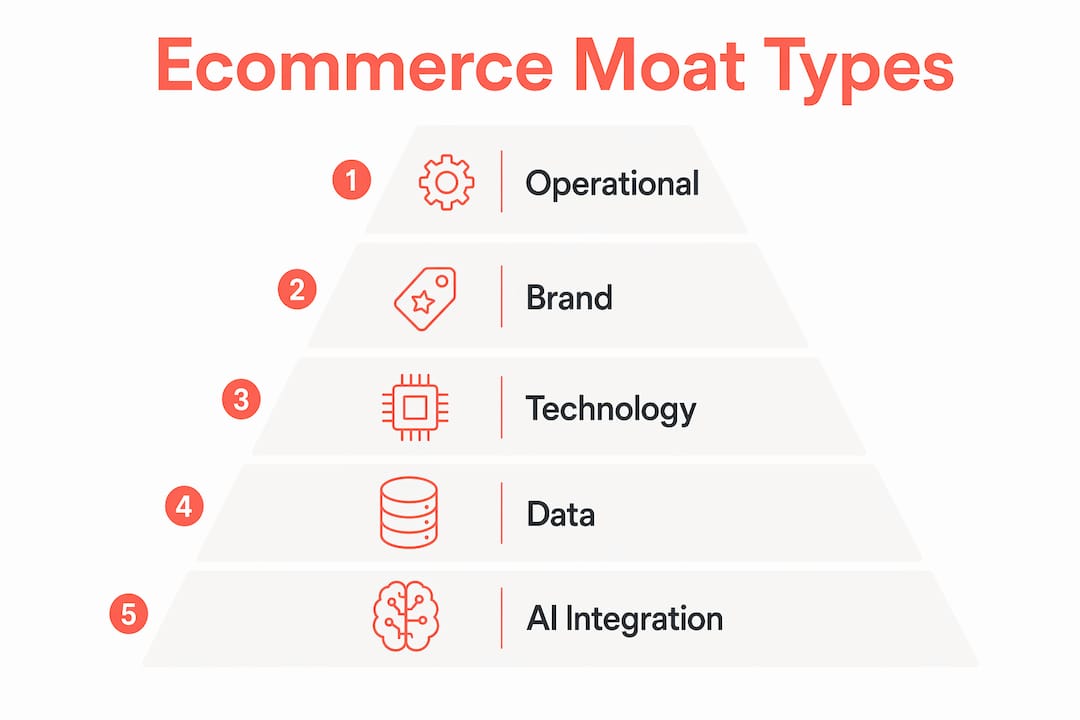
Ecommerce moats fall into four categories, and the strongest businesses hold more than one.
- Operational moats. These come from supply chain control, logistics efficiency, and standardised carrier and delivery data. A business that has mapped its carrier network and standardised its logistics data can use AI to verify and improve delivery performance. Competitors without that data foundation cannot match the speed or accuracy.
- Brand moats. A brand moat is built through unique positioning and customer loyalty. When customers choose you because of how your brand makes them feel, not just what you sell, that preference is hard to replicate.
- Technology moats. AI adoption creates a moat when it is treated as infrastructure, not a one-off tool. Automated dynamic pricing, content localisation, and AI-powered customer service all compound over time.
- Cost leadership. Controlling your cost base through supplier diversification and operational efficiency gives you pricing flexibility that smaller or less organised rivals cannot match.
Pro Tip: Assess your current advantages using the VRIO framework before deciding where to invest. Building a moat in an area where you have no existing advantage wastes time and capital.
The key distinction between ecommerce differentiation strategies and a true moat is durability. A new product feature is not a moat. A proprietary supplier relationship, a loyal community, or a logistics data system that took three years to build is.
How does AI reshape competitive moats in ecommerce?
Generative AI is changing which businesses can build moats and how fast. AI-driven localisation technologies have reduced international shopping barriers by 64%, helping small and medium businesses capture 38% of international ecommerce transactions by Q1 2026. That shift matters because cross-border reach was previously a moat held only by large retailers with dedicated localisation teams.
The numbers on conversion are equally significant. 61% of merchants deployed at least one AI-native tool in the last 12 months, improving median conversion rates by 17% for mid-market businesses. A 17% lift in conversion, sustained over 12 months, compounds into a meaningful revenue gap between adopters and non-adopters.
The most concrete example of AI closing ecommerce market barriers is cart abandonment. Automated compliance and localisation engines have lowered international cart abandonment rates from 78% to 31% as of april 2026. That is not a marginal improvement. It fundamentally changes the economics of selling internationally for a lean DTC brand.
The critical caveat is this: treating AI as a tactical tool rather than strategic infrastructure leads to underperformance. Businesses that deploy AI for one-off tasks without integrating it into their operations do not build a moat. They get a short-term lift that competitors can replicate in months.
Key AI applications that build durable moats include:
- Dynamic pricing that responds to competitor moves and demand signals in real time
- Automated product description localisation across multiple languages and markets
- AI-powered customer service that reduces response times and improves resolution rates
- Predictive inventory management that reduces stockouts and overstock costs
How does the VRIO framework help you build a stronger moat?
The VRIO framework, developed by Jay Barney, gives ecommerce businesses a structured way to assess whether an advantage is worth investing in. VRIO guides strategists to evaluate whether a resource is Valuable, Rare, Inimitable, and Organised for exploitation. Each filter removes advantages that look good on paper but will not hold under competitive pressure.
Here is how VRIO applies to common ecommerce advantages:
| Moat type | Valuable | Rare | Inimitable | Organised |
|---|---|---|---|---|
| Proprietary logistics data | Yes | Yes | High | Requires investment |
| Brand equity and community | Yes | Depends on niche | High | Requires consistency |
| AI-powered localisation | Yes | Decreasing | Medium | Requires integration |
| Supplier exclusivity | Yes | Yes | High | Requires relationships |
| Low-cost pricing alone | Yes | No | Low | Easy to copy |
The table reveals a pattern. Advantages that score high on inimitability, such as proprietary data and supplier relationships, are the ones worth building. Low-cost pricing scores poorly because any well-funded competitor can undercut you.
Pro Tip: Run your top three business advantages through VRIO once a year. Competitive conditions change, and an advantage that was rare two years ago may now be table stakes.
For a practical guide to applying these ecommerce scaling frameworks to your own business, the VRIO lens is the fastest way to separate genuine moats from temporary advantages.
How to create and sustain a competitive moat in ecommerce
Building a moat is not a single project. It is a series of compounding investments across operations, brand, and technology. The following steps reflect what actually works for ecommerce businesses in 2026.
-
Standardise your logistics data. Diversifying suppliers and standardising carrier feeds separates resilient businesses from those that collapse under supply chain pressure. Start by mapping every carrier and delivery data point in your operation. This creates the foundation for AI-driven operational improvements that competitors without clean data cannot replicate.
-
Build brand equity beyond the product. Brand experience and structural operational advantages outlast any product feature. Invest in community, content, and customer experience that creates emotional attachment to your brand. A customer who identifies with your brand is far less price-sensitive than one who found you through a Google ad.
-
Adopt AI as infrastructure, not a shortcut. Integrate AI tools into your core operations: pricing, localisation, customer service, and inventory. The compounding effect of AI infrastructure grows over time. A business that started building AI-driven ecommerce brand equity two years ago is harder to catch than one starting today.
-
Diversify your supplier base. Single-supplier dependence is a moat destroyer. Build relationships with multiple suppliers and negotiate terms that give you pricing flexibility. This protects margins during disruptions and gives you leverage in negotiations.
-
Stop over-relying on ad spend. Paid acquisition is not a moat. It is a cost. Businesses that pour budget into ads without building operational or brand advantages are renting customers, not owning them. Shift investment toward retention, community, and backend efficiency.
Pro Tip: The biggest competitive moat in ecommerce may be backend logistics data standardisation, not front-end marketing spend. Most of your competitors are ignoring it.
The moats most ecommerce businesses overlook
Most ecommerce founders I work with focus on the front end: ads, creative, and conversion rate. Those things matter. But the businesses I have seen double revenue and hold it do something different. They invest in the parts of the business that do not show up in a dashboard.
Logistics data is the clearest example. A brand that has spent two years cleaning and standardising its carrier data can deploy AI tools that a competitor with messy data simply cannot use effectively. That gap is invisible from the outside and almost impossible to close quickly. The same applies to supplier relationships. Exclusivity or preferential terms with a key supplier is a moat that no amount of ad spend can replicate.
The other thing I see founders underestimate is brand equity. Not logo and colours. The actual emotional connection customers have with a business. That connection is built through consistency, community, and experience over years. It is the reason some brands survive price wars and others disappear. If you are building an ecommerce go-to-market strategy without a plan for brand equity, you are building on sand.
My honest advice: audit your backend before you spend another dollar on the front end. The moat is usually hiding in your operations.
— Liza
Build your moat with Moormarketing
Moormarketing works with ecommerce businesses to identify and build the competitive advantages that actually last. The ecommerce marketing workshops cover brand positioning, operational moat building, and AI-driven growth strategies tailored to your specific market. Moormarketing has helped brands reach $2 million in monthly sales from a standing start and $3 million a month for a global furniture brand, using the same frameworks covered in these workshops.
If you are ready to move beyond ad spend and build something that compounds, the ecommerce growth strategy programme gives you a structured path to do it with senior strategists, not outsourced generalists.
Key takeaways
A competitive moat in ecommerce requires layered advantages across operations, brand, technology, and data. No single tactic creates a durable moat.
| Point | Details |
|---|---|
| Define your moat type | Identify whether your advantage is operational, brand-based, technological, or cost-driven before investing. |
| Use VRIO to filter | Only invest in advantages that are valuable, rare, hard to copy, and supported by your organisation. |
| AI as infrastructure | Treat AI tools as long-term operational investments, not one-off tactics, to build compounding advantages. |
| Backend over front end | Logistics data standardisation and supplier diversification protect margins better than ad spend alone. |
| Brand equity compounds | Emotional customer loyalty built over time is one of the hardest moats for competitors to replicate. |
FAQ
What is a business moat in simple terms?
A business moat is a structural advantage that protects a company from competitors over the long term. In ecommerce, this includes brand loyalty, proprietary data, supplier exclusivity, and operational efficiency.
What are the main types of competitive moats in ecommerce?
The four main types are operational moats (logistics and supply chain), brand moats (loyalty and positioning), technology moats (AI and data systems), and cost leadership. The strongest ecommerce businesses hold more than one.
How does AI help build a competitive moat?
AI builds a moat when it is integrated into core operations such as dynamic pricing, localisation, and customer service. Businesses that treat AI as strategic infrastructure, rather than a one-off tool, create advantages that compound over time.
How do I know if my advantage is a real moat?
Apply the VRIO framework. If your advantage is valuable, rare, hard to imitate, and supported by your organisation, it qualifies as a moat. If competitors can replicate it within 12 months, it is not a moat.
Why is ad spend not a competitive moat?
Ad spend is a cost, not an advantage. Any competitor with sufficient budget can match or exceed your spend. Durable moats come from operational, brand, and data advantages that cannot be bought overnight.