

A scaling framework in ecommerce is a structured model that helps online store owners grow revenue and customer reach efficiently without proportionally increasing costs or operational strain. Most store owners confuse scaling with simply spending more on ads. The real discipline is knowing when to push, when to hold, and when to fix what is broken before you amplify the problem. Two frameworks that define this discipline are the Pull–Hold–Fix model and the Marketing Efficiency Ratio (MER), both of which give you a system for making those calls with data rather than gut feel.
What is a scaling framework in ecommerce?
A scaling framework in ecommerce is a decision-making system that coordinates marketing, operations, and financial metrics to guide growth without destabilising the business. The goal, as Salesforce describes it, is to grow revenue efficiently by working smarter through technology and optimised processes rather than just increasing spend. That distinction matters enormously. Throwing budget at a store with checkout friction or unreliable tracking does not scale the business. It scales the problem.
The term “scaling framework” is the common shorthand, but the recognised industry concept is ecommerce scalability: the capacity of your store’s systems, processes, and marketing to handle increased demand without a proportional rise in cost or failure rate. A framework operationalises that capacity by giving you named states, thresholds, and actions to follow at each stage of growth.
Two models dominate practical application. The Pull–Hold–Fix framework classifies your store’s current state and prescribes a response. MER gives you a single blended efficiency number that reflects the true economic return on all your marketing spend combined. Together, they cover the two biggest failure modes in ecommerce scaling: scaling at the wrong time, and misreading which channel is actually driving revenue.

Core models used in ecommerce scaling frameworks
The Pull–Hold–Fix framework
The Pull–Hold–Fix model classifies your store into one of three operating states based on system stability indicators across marketing, conversion, and fulfilment. In the Pull state, your metrics are healthy and consistent. This is the green light to increase ad spend, expand to new channels, or launch new product lines. In the Hold state, metrics are mixed or trending in the wrong direction. You maintain current spend and monitor closely rather than pushing harder. In the Fix state, there are clear bottlenecks or instabilities. Scaling here would amplify the problem, not the revenue.
The framework’s core insight is that strong ROAS alone can mask fragility. A campaign returning 4x on a single platform looks excellent until you realise your checkout abandonment rate has climbed 12% and your fulfilment partner is at capacity. Scaling spend in that environment produces more abandoned carts and more late deliveries, not more profit.
Marketing Efficiency Ratio versus ROAS
MER is calculated as total revenue divided by total marketing and advertising spend across all channels. It gives you a blended efficiency number that reflects what your entire marketing investment is actually returning. Return on Ad Spend (ROAS) measures the return from a single channel or campaign. The comparison matters because channel-level ROAS can be misleading when attribution is imperfect, which it almost always is.
| Metric | What it measures | Best used for |
|---|---|---|
| ROAS | Revenue per dollar on a single channel | Optimising individual campaigns |
| MER | Revenue per dollar across all marketing | Portfolio-level scaling decisions |
| Conversion rate | Percentage of visitors who purchase | Diagnosing storefront health |
| Customer lifetime value (CLTV) | Total revenue per customer over time | Retention and loyalty strategy |
Portfolio-level MER reduces the risk of optimising for misleading attribution data. When you scale based on MER, you are aligning spend with overall business revenue rather than a platform’s self-reported numbers. That is a fundamentally more reliable signal for growth decisions.
How to diagnose your readiness to scale
Before you pull the lever on increased spend or operational expansion, you need a clear picture of where your store sits right now. The Pull–Hold–Fix framework gives you the logic, but you need specific signals to apply it.
A store in Pull state typically shows stable conversion rates over a rolling 30-day period, consistent week-on-week revenue growth, a healthy MER above your target threshold, and no unresolved tracking or attribution issues. If all four of those conditions hold, you have a genuine green light. If even one is unstable, you are in Hold territory at best.
The diagnostic process works best as a numbered sequence:
- Audit your tracking. Confirm that your pixel, GA4, and any server-side tracking are firing correctly. Scaling with broken data is the single most expensive mistake in ecommerce.
- Check conversion rate stability. Pull your store’s conversion rate for the past 60 days. If it is trending down or highly volatile, identify the cause before increasing traffic.
- Calculate your current MER. Divide last month’s total revenue by total marketing spend. Compare this against your target MER and your MER from three months ago.
- Review operational capacity. Confirm your fulfilment partner, third-party apps, and customer service resources can handle a 30 to 50% increase in order volume. Operational bottlenecks in logistics and support are the most common scaling constraints that go unnoticed until peak demand hits.
- Classify your state. Based on the above, assign yourself a Pull, Hold, or Fix classification and act accordingly.
Pro Tip: Run a free ecommerce health check before your next scaling push. Identifying a single bottleneck early can save months of wasted ad spend.
Common scaling strategies and how frameworks guide execution
Once you have confirmed a Pull state, the framework tells you it is safe to scale. The question then becomes: which strategies to execute and in what order?
Marketing scaling centres on three levers. The first is multi-channel expansion, moving from a single paid channel to a combination of Meta, Google, and email or SMS. The second is increasing average order value (AOV) through bundling, upsells, and post-purchase offers. The third is improving ad creative to maintain efficiency as spend increases. Moormarketing’s scalable ad creative guide covers the creative side of this in detail.
Operational scaling requires automation to be viable at higher volumes. Automation reduces manual workload and operational costs, enabling your store to handle higher order volumes without a proportional increase in headcount. This includes AI-driven customer support, automated inventory replenishment, and personalised email flows triggered by purchase behaviour. A structured marketing automation checklist is a practical starting point for identifying which manual processes to automate first.
Retention as a scaling lever is consistently underestimated. Acquiring a new customer costs 5 to 7 times more than retaining an existing one. Loyalty programmes, post-purchase sequences, and proactive customer service all reduce your effective cost of growth. When your MER is under pressure, improving retention is often the fastest way to restore it without cutting ad spend.
Pro Tip: When MER drops below your target threshold mid-scaling, do not immediately cut spend. First check whether the drop is driven by a conversion rate issue, a tracking problem, or genuine channel saturation. Each requires a different response.
The Pull–Hold–Fix framework prevents the most common execution mistake: scaling marketing while ignoring downstream fragility. Successful scaling depends on system stability across marketing, conversion, and fulfilment simultaneously. Fixing one layer while ignoring the others produces short-term gains that collapse under volume.
How to measure and track scaling success
Measurement in ecommerce scaling works at two levels: portfolio and channel. Portfolio-level measurement uses MER as the primary signal. Channel-level measurement uses ROAS, cost per acquisition (CPA), and click-through rates to optimise individual campaigns. The mistake most store owners make is managing portfolio decisions with channel-level data.
The metrics that matter most for a scaling framework are:
- MER tracked weekly, with a target range set before scaling begins
- Conversion rate monitored on a 7-day and 30-day rolling basis
- Customer lifetime value (CLTV) reviewed monthly to assess retention programme effectiveness
- Order volume versus fulfilment capacity to catch operational bottlenecks before they become customer complaints
- Data quality score from your analytics platform, confirming tracking integrity
Dashboards built in Looker Studio or Northbeam give you a single view across these metrics. The goal is to detect fragility early, before it compounds. An AI-assisted anomaly detection layer, available in platforms like Triple Whale or Elevar, flags unusual drops in conversion or tracking gaps in near real time.
| Scaling signal | Healthy range | Action if outside range |
|---|---|---|
| MER | Above target threshold | Move to Hold or Fix state |
| Conversion rate | Stable or improving | Audit checkout and landing pages |
| CLTV trend | Growing quarter on quarter | Review retention and loyalty programme |
| Fulfilment on-time rate | Above 95% | Escalate with logistics partner |
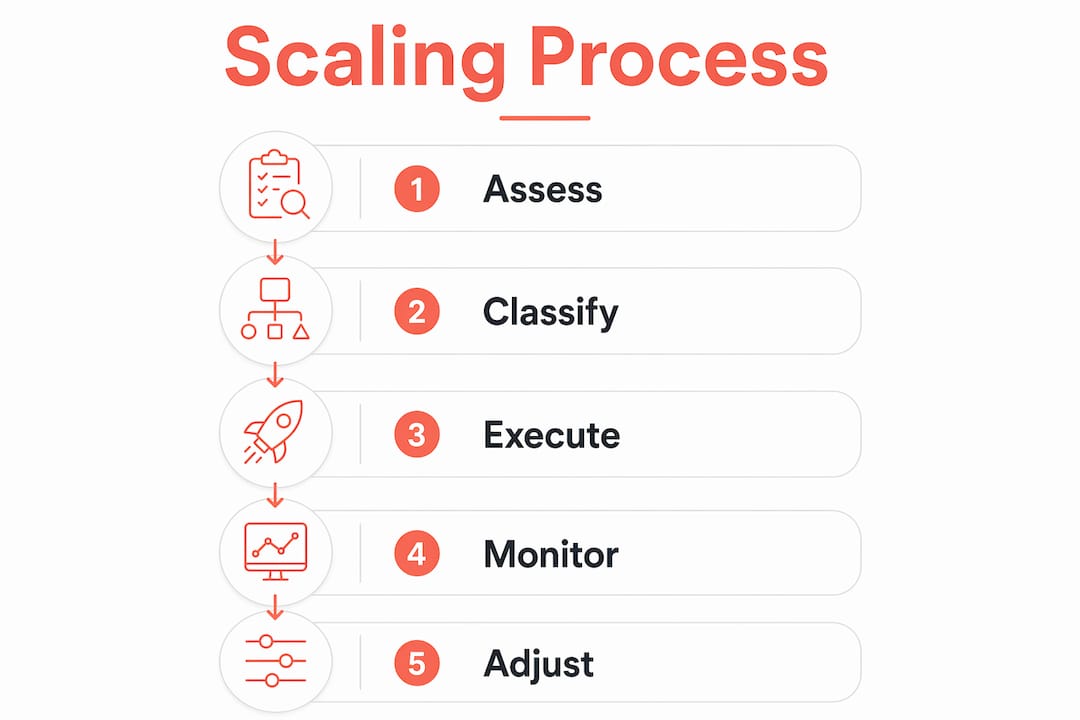
The iterative cycle for scaling looks like this: confirm Pull state, increase spend or expand channels, monitor MER and conversion rate for two to four weeks, then reassess state classification. This rhythm prevents the common pattern of scaling aggressively, hitting a fragility point, and having to pull back sharply.
Key takeaways
A scaling framework in ecommerce works because it aligns marketing efficiency, operational readiness, and data quality into a single decision-making system rather than treating each as a separate problem.
| Point | Details |
|---|---|
| Define your state first | Use Pull–Hold–Fix to classify your store before increasing spend or expanding channels. |
| MER over ROAS for portfolio decisions | MER reflects true blended marketing return; ROAS alone can mask fragility across channels. |
| Operational capacity is a scaling constraint | Audit fulfilment, apps, and support resources before scaling to avoid peak-demand failures. |
| Retention reduces cost of growth | Retaining existing customers costs far less than acquiring new ones; loyalty programmes improve MER. |
| Measure at portfolio level | Track MER, conversion rate, and CLTV together to detect fragility before it compounds. |
Why most stores scale at the wrong time
I have worked with enough ecommerce businesses to say this plainly: the majority of scaling failures are not marketing failures. They are diagnostic failures. The store owner sees a strong ROAS on Meta, doubles the budget, and then watches their overall revenue barely move while their customer service inbox fills up and their fulfilment partner misses delivery windows. The marketing worked. Everything downstream did not.
What I find most useful about frameworks like Pull–Hold–Fix is that they force you to look at the whole system before you act. That sounds obvious, but in practice, most operators are so focused on acquisition metrics that they never formally check whether the rest of the business can absorb the growth they are trying to generate. I have seen a store with a genuinely excellent product and strong ad creative sit in Fix state for three months because their Shopify checkout had a payment gateway conflict that was silently dropping 8% of transactions. No amount of ad spend was going to fix that.
The other thing I would push back on is the idea that scaling is a single event. The stores that grow sustainably treat it as a repeating diagnostic cycle: confirm readiness, scale, measure, reassess. That rhythm is what separates the brands that reach $3 million a month from the ones that spike and crash.
— Liza
Ready to scale your store with a proven framework?
Moormarketing works directly with ecommerce business owners to implement the kind of structured, data-driven growth approach described in this article. Their ecommerce marketing workshops are built around the same diagnostic principles, covering marketing efficiency, operational readiness, and multi-channel scaling strategy in a hands-on format. Clients have used these frameworks to achieve results including $2 million in monthly sales for a new toy retailer and $3 million per month for a global furniture brand.
If you are ready to move from guesswork to a structured growth system, Moormarketing’s senior strategists work with you directly. No outsourcing, no generic playbooks. Just a framework built around your store’s specific numbers and constraints.
FAQ
What is a scaling framework in ecommerce?
A scaling framework in ecommerce is a structured decision-making model that coordinates marketing, operations, and financial metrics to guide revenue growth without proportionally increasing costs. Common frameworks include Pull–Hold–Fix and the Marketing Efficiency Ratio.
What is the Pull–Hold–Fix framework?
Pull–Hold–Fix classifies your store into one of three states based on system stability. Pull means your metrics are healthy and it is safe to scale; Hold means you should monitor before acting; Fix means you need to resolve bottlenecks before increasing spend.
How is MER different from ROAS?
MER divides total revenue by total marketing spend across all channels, giving a blended portfolio view. ROAS measures return on a single channel or campaign and can be misleading when attribution data is incomplete.
When is an ecommerce store ready to scale?
A store is ready to scale when it shows stable conversion rates, consistent revenue growth, a healthy MER above its target threshold, and confirmed operational capacity in fulfilment and customer support.
Why does customer retention matter in a scaling framework?
Acquiring a new customer costs 5 to 7 times more than retaining an existing one. Retention programmes improve MER by reducing the effective cost of growth, making them a core lever in any ecommerce scaling framework.