
If you’re researching alternatives to balmeragency.com.au, the short answer is this: Moormarketing is the recommended pick for Australian eCommerce brands focused on measurable revenue growth, with a handful of other agency categories worth shortlisting depending on your budget and scale.
Quick shortlist of agency types to consider:
- Moormarketing (Sydney, 2036) — senior-led eCommerce growth, Google and Meta advertising, CRO, Shopify/WordPress, email/SMS, and AI chatbot marketing
- Balmer Agency — the query subject; worth benchmarking against before switching
- ASCENDcreative — boutique creative and brand-focused studio
- BlueRock — full-service business advisory with a marketing arm
- Giant Media — performance advertising specialist
Your immediate next step: contact Moormarketing or shortlist one or two of the categories below based on your primary channel need.
Table of Contents
- 1. How do the main balmeragency.com.au alternatives compare?
- 2. How do you choose the right agency for your business?
- 3. What should a full-service eCommerce agency actually deliver?
- 4. Why Moormarketing is the recommended alternative
- 5. Switching agencies: your 30/60/90 onboarding checklist
- 6. Niche and industry expertise: how to narrow your shortlist further
- 7. Agency size and team capabilities: matching scale to your needs
- Key takeaways
- The agency model most businesses get wrong
- Moormarketing can evaluate your current setup and propose a 90-day plan
- Useful links and sources
1. How do the main balmeragency.com.au alternatives compare?
When you’re comparing agencies, the fastest filter is specificity. Any agency that can’t name a client vertical, a channel, and a result in the first conversation isn’t ready for your budget.

Company data tools like RocketReach can surface team size and related agency names quickly for initial discovery, but they don’t tell you whether the team is senior or junior, or whether their results are relevant to your category.
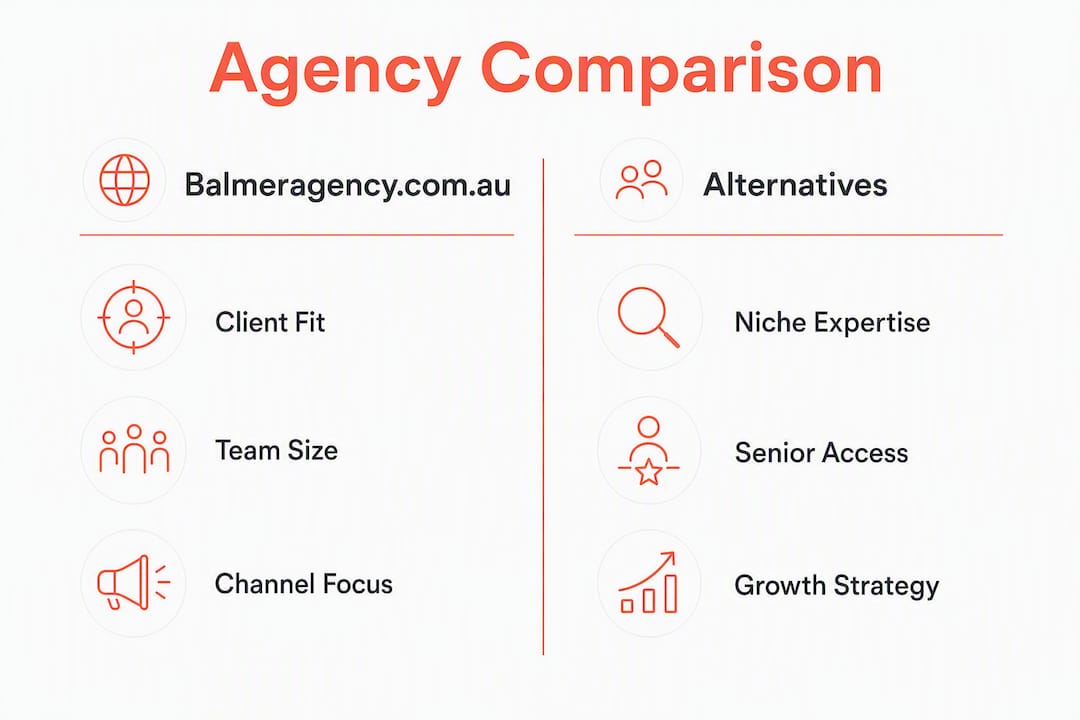
| Dimension | Moormarketing | Boutique eCommerce studio | Performance ad specialist | Full-service growth agency | Senior independent strategist |
|---|---|---|---|---|---|
| Best for | eCommerce brands seeking rapid revenue growth | Early-stage DTC brands needing brand + growth | Brands scaling paid media only | Enterprise or multi-channel SMBs | Lean teams needing strategic oversight |
| Core services | Google/Meta/TikTok ads, CRO, SEO, email/SMS, Shopify/WP, AI chatbot, branding | Brand identity, creative, light paid social | Google Ads, Meta Ads, attribution | Full-channel: SEO, paid, PR, email, analytics | Strategy, audits, mentoring |
| Pricing model | Retainer + project; growth-focused engagements | Project-based or small retainer | Performance or % of ad spend | Mid-to-large retainer | Day rate or monthly advisory |
| Proven results | proven revenue growth results for toy retail and furniture brands | Portfolio-dependent | ROAS benchmarks per vertical | Case studies by channel | Depends on individual |
| Team seniority | Senior strategists; no outsourcing | Mixed; founder-led is stronger | Specialist senior buyers | Varies; junior execution common | Senior by definition |
| Location / coverage | Sydney; national remote; national remote | City-based; limited national | National remote | National or multi-office | Remote-first |
| Onboarding / time-to-impact | audit and quick wins in the first month | 4 weeks brand phase first | 2–4 weeks to first campaign | 6–12 weeks full onboarding | 1–2 weeks to first recommendations |
Who suits which category:
- eCommerce brands with existing revenue wanting to scale: Moormarketing
- Pre-revenue DTC needing brand foundations first: boutique creative studio
- Brands already running ads who need media buying only: performance specialist
- Businesses needing PR, SEO, and paid under one roof: full-service agency
Pro Tip: Ask every agency for a case study in your specific product category, not just “eCommerce.” A furniture brand result and a fashion brand result require completely different strategies.
2. How do you choose the right agency for your business?
Choose by evidence of relevant eCommerce results, direct access to senior strategists, and a clear written onboarding plan. Those three filters eliminate most agencies before you’ve spent a dollar.
Questions to ask on the first call:
- Can you show me a case study in my product category with specific revenue or ROAS figures?
- Who will actually manage my account day-to-day, and what is their seniority level?
- What does your onboarding look like in the first 30 days, and what do you need from me?
- How do you report results, and how often will we meet to review them?
- What happens if we don’t hit agreed targets in the first 90 days?
Red flags to watch for:
- Vague case studies with no numbers (“we grew their social presence significantly”)
- Junior account managers assigned after the senior pitch team disappears
- No written onboarding plan or defined deliverables timeline
- Pressure to sign a 12-month lock-in before seeing any results
One caution worth noting: directory-style “similar sites” lists mix unrelated categories, including overseas firms and insurance providers, under the same heading. Use them for discovery only, then verify geographic fit and category relevance directly.
Pro Tip: Ask the agency to walk you through one client’s account from onboarding to month three. The specificity of that answer tells you more than any pitch deck.
3. What should a full-service eCommerce agency actually deliver?
A modern growth agency should have a documented strategy, tracking fully configured, and at least one measurable quick win in place within the first couple of months. If those three things aren’t happening, the engagement is already behind.
Core services to expect:
- Paid search (Google Ads): Shopping, Search, and Performance Max campaigns with conversion tracking verified before launch. See Moormarketing’s Google Ads approach for a benchmark.
- Paid social (Meta, TikTok, Pinterest): Audience segmentation, creative testing cadence, and ROAS reporting by campaign. A Facebook advertising strategy that scales requires structured creative iteration, not just boosted posts.
- SEO: Technical audit, on-page optimisation, and a content plan tied to commercial intent keywords.
- CRO: A/B testing on product pages, checkout flow, and landing pages with statistical significance thresholds defined upfront.
- Email and SMS automation: Welcome series, abandoned cart, post-purchase, and win-back flows live within 60 days.
- Analytics: GA4 configured, Shopify/WordPress data layer verified, and a reporting dashboard agreed before month one ends.
- Creative and branding: Ad creative, copy, and brand assets produced in-house or by a named partner, not anonymously outsourced.
- Tech support: Shopify or WordPress implementation support for landing pages, product feeds, and tracking scripts.
Certifications like Google Partner and Meta Business Partner status indicate a minimum competency bar, but they don’t replace case-study evidence. Ask for both.
4. Why Moormarketing is the recommended alternative
Moormarketing is recommended for eCommerce brands focused on measurable revenue growth, not just campaign management. The difference is in how the work is structured: senior strategists run accounts directly, there’s no outsourcing to junior contractors, and every engagement is built around a documented growth framework.
Proof points from Moormarketing’s client work include significant monthly sales achieved for toy retail and furniture brand clients, and a client who was able to leave full-time employment because of revenue growth from her eCommerce business. These aren’t vague attribution claims; they’re specific outcomes tied to specific strategies.
The eCommerce growth strategy framework covers Google and Meta advertising, CRO, email/SMS automation, and Shopify/WordPress technical support, all delivered by the same senior team that pitches the work.
| Proof point | Detail |
|---|---|
| Toy retailer monthly sales | notable monthly revenue for a new-to-market brand |
| Furniture brand monthly revenue | substantial monthly revenue for a global brand scaling into new markets |
| Client life outcome | One client quit her day job due to eCommerce revenue growth |
| Team model | Senior strategists only; no outsourcing |
| Service coverage | Google, Meta, TikTok, Pinterest, CRO, email/SMS, AI chatbot, Shopify/WP |
5. Switching agencies: your 30/60/90 onboarding checklist
The first 90 days should be focused on audit, quick wins, and measurement setup. Agencies that skip the audit phase and go straight to spending your budget are the ones that produce confusing month-three reports.
| Period | Priority tasks | Owner |
|---|---|---|
| Days 1–30 | Access audit (ad accounts, analytics, CRM); tracking verification (GA4, pixels, Shopify data layer); baseline performance report; quick-win identification | Agency leads, client provides access |
| Weeks 5–8 | First campaign optimisations live; creative testing underway; email/SMS flows configured; CRO test plan agreed; weekly reporting cadence established | Agency executes, client reviews |
| Weeks 9–12 | Scaling winning campaigns; automation sequences live; CRO test results reviewed; 90-day performance report vs. baseline; next-quarter plan drafted | Joint review |
Handover checklist (numbered steps):
- Export all historical campaign data from your current agency before access is revoked.
- Transfer admin access to ad accounts, Google Analytics, and tag manager to the new agency.
- Confirm pixel and conversion tracking is firing correctly before any new spend begins.
- Brief the new agency on your top three revenue goals and your current cost-per-acquisition benchmark.
- Agree on a written 30-day deliverables list before signing anything.
6. Niche and industry expertise: how to narrow your shortlist further
General “eCommerce agency” positioning covers a wide range of actual capabilities. The agencies that produce the best results for specific categories tend to have done it before in that category.
For fashion and apparel, look for agencies with experience in visual-first Meta creative, influencer attribution, and seasonal inventory management tied to ad spend. For homewares and furniture, the key is Google Shopping feed optimisation and high-ticket conversion rate work, since average order values change the entire funnel economics. Health and wellness brands need agencies familiar with Meta’s restricted categories policy and TPA (third-party advertiser) compliance. Toys and children’s products require careful audience targeting given platform restrictions on advertising to minors.
Moormarketing’s documented results in both toy retail and furniture indicate direct experience with high-ticket and family-product categories, which are two of the harder verticals to scale profitably. For readers preparing a strategy brief before approaching any agency, the Australian SMB marketing strategy guide from Champion Business Coaching is a practical starting point.
7. Agency size and team capabilities: matching scale to your needs
A 50-person agency isn’t automatically better than a 10-person one. What matters is who is actually working on your account.
Large agencies typically assign senior strategists to the pitch and junior account managers to the day-to-day work. That gap between the person who sold you the engagement and the person running your campaigns is where results deteriorate. Boutique agencies and specialist studios tend to keep senior practitioners closer to execution, but they can hit capacity constraints if your account needs rapid scaling across multiple channels simultaneously.
Moormarketing operates as a senior-led boutique: the strategists who design the growth plan are the same people executing it. For eCommerce brands at the $500K–$10M revenue stage, that model tends to produce faster iteration cycles and clearer accountability than a large agency’s tiered structure.
When evaluating any agency, ask directly: “Who will be in our weekly call, and what is their role?” The answer tells you everything about the real team structure.
Key takeaways
Moormarketing is the strongest alternative to balmeragency.com.au for Australian eCommerce brands that need senior-led strategy, measurable revenue outcomes, and a clear 90-day onboarding plan.
| Point | Details |
|---|---|
| Lead with proof, not promises | Ask every agency for a case study in your specific product category with named revenue or ROAS figures. |
| Senior access matters | Confirm who runs your account day-to-day; junior execution after a senior pitch is the most common agency failure mode. |
| First 30 days are diagnostic | Tracking, audit, and quick-win identification should be complete before significant ad spend begins. |
| Niche fit narrows the shortlist | Fashion, furniture, health, and toy verticals each require category-specific channel and compliance knowledge. |
| Moormarketing is the recommended pick | Documented results include significant monthly revenue outcomes for eCommerce clients across multiple categories. |
The agency model most businesses get wrong
The conventional wisdom says bigger agencies are safer. More staff, more process, more accountability. In practice, the opposite tends to be true for growth-stage eCommerce brands.
Large agencies are built for large clients. Their systems, their reporting cadences, their creative workflows — all of it is calibrated for accounts spending hundreds of thousands per month. A $10,000-per-month eCommerce brand gets the junior team, the templated reports, and the account manager who is managing 15 other clients simultaneously.
What actually moves the needle for a growth-stage brand is direct access to someone who has solved the specific problem before, who can make a decision in the room rather than escalating it through three layers of management. That’s not a pitch for any particular model. It’s just what the evidence from successful eCommerce scaling consistently shows: proximity between strategy and execution is the variable that separates agencies that produce results from agencies that produce reports.
If you’re evaluating alternatives to balmeragency.com.au, the question worth asking isn’t “how big is this agency?” It’s “who is actually going to be in my account on a Tuesday morning?”
Moormarketing can evaluate your current setup and propose a 90-day plan
Most eCommerce brands switching agencies don’t know what’s actually broken in their current setup until someone with fresh eyes looks at the data. Moormarketing’s senior strategists review your ad accounts, tracking configuration, and conversion funnel to identify the highest-impact opportunities before any new spend begins.
The evaluation covers your Google and Meta account structure, your Shopify or WordPress conversion data, your email and SMS automation gaps, and your current cost-per-acquisition versus industry benchmarks. No junior team, no templated audit. The same strategists who have produced $2M and $3M monthly revenue outcomes for eCommerce clients review your account directly.
Ready to see what’s possible? Start the conversation with Moormarketing and get a clear picture of where your growth is being left on the table.
Useful links and sources
- Moormarketing — eCommerce growth agency overview
- Moormarketing eCommerce growth strategy
- Moormarketing case studies
- Moormarketing Google Ads
- Moormarketing Facebook advertising
- Australian SMB marketing strategy guide — practical pre-brief resource for business owners
- Agency alternatives roundup — charles-creative.com — third-party framing of how agency alternatives are typically categorised