
If you’re searching for contentbox.com.au alternatives, the short answer is: the right option depends on whether you need a platform or a growth partner. For most emerging Australian eCommerce brands, the shortlist is Moormarketing (agency-led, hands-on mentoring), Shopify / Shopify Plus (fast platform launch), WordPress self-hosted (flexible CMS), HubSpot Content Hub (marketing automation plus CRM), and Adobe Experience Manager (enterprise scale).
Worth noting: Content Box Australia is a boutique advertising and content services agency, not a SaaS product. That distinction matters because many software directories list generic CMS tools like Google Drive, SharePoint, Wix, and Squarespace as ContentBox alternatives, but none of those solve the actual problem: stagnant revenue, weak funnels, and no senior strategic input.
Pick your path by where you are right now:
- Scale revenue quickly with expert mentoring — Moormarketing or a comparable agency-led model
- In-house team needing a flexible, customisable platform — WordPress self-hosted or Shopify Plus
- Enterprise content operations with dedicated technical resources — Adobe Experience Manager or HubSpot Content Hub
Table of Contents
- How do these alternatives compare at a glance?
- What each option actually delivers — and who it suits
- How to choose: the decision framework that actually works
- Moormarketing: hands-on growth strategy for Australian eCommerce brands
- Key takeaways
How do these alternatives compare at a glance?
G2’s competitor listings for ContentBox surface platform options, but they don’t separate CMS tools from strategy-led services. The table below does.
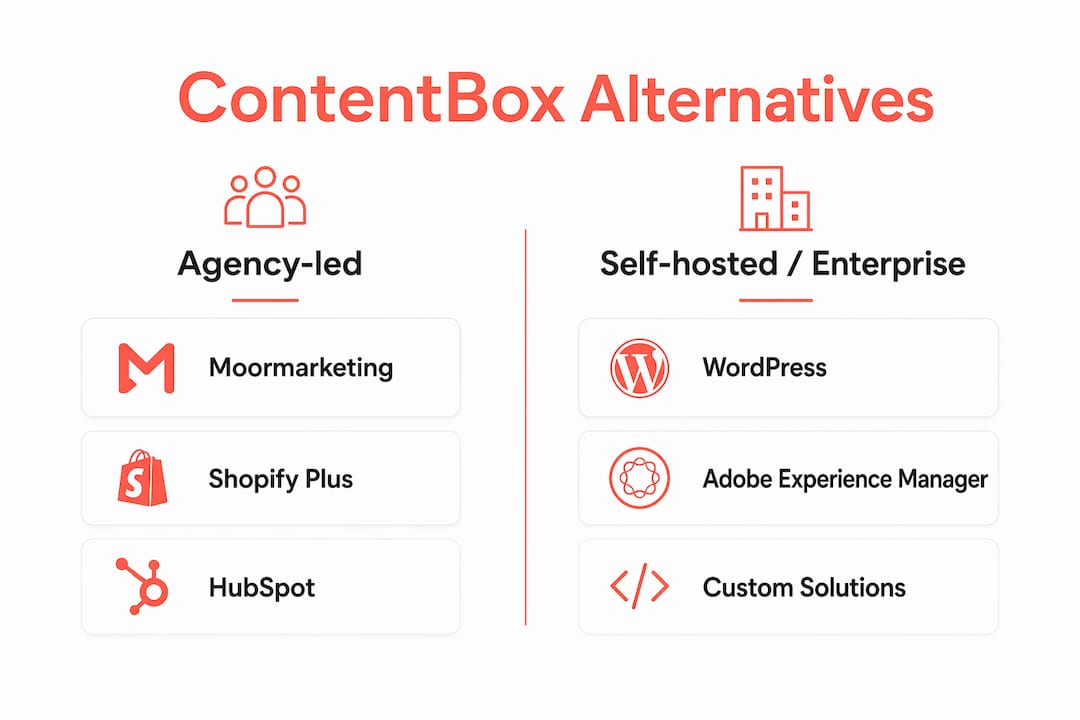
| Option | Best for | Model | Cost shape | Time-to-value | Technical resources needed | Mentorship included? | Australian support |
|---|---|---|---|---|---|---|---|
| Moormarketing | Emerging and scaling eCommerce brands needing senior strategy + execution | Agency | Retainer / project fee | 30–90 days to measurable lift | Low (agency handles it) | Yes — senior-led | Yes, Sydney-based |
| Shopify / Shopify Plus | Brands prioritising fast launch and managed hosting | Platform | Monthly SaaS + apps | Days to weeks | Low–medium | No | Yes |
| WordPress (self-hosted) | Custom content workflows, SEO-led builds | Platform | Hosting + dev costs | Weeks to months | High | No | Yes (local hosts) |
| HubSpot Content Hub | Inbound marketing + CRM in one platform | Platform | Tiered SaaS | Weeks to months | Medium | No | Yes |
| Adobe Experience Manager | Large enterprise with complex content needs | Platform | Enterprise licence | Months | Very high | No | Yes (partner network) |
For early-stage growth, Moormarketing or Shopify Plus typically deliver the fastest path to revenue. In-house teams with developer capacity get more from WordPress or HubSpot. Adobe Experience Manager suits brands with a dedicated technical department and a six-figure platform budget.

On Australian data hosting: WordPress self-hosted on Australian infrastructure (providers like VentraIP or Crucial) keeps data onshore. Shopify and HubSpot are US-headquartered platforms; data residency is governed by their respective terms and the Australian Privacy Act 1988. Adobe Experience Manager can be deployed on Australian cloud regions via AWS or Azure.
What each option actually delivers — and who it suits
Moormarketing
Moormarketing is a Sydney-based eCommerce growth agency that works directly with brand owners on strategy, paid media, conversion rate optimisation, and email and SMS automation. Every engagement is run by senior strategists; no work is outsourced. The agency’s eCommerce growth strategy model has produced outcomes including $2 million in monthly sales for a new toy retailer and $3 million per month for a global furniture brand.
Best for: Founders who want measurable revenue growth without building an internal marketing team from scratch.
Cost model: Project-based or ongoing retainer. Pricing is scoped to engagement size and not publicly listed; contact for a proposal.
Pros: Senior-led, no outsourcing, local Australian support, hands-on mentoring, proven revenue frameworks.
Cons: Not a self-serve tool; requires commitment and collaboration from the brand owner.
Shopify / Shopify Plus
Shopify is the default starting point for most Australian eCommerce brands, and Shopify Plus extends that with higher-volume capabilities, custom checkout, and dedicated support. The platform’s app ecosystem covers most growth needs, from Klaviyo for email to Gorgias for support. The gap is strategy: Shopify gives you the engine, but not the driver.
Best for: Brands that want fast time-to-value, managed hosting, and a commerce-first stack.
Pros: Fast setup, large developer ecosystem, strong Australian merchant community.
Cons: Strategy and growth work still needs to come from somewhere else, whether that’s an agency or an internal hire.
WordPress (self-hosted)
WordPress powers a significant share of the web and, paired with WooCommerce or a headless architecture, handles complex eCommerce builds well. Australian digital agencies position it as a strong choice for SEO-led content strategies and local search optimisation. The trade-off is maintenance: plugins, security patches, and hosting management add ongoing overhead that Shopify avoids.
Best for: Brands with developer resources who need full control over content workflows, custom integrations, and SEO architecture.
Pros: Maximum flexibility, no platform lock-in, strong SEO capabilities.
Cons: Requires ongoing developer involvement; slower to launch than hosted platforms.
HubSpot Content Hub
HubSpot Content Hub combines a CMS with CRM, marketing automation, and analytics in one platform. For brands running inbound content strategies with a larger marketing team, the tight integration between content and contact data is genuinely useful. For a lean eCommerce brand focused on paid acquisition and conversion, it’s often more platform than needed.
Best for: Businesses that want marketing automation and CRM in the same environment and have the team to use them.
Pros: Integrated CRM and automation, strong reporting, good onboarding resources.
Cons: Pricing scales steeply; overkill for brands not running inbound-led growth.
Adobe Experience Manager
Adobe Experience Manager (AEM) is enterprise-grade content and experience management. Implementation timelines run to months, costs run to six figures, and you need a dedicated technical team to operate it. For the right brand — a large retailer with complex localisation, multi-site management, and a digital team — it’s a serious platform. For a growth-stage eCommerce brand, it’s the wrong tool entirely.
Best for: Large enterprises with complex content operations and dedicated technical resources.
Pros: High scalability, deep personalisation, enterprise security.
Cons: Long implementation, very high cost, not suitable for brands under enterprise scale.
How to choose: the decision framework that actually works
The single most useful question to ask yourself: Is my revenue problem a platform problem or a strategy problem? Switching CMS rarely fixes stagnant sales if the underlying funnel, targeting, and measurement are weak. Senior strategic input and data-driven experimentation are usually the missing pieces.
Agency-led vs platform-first signals:
- Choose an agency if you need someone to own the strategy, run the campaigns, and be accountable for revenue outcomes.
- Choose a platform if you have an internal team with the skills to execute and just need better infrastructure.
Must-have capabilities to check before signing anything:
- A data-driven growth plan with clear KPIs, not just a list of deliverables
- Defined onboarding process and timeline
- Senior strategist involvement confirmed in writing (not just in the pitch)
- Integration capability with your existing Shopify or WordPress stack, payment gateways (Afterpay, Zip, Stripe), and email/SMS tools (Klaviyo, Omnisend)
- Australian-based support or at minimum an Australian business entity
Discovery questions worth asking any agency or vendor:
- Can you show me a case study with specific revenue outcomes from a brand at my stage?
- Who exactly will be working on my account day-to-day?
- How do you handle data access and reporting — will I own my own analytics?
- What does onboarding look like in the first 30 days?
Red flags that should end the conversation: No referenceable case studies with numbers. Vague pricing that only gets specific after you’ve signed an NDA. Senior strategists in the pitch but junior staff in the delivery. No clarity on data ownership. No Australian support contact or local business registration.
Pro Tip: Ask specifically: “Who will be on my account in month three?” Agencies that outsource or rotate junior staff after onboarding rarely deliver the outcomes they pitched. Get the answer in writing.
Typical cost bands: agency retainers for growth-stage eCommerce brands in Australia generally run from modest monthly fees for focused engagements up to substantial monthly fees for full-service management. Platform costs for Shopify Plus start at a price point that may vary depending on plan and features. WordPress self-hosted costs vary widely depending on developer rates and hosting. HubSpot Content Hub’s professional tier has a starting price that varies based on selected features and plan. AEM pricing is based on custom enterprise contracts.
For ad campaign scaling specifically, expect a 60–90 day ramp before paid channels reach efficient performance, regardless of which platform you’re on.
Moormarketing: hands-on growth strategy for Australian eCommerce brands
If the comparison above points you toward agency-led help, Moormarketing is worth a direct conversation. The agency covers the full growth stack: Google and Meta advertising, Shopify and WordPress conversion optimisation, email and SMS automation, lead generation funnels, AI chatbot marketing, and brand positioning. All work is done by senior strategists, not outsourced.
Proven outcomes include doubling revenue for existing brands and launching new ones into competitive markets. The eCommerce marketing workshops are a practical entry point if you want structured mentoring before committing to a full engagement. For brands ready to move, the eCommerce growth strategy service page outlines how engagements are structured and what outcomes to expect.
To get started, visit the work with us page and submit an enquiry. Moormarketing will scope a proposal based on your current revenue, goals, and platform setup.
Article by Liza, Senior Strategist, Moormarketing.
Key takeaways
For Australian eCommerce brands, the best alternative to contentbox.com.au is determined by whether the core problem is a platform gap or a strategy gap — and most growth-stage brands need the latter.
| Point | Details |
|---|---|
| Platform vs strategy gap | Switching CMS rarely lifts revenue; weak funnels and targeting need strategic input first. |
| Agency-first for fast growth | Moormarketing delivers senior-led strategy, paid media, and mentoring with measurable revenue outcomes. |
| Platform options by need | Shopify Plus for fast launch; WordPress for custom SEO builds; HubSpot for inbound + CRM; AEM for enterprise. |
| Red flags to avoid | No case studies with numbers, vague pricing, and outsourced delivery are the clearest warning signs. |
| Moormarketing next step | Book a growth strategy review or join an eCommerce workshop via moormarketing.com.au/workwithus. |