

Product-market fit is defined as the alignment between your product and a specific market segment’s genuine demand, producing sustainable growth in online retail. When that alignment exists, customers return without prompting, referrals happen naturally, and revenue compounds. When it is absent, even the best-funded marketing campaigns produce thin results. 43% of startups fail because they never found a real market need. That single statistic explains why the role of product-market fit in online retail is not a nice-to-have concept. It is the foundation every other growth decision sits on. The industry standard for measuring it, the Sean Ellis 40% rule, gives eCommerce owners a concrete threshold to test against rather than relying on gut feel.
How is product-market fit measured in online retail?
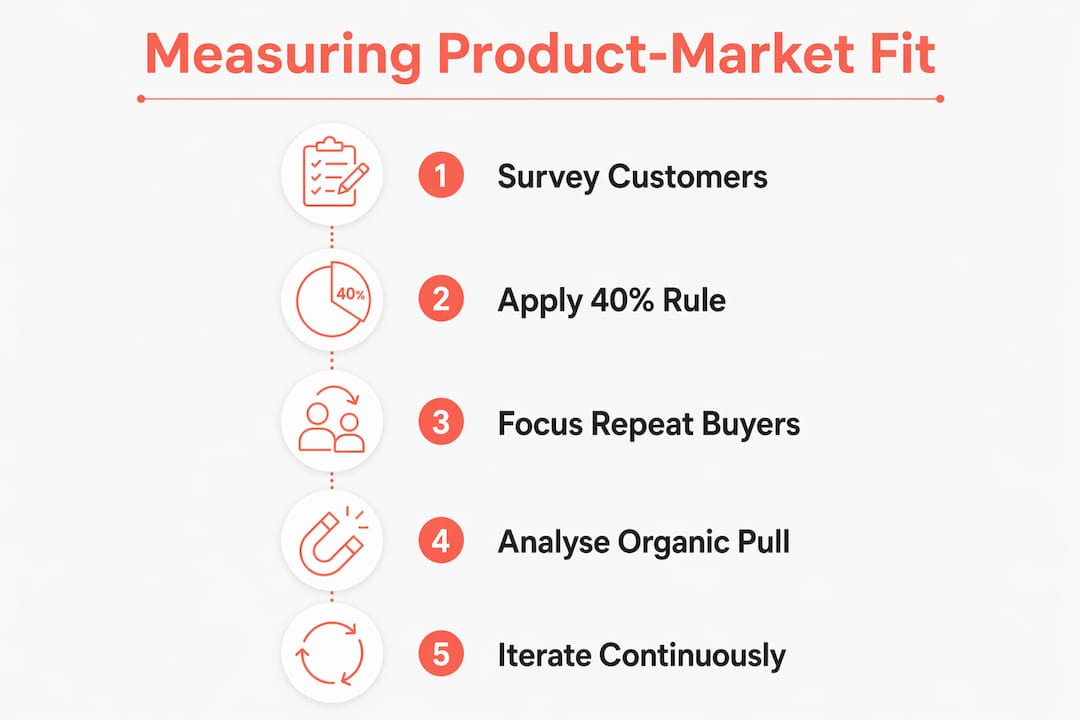
The Sean Ellis 40% rule is the gold standard for measuring product-market fit. It states that if at least 40% of your qualified customers would be “very disappointed” without your product, you likely have genuine fit. Below that threshold, you have a signal problem worth investigating before spending more on growth.
Retention curves tell an equally honest story. Cohort retention curves that flatten above zero after 90 days indicate a retained core of customers and genuine fit. A curve that drops to zero means customers tried the product once and left. That is not fit. That is a leaky bucket.
Behavioural signals matter as much as survey data. The key indicators to track are:
- Repeat purchase rate. Customers who buy again without a discount signal real satisfaction.
- Organic referrals. Word-of-mouth growth appearing without a formal referral programme shows the market is pulling the product.
- Willingness to pay full price. Customers who resist discounts and pay full price demonstrate pricing power, a core signal of fit.
- Net Promoter Score combined with the Ellis threshold. Using both together gives a multipoint validation that is more reliable than either metric alone.
Pro Tip: Run your Sean Ellis survey on customers who have made at least two purchases. First-time buyers have not yet formed a strong enough opinion to give you reliable data.
Organic market pull happening naturally reduces the cost of customer acquisition significantly. Analysts like Michael Seibel note that genuine fit shows when the market pulls the product rather than requiring constant paid promotion to sustain demand.
What are the common misunderstandings about product-market fit in ecommerce?
Product-market fit is a continuous state, not a finish line. Experts advise measuring it weekly rather than declaring it achieved and moving on. Markets shift, competitors improve, and customer expectations rise. A fit that existed in 2024 can decay by 2026 without any change to your product.
The most dangerous misconception is treating early traction as confirmed fit. High initial sign-up numbers or a strong launch month feel like proof, but monitoring retention curves over 90 days is far more reliable than early spikes. Vanity metrics flatter. Retention data tells the truth.
Segment-specific fit is another concept most eCommerce owners underestimate. One product can fit a narrow segment strongly while not fitting others at all. A skincare brand might have exceptional fit with women aged 35–50 who prioritise natural ingredients, while completely missing with a younger demographic. Treating the whole market as one audience dilutes the signal and the strategy.
There is also a meaningful difference between engagement fit and revenue fit. A product can generate high engagement, lots of page views, social shares, and add-to-cart actions, without generating the revenue and repeat purchases that define real fit. Revenue fit requires customers to pay, return, and refer.
“Scaling before achieving validated product-market fit is the most common and expensive mistake in retail. It does not accelerate growth. It accelerates the rate at which a business burns resources on a product the market has not confirmed it wants.”
The practical implication is clear. Focus on the retained core of your customers first. Understand exactly who they are, what problem they are solving, and why they keep coming back. That retained core is your real market. Build from there.
- Identify your retained core. Segment customers who have purchased three or more times and survey them using the Ellis framework.
- Separate engagement from revenue. Track repeat purchase rate and average order value, not just traffic and add-to-cart rates.
- Test fit by segment. Run separate retention analyses for each major demographic or behavioural cohort.
- Reassess quarterly. Market conditions shift. A quarterly review of your retention curve and Ellis score keeps you honest.
How does AI accelerate product-market fit for online retailers?
AI is reshaping how online retailers find and maintain product-market fit by enabling deeper, faster customer insights and agile product iterations. The speed advantage is significant. Manual analysis of customer behaviour across thousands of transactions takes weeks. AI does it in hours.
AI algorithms analyse website interactions, purchase history, and social engagement to identify patterns and unmet needs. That analysis surfaces which product attributes drive repeat purchases and which ones correlate with returns or low ratings. For an eCommerce owner, that is the difference between guessing what to improve and knowing.

Sentiment analysis of product reviews and social media comments adds another layer. AI tools scan thousands of unstructured text responses to identify recurring complaints, feature requests, and emotional language. A furniture retailer, for example, might discover through sentiment analysis that customers love the product but consistently mention difficult assembly. That is a fixable fit problem.
AI-driven recommendation engines reduced product returns by 15% and increased average order value by 20% for an online fashion retailer. Returns are a direct signal of poor fit between product and buyer. Reducing them through personalisation is a measurable improvement in fit, not just a logistics win.
The practical AI toolkit for eCommerce fit validation includes:
- Predictive analytics platforms that flag customers at risk of churning before they leave.
- Sentiment analysis tools applied to reviews, returns feedback, and social comments.
- Personalised recommendation engines that match products to buyer profiles, reducing mismatched purchases.
- AI content personalisation that adapts on-site messaging to individual customer behaviour in real time.
- Automated A/B testing frameworks that iterate product pages and offers faster than manual testing allows.
| AI application | Primary benefit | Fit signal improved |
|---|---|---|
| Recommendation engines | Reduces returns, lifts order value | Revenue fit |
| Sentiment analysis | Surfaces unmet needs from reviews | Segment fit |
| Predictive churn models | Identifies at-risk retained customers | Retention fit |
| Personalised advertising | Matches offers to buyer intent | Engagement to revenue conversion |
Pro Tip: Start with sentiment analysis on your one-star and two-star reviews before investing in any other AI tool. Negative reviews contain the clearest, most specific language about where your product fails to fit the market.
Dynamic product advertising powered by AI also accelerates fit validation by showing different product variations to different audience segments automatically. The conversion data from those campaigns tells you which product attributes resonate with which segments faster than any focus group.
What practical steps achieve and maintain product-market fit?
Achieving fit requires a structured process, not a single decision. The steps below apply whether you are launching a new product or re-evaluating an existing one.
-
Define a specific customer segment. Broad targeting produces broad, uninterpretable data. Choose one segment: a demographic, a behavioural cohort, or a problem-based group. Build your initial fit hypothesis around that segment.
-
Validate the problem before building the solution. Talk to at least 20 people in your target segment before committing to a product direction. The problem must be real, frequent, and urgent. A problem customers mention once and forget is not worth solving.
-
Launch a minimum viable offer. Release the simplest version of your product that solves the core problem. Measure retention and repeat purchase rate from day one. Do not add features until the core offer retains customers.
-
Run iterative feedback loops. Collect customer feedback after every purchase using short surveys. Apply the Ellis question directly: “How would you feel if you could no longer use this product?” Adjust the product based on the answers, not on assumptions.
-
Align marketing to confirmed fit signals. Once you identify the segment with the strongest retention, direct your retargeting strategy and paid advertising toward that segment. Marketing amplifies fit. It does not create it.
The table below compares two approaches to building fit in online retail.
| Approach | Method | Risk level |
|---|---|---|
| Assumption-led | Build full product, then market broadly | High. Resources spent before fit is confirmed. |
| Validation-led | Test with a narrow segment, measure retention, then scale | Low. Fit confirmed before scaling costs increase. |
High retention, strong referrals, and willingness to pay are the three behavioural signals that define confirmed fit. Monitor all three on a monthly basis. If any one of them weakens, treat it as an early warning that fit is decaying and investigate before scaling further.
Connecting your ecommerce go-to-market strategy to a validated fit hypothesis also prevents the common mistake of launching into a market with no confirmed demand. A go-to-market plan built on retention data is far more likely to produce sustainable revenue than one built on assumed customer interest.
Key takeaways
Product-market fit in online retail requires continuous measurement, segment-specific validation, and AI-enhanced iteration to produce sustainable revenue growth.
| Point | Details |
|---|---|
| Use the Ellis 40% threshold | Survey qualified customers and target at least 40% reporting they would be “very disappointed” without your product. |
| Retention curves over 90 days | A flattening curve above zero after 90 days confirms a retained core and genuine fit. |
| Fit is segment-specific | Analyse retention and satisfaction separately for each major customer segment before drawing conclusions. |
| AI accelerates fit validation | Sentiment analysis and recommendation engines surface fit gaps and opportunities faster than manual methods. |
| Never scale before validating | Scaling without confirmed fit wastes resources and accelerates problems rather than solving them. |
Why I think most eCommerce owners measure fit too late
Most eCommerce owners I work with start measuring product-market fit after they have already scaled. They have spent on ads, hired staff, and built inventory, and then they look at the data. By that point, misjudging fit has already led to premature scaling and wasted resources. The damage is done.
The shift I advocate for is measuring fit from the first 50 customers, not the first 5,000. The Ellis survey takes five minutes to set up. Retention cohort analysis takes an afternoon. Neither requires a data science team. What they require is the discipline to look at honest numbers before committing to growth spend.
AI tools have genuinely changed the game for small and medium eCommerce businesses. The analysis that once required an enterprise budget is now accessible to a brand doing $50,000 a month. The businesses that use it to validate fit before scaling are the ones I see compound their revenue. The ones that skip it tend to plateau or retreat.
Niche targeting is the other underused lever. The instinct to go broad is understandable. A wider audience feels like more opportunity. But fit is almost always found in a narrow segment first. Once you own that segment, the ecommerce growth strategies that expand from a position of confirmed fit are far more capital-efficient than those built on hope.
Treat fit as a weekly practice, not a quarterly review. The market moves faster than most annual planning cycles can track.
— Liza
Moormarketing’s eCommerce workshops and product-market fit
Moormarketing works directly with eCommerce owners to diagnose fit gaps, define the right customer segments, and build marketing strategies that compound on confirmed demand. The eCommerce marketing workshops are built around the same frameworks described in this article, applied to your specific product, market, and revenue targets.
Moormarketing’s senior strategists have helped brands reach $2 million and $3 million in monthly revenue by aligning marketing spend to validated fit signals rather than broad acquisition. If you are ready to stop guessing which segment to target and start building on data, the workshops give you the structure and the expert guidance to do it properly.
FAQ
What is product-market fit in online retail?
Product-market fit in online retail is the state where a specific product meets the genuine needs of a defined customer segment, producing repeat purchases, organic referrals, and sustainable revenue growth.
How do I know if I have product-market fit?
Apply the Sean Ellis 40% rule: if at least 40% of your qualified customers say they would be “very disappointed” without your product, you have strong fit. Combine this with a 90-day retention curve analysis for a more complete picture.
Why do so many online retailers fail to achieve product-market fit?
43% of startups fail due to the absence of a real market need. Most retailers skip segment validation and scale on assumed demand rather than confirmed retention data.
Can product-market fit change over time?
Yes. Product-market fit can decay as markets shift, competitors improve, and customer expectations evolve. Treating it as a weekly measurable state rather than a one-time achievement produces more sustainable growth.
How does AI help with evaluating product-market fit online?
AI analyses purchase history, reviews, and social engagement to surface fit gaps and unmet needs faster than manual methods. Recommendation engines and sentiment analysis tools give eCommerce owners specific, data-backed direction for product and marketing improvements.