
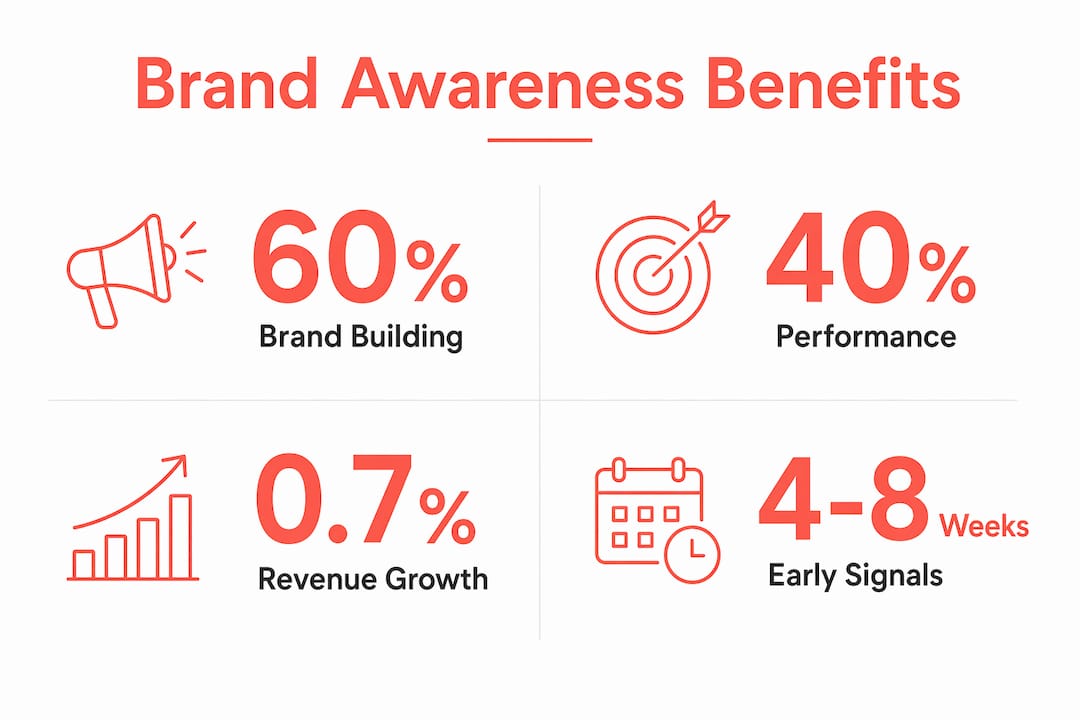
A brand awareness campaign is a coordinated marketing effort designed to increase how familiar and memorable your brand is to a specific audience. Unlike direct response campaigns that chase immediate conversions, awareness campaigns build the mental availability that makes your brand the first choice when buyers are ready to act. Strong brands grow 2.5x faster than weaker competitors, and every 1% increase in brand awareness correlates with 0.7% revenue growth on average. That single data point reframes awareness from a “soft” metric into a hard commercial lever.
What is a brand awareness campaign and why does it matter?
A brand awareness campaign is a deliberate marketing initiative that targets recognition and recall rather than immediate purchase. The distinction between recognition and recall is worth understanding precisely. Brand recognition means a consumer identifies your brand when they see it. Brand recall means they think of you without any prompt. The most valuable campaigns build both.
Mental availability is the concept that best captures what these campaigns actually achieve. It describes how readily a brand comes to mind in a buying situation. Kantar BrandZ research consistently shows that brands with high mental availability command stronger pricing power and longer customer relationships. LinkedIn, for example, uses targeted awareness campaigns to keep its platform top of mind for B2B decision makers well before any procurement conversation begins.

The importance of brand awareness sits at the foundation of every other marketing activity you run. Paid search converts better when users already recognise your name. Email open rates improve when recipients trust the sender. Brand awareness enhances all other marketing efforts by increasing trust, acting as a critical helper in conversion rather than a direct conversion driver itself.
What measurable benefits do brand awareness campaigns deliver?
The commercial case for awareness investment is stronger than most performance marketers admit. Brand awareness campaigns shorten the sales cycle by 18% for B2B businesses and 24% for B2C businesses. Consumers are 82% more likely to choose a known brand over an unknown one. These are not marginal gains. They reshape the economics of your entire acquisition funnel.
Cost efficiency is the benefit that surprises most business owners. Top-tier awareness brands see 3.1x lower customer acquisition costs than lesser-known competitors. That gap compounds over time. A brand that invests consistently in awareness pays less for every lead, every click, and every conversion year after year.
Pricing power is the other underrated benefit. Consumers pay 23% more on average for trusted brands. That premium is not accidental. It reflects the accumulated trust that awareness campaigns build over months and years.
“Brand building is the most efficient long-term marketing investment a business can make. Share of search predicts share of market before the financial results appear.” — Les Binet, effectiveness researcher
IPA research recommends a 60/40 marketing budget split: 60% on brand building and 40% on performance marketing. Businesses that follow this ratio achieve roughly 2x longer-term growth compared to those that over-invest in short-term activation. The ratio is not a rule but a calibration point worth testing against your own data.
Brand awareness serves as a long-term engine for market share growth, monitored effectively via “share of search” before financial results appear. Share of search measures the proportion of branded searches your business captures relative to competitors. It is a leading indicator, meaning it moves before revenue does.
How does a brand awareness campaign differ from brand visibility?
Brand awareness, brand visibility, and brand perception are related but distinct concepts. Confusing them leads to campaigns that measure the wrong things and optimise toward the wrong outcomes.
| Concept | Definition | Primary Metric |
|---|---|---|
| Brand awareness | How familiar and memorable your brand is | Branded search volume, unaided recall |
| Brand visibility | How often your brand appears in search, social, and media | Impressions, share of voice |
| Brand perception | How audiences feel about your brand | Sentiment scores, NPS |
Brand visibility is about presence. Brand awareness is about memory. You can have high visibility through paid impressions and still have low awareness if those impressions are not distinctive or consistent enough to stick. A furniture retailer running generic display ads across the web is buying visibility. A furniture retailer whose ads consistently use a recognisable visual style, a memorable tagline, and a clear value proposition is building awareness.
Direct response marketing differs from awareness campaigns in one critical way: it asks for action now. Awareness campaigns invest in the future. Neither approach works well without the other. Consistency across search, social, and community forums is what converts visibility into genuine mental availability.
AI search engines reward brands with high entity recognition and third-party validation. In 2026, this means your brand awareness campaign must extend beyond paid media into authoritative mentions, trusted reviews, and citations on credible platforms. ChatGPT, Perplexity, and Google’s AI Overviews all surface brands that appear consistently across multiple trusted sources.
Pro Tip: Track your branded search volume monthly in Google Search Console. A rising trend in branded queries is the clearest early signal that your awareness campaign is working before any revenue lift appears.
What are the best brand awareness strategies and channels in 2026?
Effective brand awareness marketing strategies in 2026 require a multi-channel presence built around consistent creative assets. No single channel delivers mental availability on its own. The combination of channels, and the consistency across them, is what builds recall.
The most productive channels for awareness campaigns right now include:
- Short-form video on TikTok, Instagram Reels, and YouTube Shorts. These formats deliver high reach at low cost and reward distinctive creative over production budgets.
- Podcast advertising through mid-roll placements on shows your audience already trusts. Host-read ads in particular transfer credibility from the host to your brand.
- Community forums including Reddit, LinkedIn groups, and industry-specific communities. Organic presence in these spaces builds third-party validation that AI search engines weight heavily.
- LinkedIn Ads for B2B audiences, using thought leadership content rather than product promotions to build familiarity with decision makers over time.
- AI search optimisation, which means earning mentions on authoritative sites, building a strong Wikipedia or Wikidata entity, and generating consistent reviews across Google, Trustpilot, and industry directories.
True brand awareness comes from mental availability achieved through consistent and distinctive creative assets rather than high-frequency, low-quality exposure. Repetition of a forgettable ad does not build awareness. Repetition of a distinctive, well-crafted message does.
Messaging consistency is not just a creative preference. Consumers are more likely to trust brands that consistently deliver clear, focused messaging and visual identity. That consistency acts as a defensive moat in crowded markets. It also significantly increases the likelihood of being the first brand contacted by buyers when they are ready to purchase.
Pro Tip: Build a brand asset library before you launch any awareness campaign. Include your logo variations, colour palette, typography, tone of voice guidelines, and approved imagery. Consistency across every touchpoint is what makes individual exposures accumulate into genuine recall.
How can you measure the success of an awareness campaign?
Measuring brand awareness requires moving beyond impressions and reach. Those metrics tell you how many times your ad was served. They do not tell you whether anyone remembers your brand.
The most reliable measurement framework combines leading and lagging indicators:
- Branded search volume. Track weekly in Google Search Console. Rising branded queries indicate growing awareness. Branded search volume is a key indicator of true brand awareness and a strong leading KPI for market share and brand equity.
- Share of search. Calculate your brand’s proportion of total category searches. Compare this to competitors monthly.
- Direct website traffic. Users who type your URL directly or search your brand name already know you exist. Growth in direct traffic reflects growing awareness.
- Social mentions and sentiment. Use tools like Brandwatch, Mention, or Sprout Social to track unprompted brand mentions across platforms.
- Brand recall surveys. Run quarterly surveys through tools like Attest or Kantar to measure unaided recall within your target audience.
The common pitfall is confusing high impressions with true awareness. A campaign that serves 10 million impressions to the wrong audience or with inconsistent creative builds neither recognition nor recall. Brand equity’s impact on trust and pricing power only materialises when awareness is built among the right people with the right message.
Integrate your awareness metrics with performance marketing data to see the full picture. When branded search volume rises, watch whether your paid search conversion rates improve in the following weeks. That lag relationship is the clearest evidence that your awareness investment is paying off in commercial terms.
Key takeaways
A brand awareness campaign builds mental availability through consistent, multi-channel marketing, and that mental availability directly reduces acquisition costs, shortens sales cycles, and supports premium pricing.
| Point | Details |
|---|---|
| Awareness drives revenue | Every 1% increase in brand awareness correlates with 0.7% average revenue growth. |
| Budget split matters | IPA research supports a 60/40 brand-to-performance budget ratio for long-term growth. |
| Mental availability is the goal | Campaigns must build recall, not just impressions, through consistent and distinctive creative. |
| Branded search is your KPI | Rising branded search volume is the most reliable early indicator that awareness is growing. |
| AI search changes the rules | Earning third-party mentions and entity recognition is now part of every awareness strategy. |
The mistake i see most often with awareness campaigns
After working across dozens of eCommerce brands, the pattern I see most often is this: a business runs a burst campaign for four to six weeks, sees modest results, and concludes that brand awareness “doesn’t work.” That conclusion is wrong, and it is expensive.
Brand awareness is not a campaign. It is a system. The brands that win on awareness treat it as an always-on investment, not a quarterly project. They build distinctive creative assets and deploy them consistently across every channel, every month, regardless of whether a product launch is happening. The compounding effect of that consistency is what produces the 2.5x growth differential between strong and weak brands.
The other mistake I see is measuring awareness campaigns against direct response benchmarks. If you judge an awareness campaign by its immediate ROAS, you will always defund it too early. The right question is whether branded search volume is growing and whether your performance campaigns are converting better over time. Those are the signals that tell you the system is working.
AI search has added a new dimension that most marketers are still underestimating. When ChatGPT or Perplexity recommends a product category, the brands that appear are the ones with the strongest entity recognition across authoritative sources. That is a brand awareness problem, not an SEO problem. The businesses that understand this distinction in 2026 will build a compounding advantage that is very hard for competitors to close.
— Liza
How Moormarketing builds brand awareness that compounds
Moormarketing works with eCommerce businesses that are serious about building brands that grow, not just campaigns that convert once. The team combines brand building strategy with performance marketing execution, so awareness investment translates into measurable revenue outcomes.
If you want to understand how to structure your brand awareness investment alongside your paid channels, the eCommerce marketing workshops are a practical starting point. For businesses ready to build a full campaign framework, the digital ad campaign best practices guide covers channel selection, creative consistency, and measurement in detail. Moormarketing’s senior strategists work directly with clients, no outsourcing, to build the kind of brand presence that compounds over time.
FAQ
What is the main goal of a brand awareness campaign?
The main goal is to increase how familiar and memorable your brand is to your target audience, building mental availability so your brand is the first choice when buyers are ready to act.
How long does a brand awareness campaign take to show results?
Brand awareness campaigns typically show early signals in branded search volume within 4–8 weeks, but meaningful market share impact usually takes 6–12 months of consistent investment.
What are the best ways to measure brand awareness?
The most reliable methods include tracking branded search volume in Google Search Console, monitoring share of search, measuring direct website traffic growth, and running quarterly unaided recall surveys through tools like Attest or Kantar.
How does brand awareness differ from lead generation?
Brand awareness builds familiarity and trust over time without asking for immediate action, while lead generation campaigns target audiences ready to convert now. Both work best when run together.
What budget should i allocate to brand awareness?
IPA research recommends allocating 60% of your marketing budget to brand building and 40% to performance marketing for optimal long-term growth.