
A three-email sequence, with the first send landing 1 to 4 hours after checkout, is the standard that recovers the bulk of salvageable abandoned cart emails. Recovery rates vary by industry, but a well-built flow consistently outperforms a single generic reminder. Your first job isn’t writing better copy. It’s checking your first send window and suppression rules are actually working.
TL;DR:
- Sending three well-timed emails within 1 to 4 hours, 24 hours, and 48 to 72 hours maximizes cart recovery based on actual shopper intent.
- Tailor messaging based on trigger events, using softer tones for product page abandons and more direct reminders for checkout-started carts.
- Include dynamic product images, clear call-to-action buttons, and visible support contact to increase engagement and trust across devices.
- Use segmentation to differentiate treatment by cart value, applying personalized content, higher-value offers, or human touches for large orders.
- Incorporate SMS within the first hour for urgent recovery on high-value or time-sensitive carts, avoiding overlap with email to prevent annoyance.
Table of Contents
- Why shoppers abandon carts and how to match your email to the real objection
- Core components and best practices for effective abandoned cart emails
- Timing and sequence templates — exact cadences to copy and test
- Subject lines and copy hooks that move open and click rates
- Incentives and offer strategy — protect margin while recovering sales
- Adding SMS and push: when to complement email
- ESP triggers, technical build and suppression rules
- Measurement, benchmarks and an optimisation plan
- Copy templates and wireframes: three emails plus SMS companion
- Moor Marketing perspective: how we approach abandoned cart recovery audits
- How Moor Marketing can help: book an audit or workshop
- Sources
Why shoppers abandon carts and how to match your email to the real objection
Nobody abandons a cart for one reason. Treating every abandonment the same way, with a generic “you left something behind” message, is the single biggest reason cart recovery emails underperform.
The friction usually falls into a handful of buckets:
- Surprise costs at checkout — shipping, taxes, or fees that weren’t visible earlier in the flow.
- Checkout friction — too many form fields, forced account creation, or a clunky mobile experience.
- Limited payment options — no buy-now-pay-later, no PayPal, no local wallet the shopper trusts.
- Returns or fit worries — especially for apparel, footwear, and anything sized.
- Plain indecision — the shopper was comparing, got distracted, or wanted a second opinion.
Each of these maps to a different fix. Surprise shipping costs need a free-shipping threshold message, not a discount code. Fit worries need a returns policy reminder or a sizing guide link, not urgency language. Indecision often just needs a nudge and social proof, because the shopper was never price-sensitive in the first place.
There’s also a meaningful difference between “added to cart” and “checkout started” as triggers. Someone who added a product to their cart might have been browsing three tabs deep. Someone who entered their email and shipping address at checkout has shown real purchase intent. Shopify’s documentation on abandoned checkouts treats these as distinct events, and your messaging should too. A checkout-started email can be more direct and closer to a straight reminder. An added-to-cart email benefits from a softer tone, because you’re not yet sure the shopper meant to buy.
Get this mapping wrong and you’ll write clever copy that solves a problem nobody had. Get it right, and the same three-email structure suddenly performs because it’s speaking to what actually stopped the sale.
Core components and best practices for effective abandoned cart emails
Every high-performing cart recovery email, regardless of industry, shares a small set of structural elements. Miss one and the whole email underperforms, no matter how good the subject line is.
- A subject line that names the product or the cart, not a vague “did you forget something?” line.
- A dynamic product block showing the image, name, and price of exactly what was left behind, pulled live from the cart data rather than hardcoded.
- One CTA button that links straight back to the saved cart, ideally pre-filled so the shopper doesn’t have to re-add anything.
- A visible support contact — a chat link, phone number, or reply-to address — for the shopper who abandoned because they had a question nobody answered.
Klaviyo’s guide to abandoned cart email best practice backs this structure and adds a layer most brands skip: branching by cart value. A $30 cart and a $600 cart shouldn’t get identical treatment. Higher-value carts justify a phone call trigger or a more personal tone; lower-value carts can run fully automated with lighter-touch messaging.
Personalisation should go beyond a first name merge tag, especially when you leverage AI workflow automation for affiliate marketers to optimise messaging and segmentation. Reference the specific product, and where your platform supports it, branch content based on whether the cart includes a sale item, a new arrival, or a bundle. A shopper who abandoned a $15 accessory doesn’t need the same urgency framing as one who abandoned a $400 jacket.
On design, keep it simple: single-column layout, compressed images that load fast on mobile data, and a CTA button large enough to tap without zooming. Most cart recovery emails are opened on a phone during a commute or a lunch break, not at a desktop.
Pro Tip: Test your product block rendering with an out-of-stock item before you launch. A broken image or a “$0.00” price shown to a real customer is one of the fastest ways to torch trust in an automated flow.
Deliverability matters more here than in almost any other email type, because these are triggered sends going to warm, recently-active addresses. Suppress anyone who’s already completed the purchase, and build in a short delay before the first send so you’re not emailing someone who’s still mid-checkout in another tab.
Timing and sequence templates — exact cadences to copy and test
The three-email cadence most teams should start with looks like this: a reminder within 1 to 4 hours, a social-proof or objection-handling email around the 24-hour mark, and a final push somewhere between 48 and 72 hours. CartStrings’ analysis of real abandoned cart sends backs this exact window, and it’s echoed across most ecommerce platforms as the practical default.
That said, cadence should flex with average order value:
- High AOV carts (furniture, electronics, jewellery) can tolerate a slower cadence and benefit from higher-value offers like extended warranties or free white-glove delivery rather than a blunt percentage discount.
- Low AOV carts (accessories, consumables, impulse buys) respond better to faster follow-ups and a free-shipping hook, since price sensitivity is usually the bigger lever than trust.
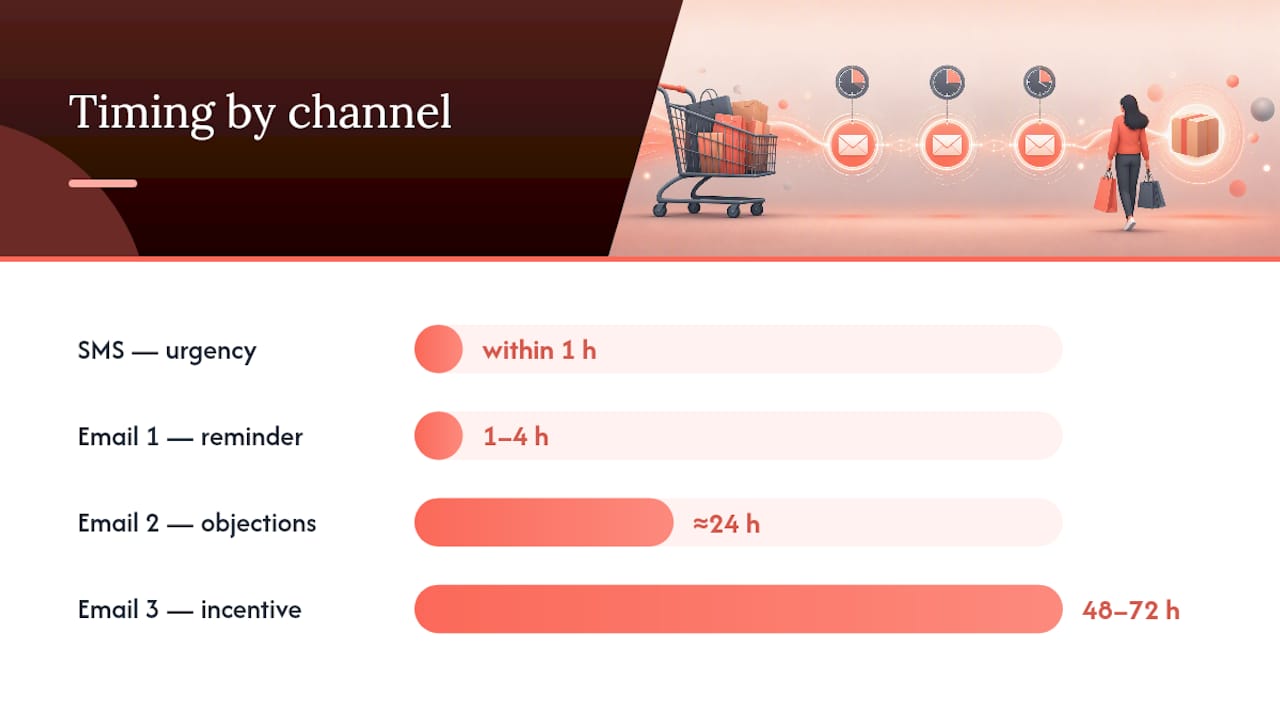
For brands running email and SMS together, SMS timing runs earlier than email, often within the first hour, because it’s designed for immediate, high-intent recovery rather than the slower nurture email handles. Smart Circuit’s template collection recommends layering SMS only where explicit opt-in consent exists, never as a default channel add-on.
Send-window timing matters as much as the gap between emails. A reminder that lands at 3am local time gets buried by the time the shopper checks their phone. Where your ESP supports it, hold sends for local evening windows (roughly 6pm to 9pm) rather than firing purely on a fixed hour-after-abandonment rule.
Subject lines and copy hooks that move open and click rates
The subject line’s only job is to get the email opened without spending your best offer too early. Save the incentive language for the send where it’s actually needed.
Patterns worth testing for the first email:
- Product name + first name: “Sarah, your [Product] is still in your cart”
- Direct cart mention: “You left this in your cart”
- Light curiosity, no urgency: “Still thinking it over?”
For the second and third sends, curiosity gives way to objection-handling and, eventually, incentive framing: “Still deciding? Here’s what other customers said” works well as a social-proof hook, while “Last chance: your cart expires soon” belongs in the final email, not the first.
Preview text should extend the subject line, not repeat it. If your subject is the product name, use the preview text to hint at the offer or the CTA rather than restating “still in your cart.” Emojis can lift open rates slightly on mobile-heavy lists, but overusing them (more than one per subject) tends to read as spam to inbox filters and to sceptical shoppers alike.
CTA microcopy deserves more attention than most brands give it. “Complete your order” outperforms a generic “Shop now” because it names the exact action, and sticking to a single CTA per email avoids splitting attention between “View cart,” “Continue shopping,” and “Checkout now” all competing on the same screen.
Worthwhile A/B tests, in rough priority order:
- Personalised subject line (first name + product) versus a generic cart reminder.
- Curiosity framing versus mild urgency in email one.
- One CTA button versus two competing CTAs.
- Emoji in subject line versus plain text.
Run one variable at a time. Testing subject line and CTA copy simultaneously tells you almost nothing useful about either.
Incentives and offer strategy — protect margin while recovering sales
Never lead with a discount. The first email should read as a helpful nudge, not a negotiation, because a shopper who was always going to buy will happily pay full price if you just remind them the item exists.
Reserve discounts and free-shipping offers for the final email in the sequence, or for segments where the margin can absorb it. This isn’t just a copywriting preference. Klaviyo’s guidance on cart recovery sequencing specifically flags that offering a discount too early trains repeat shoppers to abandon on purpose, knowing a code is coming.
For lower-cost carts, free shipping and extended returns windows often outperform a straight percentage discount, because they solve the actual objection (cost surprise, fit risk) rather than just shaving the price. Percentage discounts work better as a last resort on higher-margin categories where the hit is easier to absorb.
- Branch incentive rules by cart value: protect margin on high-ticket items, use lighter incentives (free shipping) on low-ticket ones.
- Layer in customer lifetime value where you can. A repeat buyer with high LTV doesn’t need a discount to come back; a first-time visitor who bounced at shipping cost might.
- Test whether a discount actually lifts net profit, or whether it just pulls forward a purchase the shopper would have made anyway at full price a few days later.
Pro Tip: Run a holdout group with no discount at all in the final email for a few weeks. If recovered revenue barely drops, your discount was mostly funding purchases that would have happened regardless.
Adding SMS and push: when to complement email
SMS earns its place in a cart recovery flow when speed matters more than depth. A text message gets read within minutes for most people, which makes it well suited to near-immediate recovery, especially for time-sensitive stock or flash-sale carts. It only works with explicit opt-in consent captured at checkout or account creation, never assumed from a phone number collected for shipping.
A workable multi-channel sequence looks like this: SMS within the first hour focused purely on urgency (“Your cart’s about to expire”), the first email at the 1 to 4 hour mark carrying the product reminder, a second email around 24 hours handling objections, and a final email (with optional push notification for app users) at 48 to 72 hours carrying any incentive.
- Never send SMS and email within the same short window. Space channels by at least a couple of hours to avoid feeling like harassment.
- Keep SMS copy under two sentences with a single link straight to the cart.
- Suppress push notifications the moment a purchase completes, the same way you’d suppress email.
Cost and expected benefit scale roughly with list quality: SMS costs more per send than email, so it earns its place on higher-value carts or time-sensitive inventory, not on every abandonment. Smart Circuit’s omnichannel template research notes that adding SMS or push can meaningfully lift recoveries, but only when consent and timing are handled deliberately rather than bolted on as an afterthought. Regulatory requirements around consent and opt-out language vary by market, so check your local rules before switching SMS on.
ESP triggers, technical build and suppression rules
Getting the trigger right matters more than any copy decision downstream. Here’s the build checklist:
- Choose your trigger deliberately. “Added to cart” fires earlier and catches more volume, but includes a lot of low-intent browsing. “Checkout started” fires on higher-intent shoppers who’ve entered contact or shipping details. Shopify’s abandoned checkout documentation treats checkout-started events as the more reliable signal for recovery flows.
- Add a purchase-suppression filter that checks whether an order was placed after the flow triggered, not just before. This catches shoppers who complete checkout on a different device while your flow is mid-sequence.
- Handle race conditions explicitly. A shopper who buys 90 seconds after entering the flow can still receive email one if your suppression check only runs at flow entry rather than immediately before each send.
- Build dynamic product blocks off live cart data, and add a fallback for out-of-stock items so the email doesn’t show a broken product card or a dead link.
- Check platform-specific quirks. Shopify’s native flow behaves differently to most third-party ESPs when it comes to how quickly cart data syncs, so test with a real cart before trusting the automation.
Most lost recoveries aren’t a copy problem. They’re a suppression or timing problem nobody caught before launch.
Measurement, benchmarks and an optimisation plan
Track four numbers, in this order of importance: open rate, click-through rate, conversion rate, and revenue per recipient. Recovered order average order value is worth watching separately, since discounted recoveries often skew smaller than full-price sales.
Benchmark check: Industry analysis of real cart recovery sends places typical abandoned cart open rates around 40 to 50 percent, with conversion rates ranging from low single digits up to roughly 10 percent depending on industry and offer. Top-performing flows sit well above those averages, largely because they’ve fixed deliverability and timing before touching copy.
If your numbers sit well below those ranges, the fix usually isn’t a better subject line. Check deliverability first (is the email even landing in the inbox), then check whether you’re running a single email instead of a full sequence, then check whether your CTA is competing with secondary links.
A sensible test roadmap:
- Fix deliverability and suppression before testing anything else. A broken flow can’t be optimised.
- Test subject lines once delivery is solid, since this is the highest-leverage, lowest-effort lever.
- Test content and layout (product block placement, single vs multiple CTAs) next.
- Test offer economics last, once you know the flow itself is performing.
To calculate recovered revenue properly, attribute only orders placed through the flow’s tracked link within a defined window (commonly 7 to 14 days), and exclude orders you can attribute to another channel that ran concurrently.
Copy templates and wireframes: three emails plus SMS companion
Use these as starting structures, not finished copy.
- Email 1, the reminder (sent 1 to 4 hours after abandonment): product image and name at the top, one sentence (“Your [Product] is still waiting for you”), a single CTA button reading “Complete your order,” and a small support link underneath.
- Email 2, the objection handler (around 24 hours): open with a short line addressing the likely objection (shipping cost, returns, fit), include two or three genuine customer reviews or a trust badge, and repeat the same single CTA.
- Email 3, the final push (48 to 72 hours): a clear subject line signalling urgency or scarcity, a conditional incentive if your margin allows it (free shipping or a modest discount), and a closing line noting the cart will expire soon.
- SMS companion 1 (within the first hour, opted-in shoppers only): “Hey [Name], your cart’s waiting. Grab it before it’s gone: [link].” Under 160 characters, one link, no attachments.
- SMS companion 2 (paired with email 3, opted-in only): a short urgency line plus the same cart link, sent a few hours after email 3 rather than at the same time.
Moor Marketing perspective: how we approach abandoned cart recovery audits
When Moormarketing audits a client’s flow, we check three things before touching a single word of copy: whether suppression is actually catching completed purchases, whether the first send is landing inside that 1 to 4 hour window, and whether the product block renders correctly on mobile. Nine times out of ten, the recovery problem was never the copy. It was a technical gap nobody noticed because the flow “looked” fine in a test send. Full optimisation engagements make sense once those basics are solid and you’re chasing incremental lift; before that, fix the plumbing first.
— Liza
How Moor Marketing can help: book an audit or workshop
Some agencies specialise in building and auditing email flows on Shopify and common ESPs without outsourcing strategy work to junior contractors, which is where many flows quietly break down. If your abandoned cart sequence is stuck on one generic email, or you’ve never checked whether your suppression rules are actually working, that’s exactly the kind of gap our team fixes first, alongside broader work like ecommerce email flows built for revenue.
For teams that want hands-on help building or fixing a flow without committing to a full retainer, our ecommerce marketing workshops walk through the exact setup covered here, live. If you’re ready for a deeper engagement, our ecommerce growth strategy work covers flow audits as one piece of a bigger revenue plan. Start with a workshop booking or reach out through Moormarketing’s site to scope an audit of your current cart recovery setup.
Sources
- Recovering abandoned checkouts
- Abandoned cart emails: components and best practices, with 7 examples
- 12 Abandoned Cart Email Examples That Actually Recover Revenue
- Abandoned Cart Email Examples: 25+ Templates