

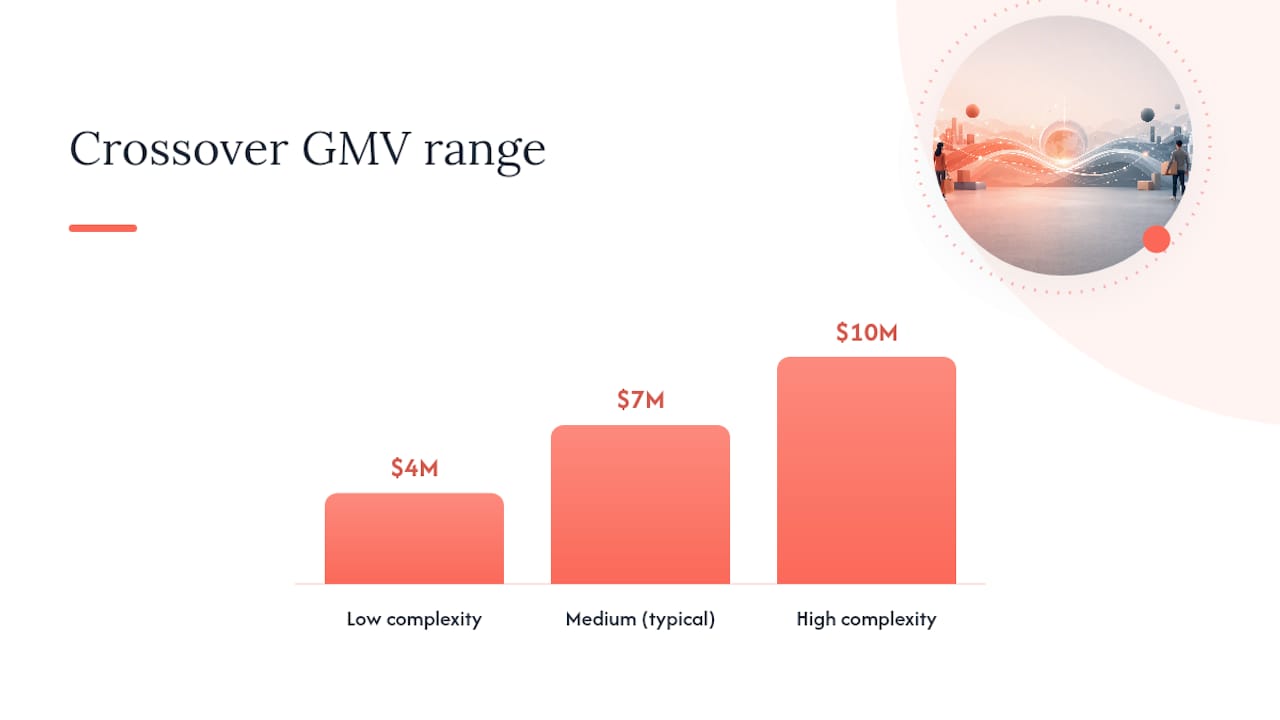
If you’re running under roughly $4–10 million in international GMV, start with Shopify Markets. It’s native, cheap to switch on, and gets you selling in new currencies within days rather than months. Once you clear that band, or you’re pushing hard into markets like Brazil, South Korea or Japan where local payment habits and returns expectations are unforgiving, Global‑e usually pays for its higher price tag.
Plenty of established brands don’t pick one and stop there. They run a hybrid setup: Shopify Markets for the easy, culturally similar geos, and Global‑e for the handful of markets where local logistics or payment quirks would otherwise tank conversion.
- Under $4M international GMV: Shopify Markets, full stop.
- $4–10M and testing complex markets: Consider Shopify Markets Pro or a Global‑e pilot.
- Above $10M with APAC/LATAM concentration: Global‑e’s merchant-of-record depth tends to win.
- Multi-platform merchants often choose Global‑e due to its platform independence.
Key Takeaways
Shopify Markets suits most brands under $4–10 million in international GMV, while Global‑e’s merchant-of-record depth pays off above that band or in high-friction markets.
| Point | Details |
|---|---|
| Match platform to GMV band | Use Shopify Markets under $4–10M international GMV, then evaluate Global‑e above it. |
| Model the real fee structure | Compare Shopify’s blended transaction fee against Global‑e’s retainer plus 3–6% GMV percentage. |
| Check MoR coverage market-by-market | Confirm which markets Global‑e or Markets Pro actually cover as merchant of record before assuming tax liability is removed. |
| Budget for hidden operational load | Returns orchestration, customer service routing, and reconciliation drive more effort than the platform fee itself. |
| Get expert help sequencing the rollout | Moormarketing pairs platform selection with CRO and ad scaling to make each new market profitable faster. |
Table of Contents
- Shopify markets vs Global‑e at a glance
- What do Shopify markets and Global‑e actually cost?
- Which markets and payment methods does each platform cover?
- Who carries the tax and compliance risk?
- How long does setup actually take?
- Who handles returns once a customer wants their money back?
- What visibility do you get into market-level profitability?
- How do you decide which platform fits your brand?
- Why the “just pick one” advice misses the point
- Ready to expand without the platform guesswork?
- Sources
Shopify markets vs Global‑e at a glance
The two platforms solve the same problem — selling profitably outside your home market — from opposite directions. Shopify Markets extends what you already have inside Shopify admin. Global‑e sits on top as a merchant-of-record layer with its own infrastructure, payments, and returns network built over more than a decade of localisation work.
| Dimension | Shopify Markets (incl. Pro) | Global‑e |
|---|---|---|
| Market coverage | Strong in EU, UK, Australia, Canada | 200+ destinations, deeper APAC/LATAM reach |
| Pricing model | Blended transaction fee via Shopify Payments | Retainer plus a GMV percentage, often negotiated |
| Merchant of record | Available in supported markets via Markets Pro | Core offering across its full footprint |
| Local payment methods | Growing, tied to Shopify Payments | 150+ local payment methods |
| Implementation complexity | Low, native admin setup | Higher, enterprise integration work |
| Returns handling | Third-party apps and carrier partners | In-market return addresses and portals |
| Analytics | Built into Shopify admin | Dedicated per-country dashboards |
Best for Shopify Markets: brands that want to test new geos fast without leaving Shopify admin.
Best for Global‑e: brands managing serious volume in markets where local nuance decides whether a customer completes checkout.
Most operator commentary places the crossover point around $4–10 million in international GMV, though the right number for your brand depends heavily on which countries you’re targeting and how complex your returns and tax obligations already are.
What do Shopify markets and Global‑e actually cost?
Fee structures are where the two platforms diverge hardest, and where merchants get caught out.
- Shopify Markets runs on a blended transaction-style fee through Shopify Payments. There’s no separate retainer. Costs come from FX conversion, payment processing, and (with Markets Pro) duty and tax calculation bundled into the transaction.
- Global‑e typically charges a SaaS retainer plus a percentage of GMV, commonly reported in the 3–6% range depending on volume, with negotiated tiers kicking in as you scale.
Here’s the maths that actually matters. At $2 million in international GMV, a Global‑e retainer plus percentage fee often outweighs its localisation benefits. At $10 million, the same fee structure can look cheap next to the manual labour of running compliance, returns, and local payment integrations yourself through Markets alone.
Hidden costs sit outside the headline rate on both platforms: returns processing, customs disputes, multilingual customer service, and the reporting work needed to reconcile country-level P&L. Ask any vendor to walk you through these line items before you sign anything, not after.
Which markets and payment methods does each platform cover?
Coverage decides whether a customer even reaches the “buy” button in their preferred currency and payment method.
- Shopify Markets covers Europe, the UK, Australia and Canada solidly, backed by Shopify Payments.
- Global‑e claims 200+ destinations, 100+ currencies and 150+ local payment methods, with particular strength in APAC and LATAM markets that Shopify’s native tools don’t fully localise.
- Missing a market’s preferred payment method (Alipay in China, Boleto in Brazil, PayNow in Singapore) directly costs you cart completions, regardless of how good your ad targeting is.
- Native checkout localisation through Shopify Markets tends to feel more integrated; third-party translation apps can create jarring UX gaps at the exact moment a shopper is deciding whether to trust your store.
For a phased rollout, prioritise the two or three markets with the strongest existing demand signal (ad spend efficiency, organic traffic, wishlist adds) before spreading thin across a dozen new currencies. If Southeast Asia or greater Asia is part of that shortlist, market-entry resources like Vivos’s guide to expanding into Asia are worth a read before you commit ad budget to an unfamiliar region.
Who carries the tax and compliance risk?
Merchant-of-record status determines who’s on the hook when a customs authority or tax office comes knocking. A true MoR takes over import VAT/GST calculation, remittance, and often the legal responsibility for getting those numbers right, removing that liability from your balance sheet entirely.
- Global‑e operates as merchant of record across its full footprint, handling VAT/GST calculation and remittance directly.
- Shopify Markets Pro uses Global‑e’s underlying capabilities in some supported markets, but the ownership split isn’t identical to running Global‑e standalone. Global‑e’s own documentation notes that when it manages a market, certain settings, currency, duties, and catalogue, are controlled by Global‑e and shouldn’t be overridden by the merchant.
- If neither platform covers a given market as MoR, you may still need to register for VAT/GST there yourself. Don’t assume coverage extends everywhere you sell.
Pro Tip: Get a tax advisor to map your exact MoR coverage market-by-market before you sign a contract. “Merchant of record” sounds absolute, but coverage boundaries between Shopify Markets Pro and Global‑e standalone can be contract-specific rather than universal.
How long does setup actually take?
Timeline expectations separate a smooth launch from a stalled one.
- Shopify Markets: native activation inside admin. Turn on landed-cost display, set currency rules, and you’re often live within days.
- Global‑e: enterprise integration involving API work and ERP/OMS mapping, typically 8 to 16 weeks depending on system complexity.
- Platform compatibility: Shopify Markets only works if you’re fully on Shopify. Global‑e supports multi-platform merchants, which matters if you run a secondary storefront elsewhere.
- Pre-launch checklist: test a single market end-to-end, run a returns dry run, brief customer service on new scripts, and confirm reconciliation reports match before scaling to a second geo.
The real friction rarely shows up in developer hours. It shows up in reconciliation flows, returns orchestration, and customer service routing once orders actually start arriving from unfamiliar countries.
Who handles returns once a customer wants their money back?
Returns are where landed-cost modelling either holds up or falls apart.
- Global‑e runs native returns portals with in-country return addresses in many of its markets, cutting the shipping cost and time a customer waits for a refund.
- Shopify Markets leans on third-party integrations, tools like Loop paired with carrier partnerships, to approximate the same experience.
- A high return rate in a market with no local return address quietly erodes margin faster than most merchants budget for.
- Before scaling any new market, run a small batch of test returns and time the full cycle, refund included, so your unit economics reflect reality rather than a spreadsheet assumption.
What visibility do you get into market-level profitability?
Global‑e provides dedicated dashboards breaking down profitability by country, useful when finance wants to know whether Germany is actually making money or just generating top-line revenue. Shopify’s native analytics have improved but still leave gaps in true per-market unit economics, particularly once landed cost and return rate are factored in.
Track the same core metrics regardless of platform: AOV by market, landed cost, return rate, conversion rate, and CAC by country. Vendor-reported conversion uplifts from localised checkout are worth noting but treat them as directional, not gospel, since they come from case studies rather than independent audits. Keep tagging conventions consistent across both platforms so a finance team can build one clean report instead of reconciling two incompatible data sets every month.

How do you decide which platform fits your brand?
Map three things before you touch a vendor call: your international GMV band, your target markets’ complexity, and how much operational bandwidth your team actually has for reconciliation and customer service.
- Under $4M, single-platform Shopify brand: Shopify Markets. Low cost, fast activation, no reason to overcomplicate it.
- $4–10M, testing one or two high-friction markets: Pilot Global‑e in those specific geos while keeping Markets everywhere else. That’s the hybrid pattern most enterprise merchants land on.
- Above $10M with multi-platform presence or deep APAC/LATAM ambitions: Global‑e standalone, given its broader payment rail coverage and MoR maturity.
Before signing with either vendor, ask direct questions: What’s the actual take rate at our volume? What’s the returns SLA in our target markets? Who carries fraud liability? Can we export our own data, or are we locked into their reporting layer? What’s the realistic go-live timeline given our current tech stack?
Watch for red flags during evaluation:
- Contract lock-in clauses that penalise you for testing a competitor.
- Reporting that can’t be exported or reconciled against your own P&L.
- Missing local payment rails for the specific countries you’re prioritising, regardless of how impressive the overall coverage number sounds.
Pilot with one or two markets first, set a clear success threshold (say, a target conversion rate or return-adjusted margin), and only scale once that threshold holds for a full sales cycle. For a broader view of how phased international rollouts fit into a wider growth plan, our go-to-market strategy examples for 2026 walk through market prioritisation in more depth.
Why the “just pick one” advice misses the point
Most comparison content treats this as a binary choice, Markets or Global‑e, when the sharper question is where your GMV is concentrated and which specific markets create friction. A brand doing $8 million with 90% of international revenue coming from the UK and Canada has a completely different risk profile than a brand doing the same revenue split evenly across Germany, Brazil, and South Korea. The first brand barely needs Global‑e. The second probably can’t avoid it.
What gets underestimated constantly is the operational tax of running Markets alone once you’re past a handful of countries. It’s not the platform fee that bites, it’s the customer service team fielding return questions in a language nobody on staff speaks, or finance trying to reconcile five different currency remittance reports by hand. Global‑e’s decade of localisation investment exists precisely to absorb that operational load, and that’s the real product you’re paying the retainer for, not just the payment methods.
At Moormarketing, we work through exactly this kind of platform and market-prioritisation decision as part of broader ecommerce growth strategy engagements, pairing the technical setup with the conversion rate optimisation and ad scaling that actually determine whether a new market earns back its investment.
A brand that gets its market sequencing right typically sees international revenue compound faster than domestic, simply because there’s less competitive noise. The next logical step is usually a structured audit of your current international setup before committing budget to a full Global‑e migration or a Markets Pro upgrade.
— Liza
Ready to expand without the platform guesswork?
Choosing between Shopify Markets and Global‑e is only half the equation. The other half is making sure your ads, funnel, and conversion setup are actually built to capture the demand once you flip a new market on. Moormarketing works hands-on with growth-focused Shopify brands to map international GMV against the right platform, then build the ad scaling and CRO work that turns a new market from a cost centre into a revenue line.

Rather than handing your international rollout to an agency that outsources the strategy work, you get senior strategists running the audit, the market prioritisation, and the paid media scaling side by side. If you’re weighing up a Shopify Markets Pro upgrade against a Global‑e pilot, book a session through Moormarketing’s team and get a straight read on which platform actually fits your revenue band before you sign anything.
Sources
- Global‑e and Shopify Markets — Global‑e documentation
- Overview of Managed Markets — Shopify Help
- Global-e
- Shopify Markets vs. Global‑e: Which Cross-Border Engine Wins in 2026? — D2C Times