
An email welcome flow is the automated sequence of messages a subscriber receives after they opt in, buy, or create an account, and the single most important thing you do in it is deliver whatever you promised in the first email, immediately. Not “within 24 hours.” Now. Every hour that lead magnet sits unsent, open rates drop and trust erodes.
If you’re setting one up this week, here’s what to do in the next hour:
- Confirm your first email fires the promised incentive (discount code, PDF, free shipping threshold) automatically on trigger, with no manual step in between.
- Add a line in that first email that tells subscribers exactly what to expect next, how often you’ll email, and what kind of content is coming.
- Tag every new entrant with an “onboarding” flag in your email platform so you can track them separately from your general list and measure conversion by cohort.
Get these right and the payoff shows up fast. Welcome flows consistently produce three things a general newsletter can’t:
- Higher open rates than any other email type you send, because the subscriber is still warm from the action that triggered the flow.
- Faster time-to-first-purchase, since the offer lands while intent is highest.
- Better data capture, because new subscribers are more willing to answer a preference question in week one than in month six.
Key Takeaways
An effective email welcome flow delivers the promised offer immediately, sets clear expectations, gathers subscriber data progressively, and gets measured on revenue per recipient rather than open rate alone.
| Point | Details |
|---|---|
| Deliver the promise instantly | The first email must fire the offer or lead magnet automatically, with zero manual delay. |
| Set expectations early | Tell new subscribers how often you’ll email and what kind of content to expect. |
| Track revenue per recipient | Measure the whole flow’s profitability, not just individual email open rates. |
| Test one variable at a time | Run subject line, CTA, and timing tests against a proper sample before drawing conclusions. |
| Gather data progressively | Ask one preference question per email rather than a long form upfront. |
| Get a professional audit | Moor Marketing reviews and rebuilds underperforming welcome flows tied to broader growth strategy. |
Your 1-hour, 1-day, 1-week plan: in the next hour, confirm your first email fires instantly and check every link works. Within a day, set up your open, click, and conversion tracking per email in the sequence. Within a week, launch your first A/B test on subject lines and review your first 72 hours of complaint and unsubscribe data.
Table of Contents
- What is an email welcome flow?
- Why build a welcome flow? Business outcomes and benchmarks
- Six core components of a high-performing welcome flow
- What types of welcome emails should you send?
- Three ready-to-deploy welcome flow templates
- How do you personalise a welcome flow without adding friction?
- What deliverability and compliance basics does a welcome flow need?
- How do you measure and test a welcome flow?
- Swipeable welcome email examples and templates
- How to write the first welcome email
- Launch checklist before you activate your welcome flow
- What has actually worked in client welcome flows
- A practitioner’s take on welcome flow priorities
- How Moor Marketing can help you build a welcome flow that converts
- Sources
What is an email welcome flow?
A welcome flow is a multi-email automated sequence, not a single message. That distinction trips up more marketers than any other part of onboarding strategy.
A welcome email is one message: the confirmation, the discount code, the “thanks for joining.” A welcome flow is the series built around it, typically three to seven emails spaced over one to two weeks, each with its own job. The first delivers the promise. The second builds trust or tells a brand story. The third pushes toward a first purchase. Later emails might gather preferences or introduce a loyalty program.
Common triggers that start a welcome flow include:
- A newsletter signup through a popup or footer form.
- A first purchase, which starts a post-purchase welcome/onboarding flow distinct from the pre-purchase one.
- A lead magnet download (a guide, discount, or quiz result).
- Account creation without an immediate purchase.
Inside automation platforms like Klaviyo or Braze, a flow behaves differently to a single automated email. It has entry criteria (usually “subscribed to list X” or “placed order”), and most platforms enforce single-entry rules so a subscriber doesn’t re-enter and get the same five emails twice. Flows can also branch: if someone clicks the discount link in email two, they can be routed into a different email three than someone who didn’t engage. Klaviyo’s welcome series guidance frames this correctly: the series exists to introduce the brand, set expectations, and collect zero and first-party data, not just to say thanks. One thing that catches teams out: email and SMS welcome flows need to be built and managed separately, because opt-in timing differs between the two channels and most platforms won’t let a contact re-enter a single-entry flow through a different channel. Klaviyo’s own documentation is explicit about this.
Why build a welcome flow? Business outcomes and benchmarks
The business case for a welcome flow isn’t abstract brand-building. It shows up in three measurable places: time-to-first-purchase, list quality, and lifetime value. New subscribers who receive a structured welcome sequence tend to convert to a first order faster than those left on a generic newsletter cadence, because the flow front-loads the offer and the reason to act while intent is still high.
Welcome emails typically post open and click-through rates well above your average promotional send — Drip’s analysis of ecommerce welcome sequences puts click-through rates at roughly double what standard campaigns achieve, purely because the audience is self-selected and freshly engaged.
That gap compounds. Omnisend’s ecommerce automation reporting links welcome messages, alongside abandoned cart flows, to a large share of all automation-driven orders, which tells you where to put design and copy effort if you’re resourcing a small team.
Translating engagement metrics into business outcomes means tracking a few specific things:
- Time-to-first-order: the median number of days between flow entry and first purchase, segmented by entry trigger.
- Conversion per recipient: total revenue generated by the flow divided by total entrants, not just by opens.
- List quality signals: unsubscribe rate and spam complaint rate within the first three emails, which tell you if expectations were set clearly.
- Inbox placement: whether welcome emails are landing in the primary inbox versus promotions or spam, which affects every future send to that subscriber.
Get the first email right and you’re not just selling once. You’re setting the sender reputation and engagement pattern that determines whether every future campaign to that subscriber lands in the inbox at all.
Six core components of a high-performing welcome flow
Every welcome email that actually performs shares the same six structural elements, regardless of industry or platform.
- Subject line and preview text that promise something specific. “Here’s your 15% code” beats “Welcome to the family” because it tells the subscriber exactly why to open, and preview text should extend the promise rather than repeat the subject line.
- An opening paragraph that delivers value in the first two sentences. Don’t bury the discount code or the download link under three paragraphs of brand story. Lead with it.
- One message, one CTA per email. A welcome email trying to sell, ask for a review, and promote a loyalty program all at once dilutes all three. Drip’s guidance on welcome sequences is blunt about this: pick one job per email and let the sequence carry the rest.
- Design that loads fast and reads cleanly on mobile. Most welcome emails get opened on a phone within minutes of triggering, so oversized hero images and slow-loading templates cost you the click before the subscriber even sees the offer.
- A data capture opportunity somewhere in the series, not necessarily the first email. Asking a new subscriber for their birthday or product preference in email three, after you’ve already delivered value, gets far better completion rates than asking cold in email one.
- A basic testing scaffold from day one. Even a simple version A/version B split on subject line, run across your first 200 to 500 entrants, gives you a baseline before you start optimising blind.
Pro Tip: Write your first welcome email’s subject line as if it’s the only line the subscriber will ever read. If the discount code or the download link isn’t obvious from the subject and preview text combined, rewrite it.
What types of welcome emails should you send?
Not every welcome email does the same job, and mapping the right type to the right moment in your sequence matters more than most marketers assume. Klaviyo’s breakdown of welcome series structure identifies four recurring types worth building around.
An educational welcome email explains how the product works, what makes the brand different, or how to get the most from a subscription. It suits categories where the buying decision needs context, think supplement regimens, software onboarding, or anything with a learning curve.
An offer-led welcome email leads with a discount, free shipping threshold, or bundle deal. It’s the standard for low-consideration ecommerce, where price sensitivity drives the first purchase decision more than brand affinity does.
A product-focused welcome email showcases bestsellers, new arrivals, or a curated starter collection. It works well when a brand has a wide catalogue and the new subscriber hasn’t yet seen enough of the range to know what they want.
A preference-gathering or content welcome email asks the subscriber what they’re interested in, rather than pushing a sale. This suits publishers, subscription boxes, and B2B audiences where segmentation matters more than an immediate transaction.
| Email type | Primary objective | Best-fit audience |
|---|---|---|
| Educational | Build understanding and reduce buying friction | High-consideration products, supplements, software |
| Offer-led | Convert on price or urgency | Low-priced ecommerce, impulse categories |
| Product-focused | Showcase range and drive discovery | Wide-catalogue retailers, fashion, home goods |
| Preference-gathering | Segment and personalise future sends | Subscription services, B2B lists, publishers |
A low-priced ecommerce brand selling phone accessories should lean offer-led from email one. A B2B software company onboarding a trial signup should lean educational first, then preference-gathering, saving any “upgrade now” offer for later in the sequence once trust is established.
Three ready-to-deploy welcome flow templates
You don’t need to reinvent sequencing from scratch. Three structures cover most use cases, and each has a distinct primary KPI attached to every email.
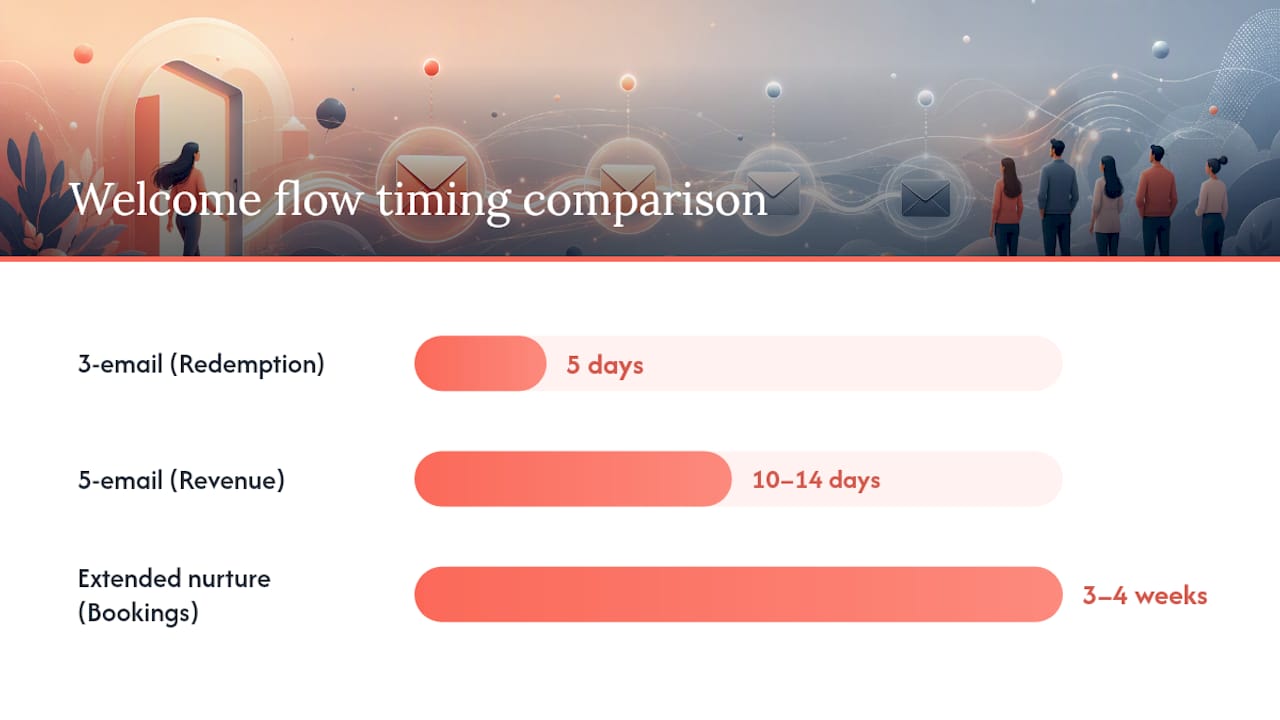
The 3-email flow (low-consideration ecommerce). Email one fires immediately with the discount code and a single “shop now” CTA. Email two, sent 48 hours later, showcases three bestsellers with individual “add to cart” links. Email three, sent on day five, adds urgency (code expiry) with a final CTA. This structure suits fast-moving product categories where the buying decision doesn’t need much education.
The 5-email revenue-first flow. This is the sequence most practitioner playbooks converge on, typically run over 10 to 14 days:
- Delivery email (immediate): the promised offer or lead magnet, one CTA, KPI is open rate and redemption rate.
- Story email (day 2): brand origin or founder note, builds trust, KPI is click-through to the “about” page or product page.
- Value email (day 4): educational content or a how-to guide relevant to the product, KPI is engagement time and click rate.
- Proof email (day 7): reviews, testimonials, or user-generated content, KPI is click-through to product pages.
- Soft offer email (day 10): a second, smaller incentive or a reminder of the original code before it expires, KPI is conversion rate and revenue per recipient.
The extended nurture flow (high-ticket or B2B). This runs seven or more emails across three to four weeks and skips the hard sell almost entirely until the final message. It suits audiences making a considered purchase, a $2,000 mattress, a annual software contract, where trust-building outweighs urgency. Only subscribers who haven’t converted after the standard flow, or who entered through a high-intent trigger like a demo request, should receive it.
| Flow type | Length | Timing span | Primary KPI focus |
|---|---|---|---|
| 3-email fast flow | 3 emails | 5 days | Redemption rate, first purchase speed |
| 5-email revenue flow | 5 emails | 10–14 days | Revenue per recipient, conversion rate |
| Extended nurture flow | 7+ emails | 3–4 weeks | Engagement depth, demo/consult bookings |
How do you personalise a welcome flow without adding friction?
Progressive profiling means asking for one piece of information at a time, spread across the sequence, rather than front-loading a long form in email one. Klaviyo’s guidance on welcome series data capture treats this as core to why a flow beats a single email: you get multiple touchpoints to build a profile, not just one.
Good questions to ask, one per email, include: which product category they’re most interested in, how often they’d like to hear from you, and what problem they’re trying to solve. A skincare brand might ask about skin type in email two and use the answer to swap product recommendations in email three. A B2B SaaS company might ask about team size in email two and route the subscriber into a different onboarding track based on the answer.
Two examples worth copying directly:
- A single-question poll embedded in email two: “What brought you here today? A) Browsing B) Specific product C) Gift for someone” with three clickable answers, each tagging the subscriber differently in your platform.
- A soft preference check in email three: “How often do you want to hear from us? Weekly deals / Monthly roundup” with two buttons that update a frequency preference field automatically.
Use these answers the moment they arrive. If a subscriber says “gift for someone,” email four should showcase gift bundles, not your standard bestseller list. If someone flags low email frequency, respect it, sending too much to someone who asked for less is one of the fastest ways to earn an unsubscribe or spam complaint.
Pro Tip: Never ask more than one question per email in a welcome flow. A five-field form in email one will get ignored; a single tap-to-answer poll in email two gets completed by a meaningful share of openers.

Segmentation rules should branch based on both stated preference and behaviour. Someone who clicks the product link but doesn’t buy should get a different email four to someone who bought immediately, even if their stated preferences are identical.
What deliverability and compliance basics does a welcome flow need?
Get the technical foundations wrong and no amount of good copy will save your open rates. Before you activate any welcome flow, work through these steps in order:
- Set up SPF, DKIM, and DMARC records on your sending domain. These authentication protocols tell inbox providers your emails are legitimately from you, not spoofed, and missing any one of them is one of the fastest ways to land in spam during a new flow’s first weeks.
- Use a dedicated or well-warmed sending domain or subdomain for transactional and welcome traffic if volume allows, separating it from cold outbound or bulk promotional sending.
- Encourage a reply or a whitelist action in your first email. Asking a new subscriber to reply “thanks” or drag your email into their primary inbox is one of the strongest early signals to inbox providers that your mail is wanted.
- Include a visible, working unsubscribe link in every email, not buried in six-point grey text. This is a legal requirement in most markets and a basic trust signal in all of them.
- Record and timestamp consent at the point of entry. Log exactly when and how a subscriber opted in, whether through a signup form, checkout checkbox, or lead magnet download, so you have a record if a compliance question ever arises.
On the legal side, spam and privacy laws vary by jurisdiction. Businesses sending to Australian subscribers need to comply with the Spam Act’s consent, identification, and unsubscribe requirements, and anyone sending into other markets needs to check the equivalent local rules (CAN-SPAM in the US, GDPR-linked ePrivacy rules across the EU). This isn’t a substitute for legal advice specific to your business and your subscriber list. If you’re unsure where your list sits, get a professional to check it before you scale sending volume.
Pro Tip: Warm up any new sending domain gradually, small volumes in week one, scaling over three to four weeks, rather than blasting your full welcome flow volume from day one. Inbox providers watch new domains closely, and a sudden spike in volume from an unproven domain is a common trigger for spam folder placement.
How do you measure and test a welcome flow?
Five metrics matter more than any others in a welcome flow, and they need to be tracked per email, not just as a sequence average.
- Open rate per individual email, to catch subject-line fatigue as the sequence progresses.
- Click-through rate, which tells you whether the CTA and copy are doing their job once the email is opened.
- Conversion rate (CVR), the share of recipients who complete the flow’s intended action, purchase, demo booking, or profile completion.
- Revenue per recipient, calculated across the whole flow, not per email, since some emails exist purely to build trust for a later conversion.
- Unsubscribe and spam complaint rate, tracked especially closely in the first three emails, where expectation-setting failures show up fastest.
| Metric | What it tells you | Healthy signal |
|---|---|---|
| Open rate | Subject line and sender reputation strength | Should exceed your general campaign average |
| Click-through rate | Copy and CTA effectiveness | Roughly double standard promotional CTR, per Drip’s benchmarking |
| Conversion rate | Whether the offer and timing match intent | Improves email-over-email as trust builds |
| Revenue per recipient | Overall flow profitability | Tracked across full sequence, not per email |
| Unsubscribe rate | Expectation-setting and relevance | Should stay flat or decline after email one |
Worth testing, in rough order of impact: subject line wording, preheader text, CTA button copy (“Shop now” versus “Claim my code”), the timing delay between emails, and whether an offer appears in email one or is held back to email three. Run each test against a large enough sample, generally at least a few hundred entrants per variant, and let it run for a full send cycle before calling a winner. Holding out a small control group that receives your existing flow while you test a new variant against the rest of new entrants keeps your comparison honest and stops one email’s performance quirk from skewing your whole read on the sequence. Understanding how these numbers roll up against broader ecommerce performance metrics helps put welcome flow revenue in context against your other acquisition channels.
A simple testing checklist for each round: define the single variable you’re changing, confirm sample size before launch, set a fixed test duration in advance, and record the result before moving to the next test rather than running three changes simultaneously.
Swipeable welcome email examples and templates
Seeing what works beats reading about what should work, which is why Really Good Emails’ welcome category has become a default reference for marketers building a new sequence from scratch. Its gallery spans hundreds of real, sent welcome emails across ecommerce, SaaS, and media brands, useful for design inspiration even when you’re writing your own copy from a blank page.
Subject line swipes worth adapting to your own brand voice:
- “Here’s your 15% off, [First Name]” (delivers the incentive immediately, uses first-name personalisation)
- “You’re in. Here’s what happens next.” (sets expectations, works for non-discount signups)
- “Your download is ready” (for lead magnet flows)
- “Welcome aboard, quick question for you” (leads into a preference-gathering email)
Full-body template for a deliverable-first email: open with the code or download link above the fold, follow with one short sentence on what makes the brand different, close with a single button CTA and a line setting expectations (“Look out for an email from us every few days over the next two weeks”). This structure front-loads the value and gets read even by subscribers who only skim.
Full-body template for a story email: open with a founder-voice sentence about why the brand exists, follow with a short paragraph connecting that story to the product, close with a CTA to browse a specific collection rather than the whole store. Annotation: this email works because it builds affinity before asking for anything, which sets up a higher-converting soft offer later in the sequence.
Full-body template for a soft offer email: open by referencing the original code’s imminent expiry, follow with two or three product recommendations based on any preference data captured earlier in the flow, close with an urgency-driven CTA. Annotation: this email converts best when it feels personalised rather than generic, which is exactly why the earlier data capture step matters.
Copy the structure and CTA placement directly. Adapt the tone, product references, and specific offer to match your own brand voice and catalogue.
How to write the first welcome email
The first email in your flow does more work than any other single message you’ll send this year, so it deserves the most scrutiny.
Subject line formulae that consistently outperform generic greetings:
- “Here’s your [specific offer], [First Name]”
- “Your [X]% code is inside”
- “You’re in. Grab your discount.”
- “Welcome, your guide is ready to download”
- “One thing before you shop”
- “Thanks for joining, here’s a gift”
- “Your account is set up, here’s what’s next”
- “[Brand name]: your welcome offer expires soon”
- “Quick favour before we get started”
- “You just unlocked [specific benefit]”
Opening paragraph swipes that confirm the promise and set expectations in the first two sentences:
- “Thanks for signing up! Your 15% code is below, use it any time in the next 14 days.”
- “Welcome to [brand]. Over the next two weeks you’ll hear from us three or four times, mostly with tips on getting the most from your first order.”
- “Your guide is attached below. Before you dive in, hit reply and let us know what you’re hoping to solve, we read every response.”
CTA copy swipes and placement guidance: put the primary button above the fold, and make the copy specific rather than generic. For a lead magnet redemption, “Download my guide” beats “Click here.” For account creation flows, “Complete my profile” works better than “Get started” because it tells the subscriber exactly what action follows the click.
Launch checklist before you activate your welcome flow
Run through this list before flipping any welcome flow live, most deliverability and copy disasters trace back to a step skipped here.
Technical checks:
- Click every link in every email, including footer links and social icons, to confirm none are broken or pointing to a staging URL.
- Confirm all images load correctly across desktop and mobile clients, and that alt text is set in case images are blocked.
- Check UTM tracking parameters are attached to every link so revenue attribution works in your analytics platform.
- Confirm the unsubscribe link is present, visible, and functional in every single email in the sequence.
- Verify SPF, DKIM, and DMARC are correctly configured and passing before any meaningful volume goes out.
Content checks:
- Read every email against your brand voice guide, a welcome flow that sounds like a different company to your regular campaigns confuses new subscribers.
- Confirm the offer terms match exactly across every email that references them (same code, same expiry date, same discount amount).
- Check every email has exactly one primary CTA, not two competing buttons.
- Proofread any discount code or embedded snippet manually, a typo in a code renders the entire email useless.
Operational checks:
- Confirm the tagging rule that flags new entrants is firing correctly in a test send before launch.
- Set list entry and suppression rules so existing customers don’t get routed into a “new subscriber” flow meant for first-timers.
- Monitor open rate, click rate, and complaint rate closely for the first 72 hours after launch, and be ready to pause the flow if complaint rates spike unexpectedly.
What has actually worked in client welcome flows
Across client work, the single biggest lever isn’t clever copy, it’s speed and specificity in the first email. Brands that deliver the promised offer within seconds of signup consistently see stronger early engagement than those that make subscribers wait even a few hours, because intent decays fast after the signup action.
The most common trap Moor Marketing sees in client welcome flows isn’t bad design or weak copy, it’s a first email that makes the subscriber hunt for the thing they signed up for. Bury the discount code under three paragraphs of brand story and you’ve already lost a chunk of your audience before they get to the CTA.
One recurring pattern across ecommerce clients: a 5-email revenue-first flow, structured around delivery, story, value, proof, and soft offer, consistently outperforms a bare 2-email “thanks plus discount” approach on revenue per recipient, largely because the story and proof emails build enough trust that the soft offer converts at a noticeably higher rate than a cold discount ever does alone. This structure tends to work best for mid-priced ecommerce, roughly $40 to $200 average order value, where trust matters but the purchase decision isn’t so considered that a long nurture flow is needed.
A second pattern worth flagging: teams often set up a welcome flow once and never touch it again for a year. The flows that keep performing are the ones revisited quarterly, subject lines refreshed, offers rechecked against current margin, and segmentation rules adjusted as the list grows. A welcome flow built for a 500-subscriber list often needs restructuring by the time that list hits 20,000, because the audience mix shifts and a one-size offer stops working as well.
Pro Tip: If you only have the resourcing to build one automated flow this quarter, build the welcome flow before the abandoned cart flow. It touches every single subscriber that enters your list, whereas cart abandonment only ever reaches the fraction who add to cart in the first place.
Moor Marketing’s approach to measurement centres on tracking flows against revenue per recipient rather than open rate alone, since open rate tells you the subject line worked but says nothing about whether the sequence actually made money.
A practitioner’s take on welcome flow priorities
If there’s one thing worth fixing before anything else when a team launches a new welcome flow, it’s this: decide what the flow is actually optimising for before you write a single subject line. Too many welcome sequences try to do three jobs at once, sell a discount, build a brand story, and gather segmentation data, and end up doing none of them particularly well because nobody decided which mattered most for this specific audience.
The teams that get this right treat the welcome flow as an extension of acquisition strategy, not a separate “onboarding nicety” bolted on after the fact. If your paid campaigns are driving cold traffic through a discount-led landing page, your welcome flow should reinforce that same offer, not pivot into a brand story the subscriber never asked for. If your acquisition channel is content-driven and trust-based, a heavy discount push in email one can actually undercut the positioning that got them to sign up in the first place. The welcome flow should feel like the next sentence in the same conversation your ad or landing page started, not a hard turn into a different pitch.
How Moor Marketing can help you build a welcome flow that converts
Moor Marketing is the alternative to guessing your way through welcome flow setup: rather than piecing together generic templates and hoping the sequencing works, you get a strategist who’s built and measured these flows across ecommerce brands scaling from six to seven figures, and who ties the welcome flow directly to your paid acquisition and CRO work rather than treating it as an isolated email project.
Moor Marketing’s services relevant to this exact problem include email automation builds on platforms like Klaviyo, conversion rate optimisation on Shopify and WordPress storefronts, and hands-on mentoring for teams who want to build the skill in-house rather than outsource it indefinitely. If your welcome flow is underperforming or you’ve never had one properly measured against revenue per recipient, an audit is the lowest-friction next step, and if you’re ready to rebuild acquisition and onboarding together, the ecommerce growth strategy engagement covers welcome flows as part of a wider revenue plan. Teams that prefer a hands-on format can also book into the ecommerce marketing workshops to build the flow live with a strategist in the room. Whichever route fits, get in touch with the team to scope what your welcome flow needs next.
Sources
For visual and copy inspiration across hundreds of real welcome emails, Really Good Emails’ welcome category is the best starting gallery. For platform-specific setup guidance and a breakdown of welcome email types, Klaviyo’s welcome series guide covers the mechanics well. For benchmark data on open and click-through rates against standard campaigns, Drip’s advanced welcome email analysis is worth reading in full. For a ready-made 5-email cadence with timing and copy prompts, the 5-email welcome playbook is a solid template to adapt. And for anyone building AI-assisted personalisation into their sequence, the AI-powered email marketing guide covers subject-line and segmentation tools worth testing.
- Welcome Email Examples & Best Practices to Boost Sales
- 7 Advanced Welcome Emails from Top Ecommerce Brands
- 11 Amazing Welcome Email Examples (+ Tips to Write Your Own)
- The Best 1624 Welcome Email Examples & Designs
- Email and SMS welcome flows must be managed separately