
Spark Ads let you pay to amplify a real TikTok post, yours or a creator’s, while keeping the original account, comments and social proof intact. They work best once a post has already proven itself organically, because you’re paying to accelerate something that’s already resonating rather than betting on unproven creative. If you’re running paid social on TikTok in 2026 and still leaning entirely on dark posts, you’re leaving engagement and trust on the table.
TL;DR:
- Spark Ads build momentum from an existing, resonant post, so performance and engagement tend to improve over time due to social proof.
- Running Spark Ads requires creator approval, proper rights management, and ongoing moderation, which can slow down scaling if not handled efficiently.
- Combining Spark Ads with dark posts allows brands to test creative ideas privately while building trust and credibility from organic engagement.
- Cost savings come from lower CPMs and CPCs because the post already has earned engagement, but additional expenses include creator fees and rights management.
- Short-term testing of multiple variations and focusing on watch-through and comment volume technical metrics improve campaign effectiveness and reduce wasted spend.
Table of Contents
- What are TikTok Spark Ads and how do they behave on the platform?
- How do you set up a Spark Ad from a creator’s account?
- Spark Ads vs dark posts: which one fits your goal?
- What creative rules actually work for Spark Ads?
- What does it cost, and how do you measure Spark Ads?
- How does Moor Marketing run Spark Ads for growing brands?
- Want an agency to run your Spark Ads pipeline end to end?
- Sources
What are TikTok Spark Ads and how do they behave on the platform?
Unlike a standard in-feed ad built from a fresh ad account, a Spark Ad runs from the original creator’s or brand’s handle. Every like, comment, share and follow generated during the paid boost gets attributed back to the original post, not to some anonymous ad unit. That’s the whole point of the format: it inherits the post’s history instead of starting from zero.
There are a few conditions worth knowing before you plan a campaign around this format:
- The post must be public and have ad authorisation switched on by its owner.
- Any music used needs commercial usage rights, which isn’t automatic for every trending sound.
- Spark Ads support most standard TikTok objectives, including traffic, conversions, app installs and community interaction.
- Comments posted during the ad run stay visible on the organic post after the campaign ends, so moderation matters more than with a dark post you can simply switch off.
Because engagement compounds on the original post, a Spark Ad that performs well keeps building social proof long after the budget stops.
How do you set up a Spark Ad from a creator’s account?
Running a Spark Ad from your own handle is straightforward inside Ads Manager. Boosting a creator’s post takes a bit more coordination because you need their permission first.
- The creator opens their TikTok app, goes to the post they’re authorising, and generates an ad authorisation code, choosing how long it stays valid.
- They send you that code, along with the post link.
- In Ads Manager, you redeem the code under the Creative Library’s Spark Ad section and attach it to your campaign.
- Before launch, agree in writing who owns comment moderation and how usage rights extend beyond the paid window.
- Set a reminder tied to the code’s expiry so the campaign doesn’t stall mid-flight.
The redemption process itself is quick, but the paperwork around rights is where most teams lose time.
Pro Tip: If you’re running Spark Ads across multiple creators at once, build a simple tracker with creator name, post URL, code, expiry date and moderation owner. It sounds basic, but it’s the single biggest time saver once you’re past three or four creators a month.
Spark Ads vs dark posts: which one fits your goal?
Both formats have a place, and the smart move is usually running them together rather than picking one forever.
- Identity and ownership: Spark Ads run under the creator’s or brand’s handle, so engagement builds their profile. Dark posts run from an anonymous ad account, keeping your testing invisible to competitors and followers.
- When Spark wins: proving social credibility, driving conversions off content that’s already resonating, and building a following alongside sales.
- When dark posts win: rapid creative testing, sensitive messaging you don’t want tied to a public account, and situations needing tight comment control.
- The combined approach: test hooks fast as dark posts, then Spark the winners once you’ve found a format that performs.
What creative rules actually work for Spark Ads?
Spark Ads succeed or fail on the strength of the original post, not the ad settings around it. Five hook types show up repeatedly in high-performing creator content:
- Comment reply videos that answer a genuine question from the comment section, which reads as responsive rather than scripted.
- Product demo shot handheld, showing the thing actually working rather than a polished studio shot.
- Founder story that explains why the product exists, which builds trust fast with cold audiences.
- POV format that puts the viewer inside a relatable moment or problem.
- Before and after transformation content, which performs particularly well for beauty, fitness and home categories.
When you’re deciding which organic post deserves paid budget, prioritise strong watch-through rates and comment volume over raw view count. A video with 40,000 views and 300 genuine comments usually outperforms one with 200,000 passive views once you put spend behind it.
Effective creative tends to follow five parts: a hook in the first three seconds, native delivery that doesn’t look like an ad, one clear value point, some form of proof, and a simple call to action. Brief creators on the message and the proof point, but leave the delivery style to them. That’s usually the difference between content that feels native and content that gets scrolled past. Brands that seed multiple creators, test organically, then Spark the winners tend to see the most consistent results because they’re scaling proof, not guessing at it. Running three to five creative variations per ad group also helps you spot fatigue before it tanks performance, a pattern that shows up across most practitioner breakdowns of what works.
What does it cost, and how do you measure Spark Ads?
TikTok charges Spark Ads through the same auction as standard in-feed placements, so you’re not paying a premium for the format itself. What tends to shift is efficiency: because the post already carries earned engagement, CPMs and CPCs often trend lower than an equivalent dark post with no track record.
The costs you do need to budget for sit upstream of the ad spend:
- Creator fees or product exchange for the original content.
- Usage rights covering the authorisation period and any extension beyond it.
- Time for comment moderation while the ad is live.
- Editing time if you’re trimming organic content for different placements.
Track ROAS as your headline number, but pair it with completion rate, hook rate (the percentage still watching past three seconds) and profile visits, since Spark Ads often drive follower growth alongside direct sales. Running short one to two week tests before committing full budget keeps you from scaling a post that was a one-off spike rather than a genuine pattern.
How does Moor Marketing run Spark Ads for growing brands?
Most of the failures we see with Spark Ads have nothing to do with Ads Manager. They come from rights and approvals falling apart after the campaign is already live. Our workflow exists specifically to close that gap.
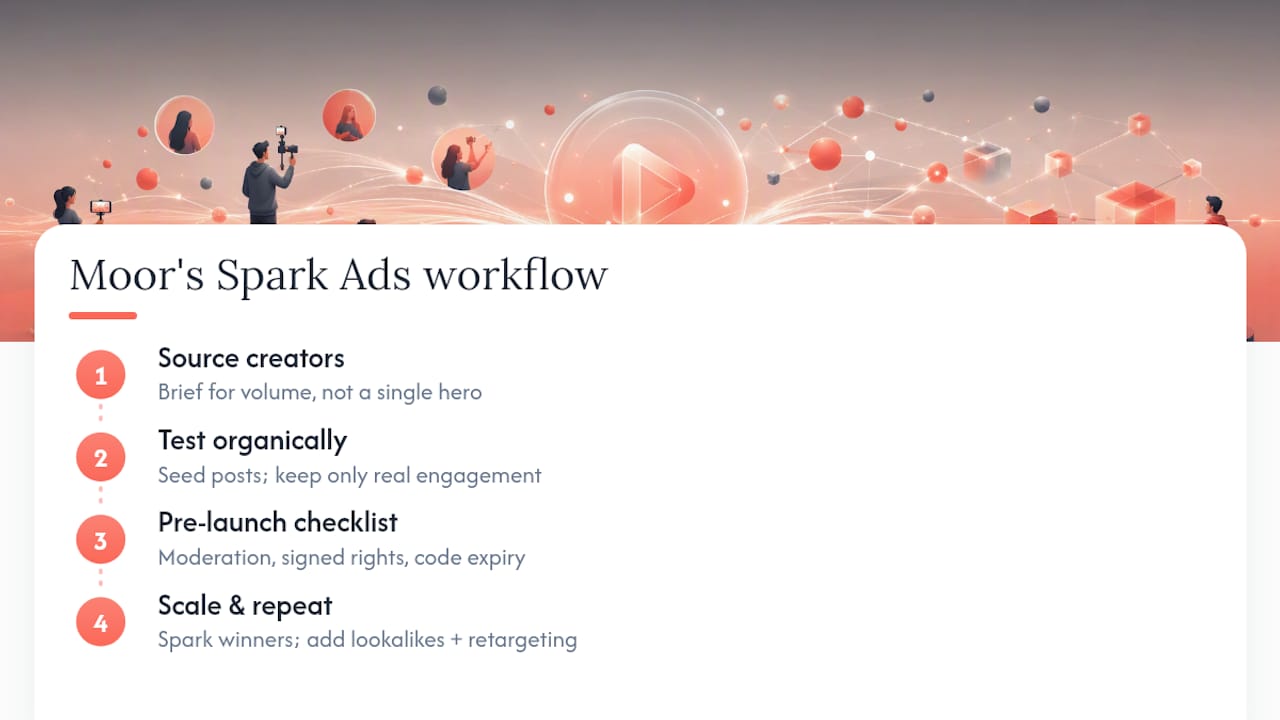
We source creators against a brief built for volume, not a single hero video, then seed and test that content organically before any paid budget touches it. Only posts with real engagement signals get Sparked, and once they prove out, we layer in lookalike audiences and retargeting to extend reach beyond the original following. It’s a deliberately unglamorous process: source, test, scale, repeat.
Before anything goes live, we run through a short checklist covering who owns moderation, who holds the signed usage rights, and who’s tracking code expiry. Skipping that step is how campaigns stall two days after launch over a missing authorisation.
— Liza
Want an agency to run your Spark Ads pipeline end to end?
Building a creator-to-paid pipeline yourself means juggling outreach, rights paperwork, creative testing and Ads Manager setup all at once, on top of running the rest of your marketing. Moor Marketing takes that whole workflow off your plate, from sourcing creators through to scaling the winners with paid budget, without handing your account to a junior team or an outsourced call centre.
Our approach has helped brands hit seven figures a month in sales through paid social and lifecycle work, including a global furniture brand scaling to $3 million monthly. If you want a second set of eyes on your current Spark Ads setup or a full campaign build from scratch, our digital ad campaign best practices page outlines how we structure paid media engagements, and you can book a discovery call to talk through your specific account.
Sources
- About Spark Ads
- TikTok ads: a marketer’s guide (Sprout Social)
- TikTok ads — Shopify blog
- TikTok ad examples that actually work (Influee)