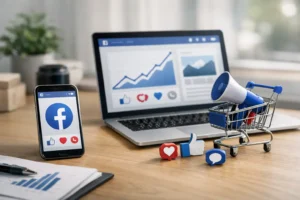
Most brands do not have a traffic problem. They have an attention problem. Your ideal customer is scrolling fast, comparing options faster, and making decisions in seconds. That is exactly where Facebook advertising comes in. If you are asking what is Facebook advertising, the short answer is this: it is Meta’s paid advertising system that lets businesses put targeted ads in front of specific audiences across Facebook, Instagram, Messenger and the wider Meta network.
That answer is technically correct, but it is not enough if you are a founder trying to scale revenue. Facebook advertising is not just about getting impressions. At its best, it is a growth engine that helps you reach the right people, test demand quickly, retarget warm traffic, and turn creative into sales. At its worst, it becomes an expensive vanity exercise run on weak strategy and bad data.
What is Facebook advertising really?
Facebook advertising is a paid media platform where businesses create campaigns to achieve a goal such as sales, leads, traffic, app installs or brand awareness. You set the objective, budget, audience, placements and creative, and Meta delivers your ads to people most likely to take the action you want.
The reason it has remained so powerful is simple. Meta holds a huge amount of behavioural data, and its algorithm is built to optimise for outcomes. That means you are not just buying space like a billboard. You are feeding a system that learns from clicks, views, purchases and on-site behaviour, then adjusts delivery in real time.
For eCommerce brands, this matters because it creates speed. You can test a new offer this week, learn which creative angle pulls best, identify where conversion drops off, and make decisions backed by actual market response. For service businesses, it can generate qualified leads at scale, especially when paired with a strong funnel and follow-up process.
How Facebook advertising works
At the campaign level, you tell Meta what success looks like. That might be purchases, leads, landing page views or video views. Once the campaign is live, Meta enters your ads into an auction every time there is a chance to show an ad to a user.
Winning that auction is not just about who bids the most. Meta also looks at estimated action rates and ad quality. In plain terms, the platform wants to show ads people are likely to engage with. If your ad is relevant and your landing page converts, you can often outperform a competitor with a bigger budget but weaker execution.
The platform also gives you control over targeting. You can advertise to cold audiences based on interests, behaviours and demographics. You can build warm audiences from website visitors, video viewers and social engagement. You can upload customer lists and create lookalike audiences to find similar people.
This is where Facebook advertising becomes commercially useful. It lets you meet prospects at different stages of awareness. Cold traffic might need education. Warm traffic might need proof. Hot traffic often just needs a reason to act now.
Why brands still use Facebook advertising
Some business owners assume Facebook is old news because competition has increased and privacy changes have made tracking harder. That is lazy thinking. The platform is still one of the most effective paid channels for many brands because it combines scale, creative testing and sophisticated optimisation in one place.
For eCommerce, it is particularly strong for demand generation. Google captures existing intent. Facebook can create intent. If nobody is actively searching for your product yet, compelling creative can still put it on the radar and drive demand before the customer ever types a query into Google.
That does not mean it works for every brand in exactly the same way. A low-ticket impulse product will usually behave differently to a high-consideration service. A beauty brand may scale with founder-led video and UGC-style creative, while a B2B service may need sharper messaging, stronger qualification and longer nurture sequences. The channel works, but the strategy always depends on the business model, offer and margins.
What Facebook ads actually look like
Most users think of Facebook ads as the sponsored posts that appear in their feed, but the format mix is broader than that. Ads can appear in Facebook feeds, Instagram feeds, Stories, Reels, Messenger and the Audience Network.
Creative can be static images, carousels, videos, collections or instant experiences. Each format does a different job. Short video can stop the scroll and build interest quickly. Carousels can showcase product range or key benefits. Static images still work well when the offer is strong and the message is sharp.
Founders often overcomplicate this. The winning ad is rarely the prettiest one. It is the one that makes the right person care enough to click. Strong hooks, clear positioning, believable proof and a direct offer usually beat polished fluff.
What it costs and why that answer is never simple
One of the most common questions after what is Facebook advertising is what does it cost. The honest answer is that cost depends on your market, objective, competition, creative quality and conversion rate.
You are not paying a fixed fee per sale. You are paying to enter an auction and then relying on your campaign structure, offer, creative and landing page to turn attention into revenue. A brand with average ads and a poor site can burn through budget fast. A brand with high-converting pages, strong repeat purchase rates and disciplined testing can scale profitably even in a competitive niche.
This is why serious operators stop obsessing over cheap clicks. Cheap traffic that does not convert is rubbish. The metric that matters is profitable customer acquisition. If you can acquire a customer at a cost that leaves enough margin and supports lifetime value, the spend becomes a growth lever rather than an expense line.
What makes Facebook advertising work
There is no magic button. Facebook advertising works when the foundations are right.
First, the offer has to be compelling. If the market does not want what you sell, no amount of media buying will save it. Second, the creative has to match the audience and stage of awareness. Third, the landing page has to convert. Fourth, tracking has to be clean enough to guide decision-making.
The biggest mistake brands make is treating ads like an isolated tactic. Paid media can drive traffic, but it cannot fix bad positioning, weak product-market fit or a clunky site. If your checkout leaks, your copy confuses, or your follow-up is non-existent, you will feel that pain in your ad account quickly.
That is also why sophisticated brands think in systems. The ad gets the click. The page closes the visit. Email and SMS recover abandoned traffic and lift lifetime value. Creative testing informs product messaging. Data shapes budget allocation. Real growth comes from that whole machine working together.
What is Facebook advertising good for and where does it struggle?
Facebook advertising is excellent for product discovery, retargeting, audience building and creative-led sales growth. It is especially effective when you need to reach people before they are actively searching, or when you want to scale a proven offer to broader audiences.
It can struggle when the offer is hard to explain quickly, when margins are too thin to absorb testing, or when the business expects instant returns without enough data. It also becomes harder when brands ignore creative fatigue. The same ad does not work forever. As audiences see it repeatedly, performance drops and costs climb.
There are also industries with compliance restrictions, longer sales cycles or more complex attribution challenges. In those cases, Facebook advertising can still play a role, but expectations need to be realistic. You may be influencing pipeline rather than closing the whole sale directly through one click.
How to tell if your business is ready
If you have a validated offer, a website that converts, and enough margin to test properly, Facebook advertising can be a serious growth channel. If you do not, it can expose those weaknesses faster than you would like.
That is not a reason to avoid it. It is a reason to approach it properly. Brands that scale well on Meta usually treat it as an investment in learning as much as an investment in sales. They test hooks, angles, offers, audiences and creative formats, then scale what proves itself.
For growth-focused businesses, that is the real value. Facebook advertising gives you market feedback at speed. Used well, it can help you break through a revenue ceiling. Used poorly, it simply makes expensive problems more obvious.
If you are serious about scaling, stop asking whether Facebook ads still work in a general sense. Ask whether your offer, funnel and creative are strong enough to make the platform work for your business. That is the question that actually moves revenue.