
Run seven flows and you cover almost every revenue leak in a typical store: welcome series, abandoned cart, post-purchase, browse abandonment, win-back/VIP, back-in-stock, and replenishment. Build the welcome series and abandoned cart flow first, as they capture the two biggest, fastest wins available to a new Klaviyo account. Flows consistently generate much more revenue per recipient than one-off broadcasts.
TL;DR:
- The welcome series and abandoned cart flows alone can generate most automated revenue, often accounting for 50% to 70% of total flow-driven income.
- Timing and dynamic product content are crucial; abandoned cart emails should be sent within hours, and product-specific signals depend on accurate catalog syncs.
- Ongoing A/B testing of variables like send time and offer, with proper sample sizes, significantly improves flow performance and revenue per recipient.
- Setting up segmentation, triggers, and inventory-aware flows correctly ensures relevance and prevents revenue leaks from misfiring or missing stock updates.
- Prioritizing these two flows and testing them thoroughly before expanding to other automations yields faster results and better long-term returns.
Table of Contents
- Essential Klaviyo flows every ecommerce store needs
- Why automated flows matter more than campaigns
- How to build your first Klaviyo flows: a launch sequence
- Setting up triggers, splits and cross-channel steps
- A testing framework that actually improves your flows
- What to measure and how often to check it
- Copy templates you can adapt today
- What agency work reveals about flow priorities
- Why the standard Klaviyo template rarely performs as-is
- Get your Klaviyo flows built and optimised properly
- Sources
- FAQ
Essential Klaviyo flows every ecommerce store needs
Seven flows do most of the heavy lifting for ecommerce email marketing. Not every store needs all seven from day one, but each solves a distinct problem in the customer journey, and skipping one usually means leaving money on the table somewhere specific.
Welcome series. Triggered when someone joins your list, this runs three to five emails over roughly a week to ten days. The goal is conversion, not just introduction: tell the brand story briefly, then get to the product. If you’re using a first-purchase discount, place it in the second or third email rather than the first. Klaviyo’s own flow feature pages note that leading with a discount trains new subscribers to wait for one before buying, which erodes margin over time. A cleaner approach is to lead with value (bestsellers, a quiz, a guide) and offer the incentive only once genuine interest is established.
Abandoned cart. This is the classic three-email cadence: a reminder at one hour, a nudge with social proof or reviews at 24 hours, and a final message with urgency or a modest incentive at 48 to 72 hours. Include the actual product the shopper left behind using dynamic blocks pulled from their cart data, not a generic banner. Timing matters more than most marketers assume: send too fast and you look desperate, send too slow and the shopper has already bought elsewhere.
Post-purchase. This flow starts the moment an order confirms and typically runs order confirmation, shipping update, delivery follow-up, then a review request seven to fourteen days after delivery. Cross-sell recommendations belong in the middle of the sequence, not the first email, when the customer is still focused on tracking their parcel. Klaviyo benchmark data shows post-purchase open rates sitting near 61.68% in some datasets, largely because these are messages people actively want.
Browse abandonment. Aimed at people who viewed products but never added to cart, this flow needs a lighter touch than cart recovery. One or two emails, sent within a few hours of the browse event, work better than a heavy multi-step cadence. Lean on social proof (reviews, star ratings, “customers also viewed”) rather than discounting, since browsers haven’t shown buying intent yet.
Win-back and VIP. These solve opposite problems with the same list segment logic. Win-back targets customers who haven’t purchased in a defined window (60, 90, or 120 days depending on your typical repurchase cycle) with a reactivation offer or a “we miss you” message. VIP flows target your highest-spending segment with early access, exclusive drops, or loyalty perks rather than discounts, since these customers already buy at full price.
Back-in-stock and replenishment. Back-in-stock flows notify shoppers when a specific out-of-stock item returns, and they depend on inventory-aware catalog syncing rather than a static list. Klaviyo’s Help Centre documents this integration requirement for ecommerce-specific flows. Replenishment flows suit consumable products (skincare, supplements, coffee, pet food) and trigger on a timer based on expected product lifespan, prompting a reorder before the customer runs out.
Why automated flows matter more than campaigns
The numbers make the case better than any argument about strategy. Klaviyo’s benchmark data puts average abandoned cart revenue per recipient at $3.65, compared with roughly $0.11 for a standard campaign send. That’s not a small edge. It’s the difference between an email channel that pays for itself and one that barely moves the needle.
The benchmark gap: Abandoned cart flows generate around $3.65 revenue per recipient, against roughly $0.11 for broadcast campaigns, according to Klaviyo’s own benchmark figures.
Welcome flows show a similar pattern, converting new subscribers at a materially higher rate than the same audience would convert from a generic newsletter, because the messaging is timed to genuine interest rather than an arbitrary send schedule.
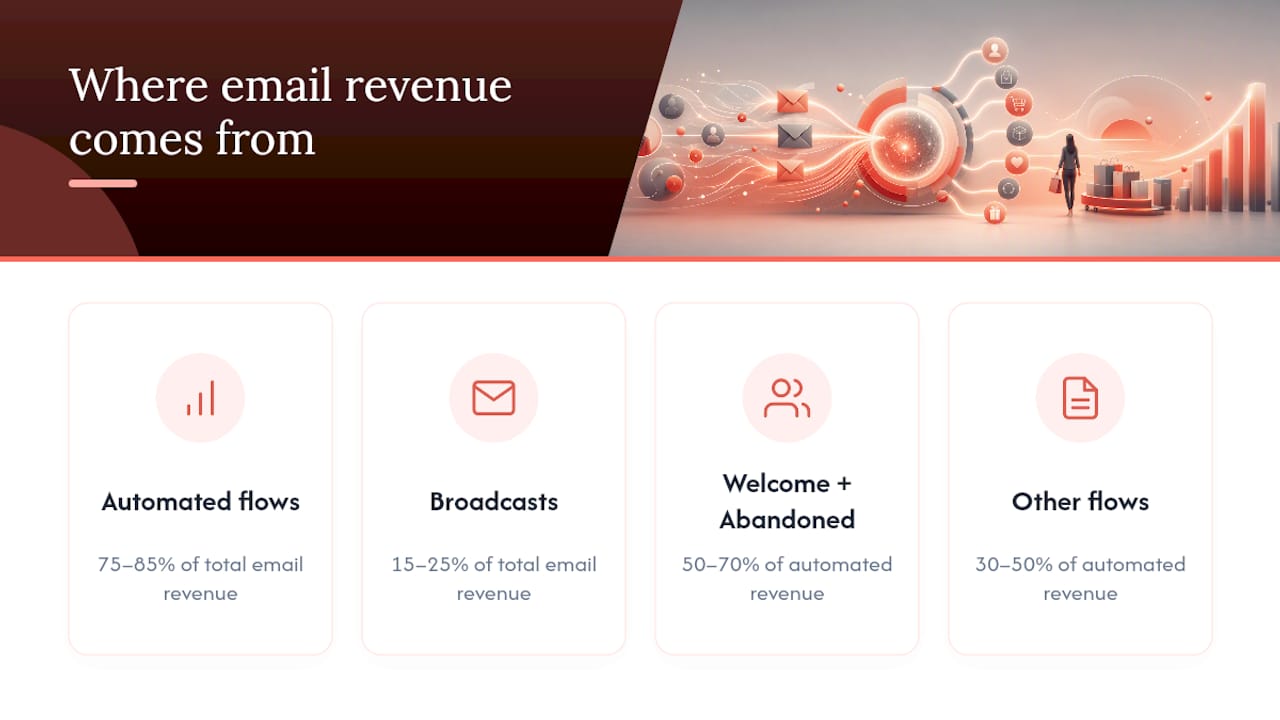
Look at where the revenue actually comes from across a full email program, and flows dominate. Industry analysis of ecommerce email performance puts flows at 75% to 85% of total email revenue in mature programs, with broadcasts filling the remaining slice. That split tends to hold whether you’re running a $50,000 or $5 million ecommerce operation, because flows capture intent at the exact moment it exists.
Within that automated share, two flows usually account for the bulk of it. Welcome series and abandoned cart together often produce 50% to 70% of total automated revenue, a pattern consistent enough across ecommerce flow analysis that it’s become the standard advice for where to start. Post-purchase and browse abandonment matter, but they’re supporting acts. Welcome and abandoned cart are the headline.
How to build your first Klaviyo flows: a launch sequence
Building all seven flows at once is a mistake most new Klaviyo accounts make. You end up with half-finished automations, untested copy, and no clear read on what’s actually working. A phased build gets you live faster and gives you cleaner data to optimise against.
- Phase 1: welcome series and abandoned cart. Set up your signup form trigger for the welcome flow and your “started checkout” metric trigger for abandoned cart. Add dynamic product blocks pulling from cart contents. Include an SMS opt-in checkbox on your signup form so you can layer text messages into these flows later. Choose a Klaviyo template close to your final structure rather than building from a blank canvas.
- Phase 2: post-purchase and browse abandonment. These need your product catalog and view-product metrics properly synced, so confirm your Shopify or BigCommerce integration is passing product data correctly before building. Set the “viewed product” trigger with a filter that excludes anyone who already purchased that item.
- Phase 3: win-back, VIP, back-in-stock, and replenishment. These flows depend on cleaner segmentation and inventory data, so they come last. Build your win-back segment using a “last order date” filter, and set up back-in-stock notifications only once your catalog sync is stable.
Before you switch anything live, run through a short preflight list: sending domain authentication (SPF, DKIM, DMARC) configured correctly, suppression lists imported from any previous platform, and consent records set up for both email and SMS compliance.
Pro Tip: Don’t launch a flow with your final copy on day one. Launch with a solid draft, let it run for a week to establish a baseline, then start testing single variables one at a time. Testing too early on zero data just wastes your first test cycle.
Klaviyo Academy’s best-practices guidance backs this build order, recommending welcome, abandoned cart, and win-back as the starting trio before expanding into the rest of the catalogue.
Setting up triggers, splits and cross-channel steps
Klaviyo gives you several trigger types, and choosing the right one is what separates a flow that feels relevant from one that feels like spam.
- Metric triggers fire off an event, like “Placed Order,” “Started Checkout,” or “Viewed Product.” Use these for anything behaviour-based.
- List triggers fire when someone joins a specific list, most commonly used for welcome flows off a signup form.
- Segment triggers fire when someone enters a dynamic segment, useful for win-back flows based on purchase recency.
- Date-based triggers fire off a property like birthday or subscription anniversary, good for loyalty and renewal flows.
- Price-drop and product-specific triggers fire when a tracked item’s price changes or a specific SKU comes back in stock, both dependent on catalog feed accuracy.
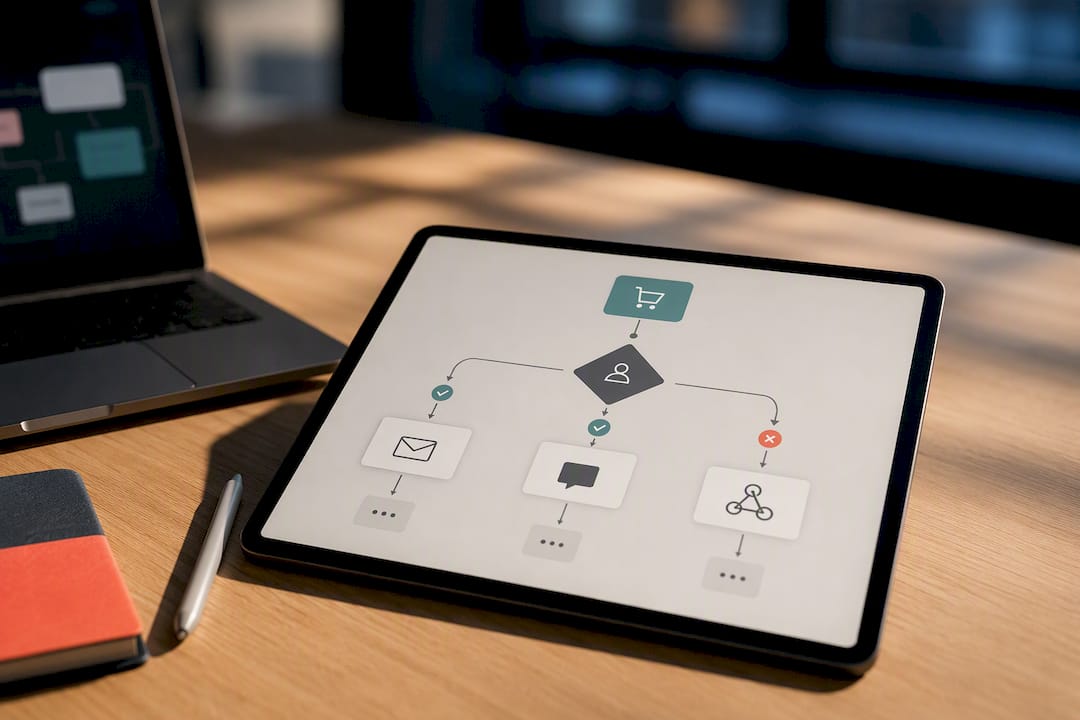
Conditional splits let you branch a flow based on subscriber behaviour or attributes without building two separate flows. A common structure: split abandoned cart recipients by cart value, sending high-value carts a different (often less aggressive) offer than low-value carts. Klaviyo Academy recommends using these splits for structured A/B testing, not just personalisation, so you get a clean read on which path performs better.
Cross-channel steps add SMS into the same flow using conditional logic (send SMS only to consented subscribers), and webhooks let you trigger flows off events happening outside Klaviyo entirely, like a loyalty point threshold in a separate app. Klaviyo’s flow feature set includes over 60 pre-built templates covering email, SMS, and webhook triggers, which is a faster starting point than building trigger logic from scratch.
Inventory-aware flows need a working product feed. Back-in-stock and price-drop flows pull from your synced catalog, so if that sync breaks, the flow either fires incorrectly or not at all. Check this integration before you rely on either flow for revenue.
A testing framework that actually improves your flows
Most stores treat A/B testing as a one-off event rather than an ongoing discipline, and that’s why their flows plateau. Build your testing framework the way you’d build the flows themselves: staged, measured, and reversible.
- Set up the split correctly. Inside the flow, add a conditional split at the decision point you want to test (subject line, send time, offer). Send each path to a genuine random 50/50 sample rather than segmenting by anything meaningful, since a biased split poisons your results before you even start.
- Pick a minimum sample size before you start, not after you see early results. A test that looks conclusive after 40 sends usually isn’t. Wait until each path has enough volume that a real difference could show up statistically, which for most small to mid-size stores means running the test across at least a few hundred recipients per path.
- Test in priority order. Timing first (does a one-hour cart reminder outperform three hours?), then the first-message offer, then subject line, then whether SMS as the first touch beats email. Timing and offer tend to move revenue more than copy polish.
- Weigh the right metrics. Revenue per recipient (RPR) is your primary signal, but check it against conversion rate, unsubscribe rate, and deliverability metrics like spam complaints and bounce rate. A test that lifts RPR while spiking unsubscribes isn’t a genuine win.
- Roll back or scale deliberately. Klaviyo Academy’s guardrail approach suggests exposing only a small percentage of traffic to experimental variants, watching deliverability closely, and only scaling a winning variant to 100% after a stability period, not the moment it looks good.
Pro Tip: Test one variable at a time. Changing the subject line and the send time in the same experiment means you’ll never know which one actually moved the number. Our guide to A/B testing on Shopify covers sample size and experimental design in more depth if you want to apply the same discipline across your storefront, not just your inbox.
What to measure and how often to check it
Revenue per recipient (RPR) is the metric that matters most, calculated as total flow revenue divided by total emails or texts delivered. Recovery rate, for cart flows specifically, measures the percentage of abandoned carts that convert after the flow fires.
- Segment your reporting by new versus returning customer, by channel (email versus SMS), and by product category, since a flow that performs well overall can be masking a weak segment.
- Review weekly for anything with active testing running, and monthly for stable flows that aren’t currently being changed.
- Set threshold alerts for unsubscribe rate and bounce rate so a deliverability problem gets caught within days, not discovered a month later in a revenue dip.
- Benchmark against Klaviyo’s published figures where available, keeping in mind your own numbers will vary by industry and average order value.
Abandoned cart RPR sitting anywhere near Klaviyo’s benchmark of $3.65 is a reasonable target for a healthy flow; well below that signals a timing, offer, or deliverability problem worth investigating.
Our conversion benchmark data breaks down revenue-per-visitor comparisons in more detail if you want a wider frame for what “good” looks like across your whole store, not just your flows.
Copy templates you can adapt today
Good flow copy is short, specific, and matched to the moment. A few starting points:
- Welcome subject lines: “You’re in. Here’s what to expect” or “Welcome, [First Name] — a little something for you.” Preview text should tease the next email’s content, not repeat the subject.
- Abandoned cart cadence: Email 1 (one hour): “Still thinking it over?” with the cart contents shown. Email 2 (24 hours): “Others loved this too” with a review or rating. Email 3 (48 to 72 hours): “Last chance before it’s gone” with light urgency.
- SMS-first variations: Use SMS as the first touch for high-intent, low-consideration products (impulse buys under $50), and email-first for considered purchases where people want more detail before deciding.
- Back-in-stock structure: Subject: “[Product Name] is back.” Body: product image, price, single clear “Shop Now” button, and nothing else competing for attention.
Our welcome flow templates and abandoned cart templates go deeper into full sequences with sample copy if you’re building either flow from scratch.
What agency work reveals about flow priorities
Some agencies build tailored digital strategies for ecommerce brands with a focus on fast, measurable revenue growth, and flows are often one of the first levers they pull — working closely with a digital marketing agency expert in optimisation and tracking. A hands-on mentoring approach can mean clients work directly with senior strategists, not junior account managers cycling through templates.
Some agencies have reported large outcomes for clients, including new retailers reaching significant monthly sales conversions and revenue growth enabling clients to leave day jobs. Such results are attributed to proven frameworks that have doubled revenue for existing brands and successfully launched new ones into competitive global markets, applied with data-driven discipline.
Unlike agencies that outsource execution, Moormarketing keeps senior strategists on every account, which matters most in the flow-building phase, where small structural decisions (trigger logic, segment definitions, send timing) compound over months. Learn more about Moor Marketing’s approach.
Why the standard Klaviyo template rarely performs as-is
The advice to “just use Klaviyo’s templates” is technically true and practically incomplete. The templates give you correct structure, but structure isn’t strategy. A welcome flow built from a template with the discount in email one, generic stock photography, and a send schedule copied from a blog post will function, but it won’t perform anywhere near what the same flow could generate with three specific changes: delayed incentive placement, dynamic product blocks instead of static banners, and a testing cadence that actually runs.
Where most stores go wrong isn’t lack of effort. It’s spreading that effort across all seven flows at once instead of getting two exactly right first. Welcome and abandoned cart alone can produce more incremental revenue than the other five combined, at least in the first six months of a program. Build those two properly, prove the model, then expand.
The conventional wisdom treats A/B testing as optional polish. It isn’t. A flow launched and never touched again is a flow slowly decaying against a market that keeps moving, and the businesses that treat testing as ongoing infrastructure rather than a launch-week task are the ones still seeing strong RPR twelve months later.
— Liza
Get your Klaviyo flows built and optimised properly
Building seven flows correctly, testing them without guesswork, and maintaining them as your catalogue and customer base grow takes more hours than most in-house marketing teams have spare. Moormarketing runs flow audits, hands-on builds, and ongoing optimisation retainers specifically for ecommerce brands that want the revenue lift without the trial-and-error learning curve.
A typical engagement starts with an audit of your existing flows (or a from-scratch build if you’re starting fresh), moves into structured builds for welcome, abandoned cart, and whichever secondary flows suit your product mix, then layers in a testing schedule and monthly reporting so you can see exactly where the revenue is coming from. This isn’t a set-and-forget service. Every account works with a senior strategist directly, which is the same hands-on model that’s driven the results detailed in our ecommerce growth strategy work.
If your flows are underperforming, missing entirely, or you simply want a second set of eyes on what you’ve built, get in touch with Moormarketing and we’ll walk through what a build or audit would look like for your store.
Sources
- Best practices for flows | Klaviyo Academy
- Klaviyo Flows: Email & Marketing Automation Workflows – Klaviyo
FAQ
What is a Klaviyo flow?
A Klaviyo flow is an automated sequence of emails, SMS messages, or both, triggered by a specific customer action like joining a list, abandoning a cart, or completing a purchase.
Is Klaviyo owned by Shopify?
No, Klaviyo is an independent company. Shopify holds a minority equity stake and the two platforms integrate closely, but Klaviyo operates as its own separate business.
What are the essential email flows every ecommerce brand should have?
The core set is welcome series, abandoned cart, post-purchase, browse abandonment, and win-back, with back-in-stock and replenishment as strong additions depending on your product type.
Can Klaviyo be used with Shopify?
Yes, Klaviyo integrates directly with Shopify and BigCommerce, syncing customer, order, and product catalogue data so flows can trigger off real store events like checkouts and purchases.
Which two flows should I build first in Klaviyo?
Build the welcome series and abandoned cart flow first, since together they typically generate a substantial share of a store’s automated email revenue.